
Festival POS Comparison: What's Better for Events in 2026?

Cashless and RFID-enabled festival POS systems are pulling ahead of traditional retail payment setups across nearly every metric that matters to event organizers.
- About half of U.S. concerts already operate cashless, and adoption is accelerating into 2026 as attendee expectations shift toward frictionless digital payments.
- Festival-specific POS platforms offer offline processing, multi-vendor dashboards, and real-time analytics that standard retail terminals were never designed to deliver.
- Event organizers using purpose-built payment systems report faster transaction speeds, stronger revenue per attendee, and dramatically simplified vendor settlements.
If you're evaluating POS options for an upcoming event season, the festival POS comparison below will help you make a decision grounded in operational reality rather than marketing hype.
Why Does a Festival POS Comparison Matter for Event Organizers?
Choosing the wrong payment system for your event can quietly drain revenue, frustrate attendees, and create accounting headaches that last weeks after the gates close. The gap between festival-specific and traditional POS platforms has widened significantly, and organizers evaluating their 2026 options need to understand where that gap sits.
According to Payments Dive, roughly half of all U.S. concerts now operate on fully cashless systems. That number keeps climbing because organizers who switch consistently see measurable improvements in throughput, spending, and operational control. A thorough festival POS comparison starts with understanding why festival environments demand specialized tools in the first place.
What Makes Festival Environments Different from Retail?
Retail POS systems were engineered for permanent locations with stable power, reliable internet, climate-controlled spaces, and predictable customer flow. Festivals flip every single one of those assumptions. Outdoor events deal with weather extremes, temporary infrastructure, spotty cellular coverage, and transaction volumes that spike dramatically during headliner sets or between stage transitions.
A food truck at a three-day camping festival and a downtown café might both sell cold brew, but the operational demands are worlds apart. The festival vendor needs hardware that survives dust, rain, and direct sunlight. They need software that keeps processing transactions when the nearest cell tower gets overwhelmed by 40,000 smartphones. And they need settlement tools that reconcile sales across a complex web of organizers, vendors, and commission structures that a standard retail POS was never built to handle.
Where Do Traditional Systems Fall Short at Events?
The most common failure point is connectivity. Standard cloud-dependent POS terminals freeze or error out when internet drops, which at outdoor festivals happens regularly during peak attendance windows. Every stalled transaction means a lost sale, a longer line, and an attendee who walks away frustrated.
Cash handling introduces its own problems. Staff counting drawers, securing cash drops, and reconciling discrepancies at the end of each night adds hours of labor and introduces theft risk. The reconciliation process alone can stretch for weeks after a multi-day event when dozens of independent vendors are involved.
What Are the Main Types of Festival Payment Solutions?
Before diving into a side-by-side festival POS comparison, it helps to understand the three primary payment architectures that event organizers encounter. Each carries distinct trade-offs around cost, control, data ownership, and attendee experience.
Open-loop systems accept standard payment methods that attendees already carry, including contactless credit and debit cards, Apple Pay, Google Pay, and other mobile wallets. These require the least attendee education and eliminate the need for on-site top-up stations. The trade-off is that organizers get less granular data about individual spending behavior.
Closed-loop systems use RFID-enabled wristbands or event-branded cards that attendees load with funds before or during the event. Every transaction routes through a proprietary platform, giving organizers complete visibility into spending patterns, vendor performance, and crowd behavior. The complexity lies in managing top-up infrastructure and handling refund processes for unused balances.
Hybrid systems combine both approaches, accepting standard cards and mobile wallets alongside RFID wristbands. Many experienced festival operators now consider the hybrid approach the practical sweet spot for 2026 events because it accommodates attendee preferences while still capturing valuable transaction data.
5 Key Differences Between Festival POS and Retail POS
Understanding where these systems diverge helps clarify why a generic retail solution often fails at scale in festival environments.
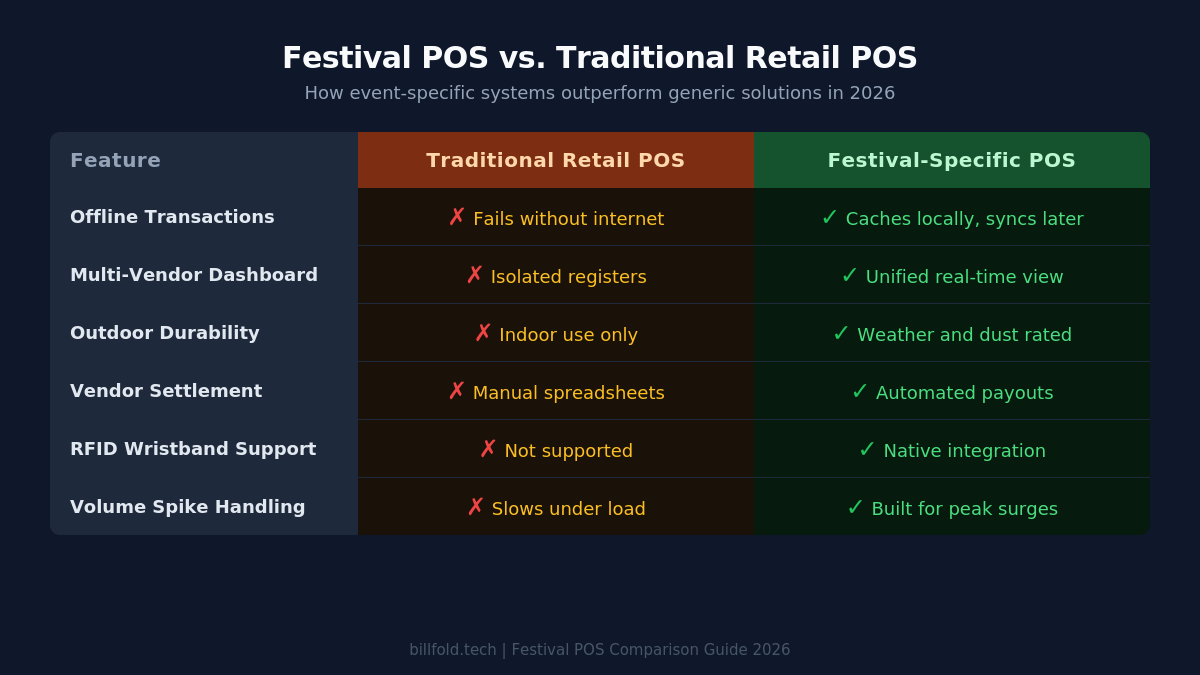
- Offline processing: Festival POS platforms cache transactions locally and sync when connectivity returns. Most retail POS terminals require a constant internet connection and will reject transactions during outages, which means lost revenue during the exact moments when lines are longest.
- Multi-vendor management: Event-specific systems let organizers onboard dozens or hundreds of vendors into a single dashboard with individualized menus, pricing, and settlement terms. Retail POS systems treat each register as an isolated unit with no cross-vendor visibility.
- Environmental durability: Festival hardware is rated for outdoor conditions, including dust, moisture, temperature swings, and extended battery operation. Standard retail tablets and terminals aren't designed for these stresses and often fail partway through multi-day events.
- Real-time analytics: Purpose-built festival POS platforms provide live dashboards showing sales volume by vendor, peak transaction periods, inventory levels, and crowd flow indicators. Retail POS analytics focus on individual store metrics without the cross-venue aggregation that event organizers need.
- Settlement and reconciliation: Festival systems automate the complex payout process across organizers, vendors, artists, and sponsors with configurable commission structures. Retail POS platforms require manual reconciliation, often involving spreadsheets and days of post-event accounting.
How Do Festival Payment Solutions Handle Real-World Challenges?
The theoretical advantages of event-specific POS technology only matter if they hold up under the pressure of actual festival conditions. Here's where the festival POS comparison gets practical.
How Do Systems Maintain Operations Without Reliable Internet?
Connectivity failure is the single biggest operational risk at outdoor events. Purpose-built festival POS platforms address this with local transaction caching, which stores every sale on the device itself and synchronizes with the central server once a connection reestablishes. Vendors keep ringing up sales even during complete network outages, and no transaction data is lost.
Retail POS systems that depend on continuous cloud connectivity will display error messages or force staff into awkward manual workarounds. At peak volume, this kind of fallback is impractical and directly translates into lost revenue.
How Is Multi-Vendor Coordination Handled?
Festivals typically operate with dozens of independent food vendors, merchandise sellers, and beverage operations, each with different menus, pricing, and financial arrangements with the organizer. Managing this complexity through individual retail POS setups creates a fragmented mess that is extremely difficult to reconcile.
Festival payment solutions consolidate all vendor operations into a unified platform. Organizers can push menu updates to every vendor simultaneously, monitor which booths are underperforming in real time, identify inventory shortages before sellouts happen, and run settlement calculations automatically. This centralized approach provides the kind of event vendor payment tech visibility that drives better decision-making during live operations.
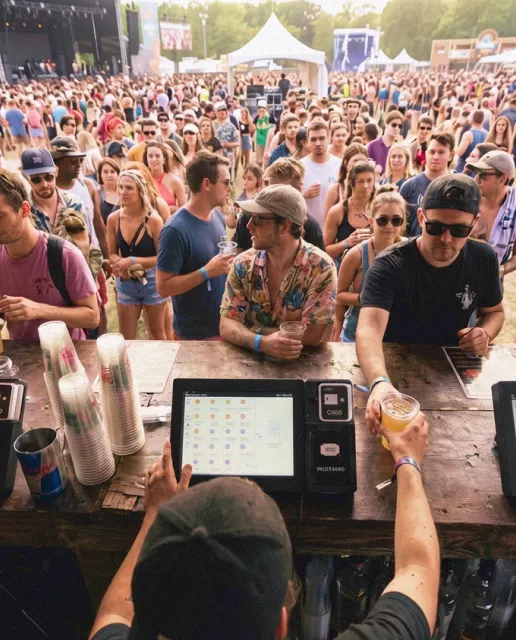
Built for Peak-Hour Traffic
Built for high-volume festivals where speed, offline capability, and operational visibility matter most.
Explore Festival POSWhat Should Event Organizers Evaluate in a Festival POS Comparison?
Selecting the right system is about matching capabilities to your specific event profile. A 500-person food and wine tasting has fundamentally different needs than a 50,000-person multi-day camping festival, and the ideal pos for events solution reflects those differences.
What Are the True Cost Considerations?
Pricing models vary significantly across the event payment tech landscape. Some platforms charge per-transaction fees ranging from 2.5% to 3.5% with no upfront hardware cost. Others require hardware purchases or rentals plus lower per-transaction rates. Closed-loop RFID systems involve additional costs for wristband production, activation kiosks, and top-up infrastructure.
The real cost analysis needs to account for revenue gains that offset technology expenses. Faster transactions mean more sales per vendor per hour. Cashless environments encourage higher per-attendee spending. Automated settlement eliminates days of manual accounting labor. Understanding the full cost picture requires evaluating total economic impact across an entire event cycle.
What Data and Analytics Capabilities Matter Most?
The analytics gap between festival-specific and retail POS platforms is substantial. Event organizers benefit most from systems that deliver real-time sales dashboards broken down by vendor, product category, and time period. This data enables mid-event decisions like reallocating staff to high-traffic areas, triggering restock alerts before popular items sell out, and identifying underperforming vendors who might need support.
Post-event analytics are equally valuable. Detailed reports on per-attendee spending, peak transaction windows, and product popularity create a compounding advantage over time as organizers refine layouts, vendor mixes, and pricing strategies based on actual behavioral patterns.
How Important Is Staff Training and Onboarding?
Festival staff are often temporary workers with minimal training time. A festival POS comparison should evaluate how quickly new staff can become productive on each platform. The best event vendor payment tech systems use simplified interfaces with large buttons, intuitive menu navigation, and minimal steps per transaction. If a vendor's seasonal staff can't learn the system in under 15 minutes, the platform is adding friction rather than removing it.
What Does the Data Say About Cashless Festival Payments?
The shift toward cashless events reflects broader consumer payment trends rather than a passing industry fad. According to Capital One Shopping research, approximately 86.9% of U.S. point-of-sale transactions were cashless in 2024, and projections indicate that figure will reach 94.1% by 2027. Festival attendees, who skew younger and more digitally engaged, are even further ahead of these averages.

The global event industry reached approximately $1.02 trillion in value in 2024 and is projected to grow significantly through 2033. Within this expansion, the payment technology segment is evolving rapidly as costs decrease and platform capabilities mature.
The venue and stadium sector provides a useful preview of where festivals are headed. Nearly all NFL stadiums have transitioned to cashless operations, and major international sporting events increasingly treat cashless as the default rather than the exception. These large-scale implementations demonstrate that cashless infrastructure scales effectively in the most demanding high-traffic environments.
For festival organizers still weighing their options, the convergence of consumer preference, operational efficiency, and revenue optimization points strongly toward investing in purpose-built festival payment solutions rather than adapting retail tools that weren't designed for live events.
Frequently Asked Questions
What is the biggest advantage of a festival POS over a traditional retail POS?
Offline processing capability. Festival environments deal with unreliable connectivity that causes traditional cloud-dependent POS systems to fail during peak transaction periods. Festival-specific platforms cache transactions locally and sync automatically when connectivity returns, ensuring zero lost sales during network outages.
Can event organizers use a hybrid approach that combines RFID wristbands with standard card payments?
Yes, and many experienced organizers consider hybrid the most practical approach for 2026. Hybrid systems accept contactless cards and mobile wallets alongside RFID wristbands, accommodating attendee preferences while still capturing the data and operational benefits of a unified payment platform.
How quickly can festival vendors get trained on a new POS system?
Purpose-built festival POS platforms prioritize simplicity for temporary staff. Most systems feature large-button interfaces and streamlined checkout flows that allow new vendors to become productive within 10 to 15 minutes of hands-on training.
Do cashless festivals still need to accommodate cash-paying attendees?
Many festivals maintain limited cash accommodation through reverse ATMs or cash-to-card kiosks at entry points. These convert physical cash into prepaid cards that work throughout the venue, satisfying accessibility requirements without requiring cash handling at every vendor station.
Ready to Upgrade Your Festival POS for 2026?
The festival POS comparison comes down to a straightforward question: do you want a payment system designed for your environment, or do you want to force-fit a tool built for someone else's? Purpose-built event payment platforms deliver faster transactions, richer data, stronger revenue, and simpler operations.
Billfold provides RFID-enabled cashless payment systems built specifically for festivals, events, and venues, with offline processing, multi-vendor management, and real-time analytics that give organizers complete control over every transaction on their grounds. Get in touch with the Billfold team to see how the platform can support your 2026 event season.
