
RFID vs NFC vs EMV: Choosing Event Payment Technology

Key Takeaways
Choosing between RFID, NFC, and EMV is a choice about who owns your transaction data, how fast your queues move, and whether your event keeps running when the network drops.
- RFID closed-loop systems run offline, process taps in roughly half a second, and give organizers complete visibility into every transaction at the venue.
- NFC adds smartphone and tap-to-pay convenience, but depends on attendee battery life, network signal, and bank authorization for every purchase.
- EMV chip cards offer universally trusted bank-grade encryption, but contact transactions are the slowest of the three and route data straight to issuers.
Most modern events should not pick one. The best RFID payment system is a hybrid one that defaults to RFID for speed and offline resilience, then accepts NFC and EMV for walk-up guests.
Event payment technology decides three things at once: how fast your bar lines move, how much spending data you actually own after the gates close, and whether the system survives a network outage during the headliner. Choosing the right RFID payment system is a strategic call, more than an IT call.
The market reflects that. Fortune Business Insights projects the global RFID market will grow from $19.01 billion in 2026 to $46.2 billion by 2034 at an 11.7% CAGR, with high-frequency contactless payment use cases driving much of that expansion. Any meaningful event payment comparison now starts with RFID, NFC, and EMV.
What Are the Core Differences Between RFID, NFC, and EMV?
All three technologies move payment data using radio waves and chips, but they diverge sharply in range, speed, who controls the data, and what they need from your network.
RFID Explained
Radio Frequency Identification uses electromagnetic fields to identify tags embedded in wearables: typically wristbands, cards, or lanyard credentials. Most event deployments use passive high-frequency RFID tags that have no battery and activate only when a reader powers them. They survive a four-day festival without ever charging. RFID for events almost always runs in a closed-loop architecture: the event operates its own internal wallet, attendees preload funds, and transactions clear locally without calling out to a card network. That single architectural choice is what makes the rest of RFID's advantages possible: offline operation, sub-second taps, and full data ownership at the venue.
NFC Payment Systems
Near Field Communication is a subset of high-frequency RFID standardized at 13.56 MHz with a read range of about four centimeters. The short range is a security feature that prevents accidental reads from across the room. NFC supports two-way communication, which lets a smartphone act as both payment device and reader. That's why mobile wallets like Apple Pay and Google Pay work the way they do. NFC purchases route through traditional card networks, so they need network connectivity, bank authorization, and a charged smartphone or active contactless card.
EMV Chip Technology
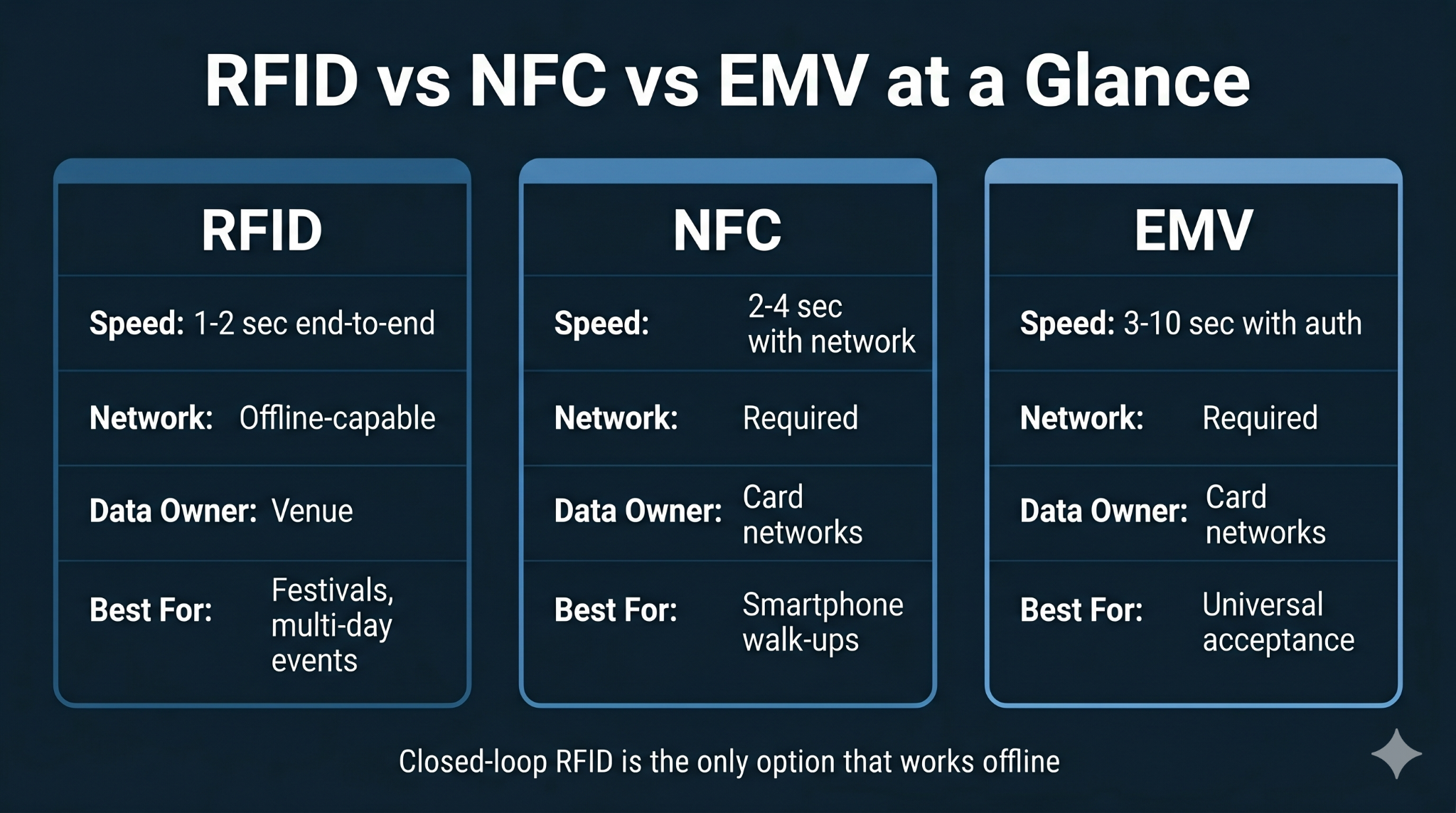
EMV is the global standard for chip-based card payments, named after Europay, Mastercard, and Visa. The chip generates a unique cryptogram for each transaction, making counterfeiting extremely difficult. EMVCo, the standards body that maintains the spec, confirms that the EMV contactless kernel keeps device-to-reader interaction under 500 milliseconds, but the full authorization round trip back to the issuer adds several more seconds. Contact EMV (chip-and-dip) is even slower. EMV gives organizers universal acceptance and bank-level encryption, but offers almost zero visibility into spending behavior because all data routes directly to the card networks. That's a meaningful difference compared to closed-loop payment systems that capture every detail of every purchase.
How Do Latency and Throughput Compare Across RFID, NFC, and EMV?
Speed at the reader is only half the story. Real event throughput is the entire round trip: tap, authentication, authorization, confirmation. That's where these three technologies diverge most, and where the wrong RFID payment system choice quietly bleeds revenue at peak hour.
Per-Transaction Latency
Closed-loop RFID transactions complete in roughly one to two seconds end to end because the entire exchange happens locally. The reader powers the tag, confirms the unique identifier against the local wallet balance, and deducts the amount. No external network call. Contactless NFC and tap-to-pay EMV cards finish the radio handshake in under a second, but the full transaction still has to round-trip to the issuing bank. In ideal connectivity, that lands in two to four seconds. In congested signal, it can stretch past ten or fail outright. Contact EMV is the slowest because the card must remain seated for the full authentication.
Throughput and Connectivity
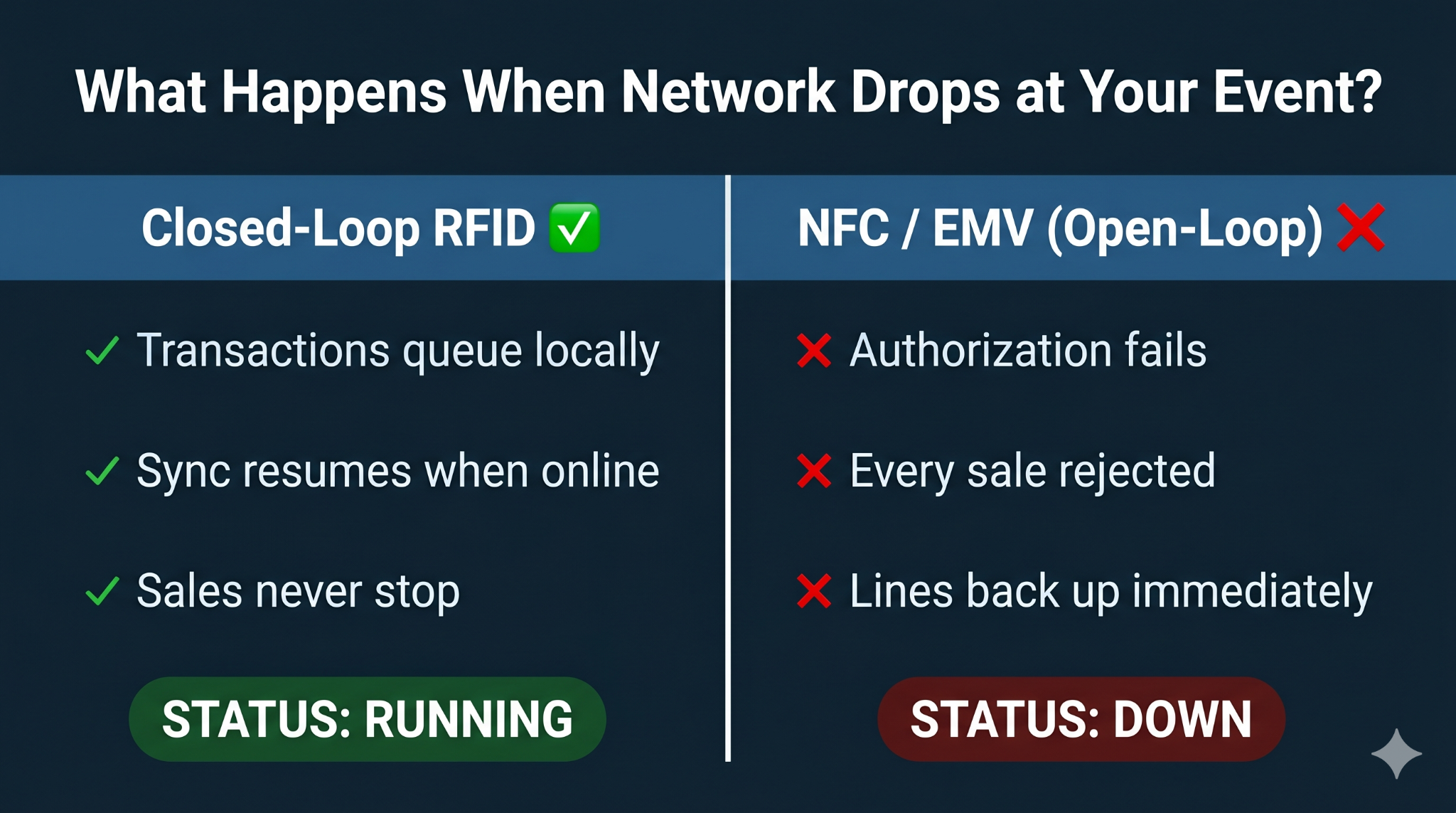
Throughput determines whether a single bar serves 60 customers in an hour or 600. The ISO 14443 standard underneath both NFC and contactless EMV supports data rates from 106 to 848 kilobits per second. Real RFID event deployments routinely process several transactions per minute per reader at sustained pace, with no degradation as crowd density increases. The biggest practical difference is connectivity dependency: closed-loop RFID terminals queue transactions locally and sync when the network returns, while NFC and EMV both stop the moment the bank-network path drops. Offline-first architecture is what makes RFID wristband infrastructure so durable under festival load.
Which Payment Technology Offers the Best Security for Events?
Every option here is meaningfully secure compared to cash. The real question is what type of fraud each one prevents, and who carries the liability when something goes wrong.
Encryption and Tokenization
RFID closed-loop systems secure data through proprietary encryption and unique tag identifiers that cannot be replicated without authorization. Every wristband links to a specific account and every transaction generates an audit record inside the event's own infrastructure. NFC mobile wallets benefit from tokenization (Apple Pay and Google Pay replace the actual card number with a single-use token), and EMV chips generate unique cryptograms for the same reason. Both are extremely secure for the cardholder, but they give the event organizer essentially zero ability to detect or respond to fraud at the venue.
Fraud Prevention at the Event
Closed-loop RFID's biggest operational advantage shows here. Lost wristbands can be deactivated in seconds, suspicious purchase velocities can be flagged before the next pour, and replacement bands transfer balances without exposing the underlying payment account. With NFC and EMV, fraud liability and visibility both sit with the issuing bank. RFID payment system security is one of the strongest arguments for closed-loop architecture at large events.
Who Owns the Transaction Data With Each Technology?
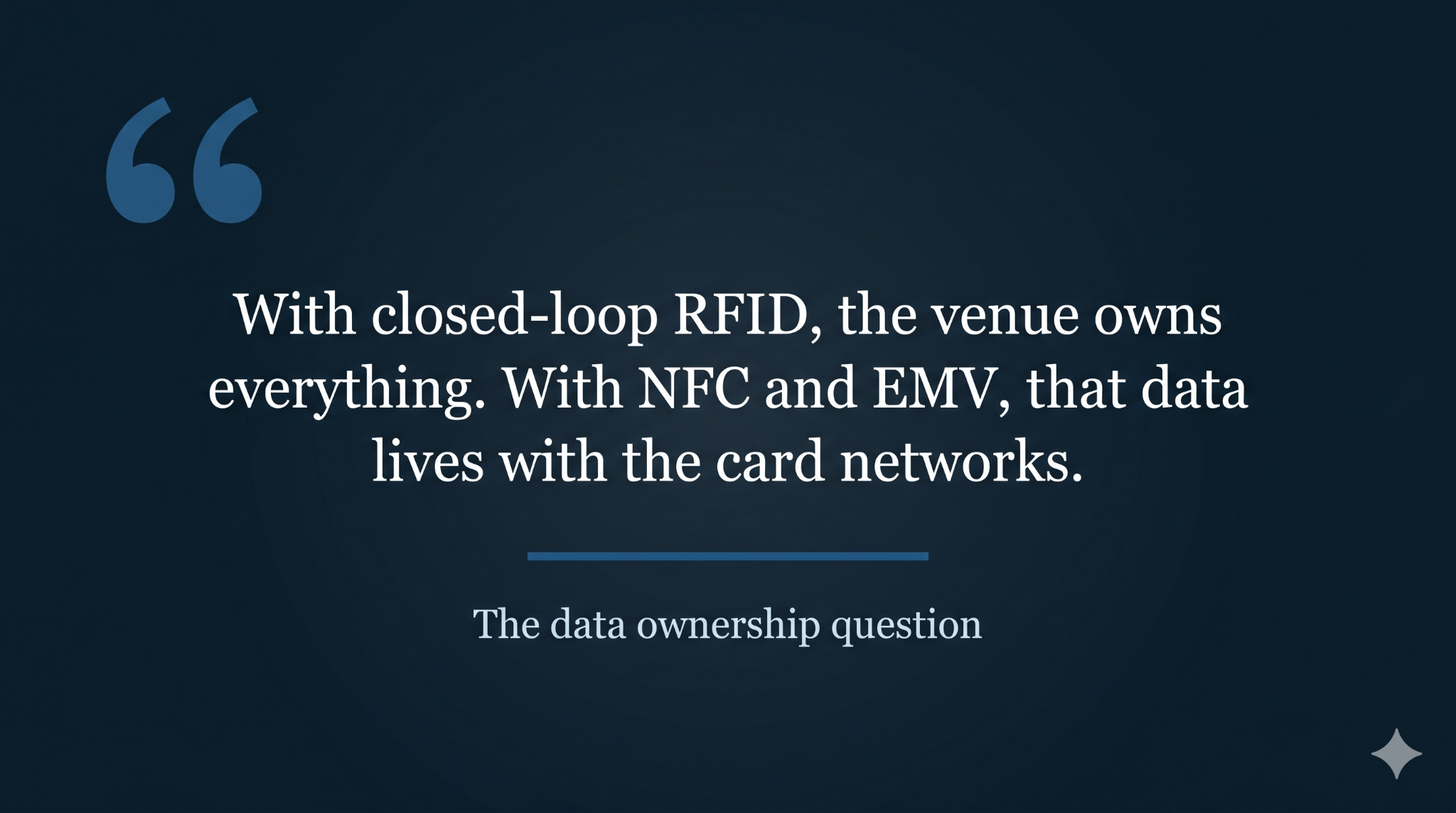
With closed-loop RFID, the venue owns everything: every tap captures the timestamp, vendor, item, amount, attendee profile, and location. That data fuels next-year planning, sponsorship reporting, vendor settlements, and dynamic operations decisions during the show. With NFC and EMV, that data lives with the card networks. This is the single biggest reason serious recurring events keep moving toward RFID, even when their attendees have phones in their pockets. The convenience of contactless payment systems through NFC is real, but the value of owning your behavioral data compounds every year you run the event.
5 Critical Factors for Choosing Event Payment Technology
Picking between RFID, NFC, and EMV isn't really about the spec sheets. It's about matching architecture to the operational reality of your event.
- Event Size and Duration. A single-day corporate happy hour can run on NFC and EMV alone. A four-day, 60,000-person festival cannot. Any event payment comparison breaks down quickly at scale, where throughput, offline resilience, and durability stop being nice-to-haves.
- Venue Connectivity. Outdoor festivals, remote venues, and temporary builds all share one problem: unreliable network. RFID's offline operation is the only architecture that doesn't bet your revenue on whether the cell tower stays up.
- Guest Experience Priorities. Wristbands free attendees from carrying phones, wallets, or cards. That matters in water parks, dance environments, and anywhere people are dressed for movement. NFC keeps the phone front and center, which suits professional events.
- Data Analytics Needs. If you actually plan to use spending data for sponsorship reporting, vendor optimization, and year-over-year planning, closed-loop RFID is the only option that delivers it natively.
- Budget Profile. RFID requires upfront investment in wristbands, readers, and the platform. NFC and EMV piggyback on existing card infrastructure but trade away data and operational control. For most recurring events, the recurring revenue lift justifies the capital cost within the first year.
How Do These Technologies Perform Across Different Event Types?
The same RFID payment system that's perfect for a 50,000-person festival is overkill for a corporate networking happy hour. Matching architecture to event profile is what separates effective deployments from expensive ones.
Festivals, Outdoor Events, and Multi-Day Activations
Large festivals and outdoor events overwhelmingly favor RFID wristbands. Nothing else handles the combined load of multi-day duration, peak-hour throughput, environmental abuse, and unreliable outdoor connectivity. Attendees register once at gate, then enjoy frictionless tap-to-pay all weekend. Weatherproof wristbands tolerate rain, humidity, and temperature extremes that compromise phone batteries and contactless card readers. Festivals running closed-loop RFID also see exactly which vendors are crushing it and which sponsorship activations actually moved the needle. Advanced cashless event technology also enables loyalty programs and on-the-fly inventory rebalancing.
Corporate Events and Indoor Venues
Professional gatherings tend to land on hybrid setups. Registered attendees get RFID badges that double as access control and cashless wallet. Walk-up guests use NFC mobile wallets or EMV cards at the same terminals. The badge-integrated approach lets organizers tie payment activity to session attendance and sponsor booth visits, the kind of behavioral data that justifies premium sponsorship pricing.
Why Are More Events Choosing Hybrid Payment Systems?
The honest answer to RFID vs NFC vs EMV is that the best architecture for most modern events isn't any one of them. It's a hybrid stack that uses RFID as the primary rail for registered attendees and offers contactless payment systems like NFC and EMV as fallbacks for walk-up guests. The Federal Reserve's 2025 Diary of Consumer Payment Choice shows U.S. consumers averaged 48 payments per month in 2024, with growth driven by credit cards and mobile devices. Attendees expect to tap their phone and have it just work. Refusing NFC and EMV creates friction. Running entirely on bank-network-dependent payments is a single point of failure waiting to happen.
Hybrid setups solve both problems. Regular and season-pass attendees get RFID speed and the closed-loop wallet. Occasional guests get a familiar phone tap. The event captures rich data on the core audience and still serves everyone else. The RFID payment system buyer's guide walks through what to look for in a multi-input platform.
FAQ
What is the fastest payment technology for events?
Closed-loop RFID is fastest end-to-end because the transaction never leaves the venue. Most taps complete in one to two seconds. NFC and EMV are quick at the reader but add bank-network round-trip time, which can stretch transactions to several seconds and fail if the network is congested.
Can RFID wristbands work without internet?
Yes. That is one of the main reasons festivals choose them. Closed-loop RFID systems process transactions locally and sync when connectivity returns. NFC and EMV both require a live network path to the bank for every sale, so they go down the moment the connection does.
Is NFC the same thing as RFID?
NFC is technically a subset of high-frequency RFID, standardized at 13.56 MHz with a read range of about four centimeters. The two share a common foundation but in payments are used differently. NFC is built for two-way smartphone communication through bank networks. RFID for events is typically a passive, closed-loop system on its own internal wallet.
Do attendees need an app to use RFID at events?
Not for basic payments. Attendees register a wristband at a kiosk or online, load funds, and tap to pay without installing anything. Optional apps add convenience like remote top-ups and post-event refunds, but they aren't required.
What happens to leftover RFID balance after the event?
Most platforms offer multiple options. Attendees can request automated refunds back to their original payment method within a defined window. Any unclaimed balance can be converted to store credit, donated, or rolled into a future event credit.
Choose the Payment Technology That Matches Your Event
The RFID vs NFC vs EMV decision comes down to three questions: How important is offline reliability? How much do you care about owning your transaction data? How much speed do you need at peak hour?
For large recurring events with serious throughput demands and any meaningful exposure to network outages, closed-loop RFID wins on all three. For smaller, indoor, single-day events with stable connectivity, NFC and EMV are perfectly serviceable on their own. For everyone in between, the answer is a hybrid stack that defaults to RFID and accepts NFC and EMV as universal fallbacks.
Built specifically for live events and entertainment venues, Billfold delivers a unified RFID payment system combining RFID, NFC, and EMV through a single platform, with offline-first architecture and full transaction data ownership. Reach out to the Billfold team to map the right payment stack to your next event.
