
The Best Festival POS Systems in 2026: Speed, Connectivity, and Vendor Control
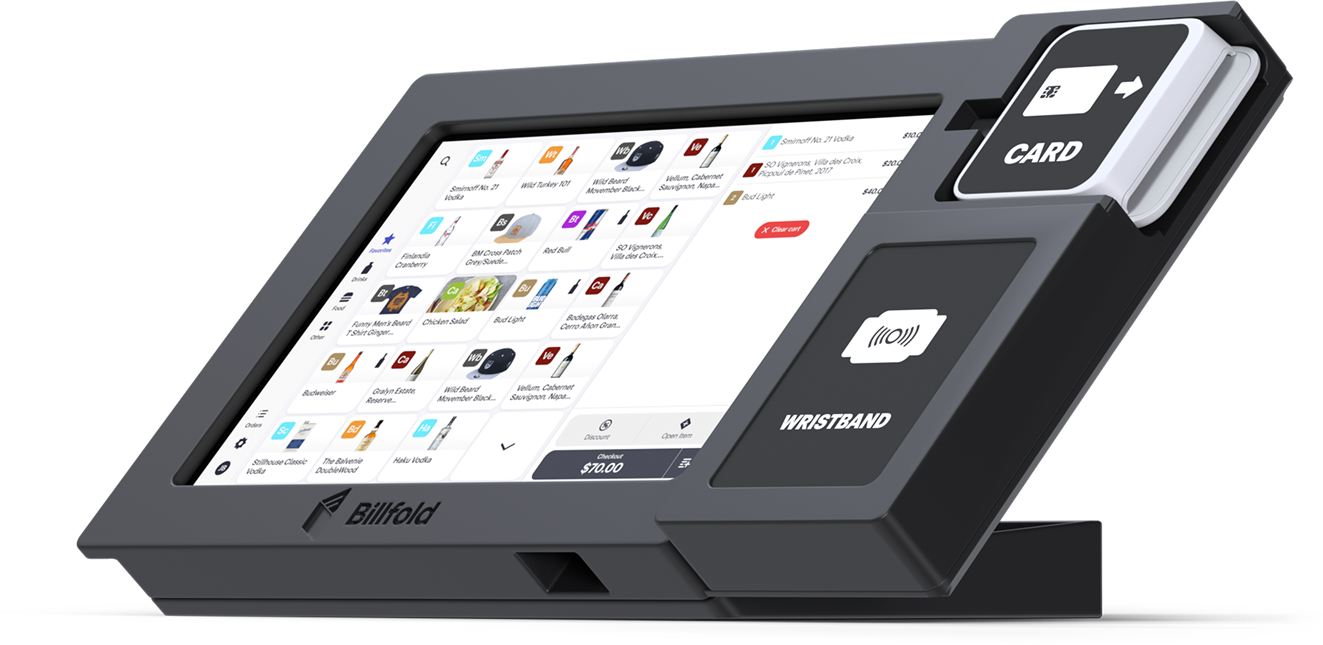
The best festival POS systems in 2026 are purpose-built for outdoor conditions, unreliable connectivity, and hundreds of vendors operating under one event umbrella, not retail systems retrofitted for live entertainment.
- Closed-loop RFID architecture handles transactions offline at the wristband, so sales continue when cellular and Wi-Fi networks fail.
- Multi-vendor management consolidates dozens or hundreds of operators into one real-time dashboard with per-location reporting and automated payouts.
- Coachella, Tomorrowland, Lollapalooza, and Glastonbury all run on cashless or RFID-driven payment infrastructure with redundant connectivity behind it.
If your event still depends on retail-grade hardware and a single network uplink, the operational risk and the revenue ceiling are now larger than the cost of upgrading.
Festival operators in 2026 face a payment problem that retail technology was never designed to solve. Multi-day events, remote venues, hundreds of independent vendors, and traffic spikes during headliner sets push standard hardware past its limits within hours. The category that has emerged in response, the modern festival POS, is engineered for outdoor conditions, intermittent connectivity, and live multi-vendor coordination at scale.
The shift is not theoretical. According to Growth Market Reports analysis of festival cashless payment platforms, the global market reached USD 2.12 billion in 2024 and is projected to grow at a 16.5% CAGR through 2033. The decision facing mid-tier and emerging festivals is no longer whether to adopt event POS technology, but which architecture fits the event, the venue, and the vendor mix.
Why Do Festivals Need a Specialized Festival POS in 2026?
Festival environments break standard retail systems for predictable reasons. Outdoor venues lack the infrastructure that retail assumes, attendee volume concentrates into windows that retail rarely sees, and vendor coordination is far more complex than a single-store operation. Purpose-built event payment infrastructure is designed around those constraints rather than against them.
Outdoor connectivity is unreliable by default
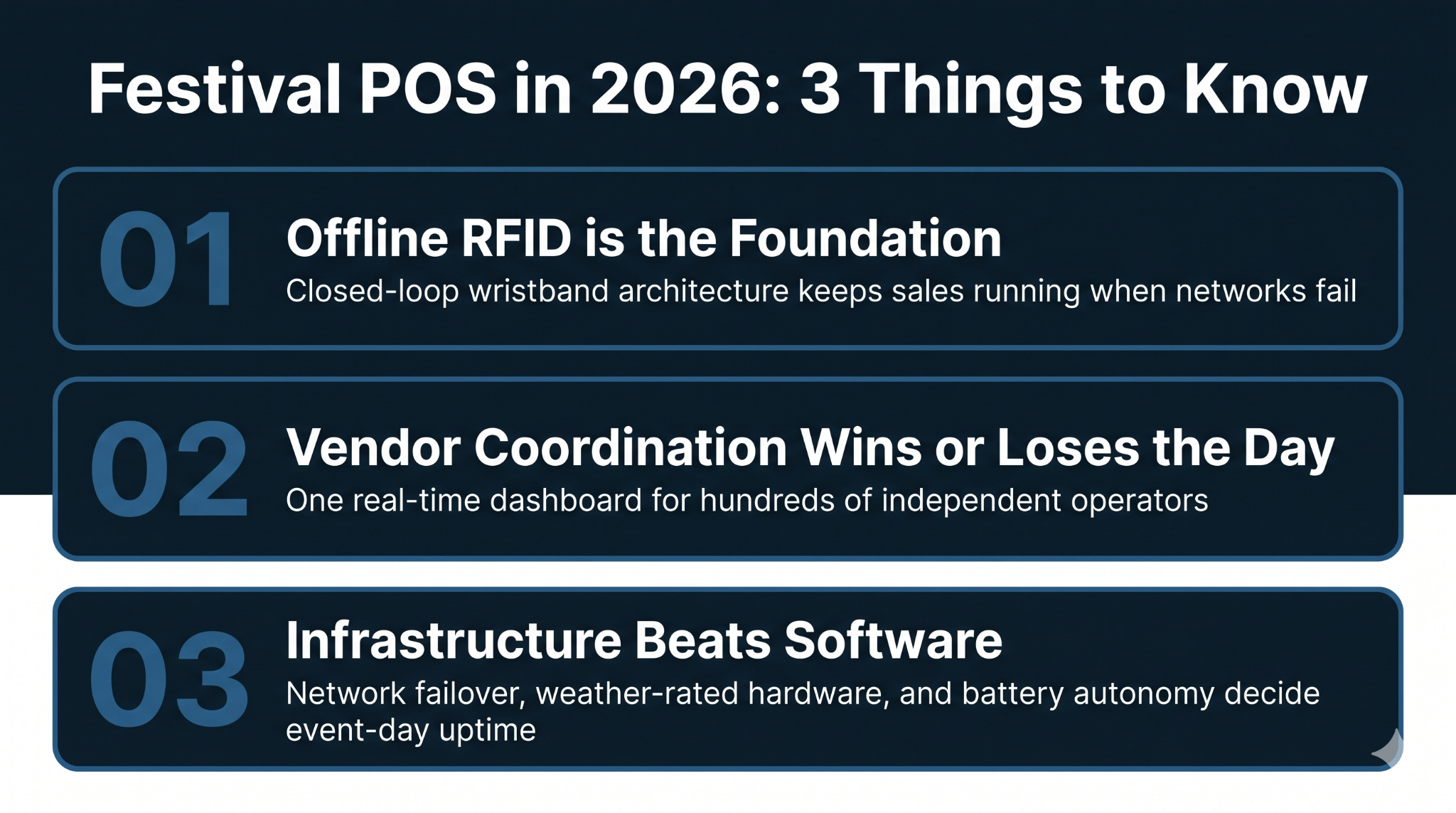
Outdoor festival sites were not built with digital infrastructure. Cellular towers get overwhelmed when 50,000 phones compete for bandwidth at once, and temporary Wi-Fi networks degrade as the day goes on. Standard retail systems assume always-on connectivity to authorize each card transaction, which makes them brittle in the conditions festivals create. Purpose-built event systems handle this with closed-loop RFID architecture that processes payments locally and syncs when service returns.
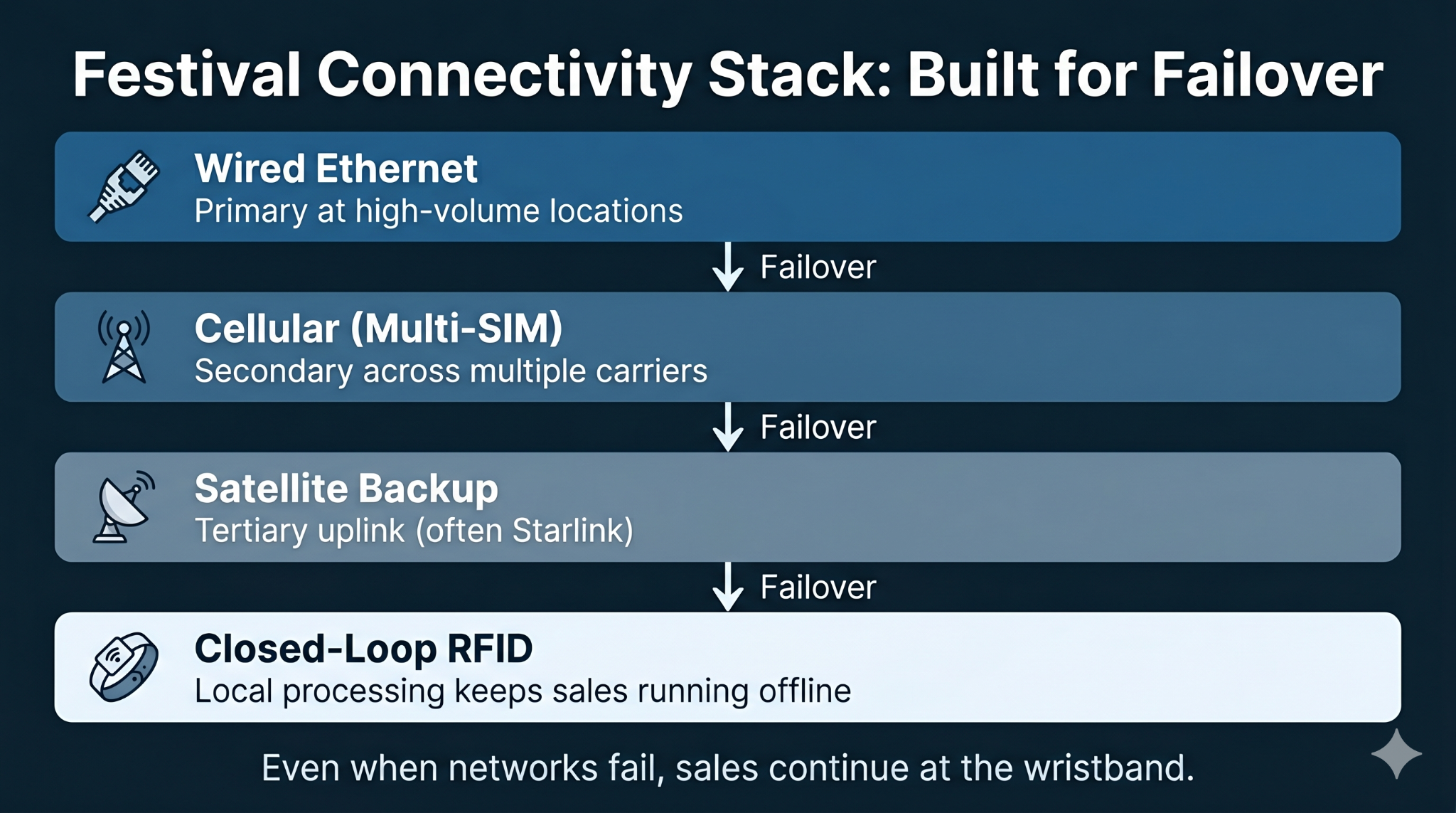
Even the largest festivals plan around connectivity failure. Glastonbury 2024 combined fiber, microwave radio, and Starlink satellite uplinks with intelligent failover, treating connectivity as mission-critical infrastructure on par with power and staging.
Volume spikes destroy retail throughput
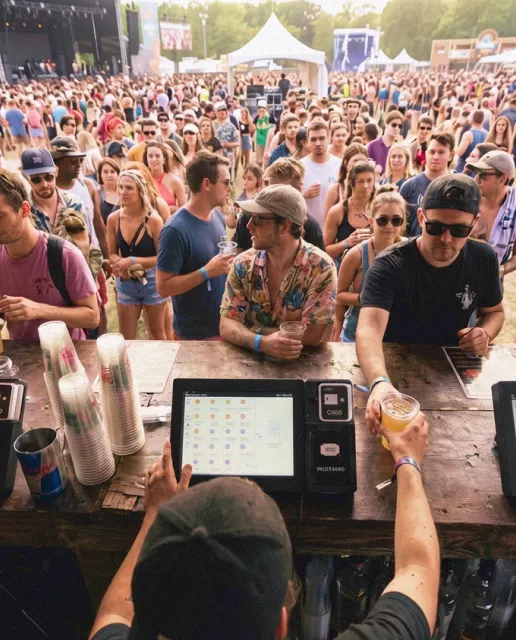
Bar lines compress into 15-minute windows between sets. Food court traffic doubles when the headliner takes the stage. Hardware optimized for steady transaction flow becomes the bottleneck when 200 people hit a single vendor station in the same hour. Festival-grade systems are tuned for high concurrent volume, sub-three-second tap-to-pay transactions, and the ability to add stations on demand.
Vendor coordination is the operational core
A festival is not one business. It is dozens or hundreds of independent vendors operating under one event umbrella, each with their own products, pricing, and settlement requirements. The right festival payment system rolls all of that into one real-time dashboard, with per-location sales data and automated payouts.
What Features Define the Best Festival POS Systems?
The features that actually matter at a festival are the ones that survive the conditions specific to live events.
Offline payment processing and multi-network failover
Offline mode is no longer a checkbox. It is the architectural foundation of any serious festival payment system. Closed-loop RFID systems hold funds on the wristband chip itself and authorize transactions locally at the reader, which means sales continue uninterrupted through every kind of connectivity failure. The strongest implementations layer multi-SIM cellular failover and satellite backup on top of that, so dashboards, top-up kiosks, and reporting layers stay live too.
RFID wristband integration
RFID wristbands have become the dominant credential at large-scale festivals because they collapse three problems into one solution. They authenticate access at the gate, store funds for cashless payment, and create a clean data trail linking spending to attendee behavior. Coachella, Tomorrowland, and Lollapalooza all run RFID-driven systems where the wristband is the wallet, the ticket, and the loyalty signal. The transaction itself happens in seconds, well below the speed any cash-handling vendor can match.
The market data behind that adoption is consistent. Fortune Business Insights values the global RFID market at USD 17.12 billion in 2025, projected to reach USD 46.2 billion by 2034 at an 11.7% CAGR. Live entertainment is among the verticals driving that growth.

Contactless versatility at the terminal
The strongest hardware accepts every payment type without forcing attendees through a specific channel. Apple Pay, Google Pay, contactless cards, EMV chip, RFID wristband, and cash top-ups should all process through the same terminal at the same speed. Contactless POS built for festivals sidesteps the operational chaos that hits when systems can only handle one or two payment methods during a peak hour.
Real-time multi-vendor dashboards
A purpose-built centralized venue payment platform consolidates every transaction across every vendor into one live view. Operators see which locations are selling, which products are moving, and which areas are running short while the event is happening. End-of-night reconciliation becomes an automated report instead of a five-hour manual process.
Weather-rated hardware and battery autonomy
Outdoor festivals will hit hardware with rain, dust, direct sun, and physical impact. Festival-grade terminals carry IP65 or IP67 ingress protection, operate across wide temperature ranges, and run on extended-life or hot-swappable batteries so vendors stay operational even when generators or outlet runs go down.
How Do Festival POS Categories Compare?
Three broad categories dominate the market in 2026, and the tradeoffs come down to size, connectivity, vendor count, and how much data the operator wants to capture.
General retail systems adapted for events
Some smaller festivals attempt to run on standard retail POS borrowed from brick-and-mortar use cases. The appeal is a low barrier to entry. The tradeoff is that retail systems were not designed for hundreds of vendors, RFID wristbands, or rugged outdoor hardware. They work for a small one-day event with reliable broadband and create reconciliation headaches the moment vendor count grows.
RFID-first closed-loop platforms
RFID-first platforms put the wristband at the center. Funds load onto a chip, all transactions happen inside the event ecosystem, and the same credential covers gate entry, age verification, VIP access, and payment. This is the architecture behind the largest festivals on earth because it solves connectivity, speed, and data capture in one move. Upfront investment is real, but it pays back at scale through faster transactions, richer data, and the operational lift of closed-loop control.
Integrated event management platforms
The most comprehensive option combines ticketing, payment processing, vendor management, access control, and analytics on a single backbone. Integrated event POS technology gives operators continuous data from ticket purchase through every on-site transaction. These platforms work especially well for festival groups running multiple events, multiple venues, or multiple vendor types under one operating company.
Built for Peak-Hour Traffic
Built for high-volume festivals where speed, offline capability, and operational visibility matter most.
Explore Festival POS5 Things to Evaluate When Choosing a Cashless POS for Your Event
Matching the platform to the realities of your specific event is what prevents an expensive mismatch.
- Event size and vendor count. A 5,000-attendee day festival with 8 vendors is a fundamentally different problem from a 100,000-attendee multi-day event with 200 vendors. Larger events require centralized vendor management, real-time settlement, and the ability to onboard hundreds of operators with their own dashboards.
- Connectivity profile of the venue. Test actual signal strength on site rather than trusting carrier coverage maps. Urban venues with reliable broadband can lean on cloud-dependent systems. Remote sites need offline-capable closed-loop architecture, multi-SIM failover, and ideally a satellite backup uplink.
- Total cost of ownership. Surface-level pricing rarely tells the full story. Calculate hardware, software licensing, transaction processing fees, professional services, and implementation across expected transaction volume. Closed-loop systems often carry higher upfront cost and lower per-transaction fees, which inverts the math at scale.
- Vendor onboarding workflow. Ask exactly how long it takes to onboard a vendor, train a volunteer at the terminal, and get a new menu live. Vendors need real-time visibility into their own sales without exposing organizer-level data.
- Data and reporting depth. Confirm that per-vendor transaction data is available in real time and exports cleanly. The right system shows which vendors underperformed, which categories drove impulse purchases, and which moments created the longest queues, while it is still possible to act on the information.
What Infrastructure Does a Cashless Event System Actually Require?
Buying the right software is only half of the work. The infrastructure underneath is what determines whether the platform actually performs on event day. Operators routinely underestimate the network, power, and hardware planning required to keep payments flowing for thousands of attendees at once.
Network design for payment traffic
Payment traffic should be segmented away from public Wi-Fi on its own VLAN or SSID, with wired Ethernet at high-traffic vendor locations whenever feasible. Cellular failover with multiple carriers prevents a single network failure from shutting down sales. At the largest festivals, a satellite link, often Starlink, sits behind the cellular layer as a tertiary backup.
Power redundancy and battery autonomy
Generators fail. Outlets get overloaded. Festival-grade terminals run on extended-life batteries with hot-swap capability so a power interruption does not become a sales interruption. Top-up kiosks and central servers should sit on UPS-backed power with generator failover behind that.
Vendor onboarding timeline
Plan for six to eight weeks of full deployment for a comprehensive multi-vendor festival, or two to three weeks for a smaller single-location event. A structured cashless implementation timeline covers stakeholder alignment, vendor catalog setup, staff training, dry runs that simulate peak load, and intentional connectivity failure tests before gates open.
Which Major Festivals Are Already Running on Cashless Payment Infrastructure?
Looking at how the largest events handle payments is the fastest way to understand where event POS technology is heading. Coachella has operated as a fully cashless festival since 2022, running on contactless and RFID-linked credentials across the entire site. Tomorrowland in Belgium uses RFID wristbands as the single point of interaction for ticketing, access control, and on-site spending. Lollapalooza pioneered RFID-linked credit card payments in U.S. festivals through its Lolla Cashless rollout, designed for offline operation given the connectivity challenges of Grant Park.
Glastonbury 2024 set the benchmark for connectivity resilience. The production team layered fiber, microwave radio, and Starlink satellite into a single failover network, hitting 100% point-of-sale uptime despite a brief fiber cut during the festival. Bonnaroo, Electric Daisy Carnival, and Splendour in the Grass all run RFID-based cashless systems, and the wave continues to extend into mid-tier events as the transition to cashless music festivals accelerates.
FAQ
What is a festival POS and how is it different from regular POS?
It is a point-of-sale system engineered specifically for live events, with offline transaction processing, RFID wristband support, weather-rated hardware, and multi-vendor management built into the core platform. Standard retail systems assume reliable connectivity, single-store operations, and indoor conditions, which is why they break under the volume and environment of a festival.
Can a cashless system work without internet?
Yes. Closed-loop RFID systems process transactions locally at the wristband and reader, queueing data and syncing when connectivity returns. Open-loop systems that route every payment through a bank network do still need connectivity, which is why most large festivals layer cellular failover and satellite backup behind their primary network.
How much does a cashless deployment cost?
Cost varies based on event size, hardware mix, and pricing model. Some providers bundle hardware rental, software licensing, payment processing fees, and on-site professional services into one package, while others charge separately. The most accurate way to compare quotes is to project total cost across expected transaction volume rather than focusing on the headline rate.
How long does it take to implement a new system?
Plan for six to eight weeks for a comprehensive multi-vendor deployment, or two to three weeks for a smaller single-location event. The timeline covers vendor catalog setup, staff training, hardware staging, network configuration, and on-site testing. Skipping the testing phase is the most common implementation mistake.
Do attendees need a smartphone to pay at a cashless festival?
No. RFID wristbands work as standalone payment credentials, with funds loaded online before the event or at on-site top-up kiosks. Attendees who prefer mobile wallets can still use Apple Pay, Google Pay, or a contactless card at the same terminals.
Choosing a Festival POS That Actually Holds Up
Operators running on retail-grade systems are accepting connectivity risk, slower throughput, and data they cannot act on, while the rest of the industry has standardized around closed-loop RFID, redundant infrastructure, and integrated vendor management. The decision is no longer whether to upgrade. It is which architecture matches your event.
Festival operations deserve technology engineered for them. Billfold builds RFID-first cashless infrastructure with offline transaction processing, multi-vendor management, and real-time analytics designed for live entertainment at every scale. Reach out to the Billfold team to map a deployment to your specific event.
