
Sporting Event POS System: What Stadiums and Arenas Need
Key Takeaways
A sporting event POS earns its keep in narrow, predictable bursts: the rush at the gates, the surge at every intermission, and the dash before the final whistle.
- Demand at sporting events spikes around fixed clock moments, so checkout speed at the stands decides how much revenue a venue actually captures.
- Stadiums and arenas run dozens of vendor locations across separate concourses, so one platform with shared inventory and reporting beats a patchwork of registers.
- Sports crowds skew older and more cash-habituated than festival crowds, so cash-to-card kiosks keep every fan spending.
- Tight integration with ticketing and access control turns a payment terminal into a connected view of who is in the building and what they buy.
Choose a platform built for the stadium clock, not a retail register stretched to fit one.
Running concessions at a stadium is a different sport from running them at a music festival, even when the buyer signing the contract looks the same. A festival spreads demand across a multi-day window. A sporting event compresses everything into a few hours on a fixed clock, with thousands of fans hitting the same stands at the same whistle. That timing is why a sporting event POS system has to be built for the building it serves rather than borrowed from a restaurant or a retail counter. The infrastructure behind cashless venues has grown into a fast-growing self-service market of its own, and purpose-built event payment platforms now treat the stadium as a category of its own.
The fan experience hangs on it. Every extra second at the register during a short halftime break is a sale that never happens and a fan who misses the start of the next quarter. This guide breaks down what separates a sports-ready point of sale from a generic one: how concession demand spikes, how multi-section venues coordinate dozens of vendors, why sports crowds still carry cash, and how payment connects to ticketing. The aim is a clear evaluation framework before you sit through a single vendor demo.
What Makes a Sporting Event POS System Different from Retail POS?
Most point of sale platforms were designed for steady, predictable traffic spread across a business day. A stadium breaks that assumption in the first minutes after the gates open. A sporting event POS lives or dies in those windows, and the difference is not cosmetic: it changes the hardware, the network design, and the way the whole system behaves under load.
Why Do Concession Sales Spike at Intermissions?
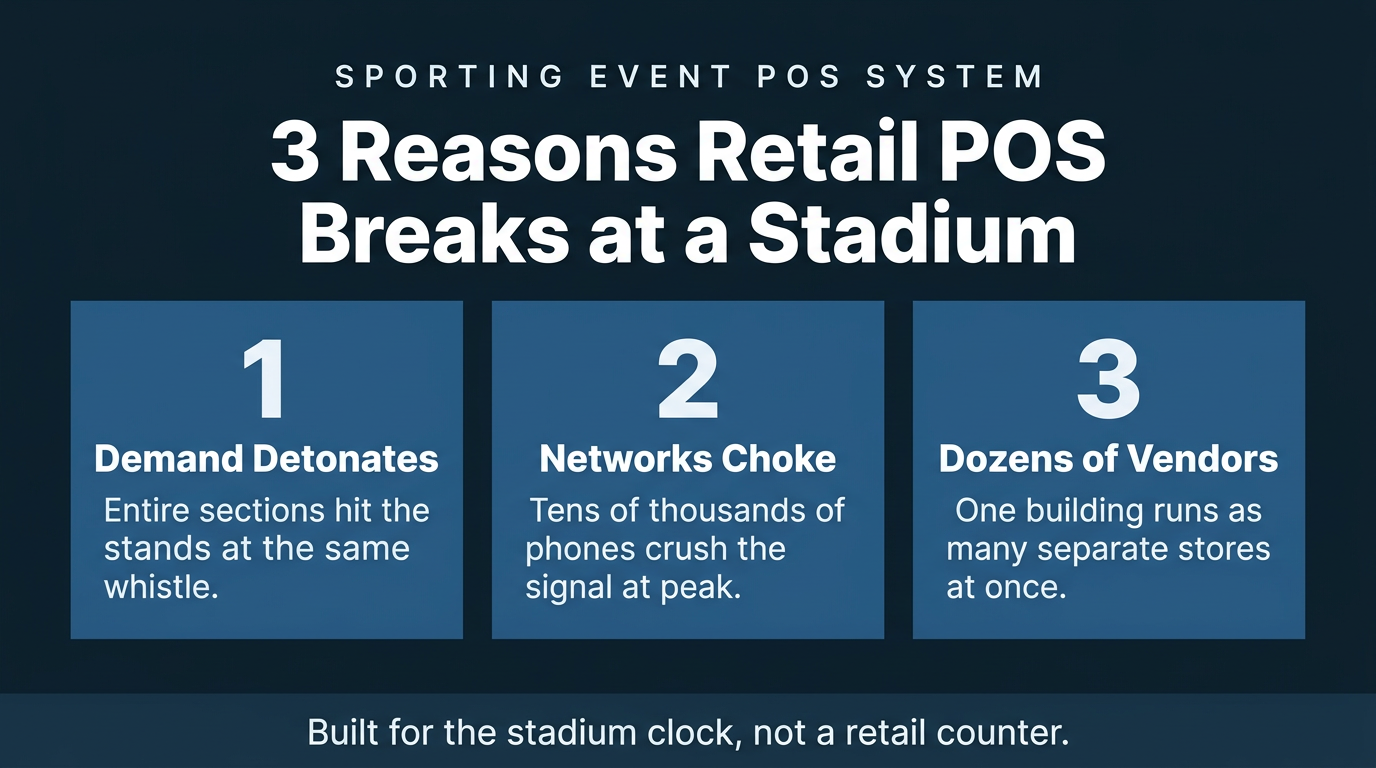
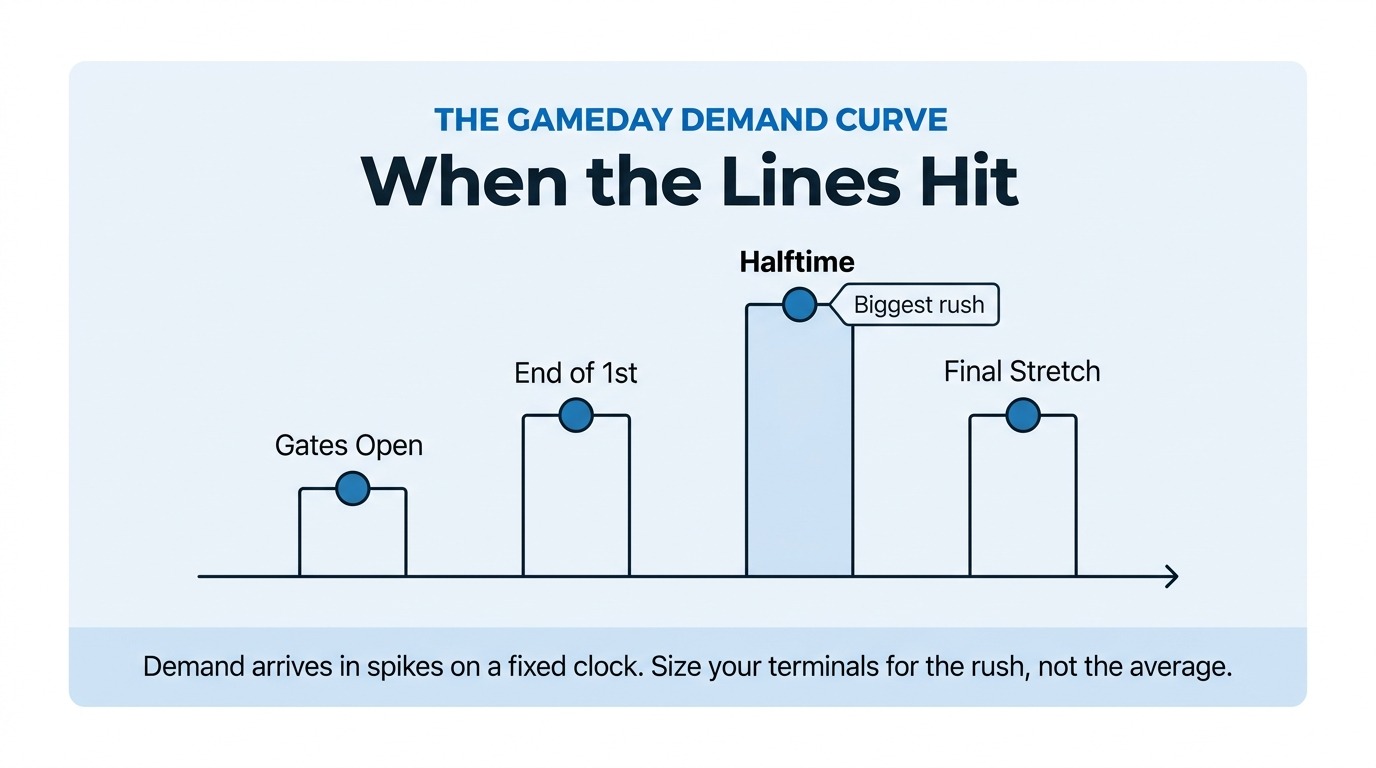
Demand at a sporting event does not build gradually. It detonates. Fans stay in their seats during play, then move all at once when the buzzer sounds, so a single stand can go from idle to a long line in under a minute. Those bursts cluster around fixed, predictable moments: the gates opening, the end of the first period, halftime, and the final stretch before the result is decided.
A register that handles a restaurant dinner rush fine will buckle when an entire section arrives at once. The systems that survive clear long lines in short windows, with fast tap-to-pay, RFID wristband options, and enough terminals to match the spike. This is where comparing the best stadium POS systems starts to separate sports-grade tools from repurposed retail gear.
Why Does Offline Processing Matter in a Packed Venue?
Tens of thousands of phones competing for the same cell towers and Wi-Fi make stadiums one of the most hostile network environments in commerce. Connectivity drops exactly when transaction volume peaks, because everyone is online at once.
A sporting event POS system that depends on a live connection for every sale will freeze mid-rush and take revenue down with it. Platforms that process transactions locally and sync automatically when the network returns keep concession lines moving regardless of signal. Offline capability is not a luxury at this scale; it is the line between a smooth event and a concourse full of stalled terminals.
How Do Stadiums and Arenas Run Multi-Section Vendor Setups?
A stadium is not one store. It is dozens of them, scattered across levels, concourses, clubs, suites, and portable stands, often run by different concessionaires under one roof. Coordinating that sprawl is one of the hardest parts of venue operations, and it is where a POS for arenas earns or loses its keep.
Can One Platform Handle Dozens of Vendors at Once?
A capable POS for arenas treats the whole building as a single store. The alternative is a patchwork of separate registers, separate reports, and separate reconciliation headaches at the end of the night.
A single system that spans every revenue center lets operators set pricing, manage product catalogs, and adjust vendor commission structures from one place. When a stand runs out of a popular item, managers can see it and shift stock instead of discovering the gap in a post-event spreadsheet. That coordination matters even more when temporary and seasonal staff turn over constantly, since a consistent interface means new hires are productive in minutes. The essential venue POS features that make this work are the same ones that separate a serious platform from a basic terminal.
What Does Real-Time Data Across the Concourse Unlock?
Every cashless transaction ties to a card, a mobile wallet, or an RFID credential, which turns routine sales into a live map of the building. Operators can see which stands are slammed and which sit idle, then move staff toward the lines before fans give up and leave. They can spot that one section drinks more than it eats, or that merchandise near the home end outsells everything else by halftime. A stadium event POS that surfaces this in real time, rather than a week later, lets venues fix problems during the event instead of after it. Over a season, that same data sharpens inventory forecasts, staffing plans, and sponsorship decisions.
Are Sports Fans Still Paying with Cash?
Cashless is the clear direction of travel, but sports has a wrinkle festivals mostly do not: the audience skews older, and older audiences hold onto cash longer. Ignoring that reality is how a venue ends up turning away paying customers at the gate.
Why Do Older Fans Still Reach for Cash?
The generational split in payments is real and measurable. Federal Reserve research on how different age groups pay found that consumers 55 and older lean on cash far more than younger cohorts, while adults aged 18 to 24 reach for their phones for nearly half of all payments. Season-ticket bases at many franchises skew toward exactly that older, cash-comfortable demographic. That does not mean a venue should cling to cash registers; it means the move to cashless has to account for the fans who still prefer bills. The smart play is designing the rollout so nobody gets stranded at a stand that cannot take their money.
How Do Cash-to-Card Kiosks Keep Every Fan Included?
This is the job cash-to-card kiosks were built for. Also called reverse ATMs, they let a fan feed in bills and walk away with a prepaid card that works at any tap-to-pay terminal in the building. They have already become standard equipment: reporting on cashless venues and the unbanked notes that reverse ATMs now sit in most Major League Baseball and National Football League ballparks, partly because roughly one in twenty Americans has no bank account and cannot be left out.

Placing kiosks at major entry points, with clear signage and a quick walkthrough from staff, converts a cash holdout into a digital spender in under a minute. The broader operational case for venues going fully cash-free is strong, but it only holds if the rollout keeps every fan in the game. Kiosks are the bridge that makes a fully cashless venue fair, and they are worth a closer look on their own.
How Should a Sporting Event POS System Connect with Ticketing?
Payment at a sporting event does not live in isolation. The same fan scans a ticket to get in, taps a credential to buy a beer, and maybe loads value onto a wristband for the day. When the sporting event POS system talks to ticketing and access control, those moments stop being separate systems and become one connected journey.
Integration lets a venue tie spending back to ticket type, link loyalty perks to purchases, and let fans preload funds before they reach a stand. It also smooths entry, since the same platform that validates a ticket can recognize a returning fan at the point of sale. A POS for arenas that cannot connect to the ticketing stack forces staff to bridge the gap by hand, which is the last thing anyone wants during a pre-game rush. Working through a full stadium POS buyer's guide before committing keeps integration from becoming an afterthought.
5 Things to Look for in a Sports Venue Point of Sale
When you evaluate a sports venue point of sale, these five capabilities matter more than anything a glossy brochure leads with.
- Spike-proof throughput. Ask how many transactions per minute each lane sustains at peak, and whether the vendor sizes the deployment for the rush instead of the daily average.
- True offline mode. Pin down exactly what happens when the network drops mid-rush: sales should keep processing on the device and reconcile automatically once the signal returns.
- Unified multi-vendor management. One platform should run every stand, suite, and cart under shared inventory and reporting, rather than a separate system per concessionaire.
- Flexible payment acceptance. Cards, mobile wallets, RFID wristbands, and a cash-to-card path all need to coexist so no fan gets turned away.
- Ticketing and analytics integration. A stadium event POS should connect to your access-control stack and surface live data you can act on mid-event, not a report that lands next week.
FAQ
What Is a Sporting Event POS System?
It is a point of sale platform built for the specific demands of stadiums and arenas: huge crowds, compressed rush periods, dozens of vendor locations, and shaky network conditions. Unlike a retail or restaurant system, it prioritizes transaction speed under extreme load, offline reliability, and multi-section coordination. The goal is to move fans through concession and merchandise lines fast enough that they keep spending and do not miss the action.
Do Stadiums Still Accept Cash if They Go Cashless?
Many fully cashless venues no longer take cash at the stand, but they install cash-to-card kiosks so cash-paying fans can convert bills into a prepaid card. This keeps the venue accessible to unbanked and cash-preferring fans while still capturing the speed and data benefits of digital payments. Some jurisdictions also require a cash option, which makes these kiosks a practical necessity rather than a courtesy.
How Is a Stadium POS Different from a Regular Restaurant POS?
A restaurant system is tuned for steady traffic across a long service window. A stadium event POS has to absorb thousands of transactions in the few minutes around a whistle, hold up when the network is overloaded, and coordinate dozens of separate vendors at once. Those are different engineering problems, which is why repurposed retail systems tend to struggle at sporting events.
Does Going Cashless Actually Increase Concession Revenue?
The mechanics point that way. Shorter lines mean more fans reach the register before play resumes, and fewer abandon the queue out of frustration, so more transactions clear in the same tight window. Faster checkout plus richer spending data is the core reason venues make the switch.
The Stadium POS Decision Comes Down to the Clock
A sporting event lives and dies on a fixed clock, and the payment system either keeps pace with it or quietly drains revenue every time a line stalls. The venues that win treat their sporting event POS as core infrastructure: spike-proof at the stands, reliable when the network buckles, unified across every concourse, and inclusive enough to keep cash-paying fans spending. Get those fundamentals right and the technology disappears into a smooth gameday. Get them wrong and fans feel every wasted second.
Billfold builds exactly this kind of platform for stadiums and arenas, combining RFID, mobile and card payments, multi-vendor management, and real-time analytics in one system made for high-volume venues. See how it fits your building on the stadium and arena payment platform page, or reach out to the Billfold team to get started.
