
Stadium POS: Why Arenas Are Going Fully Cashless
Key Takeaways
Cashless operation has shifted from a marquee experiment to the default model for major stadiums and arenas, and a modern stadium POS is what makes that shift pay off.
- Cash now accounts for only 14% of consumer payments in the U.S., according to the Federal Reserve's 2024 Diary of Consumer Payment Choice.
- Mercedes-Benz Stadium documented over $350,000 in operational savings and a 16% per-capita spending lift in its first fully cashless year.
- Modern systems bundle inventory tracking, vendor management, and real-time analytics into one platform built for compressed peak demand.
- Reverse ATMs and clear pre-event communication keep cash-preferring fans included while preserving the operational gains of a fully digital venue.
If your venue still juggles cash drawers and armored pickups, the question is no longer whether to go cashless. It is which platform can actually run a packed house.
Going cashless used to be the headline. Now it is the baseline. From flagship NFL venues to single-field MLS clubs, operators are stripping cash drawers out of concourses and replacing them with digital-only payment flows. A modern stadium POS platform moves more transactions, more quickly, with cleaner reporting at the end of the night.
The broader payment landscape has already moved. According to the Federal Reserve's 2024 Diary of Consumer Payment Choice, cash made up just 14% of all consumer payments in 2024, while mobile phone payments hit 11 transactions per consumer per month, almost triple the 2018 figure. Stadium cashless payments are responding to that reality.
Why Are Stadiums Going Fully Cashless?
The fundamental challenge at every arena is compressed time. A football halftime is roughly 13 minutes. A concert intermission might run 20. During those windows, thousands of fans want food, drinks, and merchandise simultaneously, and every second a register spends counting bills is a second that fan never gets back. A modern stadium POS exists to collapse that transaction window.
The throughput problem cash creates
Cash transactions are slow by design: handing over bills, waiting for the cashier to count them, making change, confirming the receipt. Card and mobile transactions skip almost all of that. Faster transactions mean shorter lines, and shorter lines mean revenue that would have walked away now lands in the ledger.
A concession stand serving 60 customers per hour during cash operations can roughly double that throughput on a digital-only system. During the brief windows that drive most stadium revenue, that capacity expansion is the difference between selling everything you stocked and watching fans give up on the line.
Where consumer payment behavior actually sits today
Stadium operators are catching up to behavior fans have already adopted. The Federal Reserve's 2024 data shows U.S. consumers averaged 48 payments per month, with credit and debit cards making up 35% and 30% of those payments respectively, and cash sitting third. Younger fans are even further along: consumers aged 18 to 24 used a mobile phone for 45% of all payments in 2024.
That generational pattern matters more for stadiums than for almost any other category. Live events skew younger and more mobile-native than retail or grocery. A venue still relying on cash registers is asking the demographic that drives ticket and concession growth to use a payment method they barely carry.
Why the security and labor math points the same direction
Cash is expensive to handle even when nothing goes wrong. Counting at shift change, armored pickups, cash room staffing, theft prevention, and reconciliation errors all cost money. Removing physical currency shrinks or eliminates those line items.
What Revenue Advantages Does a Cashless Stadium Deliver?
The revenue argument for stadium cashless payments has gotten stronger as more venues publish results. The basic dynamic is consistent: when paying is easier, fans buy more, and when lines move faster, more fans get to the register before the next inning, song, or quarter starts. Every modern RFID and contactless POS system compounds those two effects.
The Mercedes-Benz Stadium case study
The cleanest published example is Atlanta's Mercedes-Benz Stadium, which became the first major U.S. sports venue to run a fully cashless operation in March 2019. According to the stadium's official first-year report, the transition delivered more than $350,000 in operational savings, a combined 16% per-capita spending increase across Falcons and Atlanta United events, and a 20-to-30-second reduction in wait times during peak windows. Roughly 95% of fans reported the same or faster service speed at concession lines.
Those are reported outcomes from a venue that processes millions of fan visits a year. That kind of result pushed the rest of the industry into serious adoption mode.
Why the cashless effect compounds at scale
The per-capita spending lift is more than a faster-line story. Consumers are measurably more willing to make discretionary purchases when they are no longer handing over bills. A fan eyeing a specialty cocktail or premium merchandise is more likely to commit when payment friction disappears. That dynamic plays out thousands of times per event.
Data as a revenue engine
Cashless transactions generate the kind of data cash never could. Every purchase ties to a card, a wallet, or an RFID credential, building detailed pictures of what sells, when, and where inside the venue. Real-time analytics on those transactions let operators identify underperforming concession locations within hours rather than weeks, target sponsorship activations to actual fan spending, and forecast inventory with much higher accuracy.
How Does an Arena Payment System Improve Day-to-Day Operations?
A modern arena payment system goes well beyond a tap-to-pay terminal. Inventory, staff deployment, vendor management, and back-office reconciliation all run through it, and that integration is where the operational savings really come from.
Inventory that updates itself
Every sale automatically decrements stock counts in the back office. With a connected platform, managers see real-time stock levels across every location, redistribute product from slower stands, and reorder before the next event without waiting for a manual count. The lost-sale problem from running out of a top seller mid-event largely goes away.
Staff deployment based on real demand
Transaction data reveals demand patterns by location, by hour, and by event type. Managers can pre-position additional team members at high-traffic stands before lines form. Detailed venue POS data also makes post-event analysis much faster, which means future staffing decisions get smarter instead of repeating last season's mistakes.
Reconciliation that takes minutes instead of hours
End-of-shift reconciliation transforms from a manual count into an automated verification. The counting errors and disputes that plague cash operations largely disappear when every transaction is digital. Vendor settlements, often the most painful part of a multi-vendor operation, become a query rather than a spreadsheet exercise.
5 Key Advantages of Going Cashless at the Arena
The benefits of converting a venue to fully cashless show up across operations, finance, and fan experience. The five that consistently move the most weight in operator decisions:
- Dramatically faster throughput. Card and mobile transactions clear in a fraction of the time cash takes, expanding how many fans a single register can serve during peak windows.
- Higher per-capita spending. Fans buy more and choose premium items more often when payment friction disappears, a pattern documented by published venue results like the 16% lift at Mercedes-Benz Stadium.
- Eliminated cash-handling costs. Armored transport, cash room staffing, counterfeit detection, and reconciliation labor all shrink or disappear, generating savings that scale with event volume.
- Stronger security posture. Theft risk drops sharply when physical currency is no longer in the building, protecting venue funds and reducing employee liability exposure.
- Actionable business intelligence. Every transaction generates data that informs inventory, marketing, sponsorship ROI, and operational optimization in ways cash systems simply cannot.
What Does Modern Stadium Payment Technology Look Like in Practice?
The case studies have moved past pilots. Multiple major venues now run fully cashless operations with published results, and the next wave of technology, including biometric authentication, is being deployed alongside traditional payment terminals.
BMO Stadium and the move toward biometric checkout
BMO Stadium, home of LAFC, operates as a fully cashless venue accepting credit cards, debit cards, Apple Pay, and Google Pay across all points of sale. In 2025, the club partnered with computer vision firm Wicket to launch BMO Stadium Express, a facial authentication system for ticketing and concession purchases. Fans who enroll in advance can enter the venue and pay at concession stands without pulling out a phone or card at all. The next layer of stadium payment technology will sit on top of the cashless foundation, not replace it.
Red Rocks and the inclusive cashless model
Red Rocks Amphitheatre runs all food, beverage, and merchandise operations on a fully cashless basis. Fans who arrive with only physical currency convert it to prepaid debit cards at on-site reverse ATM kiosks, which charge no fee. That approach has become a template for venues that want digital-only operational benefits without leaving cash-preferring attendees behind.
Mobile and in-seat ordering as the next layer
A growing share of cashless stadium revenue is now flowing through mobile order-ahead and in-seat delivery channels. Implementing those payment workflows correctly requires a platform that can handle on-counter, kiosk, and mobile-app transactions through one system. When the back end is unified, in-seat orders, express pickup, and concession-stand purchases all roll up into the same dashboard.
How Can Venues Transition to a Cashless Stadium POS Successfully?
Going cashless is a planned project. Venues that get clean rollouts prepare the infrastructure, the customer communication, and the inclusive payment options well before the first event.
Audit infrastructure before terminals
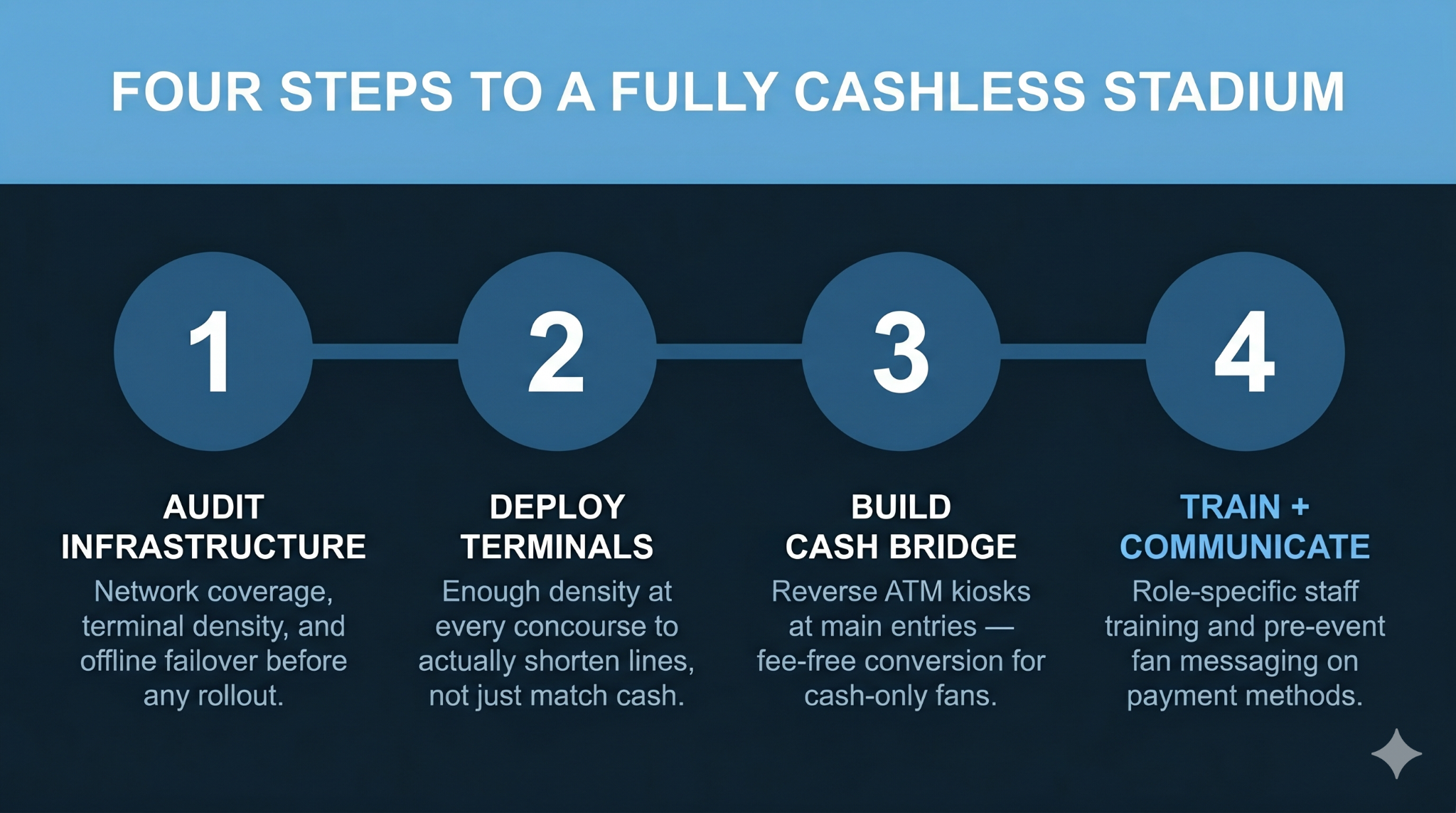
Reliable network connectivity is the most underestimated requirement. A modern arena payment system needs sufficient terminal density at every concourse, a stable cellular or Wi-Fi backbone, and offline transaction handling for moments when connectivity falters. Many venues underestimate how many terminals are actually needed to keep lines moving.
Build in the cash bridge
Reverse ATM kiosks are how cashless venues stay inclusive. They convert physical currency into prepaid cards without fees, ensuring unbanked attendees and cash-preferring fans can still participate. Prominent signage and trained staff to assist newcomers reduce the friction that often becomes the loudest complaint in the first month.
Invest in staff training and pre-event communication
Sophisticated payment technology only delivers if the people running it are confident with it. Bartenders, cashiers, and venue managers all need different training paths. Customer communication has to start before event day, with clear messaging on tickets, the venue website, and social channels. The same playbook that works for festival POS rollouts applies to stadium environments, with the added requirement of much higher peak transaction volumes per hour.
FAQ
What happens if a fan arrives at a cashless stadium with only cash?
Most cashless stadiums install reverse ATM kiosks that convert physical currency into prepaid debit cards at no charge. Fans load funds onto the card and use it throughout the venue exactly like a regular debit card. The kiosks are typically placed at main entry points and high-traffic concourses with clear signage.
How much does it cost to implement a stadium POS that supports cashless operations?
Implementation costs vary based on venue size, existing infrastructure, terminal count, and whether the system is purchased or rented. Most venues recover their initial investment within one to two seasons through operational savings and per-capita spending increases. Mercedes-Benz Stadium documented over $350,000 in first-year operational savings on cash handling alone.
Do cashless stadium systems work during network outages?
A well-designed payment system includes offline transaction handling so registers continue accepting payments when connectivity drops. Transactions are queued locally and sync automatically once the connection returns. Venues should specifically ask vendors about offline modes during evaluation.
Can stadiums actually use cashless data to improve concession performance?
Yes, and this is one of the largest underused benefits. Modern stadium payment systems generate detailed analytics by stand location, time period, and product category. Operators can identify which stands underperform, which products sell best during specific game situations, and which fan segments drive the highest spend.
Are facial authentication and biometric payments going to replace cards at stadiums?
Probably not entirely, and certainly not soon. Biometric payment systems like the one at BMO Stadium sit on top of an existing cashless platform rather than replacing it. Fans still link a credit card to their face during enrollment, so the underlying payment rail is the same. The authentication layer simply removes the need to physically present a card or phone.
The Cashless Stadium Is Already the Default
The shift to cashless stadium operations stopped being a debate years ago. Major venues across the NFL, MLB, MLS, and concert circuits have proven the model. Federal Reserve data shows fan payment behavior already moved. What separates a smooth rollout from a chaotic one is the platform underneath it: a stadium POS built for compressed peak demand, multi-vendor environments, and operational complexity that retail systems were never designed to handle.
For operators ready to upgrade legacy infrastructure, Billfold builds cashless POS systems specifically for high-volume venue environments, with RFID, mobile payments, vendor management, and real-time analytics in one platform. Reach out to the team to map a transition plan that fits your venue.
