
Stadium POS Systems: The 2026 Buyer's Guide

Key Takeaways
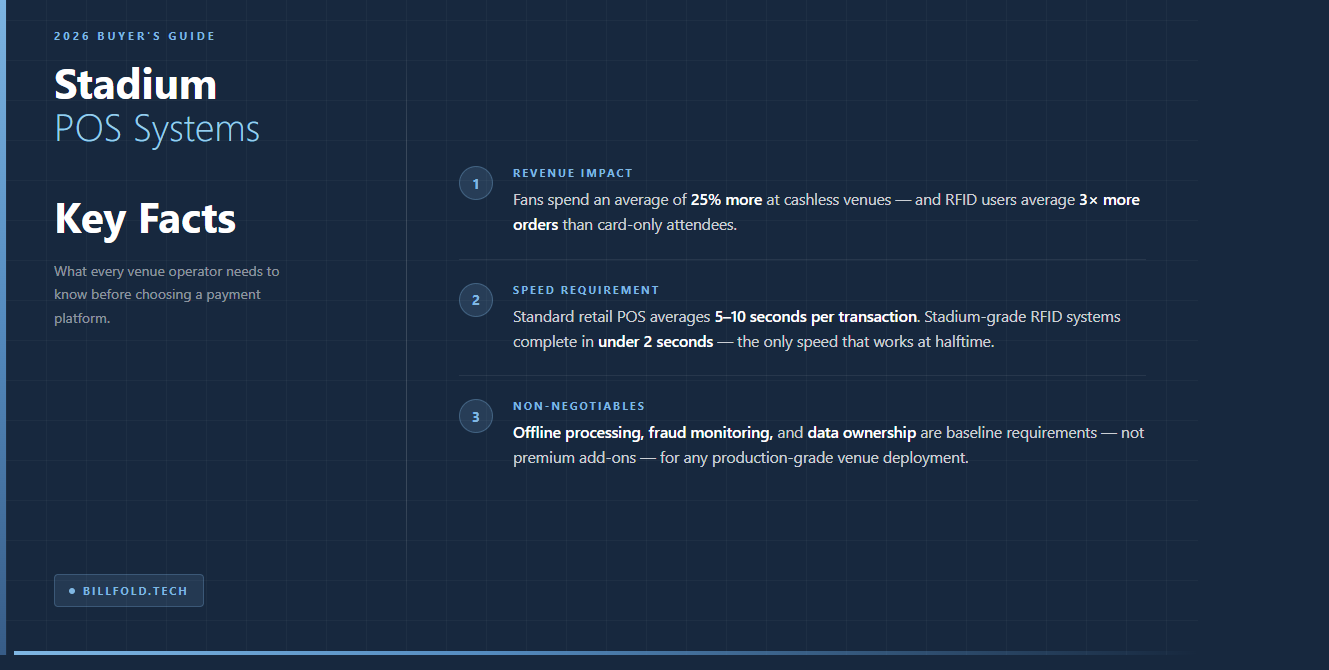
Choosing the right stadium POS system in 2026 means evaluating transaction speed, RFID capability, fraud prevention, offline reliability, and data ownership. Hardware price is only one input in a much larger decision.
- Standard retail POS platforms are not built for the transaction spike environment of a stadium; venues need systems purpose-built for compressed, high-volume service windows.
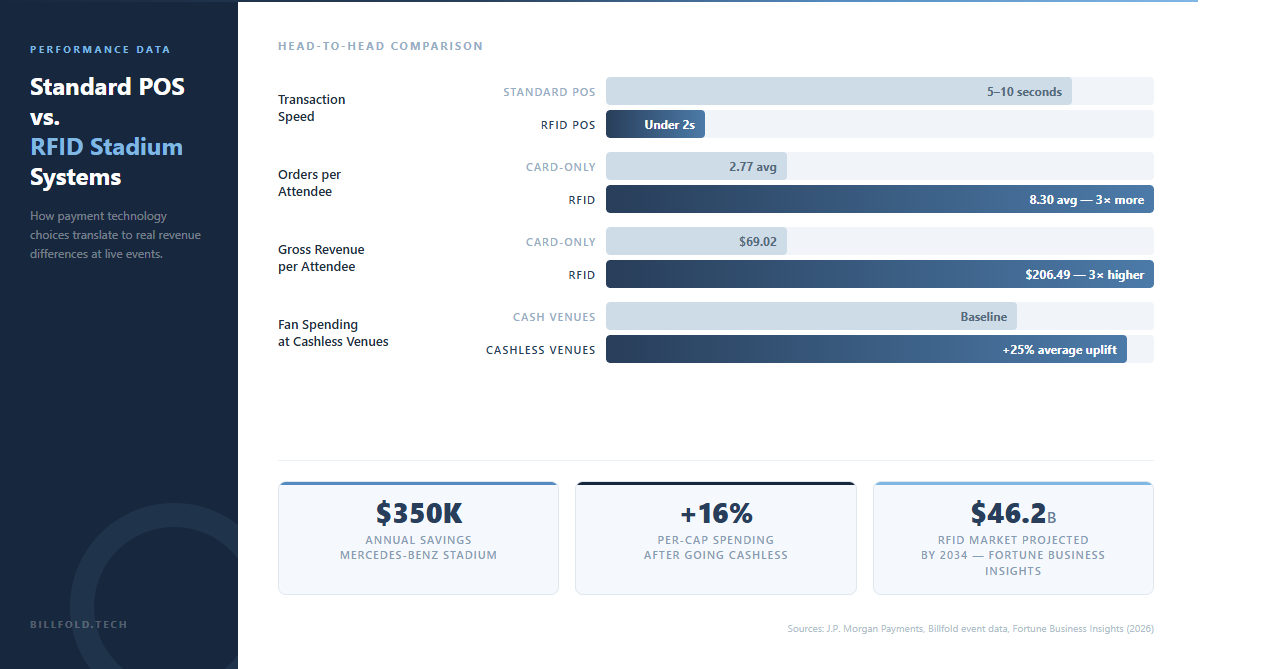
- RFID-enabled systems process transactions in under two seconds and generate a 3x revenue-per-attendee advantage over card-only alternatives at comparable events.
- Offline capability, real-time fraud monitoring, and data ownership are non-negotiable at scale. Venues that treat them as optional upgrades pay for it in revenue and exposure.
The venues pulling ahead in per-cap revenue are not the ones with the most seats. They are the ones with the smartest payment infrastructure.
Halftime at a 60,000-seat stadium. Twenty minutes on the clock. Thousands of fans simultaneously deciding to grab a beer, a hot dog, or a jersey. This is the moment that separates a well-designed stadium POS system from a liability. The payment infrastructure running a venue's concession operations is one of the most stress-tested technology environments in commercial life — and most venues are still running systems built for a fraction of that demand.
The business case for upgrading is clear. Research from J.P. Morgan Payments shows that fans spend an average of 25% more at cashless venues compared to cash-dependent environments, and that gap compounds when faster transactions mean more purchases per event. This guide covers the full decision framework for stadium POS systems in 2026: what to evaluate, how RFID changes the revenue equation, what fraud protection actually looks like at scale, and how to understand implementation costs without leaving money on the table.
What Makes Stadium POS Systems Different from Standard Retail POS?
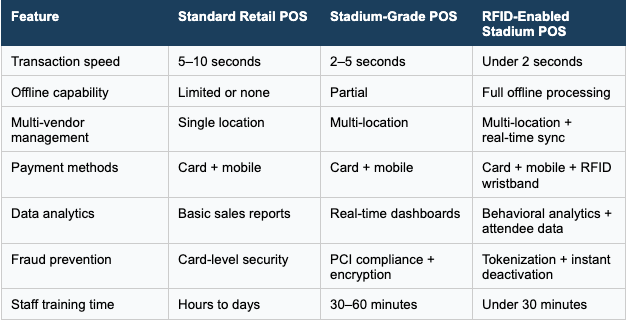
Most POS platforms on the market were designed for restaurants and retail shops, where predictable transaction volumes spread over a full business day. A stadium POS system operates on a fundamentally different schedule. Transaction demand arrives in violent spikes: pre-game rushes, halftime breaks, and intermissions that may last fifteen to twenty minutes while thousands of fans compete for service across dozens of simultaneous vendor locations.
Built for Peak Load, Not Average Load
Standard retail systems are optimized for daily throughput. A venue platform needs to handle that same throughput in thirty-minute windows. A system that processes a transaction in eight seconds is adequate in a grocery store. At halftime, that speed creates lines that send fans back to their seats empty-handed. Offline processing capability is equally non-negotiable: dense stadium environments with tens of thousands of smartphones create RF interference that can degrade connectivity, and any arena POS system that depends on live network connectivity is a direct revenue risk the moment the network degrades.
Multi-Vendor Operational Complexity
A single stadium might run concession stands, merchandise stores, premium suites, mobile kiosks, and VIP bar service simultaneously, each with different menus, pricing structures, and inventory. A quality stadium POS system brings all of these into a single backend with real-time reporting, centralized inventory management, and role-based staff access. Without that unified backend, operators are reconciling siloed data after the event, which is both slow and inaccurate. Large venues also depend heavily on temporary and seasonal staff, which means intuitive interfaces and fast onboarding are not conveniences but operational requirements.
What Should You Look for in an Arena POS System?
Not every platform marketed toward venues is genuinely built for the stadium environment. Evaluating an arena POS system means looking past the marketing and asking specific questions about how it performs under real event pressure. The core requirements fall into four areas.
Payment Flexibility
The baseline expectation from fans in 2026 is frictionless multi-method payment: credit and debit cards, mobile wallets (Apple Pay, Google Pay), and increasingly, RFID wristband tap-to-pay. Any stadium POS system worth evaluating must accept every payment type a fan might prefer at every point of service across the venue. Limiting options to a single method creates friction that costs real revenue.
Offline Reliability and Real-Time Analytics
Every major stadium has experienced network disruptions during events. Platforms that store transaction data locally and sync automatically when connectivity returns ensure vendor operations never stop regardless of network conditions. On the analytics side, real-time dashboards that surface which vendors are running low, which locations are building queues, and where staff redeployment would drive the most revenue are what separate modern venue operations from outdated ones. This is one of the core advantages that stadium cashless payments deliver over cash-heavy operations, where end-of-shift reconciliation provides totals but no behavioral insight.
How Does RFID for Stadiums Change the Revenue Equation?
RFID is the most significant payment technology advancement available to stadium operators today. RFID for stadiums works by embedding a small radio frequency chip in a wristband or card that communicates with point-of-sale readers in milliseconds. Attendees preload funds before the event or on-site at kiosks, then tap to pay at any vendor without waiting for card authorization or network confirmation. The result is a transaction that completes in under two seconds, which radically changes what is possible during a fifteen-minute halftime break.
Spending Uplift: What the Data Shows
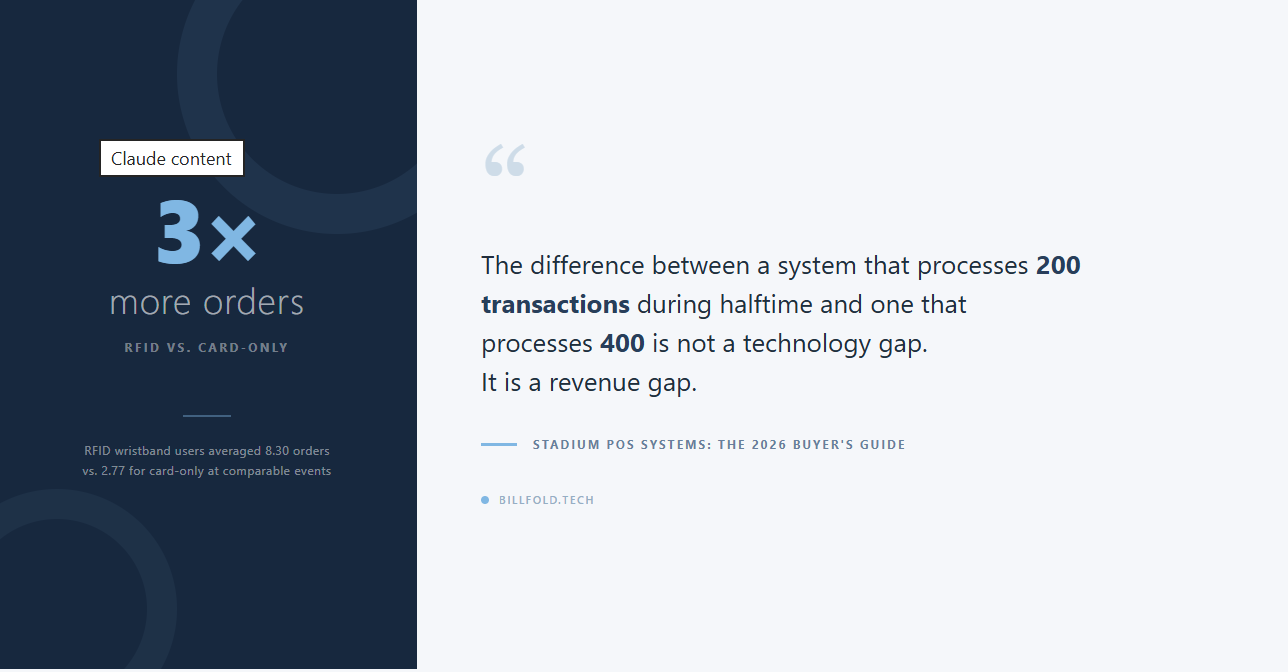
The revenue impact of RFID has been measured at real events. Data from an 18,000-person multi-day venue event found that RFID wristband users averaged 8.30 orders per event generating $206.49 in average gross profit, compared to 2.77 orders and $69.02 for card-only transactions. That is a 3x difference in order frequency and revenue per attendee. The behavioral driver is simple: when payment is a wrist tap, the psychological friction of spending is eliminated and fans buy more because buying is easier.

Data Ownership: The Underrated Advantage
When fans pay with a bank card or mobile wallet, transaction data flows through third-party networks and the venue receives only a settlement report, not insight. RFID systems capture every transaction within a closed-loop ecosystem, giving operators direct visibility into spending patterns, peak purchasing windows, and movement across venue sections. This data transforms event planning from guesswork into informed strategy. For venue operators evaluating this distinction, the breakdown of cashless vs. contactless payments explains exactly how data ownership differs between closed-loop and open-loop systems.
RFID Beyond Concessions
RFID is also reshaping stadium merchandise retail. According to Stadium Tech Report, RFID-powered self-checkout systems deployed across 24 U.S. professional sports venues have reduced average merchandise transaction times from three to four minutes to 30 seconds or less. Venue operators report double-digit percentage increases in merchandise sales following deployment. The lines that previously kept fans away from team stores are simply gone.
How Do Stadium POS Systems Prevent Fraud and Protect Revenue?
Fraud prevention at a stadium has two dimensions. External fraud, including counterfeit payments and stolen cards, gets the most attention. But internal revenue leakage through cash mishandling, reconciliation errors, and off-the-books transactions is often equally costly and far less visible.
Eliminating Cash Risk
Cash operations create vulnerabilities at every touchpoint: counting, transport, storage, and reconciliation all introduce both human error and theft risk. Transitioning to a fully cashless venue removes the majority of these exposure points. Digital transactions generate an automatic, tamper-proof audit trail where every sale is logged, timestamped, and attributed to a specific vendor terminal and staff member. Discrepancies that would have been invisible in cash operations surface immediately in digital reporting, creating accountability that deters internal theft and simplifies end-of-event reconciliation.
Encryption, Tokenization, and Real-Time Monitoring
Production-grade arena POS platforms protect payment data through end-to-end encryption, tokenization, and PCI DSS compliance. Tokenization replaces actual credentials with a unique identifier that has no value outside the ecosystem, making intercepted data useless. RFID's 2–4 inch read range makes remote skimming attacks practically impossible, and lost wristbands can be instantly deactivated from a central dashboard. Modern platforms also include real-time transaction monitoring: unusual patterns such as excessive voids, repeated small transactions from the same terminal, or off-menu pricing trigger alerts immediately rather than surfacing in post-event reconciliation.
6 Questions to Ask Before Choosing Stadium POS Systems
Vendor selection is where most stadium operators make their biggest mistakes, either prioritizing price over capability or evaluating features outside their actual operating context. These six questions will surface the gaps that matter.
- Does it process fully offline? Any vendor that cannot confirm complete offline transaction processing with automatic sync is not stadium-ready. Network disruptions at large venues are predictable events, not edge cases.
- What is transaction speed under peak load? Ask for documented performance data from deployments comparable in size and concurrency to yours. Average transaction time means nothing if the system degrades under simultaneous sold-out-game load.
- Does it support RFID wristband payments? If not today, understand the roadmap. The revenue differential between RFID and card-only transactions at comparable events is significant and documented. A system without RFID capability is already a generation behind.
- Who owns the transaction data? Some platforms route all transactions through external networks and provide only summary reports. Others keep all data within a closed ecosystem. The strategic difference between the two is enormous.
- What does event-day support look like? Stadium events have zero tolerance for go-live failures. Ask specifically about event-day support availability and how quickly the vendor can resolve a critical failure mid-event. References from comparable venue operators are worth more than any sales deck.
- How are unspent RFID balances handled? Attendees who preload wristband funds expect a clear, frictionless refund process. Refund policies must be defined before deployment, not figured out post-event.
What Does It Cost to Implement Stadium POS Systems?
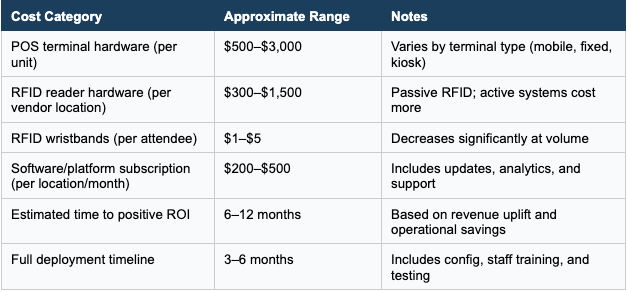
Implementation costs vary significantly based on venue size, terminal count, whether RFID infrastructure is included, and depth of integration with existing ticketing and inventory systems. That said, the general cost structure follows a recognizable pattern.
Hardware, Setup, and Ongoing Fees
Payment terminal hardware ranges from several hundred to several thousand dollars per unit depending on capability level, with mobile, fixed, and self-service kiosk units each at different price points. RFID infrastructure adds reader hardware and per-event wristband costs that vary by order volume and customization. Industry experience with stadium POS systems puts initial setup in the range of $500 to $2,000 per POS location, with ongoing subscription and processing fees of $200 to $500 per location monthly, and most deployments reaching positive ROI within six to twelve months through increased revenue and reduced operational costs.
The Operational Savings Side of the Equation
The investment looks very different when operational savings are factored in. Eliminating cash handling reduces labor for counting, reconciliation, and armored transport. Faster transactions reduce the number of terminals needed to serve the same volume. Real-time inventory data cuts end-of-event waste. Mercedes-Benz Stadium reported $350,000 in annual operational savings alongside a 16% increase in per-capita spending after going fully cashless in 2019, a result that paid for significant technology investment many times over. The broader RFID market, currently valued at $19.01 billion and projected to reach $46.2 billion by 2034 according to Fortune Business Insights, reflects exactly this kind of accelerating adoption driven by proven ROI.
FAQ
What is a stadium POS system and how is it different from a regular POS?
A stadium POS system is a payment processing platform built specifically for the high-volume, multi-vendor, time-compressed environment of large sports and entertainment venues. Unlike standard retail or restaurant platforms, venue-grade systems are designed for transaction spikes, full offline reliability, simultaneous multi-location management, and RFID wristband integration. The core difference is performance under peak pressure.
How does RFID work for stadium payments?
RFID stadium payment systems embed a radio frequency chip in a wristband or card that communicates wirelessly with point-of-sale readers. Attendees link a payment method to their wristband and tap to pay at any vendor. Transactions complete in under two seconds and process independently of live network connectivity. Lost or stolen wristbands can be deactivated instantly from a central dashboard without exposing the linked payment account.
Are cashless stadium POS systems accessible to fans without bank cards?
Yes. Most venue operators using cashless infrastructure deploy cash-to-card kiosks or prepaid card stations that allow unbanked fans to convert cash into a digital payment method on-site. This preserves the operational benefits of cashless while maintaining access for all attendees, and some jurisdictions require venues to offer this accommodation by law.
How long does it take to implement a stadium POS system?
A full deployment including hardware installation, software configuration, staff training, and pre-event testing typically takes three to six months. The variables most affecting timeline are integration complexity with existing ticketing or inventory systems and the number of vendor locations requiring hardware. Building in adequate testing time before the first live event is critical.
What happens to data from stadium POS transactions?
It depends entirely on the architecture. Open-loop systems (contactless cards, mobile wallets) route data through banks and payment networks, giving the venue a settlement report but no attendee-level insight. Closed-loop cashless systems, including RFID wristband platforms, retain all transaction data within the venue's ecosystem, delivering behavioral analytics, spending breakdowns by attendee segment, and real-time operational intelligence that open-loop systems simply cannot provide.
The Right Stadium POS System Is a Revenue Decision
Venue operators who treat payment infrastructure as a commodity purchase are the ones leaving the most revenue on the table. Transaction speed, RFID compatibility, fraud prevention, offline reliability, and data ownership are not features on a spec sheet. They are operational levers that directly determine how much revenue a venue captures per event and how intelligently it can plan for the next one. The difference between a platform that processes 200 transactions during halftime and one that processes 400 is not a technology gap. It is a revenue gap.
Billfold builds cashless payment systems purpose-built for live events and venues, combining RFID wristband technology, real-time analytics, and multi-payment acceptance into a single platform designed to perform when it matters most. Reach out to the Billfold team to see how the right stadium POS system can transform your venue's revenue and fan experience.
