
Resilient Cashless Event Architecture for Multi-Venue Events

Payment systems fail at the worst possible moments. Resilient cashless event architecture turns potential disasters into seamless operations.
Key findings:
- Network outages cost events an average of $14,056 per minute, making offline capabilities essential
- 68% of cashless payment users identify connectivity issues as their biggest operational challenge
- Multi-venue events require distributed architecture with independent processing at each location
- Offline-first systems maintain 100% uptime regardless of network conditions
Smart event operators build redundancy into every layer of their payment infrastructure before problems occur.
The rush hits at 8 PM. Your headliner takes the stage. Fifteen thousand fans simultaneously hit the bars and merch stands. Then your internet connection drops.
Traditional payment systems would grind to a halt. Credit card terminals throw errors. Mobile wallet payments fail. Staff scramble with calculators and paper receipts. Revenue evaporates while frustrated customers abandon lines.
This scenario plays out at events worldwide, costing organizers tens of thousands in lost sales and damaging attendee experiences. According to Fortune Business Insights, the global cashless payments market reached $139.61 billion in 2024, yet network vulnerabilities remain the single greatest operational threat to event revenue, with 68% of users citing connectivity as their primary concern.
Modern cashless event architecture solves this problem by building resilience into every system layer. When designed correctly, your payment infrastructure continues operating through network failures, hardware malfunctions, and traffic spikes that would cripple conventional systems.
What Makes Cashless Event Architecture Critical for Modern Events?
Cashless event architecture refers to the complete technical framework that processes digital payments across event venues. This includes hardware devices, software applications, network infrastructure, data storage systems, and the protocols that connect them.
Unlike simple payment terminals that rely on constant connectivity, robust cashless event architecture operates as a distributed system. Each point of sale functions independently while synchronizing with central databases when connections allow. This design philosophy transforms potential single points of failure into redundant, self-healing systems.
The stakes have never been higher. Major IT outages affected millions of devices in 2024, with the July CrowdStrike incident alone disrupting 8.5 million Windows systems worldwide. Payment platforms experienced direct impacts, leaving individuals without expected paychecks and businesses unable to process transactions.
The Real Cost of System Failures
Event operators face brutal financial consequences when payment systems fail. Research shows that organizations lose an average of $14,056 per minute during IT outages, with large enterprises averaging $23,750 per minute according to 2024 EMA Research data.
For multi-day festivals processing thousands of transactions per hour, these numbers scale exponentially. Even a brief network outage during peak sales periods translates to significant lost revenue. The reputational damage compounds these losses as frustrated attendees share negative experiences on social media.
Beyond immediate revenue impact, system failures create operational chaos. Staff must manually record transactions, reconcile cash floats, and manage angry crowds without functioning technology. Security risks multiply as venues resort to cash handling. Recovery efforts consume days of administrative time after events conclude.
Multi-Venue Complexity Amplifies Risk
Operating across multiple venues simultaneously introduces exponential complexity into cashless event architecture. Each location requires independent processing capability, local data storage, and autonomous decision-making during network disruptions.
Traditional centralized systems create vulnerability. When the central server fails or loses connectivity, every venue stops processing payments simultaneously. The impact cascades as technical issues at one location affect operations across the entire event.
Multi-venue tech demands distributed architecture where each site operates as a self-contained unit. Local processing enables transactions to continue during network partitions. Data synchronizes automatically when connectivity returns, maintaining consistency across the entire event ecosystem without requiring constant central coordination.
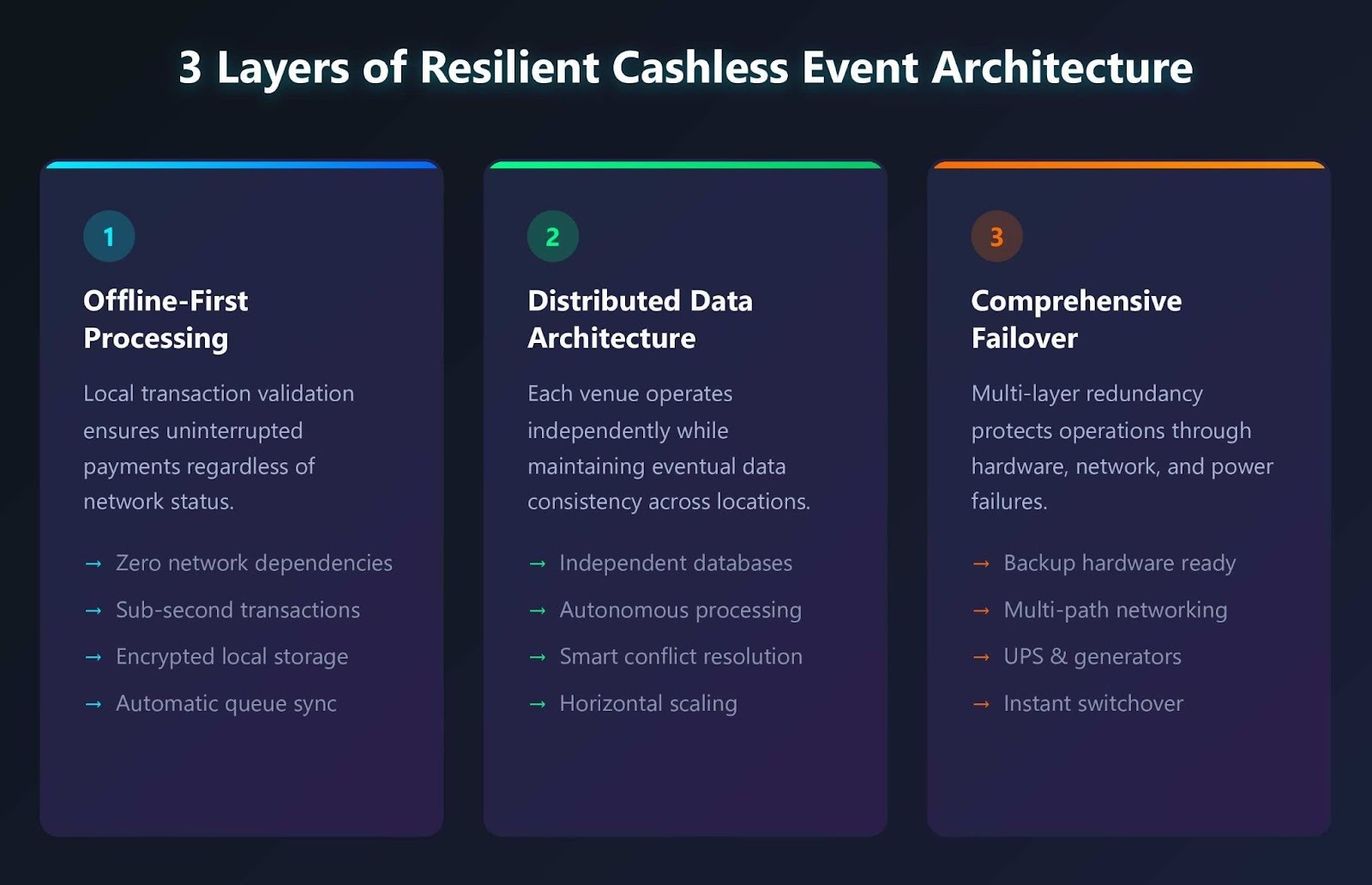
What Are the Core Components of Resilient Cashless Event Architecture?
Building truly resilient systems requires understanding the technical layers that enable uninterrupted operation. Each component plays a specific role in maintaining transaction processing when traditional infrastructure fails.
How Does Offline-First Processing Protect Revenue?
Offline POS systems represent the foundation of resilient cashless event architecture. Rather than treating offline capability as a backup mode, these systems prioritize local transaction processing as their primary operating method.
When customers tap wristbands or cards, offline POS devices store transaction data locally in encrypted databases. The system validates payment credentials against locally cached information, processes the transaction immediately, and queues the data for synchronization when network connectivity returns.
This approach eliminates network latency as a bottleneck. Transaction speeds remain consistent regardless of connection quality. Even during complete internet outages, attendees experience identical sub-second payment processing that defines modern cashless payment experiences.
The technical implementation requires sophisticated data management. Local databases maintain copies of critical information including attendee account balances, product catalogs, pricing rules, and transaction histories. Conflict resolution algorithms handle edge cases where the same account processes multiple transactions at different venues before synchronizing.
Why Distributed Data Architecture Matters
Centralized databases create single points of failure that compromise entire event operations. Distributed data architecture spreads information across multiple systems, ensuring that localized failures never cascade into complete shutdowns.
In properly designed cashless event architecture, each venue maintains its own database instance. These instances operate independently while participating in eventual consistency protocols that synchronize data across the network. When any location loses connectivity, it continues operating from local data without requiring external validation.
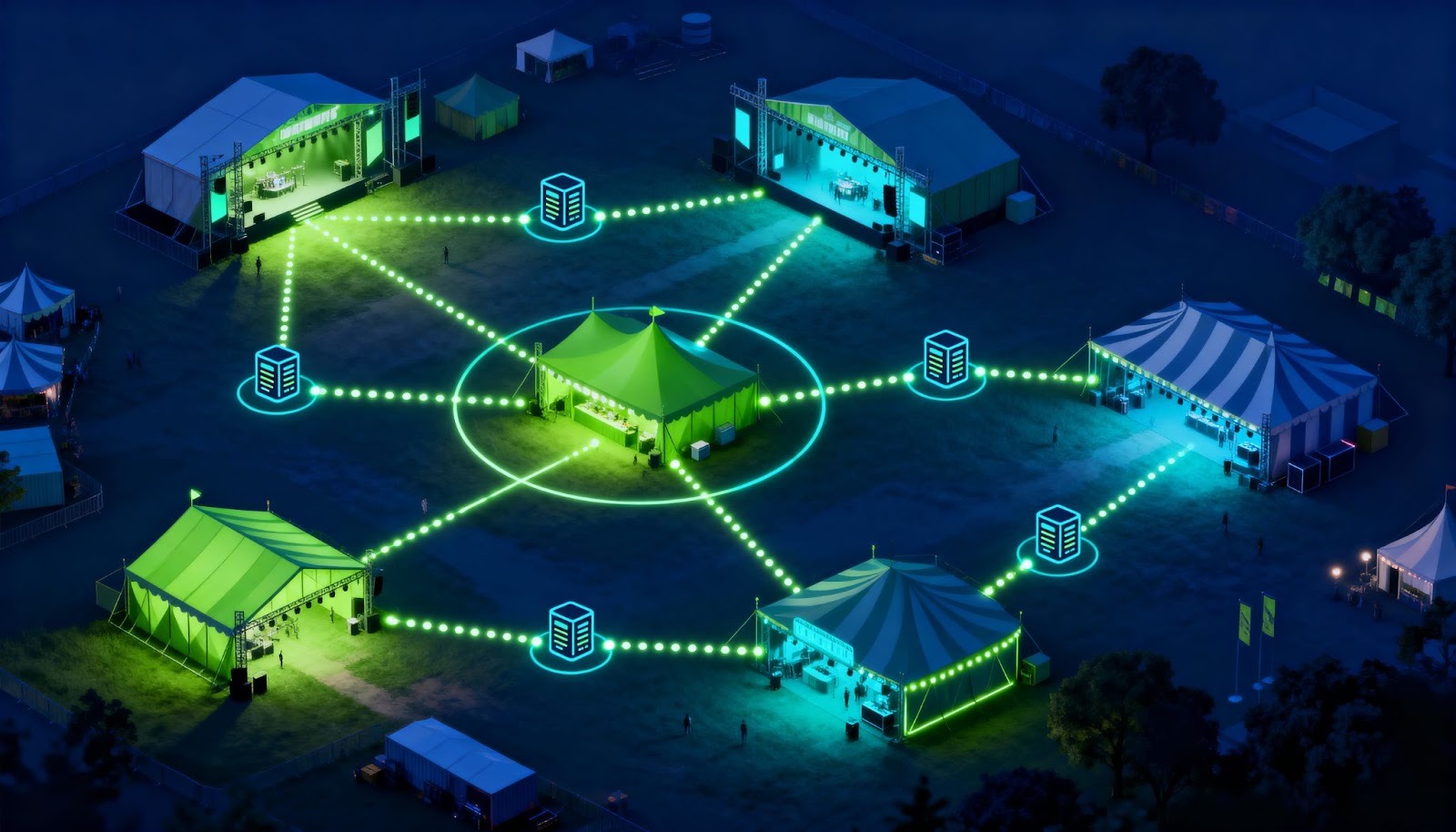
The synchronization logic runs continuously in the background, pushing local transactions to central servers and pulling updates from other venues whenever network connections allow. Smart conflict resolution ensures data integrity when the same resources are modified at multiple locations simultaneously.
This distributed approach also enables horizontal scaling. Adding new venues to an event requires deploying additional local instances rather than upgrading central infrastructure. Processing capacity grows linearly with the number of locations, eliminating centralized bottlenecks that limit transaction throughput.
What Failover Mechanisms Protect Against Hardware Failures?
Cashless failover systems automatically redirect operations when primary hardware fails. These mechanisms operate at multiple infrastructure layers, creating redundancy that maintains operations through diverse failure scenarios.
At the device level, redundant payment terminals enable instant switching when primary units malfunction. When a POS device experiences hardware failure, staff simply grab a backup unit that's already configured and synchronized. The replacement device loads the current session state and continues processing transactions without disruption.
Network failover proves equally critical. Events deploy multiple internet connections using different providers and technologies. When the primary fiber connection fails, systems automatically route traffic through cellular backup connections. Load balancers monitor connection health and shift traffic seamlessly between available networks.
Power redundancy completes the failover stack. Uninterruptible power supplies keep critical systems running during brief outages. Backup generators provide extended operation during prolonged power failures. Battery-powered mobile devices continue processing transactions even when venue power fails completely.
What 5 Critical Features Does Your Multi-Venue Tech Stack Need?
Evaluating cashless event architecture requires understanding which capabilities separate enterprise-grade systems from consumer solutions. These five features determine whether your infrastructure withstands real-world event conditions.
1. Independent Venue Operation
Each location must process transactions completely autonomously. When venue A loses network connectivity, venues B through Z continue operating normally. Local transaction processing, offline data validation, and autonomous decision-making ensure zero cross-venue dependencies during network failures.
2. Automatic Data Synchronization
Smart synchronization protocols push and pull data without manual intervention. Systems automatically detect when connectivity returns after outages, queue pending transactions for upload, pull updates from other venues, and resolve conflicts through predefined business rules that maintain data consistency.
3. Real-Time Analytics Across All Venues
Operators need unified visibility into multi-venue operations. Centralized dashboards aggregate data from all locations, displaying sales trends, inventory levels, transaction volumes, and operational metrics. During network outages, systems cache analytics locally and synchronize historical data when connectivity returns.
4. Hardware Agnostic Architecture
Vendor lock-in creates vulnerability when specific hardware becomes unavailable. Robust multi-venue tech supports diverse device types including RFID readers, NFC terminals, QR code scanners, and traditional card readers. This flexibility enables rapid deployment of backup hardware during equipment failures.
5. Encrypted Local Data Storage
Security cannot depend on network connectivity. Local encryption protects sensitive payment data stored on devices during offline operation. Industry-standard encryption algorithms, secure key management protocols, and compliance with PCI DSS requirements ensure that offline processing maintains the same security posture as online systems.
How Do You Build Redundancy Into Your Payment System?
Redundancy planning transforms theoretical resilience into practical operational capability. Strategic hardware, network, and data redundancy creates multiple fallback options when primary systems fail.
Hardware Redundancy Strategies
Deploy surplus payment devices beyond peak transaction requirements. This overhead enables instant replacement during hardware failures while maintaining target transaction speeds. Store backup devices in secure locations at each venue, pre-configured and ready for immediate deployment.
Mobile processing capabilities add another redundancy layer. Staff equipped with smartphones or tablets running payment applications can establish temporary points of sale anywhere within venues. During unexpected demand spikes or fixed terminal failures, mobile units absorb excess traffic.
Regular hardware rotation prevents age-related failures during events. Devices approaching end-of-life undergo replacement during setup rather than risking failures during peak operation. Maintenance logs track device history, battery health, and performance metrics that predict potential failures.
Network Redundancy Implementation
Multi-venue tech requires multiple independent network paths to each venue. Primary fiber connections deliver high-bandwidth, low-latency connectivity for normal operations. When fiber fails, cellular backup connections using different carriers provide redundant paths.
Mesh networking between nearby venues creates peer-to-peer connectivity that survives internet outages. When external connections fail, venues synchronize through local wireless networks. This approach maintains some level of cross-venue data sharing even during complete internet failures.
Bandwidth monitoring triggers automatic failover before connections become completely unavailable. When primary connection quality degrades below operational thresholds, systems proactively shift traffic to backup networks. This preemptive failover prevents transaction interruptions that would occur waiting for complete failures.
Data Redundancy Protocols
Transaction data exists in multiple locations simultaneously. Local devices maintain primary copies during offline operation. Venue servers aggregate transactions from local devices. Central systems collect data from all venues. This three-tier storage ensures that data survives localized failures at any level.
Automatic backup schedules protect against data corruption. Systems snapshot database states at regular intervals, storing multiple versions locally and remotely. Recovery procedures restore operations to known good states when corruption occurs, minimizing lost transactions.
Verification protocols validate data consistency across storage tiers. Cryptographic checksums detect when synchronized copies diverge from source data. Conflict resolution algorithms automatically reconcile differences using timestamp-based or business-rule-based precedence.
How Does Multi-Venue Architecture Perform in Real-World Festival Scenarios?
Understanding theoretical architecture helps less than seeing how these systems perform under actual event conditions. Consider a three-day music festival operating across five stages with 200 vendors.
Day one starts smoothly. All network connections function normally. Transaction data flows seamlessly between venues and central servers. Analytics dashboards update in real-time. Organizers monitor sales patterns and make staffing adjustments based on live data.
Day two at 4 PM, severe weather damages fiber optic infrastructure serving the main stage area. Twenty vendor locations lose internet connectivity simultaneously. Traditional systems would cease processing payments immediately.
With proper offline POS capabilities, vendor terminals don't skip a beat. Locally cached account balances enable transaction validation. Devices continue processing hundreds of transactions per minute. Attendees experience identical payment speeds whether networks function or not.

The disconnected venues queue thousands of transactions over three hours until network restoration. Once connectivity returns, systems automatically synchronize queued data to central servers. Analytics dashboards fill in historical gaps. Settlement calculations incorporate offline transactions. Operations resume normal synchronization without manual intervention.
Day three demonstrates distributed processing value during traffic surges. The headliner's performance drives simultaneous purchases across all venues. Rather than overwhelming central servers, distributed cashless event architecture processes transactions locally. Each venue handles its own load independently. Central systems aggregate data without becoming transaction bottlenecks.
This scenario reflects actual conditions at major festivals operating sophisticated RFID payment systems. The difference between resilient architecture and traditional systems means significant revenue protection, seamless attendee experiences, and operational stability during adverse conditions.
Frequently Asked Questions
What happens to transaction data during network outages?
Offline POS devices store transaction data locally in encrypted databases during network outages. When connectivity returns, systems automatically synchronize queued transactions to central servers without manual intervention. The synchronization process includes conflict resolution protocols that maintain data consistency across all venues.
How long can cashless systems operate without internet connectivity?
Well-designed offline systems operate indefinitely without internet connectivity, limited only by local storage capacity and battery life of mobile devices. Typical implementations handle 48-72 hours of continuous offline operation before requiring synchronization, though actual capacity depends on transaction volumes and local storage specifications.
Do offline transactions process slower than online transactions?
Offline transactions typically process faster than online transactions because they eliminate network latency. Local validation against cached data completes in milliseconds compared to the hundreds of milliseconds required for online authorization. Attendees experience identical transaction speeds whether systems operate online or offline.
How do distributed systems handle concurrent transactions at multiple venues?
Distributed cashless event architecture uses timestamp-based conflict resolution and eventual consistency protocols. When multiple venues modify the same account simultaneously during network partitions, systems apply transactions in chronological order when synchronizing. Business rules define how systems handle edge cases like insufficient balances.
What security measures protect offline transaction data?
Offline transaction data receives industry-standard encryption using AES-256 algorithms. Secure key management protocols protect encryption keys stored on local devices. PCI DSS compliance standards govern offline data handling, requiring regular security audits and penetration testing to validate protection measures.
Ready to Build Bulletproof Payment Infrastructure?
Resilient cashless event architecture separates professional operations from amateur implementations. The technical foundations discussed here enable events to maintain revenue flow through network failures, hardware malfunctions, and demand surges that cripple inadequate systems.
Smart operators invest in redundancy before problems occur. They deploy offline-first processing, distributed data architecture, and comprehensive failover mechanisms. They understand that lost revenue during system failures costs exponentially more than robust infrastructure investments.
The complexity of multi-venue tech demands specialized expertise. Event organizers need partners who understand distributed systems, real-time synchronization, and the unique operational requirements that separate event payment solutions from retail implementations.
Billfold Connect delivers enterprise-grade cashless event architecture designed specifically for multi-venue operations. Our platform combines offline-first processing, automatic failover, and distributed data management in systems that maintain 100% uptime regardless of network conditions. Contact our team to discuss how resilient architecture protects your event revenue.
