
POS System for Concession Stands: Cut Lines, Lift Per-Cap
Key Takeaways
A concession stand is a production line with a fifteen minute shift, and the POS is either the bottleneck or the fix.
- Concession demand arrives as a spike, so the system has to be judged on how it behaves at peak, never on how it behaves at 2 p.m. on a Tuesday.
- Per-cap is a throughput metric before it is a pricing metric, because a guest who leaves the line spends nothing at all.
- Cash guests still walk through the gate, and in a growing list of states and cities, turning them away is a compliance problem.
- Operators running many stands need one menu, one reporting view, and one settlement trail, not a folder of separate merchant accounts.
If the system cannot tell you which stand slowed down while the doors were still open, it is a cash register, not a concession platform.
A concession stand does most of its business in a few minutes. Doors open, intermission hits, the set changes, and the crowd arrives all at once, buys from a short list of items, and disappears. The rest of the night is idle time. That shape is why a POS system for concession stand operations has close to nothing in common with the software running a boutique or a neighborhood cafe, even when the vendor selling it ships the same tablet to all three.
Operators who run these stands live and die by one number: per-capita spend, usually shortened to per-cap. It is a hard financial metric, not a marketing flourish. One of the largest theater chains in the world reports it to shareholders every quarter, and its U.S. theaters averaged $8.30 in concession revenue per patron across fiscal 2025, up from $7.89 the year before. Anyone selling food and drink to a captive crowd is running the same arithmetic, and the technology at the counter decides how much of it they actually collect.
What Does a POS System for Concession Stand Operations Need That Retail POS Does Not?
Retail software is designed around browsing. A guest wanders, considers, asks a question, and eventually buys one or two things. Concessions invert every part of that. The menu is short, the decision is already made, and the entire day's revenue compresses into a few violent windows. Three constraints follow from that, and every one of them breaks a system built for a store.
Demand Arrives as a Spike, Not a Curve
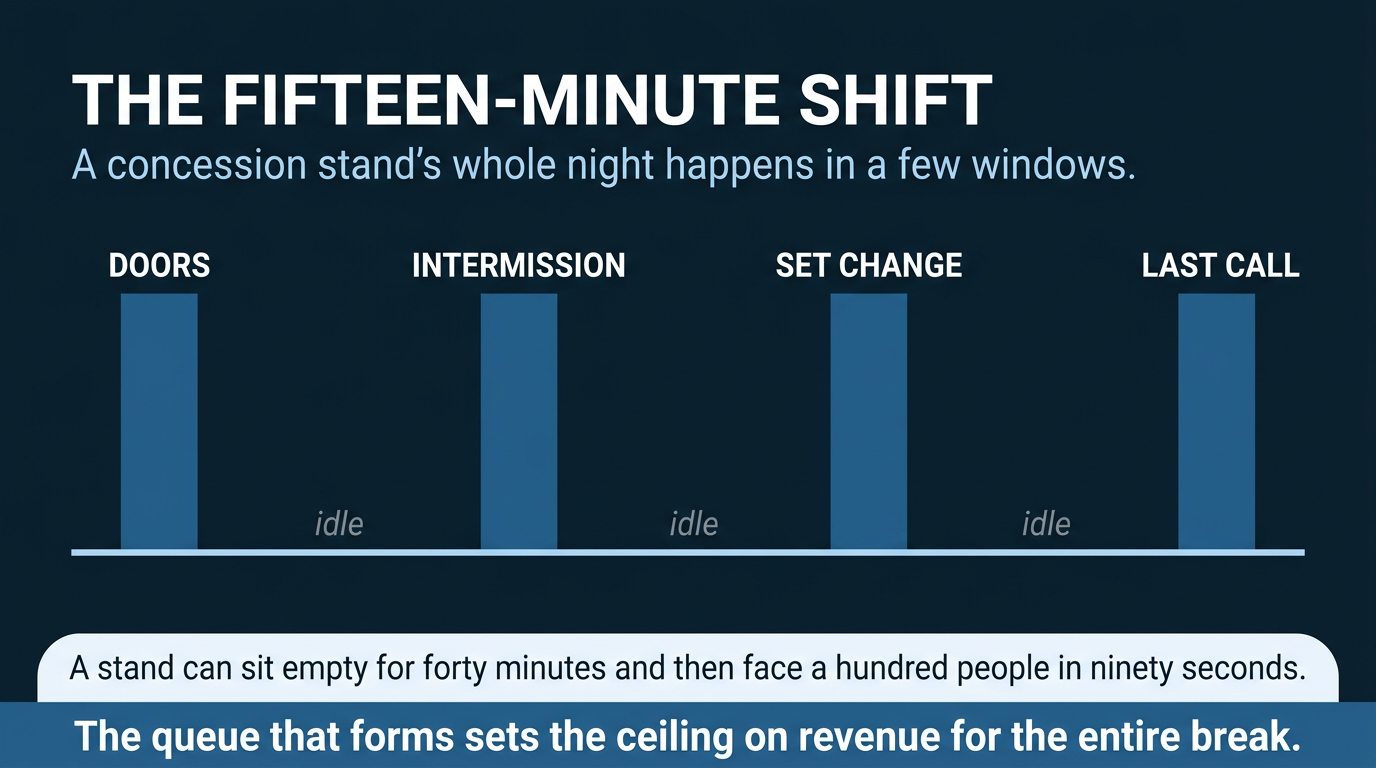
Nothing about a concession rush is gradual. A stand can sit empty for forty minutes and then face a hundred people in ninety seconds, and the queue that forms in those ninety seconds sets the ceiling on revenue for the entire break. Once the line reaches the point where a guest can see it and calculate that they will miss something, the sale is gone and it does not come back later.
This is why demos are misleading. A system that feels responsive with one operator tapping through a sample order tells you nothing about the same system with eleven registers hammering the same menu while the network is saturated by twenty thousand phones. The only meaningful evaluation happens under load, which means references from operators running comparable crowds matter more than a feature list.
One Menu, Many Stands, One Set of Rules
A stadium concourse, a festival footprint, or a multi-day fair is not one point of sale. It is dozens, often run by different crews, sometimes by entirely different businesses under one roof. Serious venue concession management means a price change, a new item, a tax rule, or a sold-out flag propagates everywhere at once, without someone walking the concourse with a clipboard.
The alternative is what most operators inherit: each stand configured on its own, each with its own version of the menu, each drifting further out of sync as the season goes on. By the time reconciliation happens, nobody can explain why the same beer rang up at three prices. A POS system for concession stand operators solves this by treating configuration as central and the stands as endpoints, which is roughly how multi-vendor event operations are structured everywhere else in the business.
Staff Who Were Hired This Morning
Concessions run on temporary labor. Volunteers, seasonal crews, and staff who met their supervisor an hour before doors are the norm, and there is no training week. The interface has to be learnable in the time it takes to walk from the staff tent to the counter, which puts a hard limit on how much configuration can live on the device itself.
That constraint pushes complexity backward into the dashboard, where an experienced manager sets it once. Anything a first-time seller has to decide at the counter, from which button is the right size to how a discount gets applied, is a decision that will be made wrong under pressure and will show up as a variance later.
How Does Concession POS Lift Per-Cap Spend?
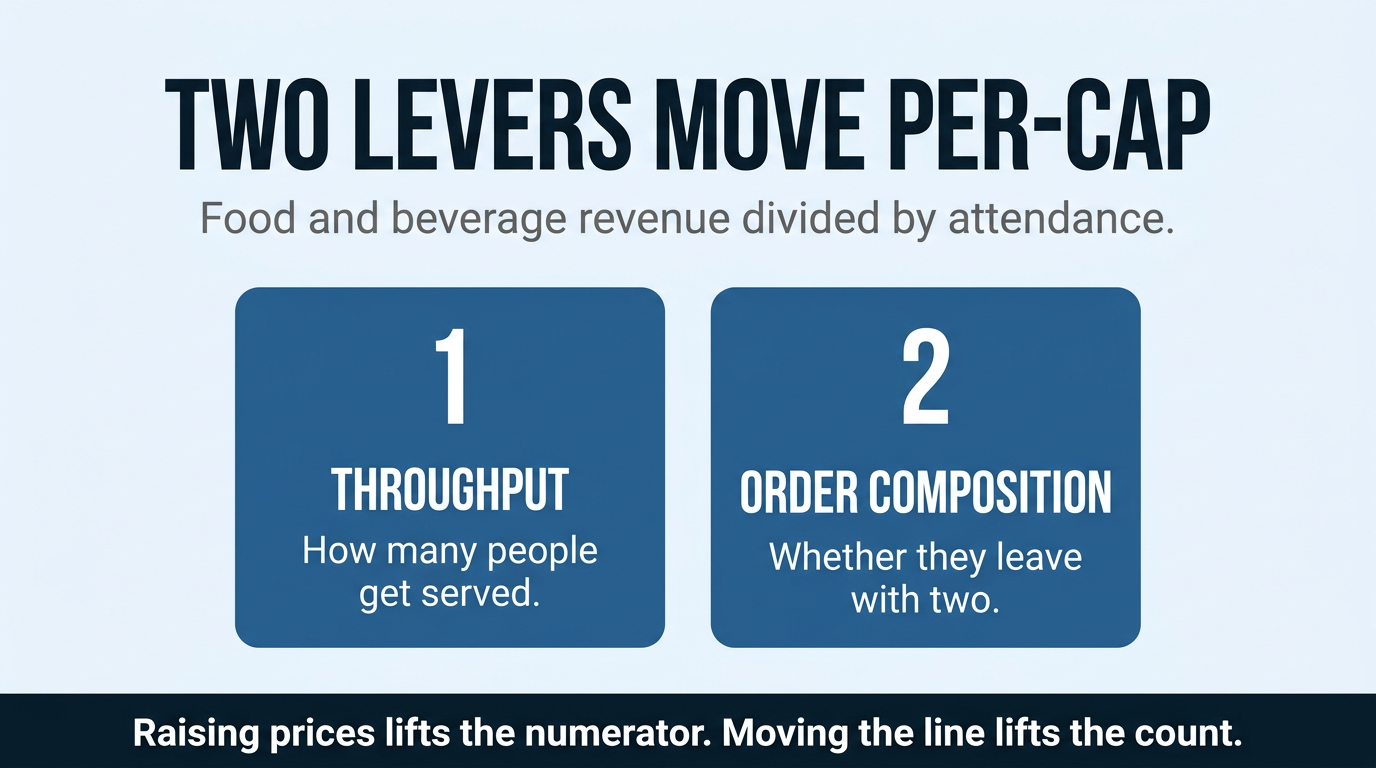
Per-cap is simple arithmetic: food and beverage revenue divided by attendance. Because attendance is fixed by the time doors open, the only variable an operator controls after that point is what happens at the counter. There are two levers, and they are not equally powerful.
Throughput Comes Before Pricing
The first lever is how many people get served. A guest standing in a line that is not moving contributes nothing, and no amount of menu engineering rescues a transaction that never happens. Every improvement that shortens the interaction, from removing a signature step to putting a second tender option in front of the guest, increases the number of people who reach the counter inside the window.
This is also why the per-cap spend concessions teams report tends to move most when a venue changes how payment happens rather than what is on the menu. Raising prices lifts the numerator on the transactions you complete. Moving the line lifts the count of transactions, and that compounds across every counter you operate. A concession POS platform earns its keep on the second effect, not the first.
The Second Item Is Where the Margin Lives
The second lever is order composition. Most concession guests arrive intending to buy one thing. Whether they leave with two depends on how the order is built, and a POS system for concession stands shapes that more than signage does. Combos that are one tap instead of three, modifiers that surface at the right moment, and item layouts that reflect what actually sells at that specific stand all shift the average ticket.
The catch is that none of this can be tuned blind. Knowing which stand is underperforming, and knowing it before the event ends rather than in a spreadsheet on Tuesday, is what makes the adjustment possible. That is the argument for live sales visibility during the event, and it is the difference between managing a night and reviewing one.
What Happens to Guests Who Only Have Cash?
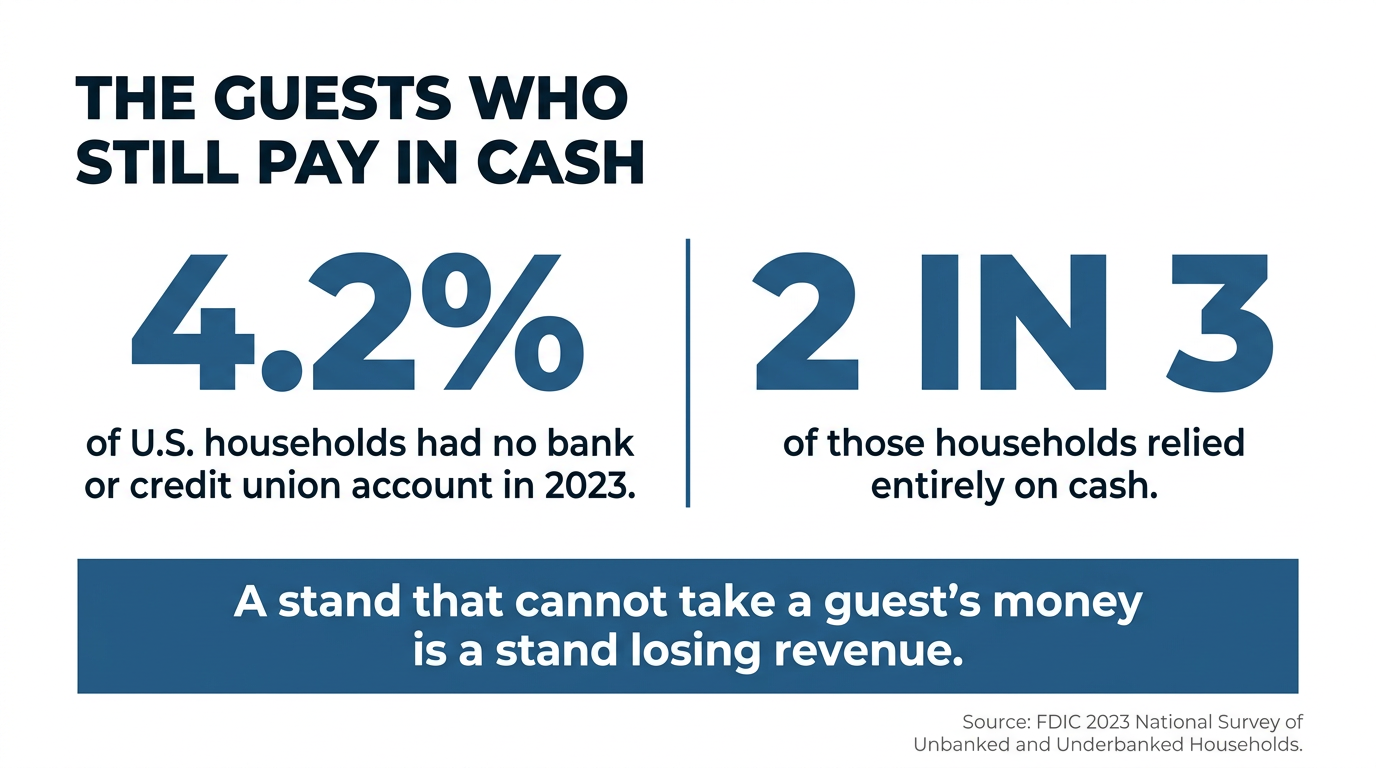
Going cashless at the stand is an operational win and a real risk at the same time. Cash handling is slow, it requires drops and counts and reconciliation, and it invites shrink. But a stand that cannot take a guest's money is a stand losing revenue, and the population that pays in cash has not disappeared.
Federal survey data puts the scale of it plainly. In 2023, 4.2 percent of U.S. households had no bank or credit union account, and two-thirds of those households relied entirely on cash, which works out to millions of people who cannot tap a card at a counter. At a general admission event drawing a broad regional crowd, some fraction of the gate falls into that group.
There is a legal dimension too. Several states and cities require in-person sellers to accept cash, and New York's statewide cash acceptance requirement took effect in March 2026. Legal analysis of that law notes it does not explicitly exclude live sporting events, and that installing a machine converting cash to a prepaid card can satisfy the requirement when the machine is free to use and functioning. Cash-to-card kiosks have become the standard industry answer for exactly this reason, and the practical questions around kiosk placement and fee structure are worth working through before a venue commits to a cashless policy.
The workable position for most concessionaires is a cashless counter with a compliant conversion path nearby. Guests who arrive with bills convert once and then move at the same speed as everyone else, staff never touch currency at the point of sale, and the venue keeps its policy defensible.
7 Questions to Ask Before You Buy a Concession Stand POS System
Vendor demos answer the questions a vendor wants asked. These are the ones that separate a concession stand POS system from a retail product with an event brochure wrapped around it.
- How long does a price change take to reach every stand? Ask for the mechanism, not the marketing answer. If the response involves touching devices individually, that is your answer for what a mid-event correction will cost you.
- What happens to a sale when connectivity drops mid-rush? Every event site has dead zones and every crowd degrades the network. Ask precisely what the device does, what the limits are, and what reconciles afterward.
- How does a new vendor get onboarded in the middle of a season? Portfolio operators add and drop food partners constantly. If onboarding requires a services engagement each time, the model does not scale to your calendar.
- What can a seller do on their tenth minute holding the device? Have someone who has never seen the system ring a modified order with a split payment. That single test predicts more about your event than the entire feature comparison.
- Who owns the transaction data if you leave? Guest purchase history is an asset. Establish now whether you can export it in full, in what format, and whether that survives the end of the contract.
- What does support look like at 11 p.m. on a Saturday? Your peak is precisely when standard business hours coverage is useless. Ask who picks up, how fast, and whether anyone can be on site.
- Can it report by stand, by device, and by operator? Aggregate revenue tells you the night was fine. Only granular attribution tells you which of your twelve stands quietly lost you money.
How Do Concessionaires Actually Get Paid After the Crowd Leaves?
The counter is only half the job. For concessionaires operating under a venue agreement, or for venues running dozens of independent food partners, the money still has to be split, documented, and moved. When a POS system for concession stands ends at the sale, that work lands on somebody's spreadsheet, and that spreadsheet is where most disputes originate and where most operator hours disappear.
Reconciliation Is a Data Problem, Not an Accounting Problem
When each stand runs its own terminal and its own merchant account, month-end becomes forensic work. Statements arrive on different schedules, fees are applied differently, and matching a vendor's claimed sales to what actually settled becomes an exercise in trust rather than verification. The fix is structural: capture every transaction in one system, tagged to a revenue center, from the moment it happens.
Once the data is unified, payouts stop being a negotiation. Each vendor sees their own numbers, the operator sees all of them, and the split follows a rule instead of a conversation. The mechanics of how money moves from a guest tap to a vendor bank account are worth understanding in detail, because settlement timing shapes vendor cash flow more than the commission rate does.
Proving Throughput to the People Who Sign the Contract
Concession contracts get renewed on evidence. A venue evaluating whether to extend an agreement wants to see per-cap by event, revenue by location, and what happened during the windows that matter. Strong venue concession management turns that from an argument into a report, and the operators who can produce it renew on better terms than the ones who cannot.
This is the practical case for treating the payment layer as infrastructure rather than a commodity. A cashless and contactless POS built for venues produces the reporting as a byproduct of doing business, which makes the per-cap spend concessions operators quote in a renewal meeting auditable rather than asserted.
FAQ
What Is a Good Per-Cap for a Concession Stand?
There is no universal benchmark, because per-cap swings enormously with venue type, event length, ticket demographic, and whether alcohol is served. A daytime family event and a late-night concert at the same venue will not produce comparable numbers. The useful comparison is against your own baseline for the same event type, tracked across multiple dates, which is why consistent measurement matters more than finding an industry average to chase.
Do I Need RFID Wristbands to Run a Cashless Concession Stand?
No. RFID is one credential among several, and plenty of high-volume concession operations run entirely on cards and mobile wallets. Wristbands become compelling when the event is multi-day, when guests are unlikely to carry a wallet, or when access control and payment should share one credential. For a single-session stadium concourse, the case is weaker.
Can a Concession Stand Legally Refuse Cash?
It depends entirely on jurisdiction. There is no federal requirement that private sellers accept cash for a point-of-sale purchase, but a growing number of states and municipalities have passed their own mandates, and the exemptions vary considerably from one to the next. Check the specific statute for every venue you operate in, because a rule that exempts sporting events in one state may say nothing about them in another.
How Many POS Devices Does One Concession Stand Need?
Work backward from the peak window rather than from the counter size. Estimate how many guests you expect to serve during your busiest break, decide how many of them you are willing to lose to the line, and staff registers to match. Most stands are underprovisioned because the count was set by how many people fit behind the counter, not by how many transactions the break actually demands.
The Stand Is the Business, Not the Sideshow
Food and beverage is often the largest controllable revenue line at a live event, and it is decided almost entirely in a handful of high-pressure minutes. A POS system for concession stand operations that treats those minutes as the design problem, rather than as an edge case, is worth considerably more than one that wins on price and folds under a rush. Speed at the counter, a compliant path for cash guests, and reporting granular enough to defend at a renewal meeting are the three things that separate the two.
Billfold builds concession POS technology for exactly this environment, with RFID wristband payments, every payment type accepted, and real-time multi-vendor reporting across every stand on the property. Talk to the Billfold team about what your next event should be capturing.
