
Cashless Event Settlement: How Vendors Get Paid Faster

Key Takeaways
Settlement is the part of your payment stack that decides how fast vendors get paid and how painful your post-event financial close is.
- Money moves in three stages: capture at the point of sale, reconciliation against vendor records, and payout to bank accounts.
- Faster payout programs compress the gap between the last transaction and the first deposit, which changes working capital for every seller on site.
- Configurable payout frequency lets one event run daily, weekly, and post-event schedules side by side instead of forcing everyone onto one timeline.
- One shared transaction record for every seller is what ends disputes. A bigger spreadsheet is not.
If your payout timeline is a mystery to your vendors, that is a design problem you can fix before the next event, not a fact of life.
The gates close, the last bar breaks down, and the money is still moving. Cashless event settlement is what happens after that, and it stays invisible right up until a vendor calls asking where their money went. Every tap at a wristband reader or card terminal kicks off a chain of clearing, matching, and disbursement that ends in somebody else's bank account. How long that chain takes, and how much manual labor it demands from your team, is a design decision somebody made months earlier.
The underlying rails have gotten faster. The ACH Network moved 1.4 billion Same Day ACH payments valued at $3.9 trillion in 2025, increases of 16.7% and 21.4% over the prior year. Speed on the rails does not automatically become speed for your vendors, though. What decides that is the event payment platform sitting between the card networks and the independent sellers working your site.
What Is Cashless Event Settlement and How Does It Work?
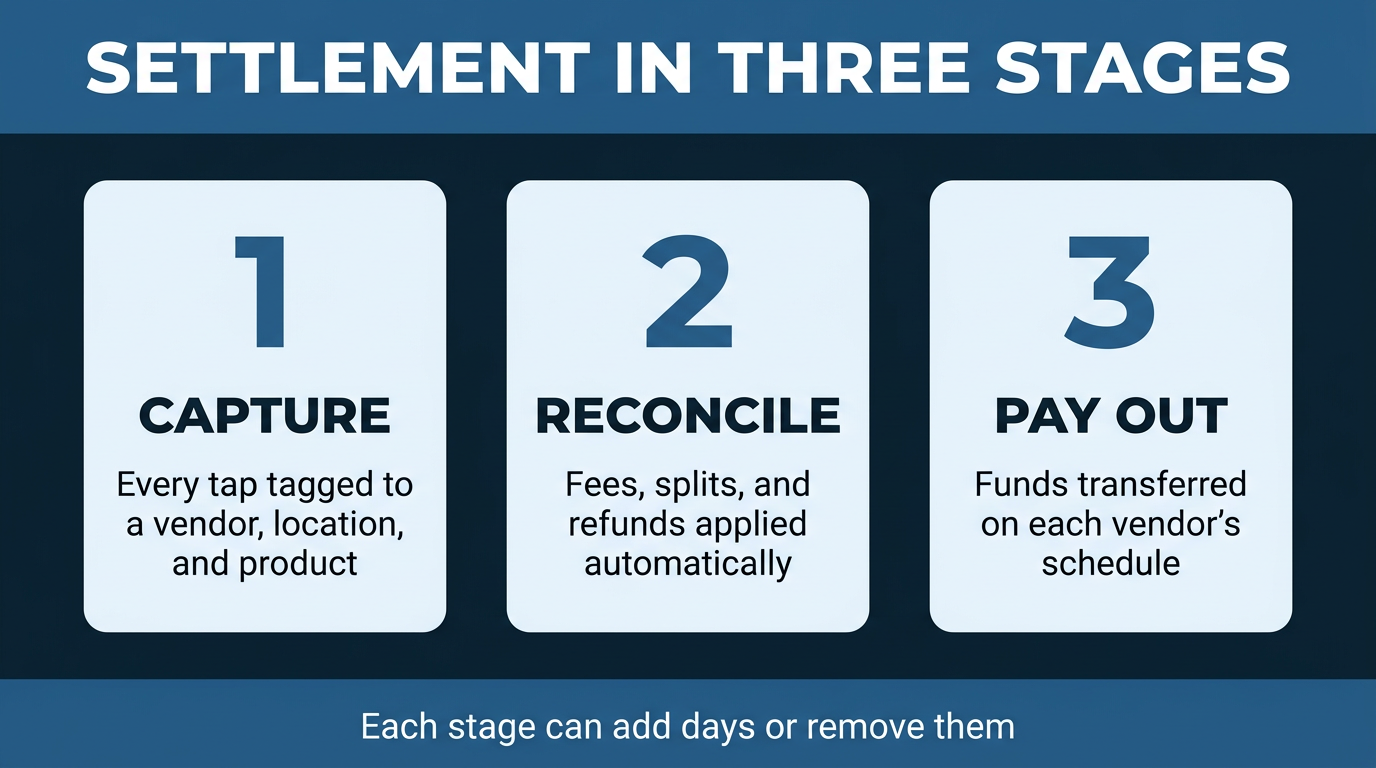
Settlement is the movement of funds from the moment a guest pays to the moment a vendor can actually spend that money. At a live event it runs through three distinct stages, and every one of them can add days or remove them depending on how the system is built.
Stage One: Capture at the Point of Sale
When a guest taps a wristband, card, or phone at a stand, the terminal records the sale and attributes it to a specific vendor, location, and product. In a closed-loop setup, the guest has preloaded a balance and the purchase draws down against it. In a direct card setup, the guest's card is linked to the credential and charged per purchase. Either way, that transaction record is the raw material for everything downstream, so the detail captured in this half-second sets a hard ceiling on how clean the rest of the process can be.
This is also where legacy setups quietly break. If half your bars run on rented terminals from one processor and your merch tent runs on something else, you have already created two datasets that a human will have to merge later.
Stage Two: Reconciliation Against Vendor Records
Payment reconciliation for events is the work of matching every captured transaction to the seller who earned it, then applying whatever fees, commissions, or revenue splits the contract calls for. Manual operations fall apart right here. When sales data lives in one system, fee schedules live in a spreadsheet, and refunds live in a third place, somebody has to stitch all of it together by hand before anyone gets paid. Platforms built for payments across multi-vendor events collapse that into a running calculation that is already correct the moment the event ends.
Stage Three: Payout to Vendor Accounts
Event vendor payouts are the final leg, where the platform initiates transfers into each seller's bank account on the agreed schedule. Timing depends on when funds settle from the card networks, when the platform releases them, and which rail carries the transfer. Instant rails have expanded fast: the RTP network passed $1.3 trillion in payments during 2025, a 428% jump over the prior year, with the round-the-clock availability that batch systems never offered.
How Do Next-Day Payouts Compare to Standard Settlement Windows?
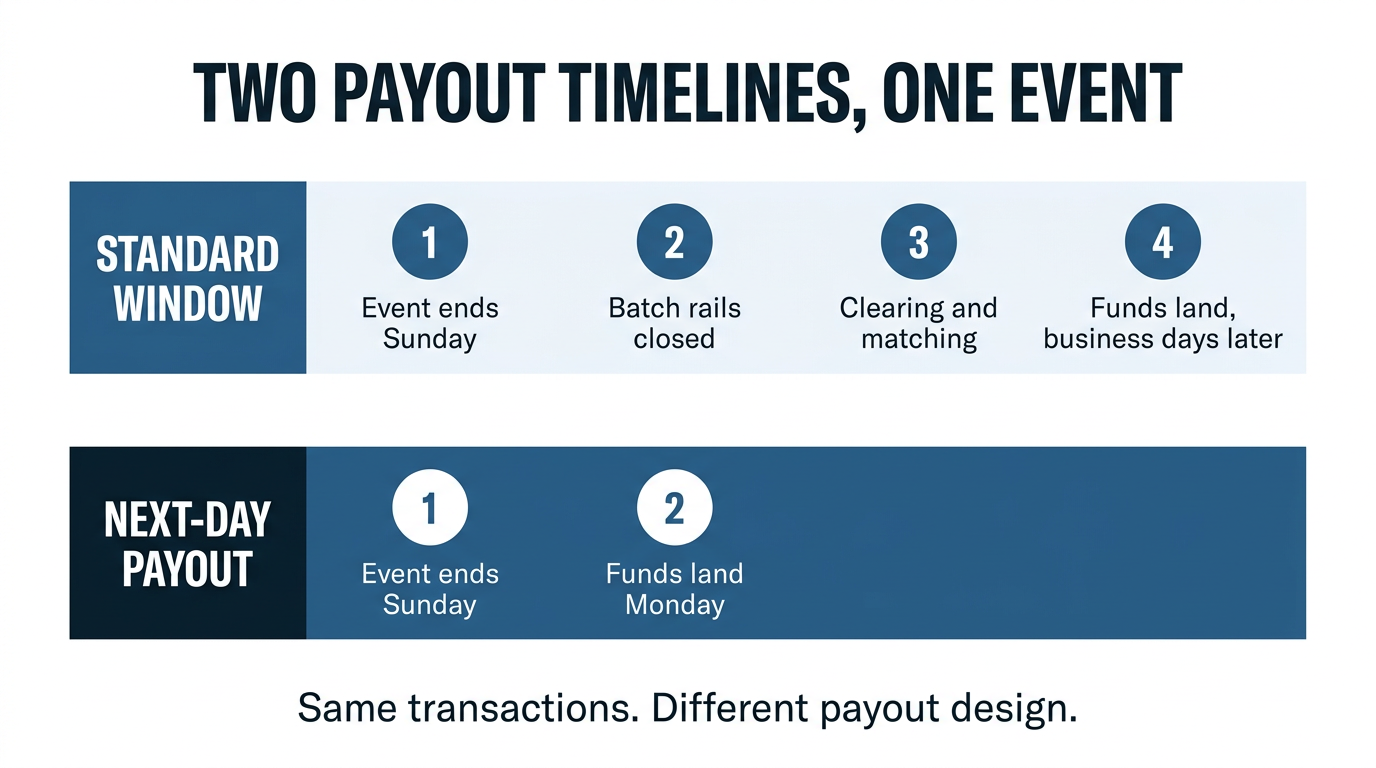
Most operators inherited a settlement window they never actually chose. It arrived with the processor, and it lands in business days rather than hours. Compressing that window is one of the highest-leverage changes available in cashless event settlement, and it costs the organizer almost nothing operationally.
What a Standard Settlement Window Costs You
A vendor who sells out on Saturday and waits until the following Thursday for funds is financing your event with their own working capital. For small food operators and independent merchants, that gap decides whether they can buy inventory for next weekend or sit it out. It also creates a support burden for the organizer, because every day of silence produces questions somebody on your team answers by hand.
Standard windows also ignore the calendar reality of live events. Festivals end on Sunday nights and holiday weekends, exactly when batch processing is closed. A gap that looked manageable on the contract stretches in practice.
What Changes When Funds Land the Next Business Day
Next-day payouts compress the distance between the last transaction and the first deposit down to a single business day. The practical value has less to do with the money itself and more to do with predictability. A vendor who knows funds will land Monday morning plans differently than a vendor hoping funds land sometime that week. Organizers who can promise a specific date also negotiate from a stronger position when they are recruiting the same vendors back for next season.
Why Does Configurable Payout Frequency Matter Across Vendors?
One payout schedule for every seller is the easy answer and usually the wrong one. A multi-day festival with dozens of food vendors, a merchandise operator, and a sponsor-run activation does not have one shared cash need, and pretending otherwise creates workarounds that finance ends up owning.
Matching Schedules to Vendor Types
Configurable payout frequency means the platform can run daily payouts for high-volume beverage stands, weekly for merchandise, and post-event for a concessionaire settling under a revenue share, all inside the same event. The operator sets the rules once and the system applies them per vendor. That flexibility matters most for event groups running back-to-back dates, where a single fixed schedule strands money between shows. Any serious cashless and contactless POS platform should treat payout rules as configuration, not as a support ticket.

Payout Programs Across Multiple Venues
Operators running a portfolio hit the same problem one level up. Each venue carries its own vendor mix, its own contract terms, and its own finance calendar. Configuring payout programs centrally and then applying them per location keeps cashless event settlement consistent without flattening the real differences between sites. It also gives finance one place to change a rule instead of chasing individual site teams.
How Does Cashless Event Settlement Reduce Disputes and Manual Work?
Disputes rarely start with bad intent. They start with two parties looking at two different numbers, each defensible inside its own system. Closing that gap is the quietest benefit of a unified payment platform, and the one your finance team notices first.
One Source of Truth for the Financial Close
When every transaction, fee, refund, and payout lives in one ledger, closing the books after an event stops being an archaeology project. Finance pulls a report instead of reconstructing the weekend from receipts. Vendors see the same figures the organizer sees, which eliminates the most common cause of post-event arguments. Real-time transaction visibility during the event means the close is largely finished before the last guest walks out.
Cutting the Paper Out of Vendor Payments
Manual payout processes lean on checks, and checks remain the most exposed instrument in business payments. Survey work from the Association for Financial Professionals found that 76% of organizations faced attempted or actual payments fraud in 2025, with checks the most targeted method at 58%. Moving vendor disbursement onto electronic rails inside the payment platform removes that exposure along with the labor of cutting, mailing, and chasing paper across a vendor list that changes every season.
7 Cashless Event Settlement Questions to Ask Before You Sign
Settlement terms are easy to skim during procurement and expensive to discover afterward. Whether you are replacing a legacy setup or working through how to implement cashless payment systems for the first time, get answers to these in writing.
- When do funds actually move? Ask for a specific day and cutoff time, not a range of business days that quietly excludes weekends.
- Which rail carries the payout? Same-day ACH, standard ACH, and instant rails have different cutoffs, different limits, and different weekend behavior.
- Can frequency vary by vendor? If every seller is locked to one schedule, your team will build the exceptions manually. Confirm this before you sign.
- Who owns the matching work? Payment reconciliation for events should apply fee and commission logic automatically, rather than handing your controller a raw export.
- What does a vendor see? Sellers with their own dashboard and their own sales data generate a fraction of the support volume that sellers in the dark do.
- How are refunds handled after payout? Refunds issued after funds have already moved need a defined offset or clawback process, in writing, before your first event.
- What does the financial close look like? Ask to see the actual report your finance team will work from, not the demo dashboard built for the sales call.
FAQ
How Long Does Cashless Event Settlement Usually Take?
It depends on the rail and the platform's release rules more than on the event itself. Standard windows run in business days after capture, while faster programs compress that to a single business day. Ask any provider for their specific cutoff times, because a Sunday night close can push a nominally short window into the middle of the following week.
What Is the Difference Between Settlement and a Payout?
Settlement is the clearing process that moves funds from the card networks into the platform's control. A payout is the transfer from there into an individual vendor's bank account. The two get quoted as one number in sales conversations, which is why vendors end up surprised. Ask for both timelines separately.
Can Vendors Get Paid Before the Event Ends?
Yes, on platforms that support daily schedules. Multi-day festivals often run daily payouts for high-volume beverage and food locations so sellers can restock mid-run without dipping into their own reserves. Whether it is available to you comes down to how flexible the payout configuration is.
How Do Refunds Affect Event Vendor Payouts?
Refunds issued before a payout is released reduce the amount transferred. Refunds issued after the money has moved require an offset against the next payout or a direct recovery from the vendor. Closed-loop systems holding prepaid balances handle guest refunds cleanly, but the vendor-side accounting still needs a defined rule.
What Should Payment Reconciliation for Events Include?
At minimum: gross sales by vendor and location, processing and platform fees, commissions or revenue splits, refunds and voids, and the net amount owed. Every one of those lines should trace back to individual transactions rather than a summary total, because summaries are exactly what disputes are made of.
Faster Money Movement Is a Design Choice, Not a Lucky Break
The rails are already fast. Whether your vendors ever feel that speed comes down to the layer above them: how transactions get captured, how reconciliation runs while the event is still live, and how payout rules were set before the first guest walked through the gate. Operators who treat that layer as an afterthought spend the week after every event answering emails about money. Operators who design it deliberately spend that week planning the next one.
Billfold builds cashless POS infrastructure for high-volume events and venues, with real-time multi-vendor reporting, automatic payouts, and payout programs you configure to fit how your events actually run. Reach out to the Billfold team to map settlement and event vendor payouts to your calendar instead of somebody else's.
