
Venue POS Systems: Managing Payments Across Multi-Vendor Events

Key Takeaways
A venue POS system designed for multi-vendor events turns a chaotic mix of independent merchants into one coordinated payment environment.
- Standard retail platforms break under the structure of an event where one venue umbrellas dozens or hundreds of independent sellers.
- Vendor onboarding, real-time fund distribution, and consolidated reporting are the three operational pillars of any platform built for this work.
- PCI DSS compliance is much harder when many merchants share infrastructure, so the platform has to carry that burden on behalf of vendors.
- Unified reporting is the actual product. Vendor-level dashboards plus venue-wide visibility lets operators make decisions during the event, not a week after.
If your event has more than ten vendors, the platform you choose is your single biggest operational lever. Pick one built for that structure, not one bolted onto it.
Multi-vendor events look simple from the audience side. Walk up to a stand, tap a card, get a beer. Behind that single transaction sits an operational structure that breaks most off-the-shelf payment platforms. The venue is responsible for revenue across dozens or hundreds of independent sellers, none of whom share the same back office, banking setup, or reporting habits. The right venue POS system is what holds that structure together. According to recent industry analysis, the global events industry was valued at $736.8 billion in 2021 and is projected to reach $2.5 trillion by 2035, with food and beverage among the largest revenue sources inside that growth.
This guide walks through how venue platforms actually function in multi vendor POS events, covering vendor onboarding, payment flow, settlement, compliance, and reporting.
What Is a Venue POS System in a Multi-Vendor Environment?
A venue POS system is the payment and operations platform that sits underneath every transaction at a venue or event. In a multi-vendor environment, that platform has to do something fundamentally different from a standard retail tool. Instead of serving one merchant with one bank account, it serves an umbrella organization coordinating many independent vendors at once.
The umbrella model explained
In the umbrella model, the venue acts as host. They license or rent the hardware, manage the network, and own the customer relationship at the door. Vendors selling food, beverages, merchandise, or services operate underneath that umbrella with their own logins, product catalogs, pricing, and sales reports, but they do not run their own payment infrastructure.
This structure exists because the alternative does not work at scale. Asking 80 food vendors to bring their own card readers, configure their own networks, and reconcile their own books at midnight is a logistical disaster.
How this differs from standard retail POS
Retail platforms assume a fixed location, a single merchant identity, and stable connectivity. Event environments assume the opposite. Hundreds of devices may need to deploy across an outdoor footprint in an afternoon. Volume may spike from zero to thousands per minute when a headliner finishes their set. The platform has to be designed for these conditions, not adapted to them.

Why Do Multi-Vendor Events Break Standard Payment Platforms?
Operators who try to scale a retail tool into this environment usually hit the same problems within hours of service.
Reconciliation becomes a nightmare
When every vendor runs their own terminal connected to their own bank account, post-event reconciliation means stitching individual reports into a venue-wide picture. With high-volume venues processing thousands of transactions per hour, that lag becomes a serious operational drag. Vendors get paid late, disputes pile up, and operators lose visibility into what actually sold.
Vendor settlement gets stuck in spreadsheets
Standard tools assume one merchant gets one payout. In an umbrella structure, the venue receives funds first and distributes them back to vendors based on individual sales, minus fees and shared costs. Without infrastructure built for this, the math gets handled in spreadsheets, which means errors, delays, and frustrated vendor relationships.
Reporting fractures
If vendors run separate systems, the operator has no real-time view of what is happening across the venue. They cannot see which stands are running low, which products are outperforming, or where lines are forming. By the time they get the data, the event is over.
How Does Vendor Onboarding Work in a Venue POS System?
Vendor onboarding is the unglamorous but critical part of running a multi-vendor venue. Done well, it gets new sellers live in hours. Done badly, it creates the kind of opening-day chaos that costs revenue.
The standard onboarding flow
Onboarding generally follows a repeatable sequence. The operator creates a vendor account with credentials and dashboard access. The vendor builds out their product catalog with pricing and modifiers. Hardware is assigned and pre-configured to the vendor's profile, so devices boot up already pointing at the right menu and deposit account. Tax rates, commission splits, and reporting permissions are set centrally.
The faster this runs, the more vendors a venue can support. The cashless payment implementation guide describes how to structure these workflows so each new vendor adds capacity instead of friction.
Roles, permissions, and access boundaries
A working onboarding model has clear role separation. The operator owns master settings: payment processing, fee structures, and global reporting. The vendor owns their store: products, pricing, and vendor-level reports. Within each vendor account, individual staff get role-based access so a bartender can ring sales but cannot pull profit reports.

What Does Payment Flow Look Like Across Multiple Vendors?
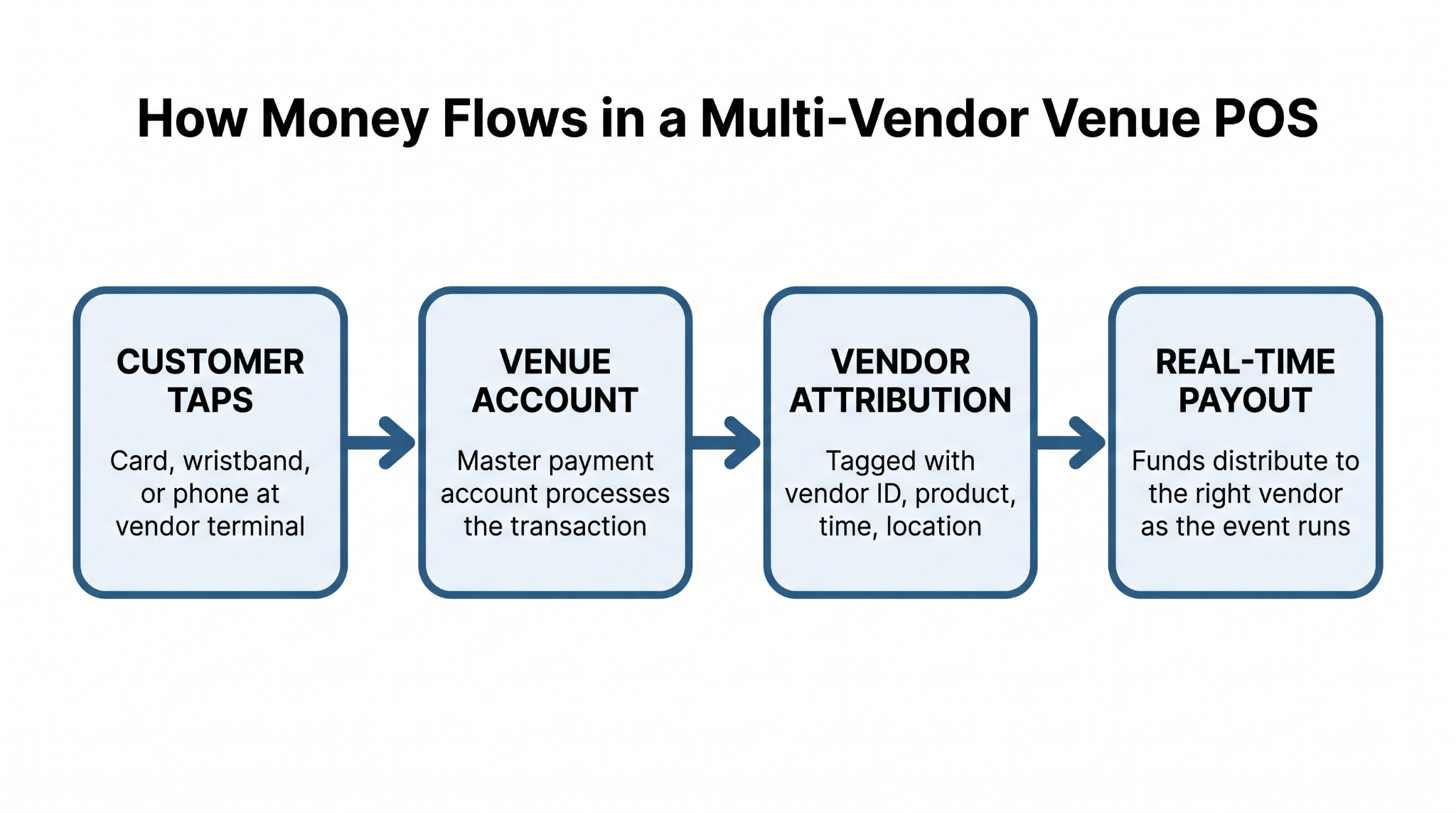
Money comes in from the customer, gets attributed to the right vendor, and gets distributed back according to the rules the venue has set.
Customer transaction to vendor attribution
When a customer taps a card, an RFID wristband, or a phone at a vendor terminal, the transaction processes through the venue's master payment account. The platform tags it with the vendor ID, the product, the time, the location, and the staff member who rang it. This metadata lets the same dollar count toward both venue-wide totals and vendor-specific earnings without double counting.
Real-time fund distribution
Older models settle vendor earnings at the end of the event. Modern platforms distribute funds in close to real time, which means vendors see their share accumulate as the event runs. Vendors who can see earnings during service are more engaged and more willing to come back next year. It also reduces the post-event finance burden.
Fees, commissions, and shared cost handling
Most venues take a percentage of vendor sales to cover hardware, infrastructure, or operating costs. The system has to handle that automatically. Configurable commission structures, tiered fee rules, and per-vendor adjustments all need to live in the platform so they apply consistently and transparently.
How Does PCI Compliance Work for Many Vendors at Once?
PCI DSS compliance is not optional for any business that accepts card payments, and the umbrella structure changes who is responsible for what.
Why multi-vendor PCI compliance is harder
The PCI Security Standards Council maintains the framework that governs how cardholder data is handled. PCI DSS v4.0.1 is the current standard, with specific requirements for any entity that stores, processes, or transmits cardholder data. In multi vendor POS events, the question of who counts as a service provider, who counts as a merchant, and where the data flows gets complicated quickly. If every vendor processes cards independently, every vendor has to validate their own compliance, which is unrealistic for small operators with no IT staff.
How the platform simplifies the picture
Well-designed platforms use a payment facilitator or sub-merchant model so vendors are not directly responsible for the underlying compliance work. The system handles encryption, tokenization, secure transmission, and approved hardware certification on behalf of every vendor. This is one of the most underappreciated value drivers in venue payment management.
5 Capabilities to Look For in a Multi-Vendor Venue POS System
Certain capabilities separate the platforms built for this work from the ones that struggle. These five are the most important to verify before signing a contract.
- Centralized vendor onboarding with self-service tools. The platform should let the operator add new vendors quickly without engineering involvement. Vendors should build their own catalogs and train their own staff inside the same dashboard the venue uses to manage them.
- Real-time payment attribution and settlement. Every transaction should map to a specific vendor in real time, and venues should be able to distribute funds without spending days on spreadsheet work.
- Unified reporting with role-based access. The operator needs a top-down view across every vendor and location. Each vendor needs a focused view of their own performance, all powered by the same data source.
- PCI compliance handled at the platform level. The provider should carry the bulk of the compliance burden. Approved hardware, end-to-end encryption, and tokenization should be standard.
- Offline transaction handling. Network connectivity at events is unpredictable. The system should queue transactions locally when the connection drops and sync them automatically when it returns.
What Reporting Do Operators Need Across Multi-Vendor Events?
Reporting is the actual product of a payment platform. The hardware accepts payments and the software processes them, but the reporting is what turns all that activity into decisions.

Real-time operational dashboards
During the event, operators need live visibility across every vendor. Sales velocity, top-selling products, average transaction value, and queue indicators all need to be visible from a single dashboard. This information lets operators open another bar, move staff from a slow location to a busy one, or adjust pricing on a slow-moving product.
Operators running large fleets benefit from device-level visibility too, including battery life, network status, and hardware health. Fleet control center capabilities describe how operators monitor thousands of devices in a single deployment.
Vendor-level performance reporting
Vendors need their own focused reports showing what they sold, when, what their fees were, and what they are owed. Reports should be exportable for accounting and clear enough to read without a finance background. Transparency reduces disputes and builds trust.
Post-event analytics for next year's planning
Hourly sales heat maps, product performance by location, and vendor performance comparisons become inputs into next year's planning. The guide to essential venue features describes how this analytics layer should be structured.
How Does Cash Use Affect Multi-Vendor Venue Strategy?
Cash usage in the United States continues to decline. According to the Federal Reserve's Diary of Consumer Payment Choice, cash accounted for roughly 14 percent of payments in 2024, with debit and credit cards continuing to dominate. Cash handling at scale is expensive, slow, and risky. Supporting the full range of contactless and card payment methods is now the baseline expectation. The strategic question is whether the platform also supports the operational structure of an umbrella environment.
FAQ
How many vendors can a single venue POS system handle at one event?
Modern platforms are built to handle hundreds of vendors and thousands of devices simultaneously. The practical limit is usually defined by network capacity at the venue and the operational maturity of the host team rather than the platform itself. Examples of how this scales across event types are covered in the best festival POS systems guide.
Can a venue POS platform pay vendors in real time during the event?
Some platforms can. Real-time fund distribution is a feature of newer venue payment management systems and is becoming a standard expectation for vendors who want visibility into their earnings during service. The exact settlement timing depends on the platform's payment processor relationships and the venue's chosen payout schedule.
What happens to multi-vendor reporting if the internet drops at the venue?
A well-designed system stores transactions locally on each device when connectivity drops and syncs the data once the connection returns. Vendors keep selling, and the reporting catches up automatically. This offline resilience is one of the most important capabilities to verify when evaluating a platform for outdoor or remote venues.
Who is responsible for PCI compliance in a multi-vendor venue setup?
In most umbrella models, the platform provider carries the bulk of the PCI DSS compliance burden as a service provider, and individual vendors operate as sub-merchants under that umbrella. This significantly reduces what each vendor has to manage on their own. The exact division depends on the platform's architecture and contract terms, so it is worth confirming the model in writing before committing.
Choosing a Platform Built for Many Vendors
Running payments across a multi-vendor event is fundamentally different from running a single retail register. Coordinating many independent sellers requires a platform built for that structure, not a retail tool stretched into a job it was never designed for. Vendor onboarding, real-time settlement, unified reporting, and platform-level compliance are the operational pillars that hold up under pressure.
Billfold builds for exactly this environment, with the vendor management infrastructure, real-time fund distribution, and unified reporting that multi vendor POS events depend on. Reach out to the Billfold team to talk through what a purpose-built setup would look like for your venue.
