
How Secure Are Contactless POS Systems for Events?

Every event organizer handling thousands of transactions per day faces the same core question: can your payment infrastructure actually protect attendee data? Secure contactless POS technology has become the frontline defense against fraud, data breaches, and revenue loss at festivals, concerts, and large-scale venues.
- The global average cost of a data breach reached $4.88 million in 2024, making payment security a financial imperative for any organization processing card data
- Closed-loop RFID payment systems offer inherent security advantages over open-loop contactless cards and cash handling at events
- PCI DSS 4.0, now fully mandatory, raises the compliance bar for every event operator accepting card payments
- Event-specific threats like connectivity disruption, high transaction volumes, and temporary staffing require purpose-built security architecture
If your event payment system doesn't address encryption, tokenization, offline capability, and PCI compliance simultaneously, you're leaving both revenue and attendee trust exposed.
Why Is Secure Contactless POS a Priority for Event Organizers?
Payment security at events operates under conditions most retail environments never face. Tens of thousands of attendees funneling through vendor lines, unstable connectivity across sprawling outdoor venues, and temporary staff with minimal training create a threat landscape that demands specialized protection. IBM's 2024 Cost of a Data Breach Report found that the average breach now costs organizations $4.88 million, a 10% increase over the prior year, with business disruption and post-breach remediation driving the spike.
For event organizers, the stakes compound quickly. A single breach during a major festival doesn't only trigger financial penalties. It erodes the trust attendees place in the entire cashless payment experience, and that trust is what drives the higher per-guest spending that makes contactless POS systems valuable in the first place. Secure contactless POS infrastructure has to perform double duty: processing transactions at speed while locking down sensitive financial data in environments where the physical and digital perimeters constantly shift.
The event POS security conversation has also shifted because of regulatory pressure. Compliance requirements no longer allow operators to treat security as an afterthought, particularly when processing thousands of card-linked transactions over a multi-day festival weekend. Understanding what protections exist, and where the gaps lie, is essential for any organizer evaluating contactless event tech solutions.
What Security Layers Protect Contactless POS Systems at Events?
Modern secure contactless POS systems rely on multiple overlapping defenses. No single technology prevents every attack vector, so effective event payment security stacks several layers that work together to reduce risk across the entire transaction lifecycle.
How Does Encryption and Tokenization Work?
End-to-end encryption (E2EE) is the first and most critical layer. When an attendee taps an RFID wristband or contactless card at a vendor terminal, E2EE ensures that payment data is encrypted at the exact moment of interaction, before it enters the operating system of the POS device. This prevents attackers from intercepting raw card data through techniques like memory scraping or network sniffing.
Tokenization adds a second layer by replacing actual card numbers with randomized token values during processing. Even if an attacker managed to compromise a transaction record, the token is meaningless outside the specific payment context that generated it. Combined with E2EE, tokenization means that sensitive cardholder data never exists in readable form on the event's local infrastructure.
For RFID-based systems specifically, the security profile is stronger than standard open-loop contactless cards. Each RFID wristband carries a unique encrypted identifier that is extremely difficult to duplicate, and organizers can instantly deactivate any compromised wristband. This closed-loop architecture, where the RFID payment system controls the entire transaction path, dramatically reduces the attack surface compared to systems relying on third-party card networks for every authorization.
What Role Does PCI DSS 4.0 Play?
PCI DSS 4.0 became the mandatory compliance standard in March 2025, representing the most significant revision to payment security requirements in over a decade. According to the PCI Security Standards Council, the new framework introduces over 60 new requirements, including mandatory multi-factor authentication for all access to cardholder data environments, enhanced vulnerability scanning, and stricter oversight of third-party service providers.
For event operators, PCI DSS 4.0 compliance means that every component of the payment chain must meet documented security standards. Organizers who outsource payment processing to a third-party provider still carry PCI DSS obligations. The standard explicitly states that outsourcing card functions does not relieve a merchant of compliance responsibility.
Event-specific challenges complicate PCI compliance further. Temporary network infrastructure, seasonal staff with system access, and multi-vendor environments all introduce variables that permanent retail locations don't typically manage. Operators evaluating event POS security should confirm that their provider handles PCI compliance comprehensively rather than shifting that burden to the event team.
How Does RFID Security at Festivals Compare to Cash-Based Systems?
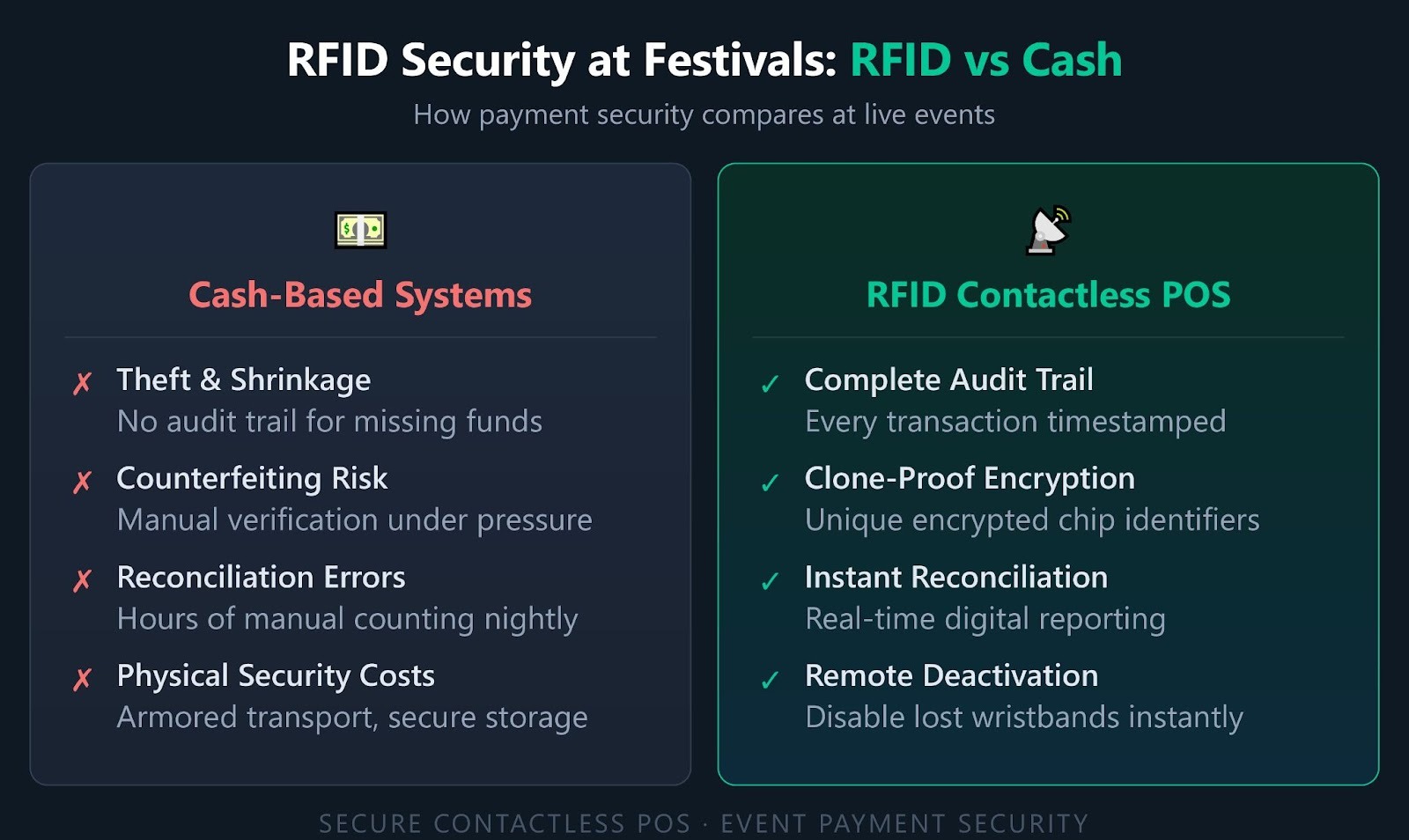
The comparison between RFID-based contactless event tech and cash handling is starker than most organizers realize. Cash introduces risks at every stage: theft during transport, miscounting at registers, counterfeit bills, and end-of-day reconciliation errors that can take hours to resolve. Security research consistently shows that cashless payment systems eliminate multiple fraud vectors that cash-heavy events struggle to control.

RFID security at festivals operates on fundamentally different principles. Each wristband transaction generates a digital record with timestamps, vendor location, and transaction value, creating a complete audit trail that makes discrepancies immediately visible. If a vendor reports a cash shortage at the end of a festival night, the investigation is often inconclusive. If an RFID transaction is disputed, the system provides exact data about when and where it occurred.
Counterfeiting highlights the gap further. Cash systems require staff to manually verify bill authenticity under time pressure. RFID wristbands use encrypted chip identifiers that are virtually impossible to clone, and any suspicious wristband can be disabled remotely without disrupting other operations.
2025 research from the University of Surrey and University of Birmingham identified vulnerabilities in open-loop EMV contactless cards, specifically around how added convenience features can create security gaps. However, these findings primarily affect standard card networks, reinforcing the advantage of closed-loop RFID systems where the event operator controls the entire payment environment.
RFID systems also eliminate the physical security logistics cash demands. Armored transport, secure counting rooms, and cash drop protocols all add cost and complexity that disappear entirely with digital payment infrastructure.
5 Security Features Every Secure Contactless POS System Needs
Not all event payment platforms offer the same level of protection. When evaluating contactless event tech for your next event, these five security features should be non-negotiable.
- End-to-end encryption with tokenization. Payment data should be encrypted from the moment of tap and tokenized before storage. Systems that store raw card data locally, even temporarily, represent an unacceptable risk for high-volume event environments.
- Offline transaction security. Connectivity drops are inevitable at outdoor festivals. A secure contactless POS must process and encrypt transactions locally during outages, then sync securely when connectivity returns without creating duplicate entries or exposing data. This resilient architecture is what separates event-grade POS from retail-grade POS.
- Role-based access controls. Temporary event staff should have limited system permissions. Vendors need access to their own transaction data but nothing beyond it. A secure contactless POS enforces these boundaries automatically, reducing the insider threat that PCI DSS 4.0 now requires organizations to address.
- Instant device deactivation. If a POS terminal or RFID wristband is lost, stolen, or compromised, the system should allow immediate remote deactivation to prevent unauthorized transactions.
- Real-time monitoring and alerting. Security teams should receive instant notifications when anomalous transaction patterns occur, such as unusually high-value purchases, rapid sequential transactions from the same wristband, or failed authentication attempts.
What Are the Biggest Event POS Security Risks?
Even well-designed systems have vulnerabilities. The primary risks to event POS security include network-based attacks during temporary infrastructure deployment, social engineering targeting seasonal staff, and physical tampering with terminals in unsupervised vendor locations.
Connectivity-dependent systems face unique exposure. When a POS terminal relies on a cloud connection for transaction authorization, any network disruption creates a decision point: refuse the transaction and lose revenue, or allow it through with reduced verification and accept higher fraud risk. Event-grade secure contactless POS systems resolve this through local encryption and offline processing, but not every provider builds this capability into their hardware.
Temporary staffing is another underappreciated vulnerability. Seasonal workers may receive minimal training on security protocols, and the high-pressure festival environment creates opportunities for social engineering that more experienced teams would recognize and deflect.
What Privacy Concerns Should Organizers Address?
RFID security at festivals extends beyond transaction protection into data privacy territory. RFID wristbands collect transaction histories, sometimes location data, and spending patterns, all tied to individual attendees. Organizers have an obligation to communicate clearly about what data is collected, how long it is retained, and who has access.
Transparency builds the trust that drives adoption. Clear privacy policies, opt-in data sharing for marketing purposes, and secure data destruction after the event window closes are practices every responsible operator should implement. Understanding how different payment technologies handle data helps organizers make informed decisions about the privacy implications of their chosen system.
How Can Event Organizers Build a Secure Contactless POS Strategy?
Building a secure contactless POS strategy starts well before the first attendee taps a wristband. Organizers should evaluate providers based on documented PCI DSS 4.0 compliance, encryption standards, offline capabilities, and the granularity of their access control systems. Requesting penetration testing results and security audit documentation is reasonable and increasingly expected.
Staff training deserves equal priority. Every vendor operator should understand basic security hygiene: recognizing social engineering attempts, reporting suspicious terminal behavior, and following proper device handling procedures. Even a 15-minute security briefing before gates open can significantly reduce the human-factor risks that technology alone cannot eliminate.
Network infrastructure planning is also part of the security equation. Redundant connectivity paths, dedicated payment networks segmented from guest Wi-Fi, and on-site technical support during event hours all contribute to a more resilient security posture. Providers offering integrated connectivity and POS solutions reduce the coordination complexity that often creates security gaps between systems from different vendors.
Post-event security practices matter too. Transaction data should be encrypted at rest and retained only for the period required by financial regulations. Access credentials issued for event staff should be deactivated immediately after the event concludes. A thorough post-event security review closes the loop and informs improvements for future deployments.
FAQ
What makes a contactless POS system secure for events? A secure contactless POS system combines end-to-end encryption, tokenization, PCI DSS 4.0 compliance, offline transaction capability, and role-based access controls. For events specifically, the system must maintain these protections under conditions of intermittent connectivity, high transaction volume, and temporary staffing.
Is RFID payment technology safer than accepting credit cards at festivals? Closed-loop RFID systems offer significant security advantages over standard open-loop credit card processing at events. RFID wristbands use unique encrypted identifiers that are extremely difficult to clone, can be deactivated instantly if compromised, and create complete audit trails.
Do event organizers need PCI DSS compliance for contactless payments? Yes. Any organization that stores, processes, or transmits cardholder data must comply with PCI DSS 4.0, regardless of whether payment processing is handled by a third-party provider. Event organizers should confirm that their POS vendor maintains current PCI compliance and provides documentation of their security practices.
What happens to attendee payment data after an event ends? Responsible operators encrypt all transaction data at rest and retain it only for the minimum period required by financial regulations. Staff access credentials should be deactivated immediately after the event, and any personal data collected through RFID wristbands should be securely deleted per the organizer's published data retention policy.
Ready to Secure Your Next Event?
Secure contactless POS is the foundation of modern event operations. The technology to protect attendee data, prevent fraud, and maintain PCI compliance at scale exists today, and organizers who implement it correctly gain both operational confidence and attendee trust. Billfold's end-to-end encrypted, PCI-compliant cashless POS platform is built specifically for the demands of live events, festivals, and venues. Get in touch with Billfold to build a payment security strategy that matches the scale of your next event.
