
Best Contactless POS Systems for Festivals and Music Events

Key Takeaways
Choosing contactless POS for festivals is an architecture decision, not a hardware purchase. The wrong call costs revenue every minute the lines are too long.
- Festival-grade systems must process payments offline because cellular networks fail at scale and Wi-Fi cannot carry the load.
- RFID wristbands outperform tap-to-pay cards on speed and reliability because the credential lives on the attendee.
- Real-time analytics turn a payment system into an operational tool that informs vendor placement, staffing, and next year's lineup.
- The cashless event payments market reached USD 7.6 billion in 2024 and is forecast to triple by 2033.
Skip the hardware spec sheet and start with a buyer's checklist. The right contactless POS for festivals matches your operational reality, not the longest feature list.
The festival economy is bigger and more competitive than it has been in years, and the operational gap between events that have modernized payments and the ones that haven't keeps widening. Attendees show up expecting to tap and go. Vendors expect terminals that don't crash. Organizers expect data that tells them what actually happened across the weekend, not a stack of cash bags to count on Monday. This is where contactless POS for festivals has shifted from optional upgrade to baseline infrastructure, and where most retail-grade systems quietly fall apart.
The market reflects that shift. Cashless payments at events reached USD 7.6 billion globally in 2024 and are projected to expand to USD 23.4 billion by 2033 as organizers across festivals, sports events, and conferences move off cash. The question is no longer whether to adopt a contactless POS. It's how to choose one that works in the specific environment of a festival.
Why Have Contactless POS for Festivals Become the Operational Standard?
Festival payment infrastructure used to be an afterthought: cash boxes, a few card readers if connectivity allowed, and hours of reconciliation when the gates closed. That model has collapsed under the weight of attendee expectations and the economics of high-volume live events.
The Shift Away from Cash Is Real and Measurable
Cash usage in the United States continues to decline as a share of total payments. According to Federal Reserve research, the share of payments made with cash dropped to 14% in 2024, down two percentage points from 2023, while card and mobile-device payments continued to grow. That trend lands hardest at festivals, where the demographic skews younger and digital-first. Attendees who tap to pay for coffee every morning don't want to fumble for bills at a beer tent.
Speed Is the Revenue Lever Most Organizers Underestimate
Every second a vendor spends counting bills is a second the line gets longer. At a festival running thousands of transactions per hour across dozens of vendors, those seconds compound into real revenue. RFID wristband taps are designed to clear in well under two seconds, which keeps the line moving and the impulse purchases coming. RFID payment systems consistently come out ahead because the credential travels with the attendee and the tap is the entire interaction.
Cash Handling Costs Quietly Eat Margin
Counting, securing, transporting, and reconciling cash takes dedicated staff, secure storage, and insurance. Multi-day festivals compound those costs across every shift. Cashless infrastructure removes that operational layer entirely, replaces it with a digital audit trail, and eliminates the most common sources of revenue leakage.
Built for Peak-Hour Traffic
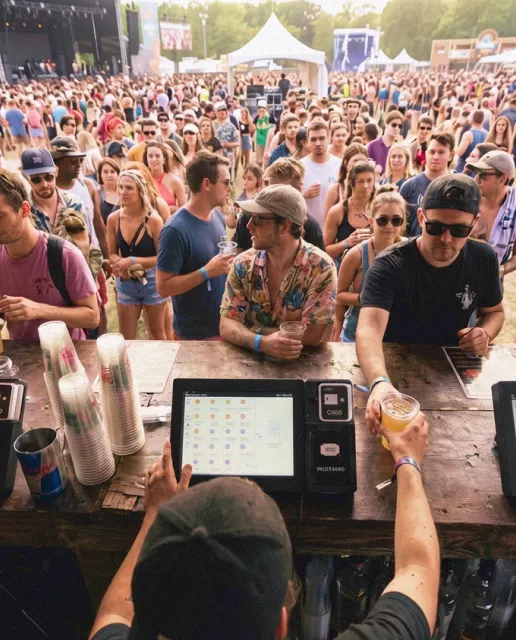
Built for high-volume festivals where speed, offline capability, and operational visibility matter most.
Explore Festival POSWhat Makes a Festival POS System Actually Work in the Field?
Most retail POS systems would not survive a Saturday night at a 30,000-person outdoor event. The conditions are different, the load is different, and the consequences of failure are different. A festival POS system has to be built for the environment.
Offline Capability Is the Foundation
Cellular networks at festivals get overwhelmed. Pop-up Wi-Fi can't handle thousands of simultaneous transactions. Any system that requires a live connection to authorize each payment will go down at some point. Closed-loop RFID systems sidestep this by storing balance information on the wristband chip and processing transactions locally. Sales continue uninterrupted during outages and sync to the central system when connectivity returns. Event payment terminals built on this architecture consistently outperform retail-grade contactless hardware at outdoor events.
Hardware Has to Survive the Environment
Heat, dust, rain, sticky bar counters, drops onto pavement. Festival POS hardware faces conditions that would destroy a typical retail terminal in a weekend. Battery life matters when shifts run long. Weather resistance matters when the bar tent is open-air. Hot-swappable hardware matters when something goes wrong on the busiest night.

Real-Time Analytics Turn Payments Into Operational Intelligence
A POS system that only processes transactions leaves most of its value unused. Real-time dashboards show which vendors are busiest, which products are selling fastest, and where bottlenecks are forming. That information lets organizers respond on the fly: open another bar, reroute traffic, redirect staff. After the event, the same data informs vendor mix, layout, and pricing for the following year.
7 Questions Every Buyer Should Ask Before Choosing an Event Payment Terminal
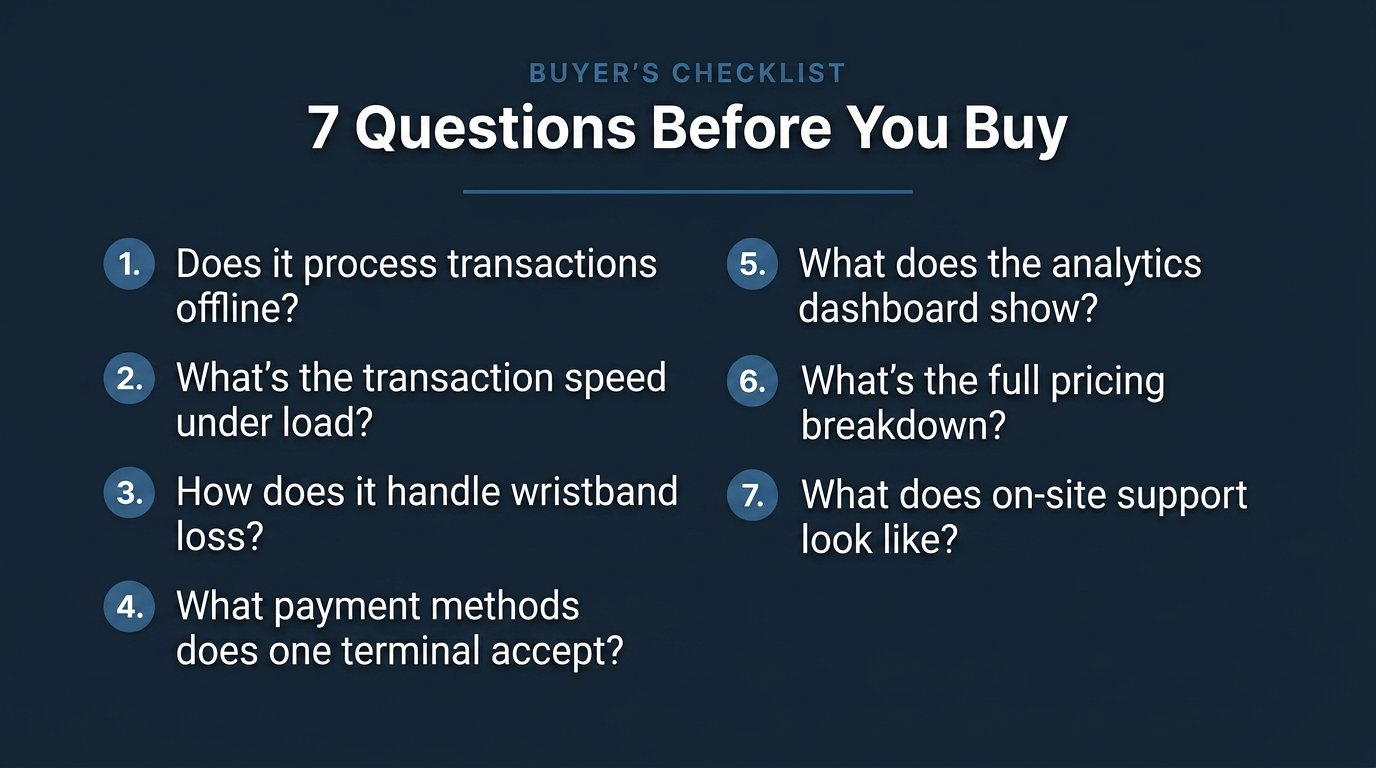
This is the practical checklist for evaluating contactless POS for festivals. If a vendor can't give clean answers to these seven questions, that's the answer.
- Does your system process transactions offline? If the answer involves caveats about cellular boosters or Wi-Fi requirements, the system is not built for festivals. True offline capability means transactions clear without any connectivity at all.
- What's the average transaction speed under load? Speed in a demo is not speed at peak. Ask for performance data from comparable events with comparable transaction volumes.
- How does the system handle wristband loss? There needs to be a clear protocol: instant deactivation, replacement, balance transfer. If the answer is vague, attendees will lose money and your customer service team will pay the price.
- What payment methods does a single terminal accept? RFID, NFC, mobile wallets, traditional cards, and a fallback for cash conversion. One device should handle all of them.
- What does the analytics layer actually show? Ask to see the dashboard. Per-vendor performance, peak time analysis, and product velocity should be visible in real time, not buried in a post-event export.
- How is the system priced? Hardware rental, software licensing, per-transaction fees, wristband costs, support staffing. Get the full breakdown for the first event and renewal terms.
- What does on-site support look like? For high-volume events, on-site staff with hardware spares is the difference between a hiccup and a crisis.
How Should You Evaluate Vendors Beyond the Feature List?
Feature lists from competing vendors look almost identical on paper. The differences only show up under load. Use this framework to cut through the marketing and assess what a system will actually do at your event.
Look at Comparable Deployments
Ask for references from events of similar size, format, and connectivity profile. A system that handles a 5,000-person indoor venue is not necessarily one that handles a 40,000-person desert festival. Talk to operators who have run multiple events on the platform.
Test the System Under Realistic Conditions
A controlled demo at a vendor office is the lowest-fidelity environment imaginable. If a serious deployment is on the table, push for a pilot at a smaller event or a stress test that simulates peak load and poor network conditions.
Evaluate the Operational Partnership
Festival payment infrastructure is more than a software-as-a-service relationship. It's an operational partnership that runs through the most critical hours of the year. The vendor's onboarding process, training, and on-site response are as important as the platform itself. Confirm that integration with event technology connects out of the box with ticketing, access control, and accounting tools you already use.
RFID Wristbands or Tap-to-Pay Cards: Which Wins for Music Events?
Both technologies fall under the contactless POS umbrella, but they solve different problems. Understanding the distinction matters when deployment scale starts climbing.
How Tap-to-Pay Cards Work in a Festival Context
NFC payments using contactless cards or mobile wallets work at very close range and require bank authorization on every transaction. That authorization needs a live connection. In a retail store, that's not a problem. In an open field with 30,000 people on the same cell tower, it absolutely is.
Why RFID Wristbands Outperform at Scale
Closed-loop RFID systems write balance data directly to the chip, so transactions clear locally without any external authorization. The wristband is durable, waterproof, and impossible to lose in a pocket. Attendees can preload funds online before arrival or at top-up kiosks during the event, which is the architecture behind the most reliable festival POS system deployments at major outdoor festivals.
Hybrid Approaches Are Increasingly the Right Answer
Most experienced operators use both. RFID wristbands handle in-event purchases on the closed loop. Open-loop card and mobile-wallet payments handle ticketing, top-ups, and accessibility. The combination keeps speed up where it matters and friction down for attendees who prefer their existing payment methods.

How Does a Modern Contactless POS Handle Security at a Festival?
Payment security at a festival has two angles: protecting attendee payment data and protecting event revenue from fraud or shrinkage. A well-built contactless system improves both at once.
Encryption and Tokenization Are the Baseline
Modern contactless payments rely on encryption and tokenization to protect cardholder data. Industry security standards require that sensitive payment information never be stored or transmitted in cleartext, and that contactless acceptance solutions undergo formal validation. Festival POS platforms built on these standards inherit that security posture by default.
Closed-Loop Architecture Adds Another Layer
RFID wristbands in a closed-loop system don't carry actual payment credentials. They carry a unique identifier linked to a balance held in the platform. If a wristband is lost or stolen, it can be deactivated instantly and the remaining balance transferred to a new device. Clear pre-event communication about this protocol prevents attendee panic when a wristband goes missing.
FAQ
What's the difference between contactless POS and cashless POS at a festival?
They overlap heavily but aren't identical. Contactless POS refers to the payment method: tap, wave, or wristband scan instead of swipe or insert. Cashless POS describes the operational model: an event that doesn't accept physical currency. Most modern festival systems combine both.
Can a contactless POS work at an outdoor festival without reliable internet?
Yes, if it's built for it. Closed-loop RFID systems process transactions offline by storing balance data on the wristband chip. Sales continue during connectivity outages and sync to the central system when networks return. Open-loop card systems that require live bank authorization will struggle in this environment.
How long does it take to set up a contactless POS for a festival?
Most providers can deploy hardware and software within a few weeks for a small event, but a proper rollout for a mid-size or large festival should start six months out. The timeline is driven less by technology and more by vendor training, attendee communication, and integration.
What happens to money left on a wristband after the festival ends?
Quality systems include a refund mechanism for unspent balances, typically processed digitally within a defined window after the event closes. Some events also allow attendees to spend the balance on merchandise or charitable donations before refunds are processed.
Are contactless POS systems worth the cost for smaller festivals?
It depends on transaction volume, not headcount. The math turns favorable as soon as the operational savings from cash handling and the revenue lift from faster transactions clear the implementation cost, which often happens within a single event cycle.
Picking the Right Contactless POS Is About Architecture, Not Brand
The best contactless POS for festivals is the one whose architecture matches the operational reality of live events: offline-capable, durable, fast, and built for the data that turns a payment system into a strategic asset. That's a different evaluation than choosing retail hardware, and the providers who actually understand festivals are the ones who can answer the buyer checklist without flinching.
Billfold builds contactless POS infrastructure designed specifically for festivals, music events, and high-volume venues, with closed-loop RFID, real-time analytics, and offline reliability built into every deployment. Reach out to the Billfold team to map a payment architecture to your event.
