
How Cashless Payments Lift Concession Per-Cap Spend
Key Takeaways
Cashless payments raise concession per-cap spend by removing the three things that hold it down: slow lines, the cash a guest happens to carry, and hesitation at the upsell.
- Per cap is food and beverage revenue divided by attendance, and it is the number concessionaires get graded on at renewal.
- Nebraska's Memorial Stadium grossed $6 million in concessions in its first cash-free season, up from $4.5 million across the same seven home games.
- Cash-to-card conversion keeps cash-carrying guests buying instead of turning them away at the counter.
- Stand-level reporting turns a per-cap gain into a number an operator will sign off on.
Treat a cashless rollout as a revenue program with a measurement plan attached, and the lift stops being anecdotal.
Ask a concessions director which number they get graded on and the answer comes back instantly: per cap. Food and beverage revenue divided by attendance, tracked event over event, compared against last season, and written into the renewal conversation. Concession per-cap spend is the scoreboard, and everything else is commentary on it.
What gets underestimated is how much of that number is decided at the counter. When the University of Nebraska turned Memorial Stadium cash-free, concessions grossed $6 million in 2024 against $4.5 million the prior season, across an identical seven-game home schedule. That is a payment change, not a menu change. The systems behind that shift are built to move crowds, and their effect on concession per-cap spend shows up in the ledger.
What Is Concession Per-Cap Spend and Why Do Operators Obsess Over It?
Per cap survives as the default metric because it strips out the one variable nobody controls. Attendance swings with weather, opponent, and luck. Dividing revenue by heads makes an inconsistent business comparable week to week and venue to venue.
How the Number Is Calculated
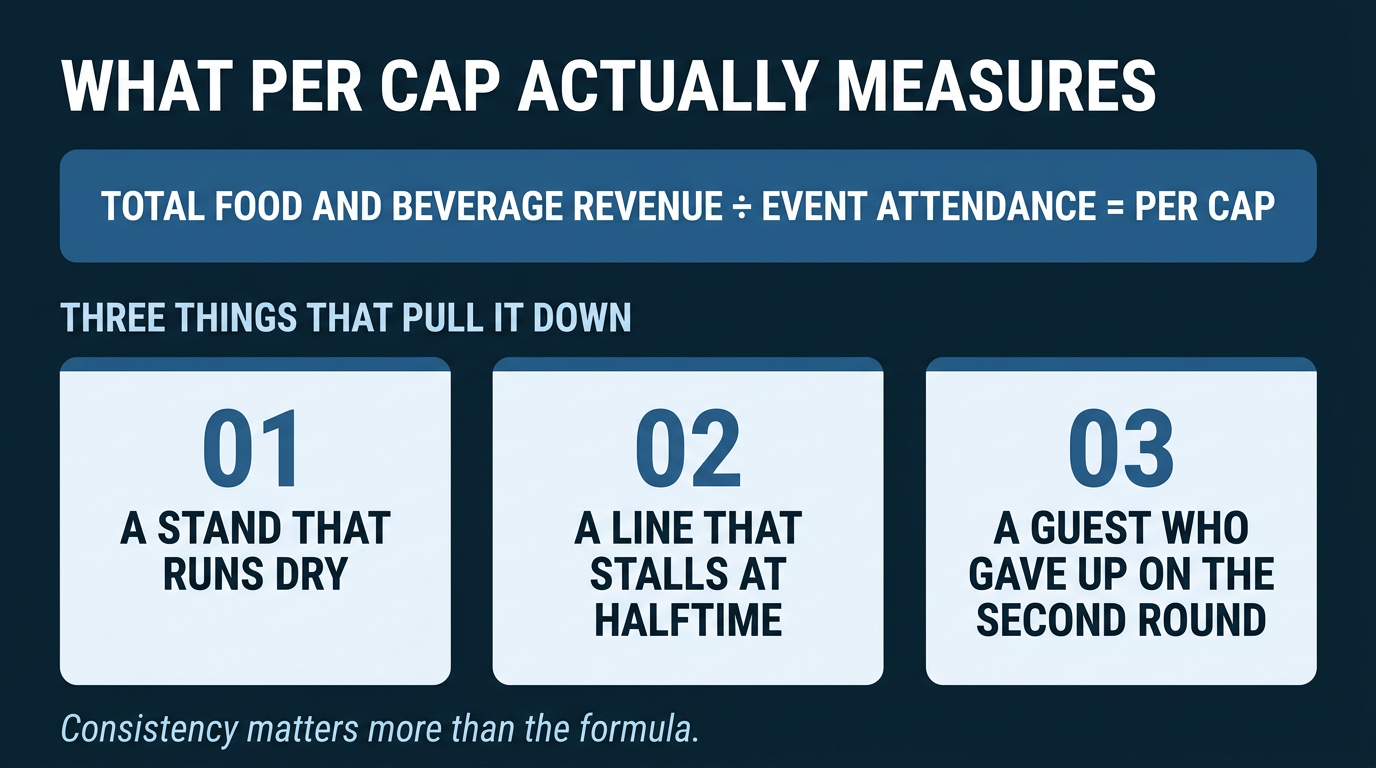
Total food and beverage revenue for an event, divided by paid or scanned attendance. Some operators run it gross, some net of taxes, some split it so beer per cap sits beside food per cap. Consistency matters more than the formula, because the value comes from comparing the number against itself over time.
It is also unusually honest, punishing every failure mode at once: a stand that runs dry, a line that stalls at halftime, a guest who wanted a second round and gave up. That is why the per cap spend concessions teams review weekly doubles as a proxy for operational health, not a plain sales figure.
Why Concessionaires Live and Die on It
Concession contracts are usually built on commission against gross sales, which indexes operator and venue to the same number. Pressure to modernize payments therefore comes from the concessionaire more often than the building, because the operator carries the cost of slow lines and captures the upside of fast ones. A sporting event POS system that clears a halftime rush is a direct margin lever for whoever runs the stands, so concession cashless conversion usually gets championed from that side of the contract.
How Does Concession Cashless Conversion Increase Concession Sales?
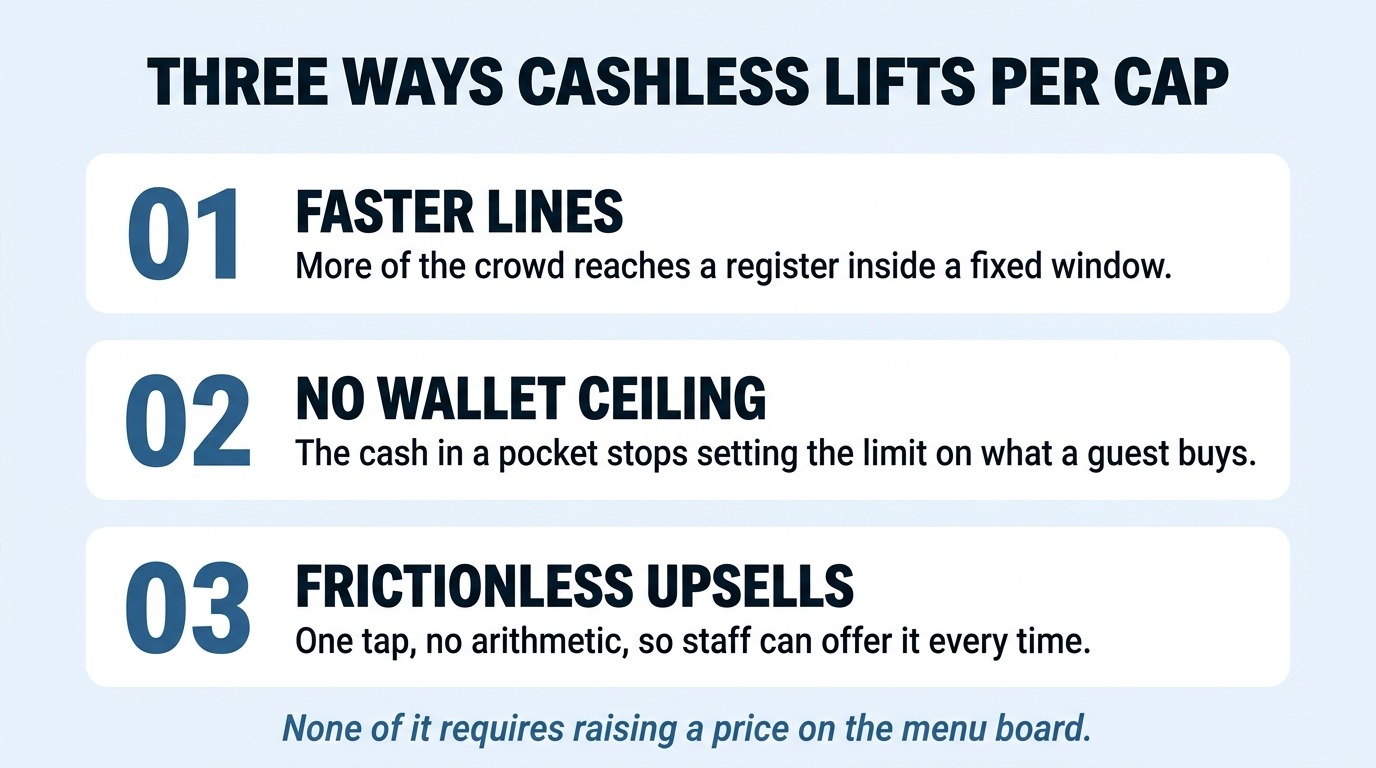
Three mechanisms do most of the work, and they compound. None require raising a single price on the menu board, which is what makes the argument land with finance teams.
Faster Lines Convert More of the Crowd
Concessions revenue is capped by a clock nobody negotiates with. Halftime runs about thirteen minutes, and a festival set change might give you twenty. Inside that window the constraint is how many guests one register can clear, and cash is the slowest way to clear one. Remove it and the same stand serves more people without a square foot of extra build. The guests you recapture are the marginal ones who eyed the queue and walked, which is how you increase concession sales without changing what is being sold.
The Cash in a Pocket Stops Being the Ceiling
A guest carrying two twenties has a hard limit of forty dollars, and in practice they spend less, because nobody wants to leave with an empty wallet. Every decision inside the building gets rationed against that number: the second beer becomes a maybe, the souvenir cup a no. Card and contactless payment removes the ceiling, and the decision reverts to whether the guest wants the thing. A meaningful share of cashless concession revenue comes from that shift, and it reaches every guest rather than only the ones stuck in long lines.
Upsells Land Differently When Nobody Is Counting Bills
Add-on offers work poorly in cash environments because they create arithmetic. A guest asked to upgrade to the large or add a pretzel has to check their wallet, calculate change, and decide while a line waits, so most default to no. On a card transaction the add-on is one tap and the math is invisible, so staff can offer it consistently. That small behavioral difference, repeated thousands of times per event, lands directly in concession per-cap spend.
What Does the Evidence on Cashless Concession Revenue Actually Show?
Published venue-level results are rarer than vendor claims suggest, which is exactly why the ones that exist deserve careful reading.
Nebraska is the cleanest recent example. Memorial Stadium went card-only in late August 2024, and the season that followed produced a 33% increase in vendor gross across the same number of home dates, per athletic department figures. The athletic director credited the change with shorter waits for food and drink.
Read it honestly and that is a revenue result rather than a controlled experiment, since attendance, menu, and pricing can all shift between seasons. What it establishes is direction and magnitude at a real venue rather than a vendor estimate, which is the standard worth holding any benchmark to before it goes anywhere near a pro forma.
Five Levers That Move Concession Per-Cap Spend
If you are building the business case, these are the variables worth isolating, roughly in order of impact.
- Throughput per register at peak. Measure transactions per minute at your busiest stand during the busiest fifteen minutes, not the event average.
- Payment coverage at every point of sale. A satellite bar that takes one payment type turns away guests who never complain, they simply do not buy.
- Cash conversion at the entry point. Count how many guests arrive with bills and how many actually convert, because unconverted cash is spend that never enters the system.
- Preloaded and prepaid balances. Value loaded before doors open is money already committed to the venue, which raises the floor before the first transaction clears.
- Stand-level visibility during the event. Reporting that arrives after load-out cannot move staff to a backed-up line, so judge a system on what it shows you mid-event.

What Happens to Guests Who Only Carry Cash?
This objection kills more cashless proposals than any other, and it deserves a real answer. A cash-only guest at a card-only counter is a lost sale and a bad experience in the same moment.
Cash-to-Card Conversion Keeps Those Guests Buying
The population that genuinely cannot pay by card is small and specific. The FDIC found that 4.2% of U.S. households were unbanked in 2023, and that about two-thirds of them relied entirely on cash. Reverse ATM kiosks answer that by taking bills and issuing a prepaid card the guest can spend anywhere in the building. The economics of cash to card kiosks at venues depend on whether the platform behind them accepts that card at every stand and reconciles the spend cleanly.
Cash Acceptance Laws Are Getting Stricter
Regulation shapes deployment decisions too. New York enacted a statewide cash acceptance law that took effect in March 2026, requiring retail establishments and food sellers to accept cash in person and barring higher prices for cash payers. The statute does not carve out live sporting events the way similar laws elsewhere do.
It does provide a path. A reverse ATM counts as compliance, provided the required deposit is a dollar or less, no fees hit the card, and the funds never expire. The machine has to be working, so any concession cashless rollout should confirm the rules in every jurisdiction.
How Do You Prove the Per-Cap Lift to an Operator?
A revenue gain nobody can attribute is a gain nobody funds twice. The reporting layer separates a payment upgrade that gets renewed from one that gets second-guessed at budget time.
Measure by Stand, Not by Building
A venue-wide number hides everything useful. Two stands can post identical totals while one runs at capacity and the other quietly fails. Break the figure out by location, category, and time slice, and the story becomes actionable. That granularity is also what lets you defend causation: if the number rose at every stand that converted and stayed flat at the two that did not, you have an argument. Real-time transaction tracking makes that comparison available during the event rather than three weeks later.
Tie Revenue to Vendors as It Happens
Multi-vendor concourses complicate this, because per cap means little if you cannot attribute each transaction to the right seller. Platforms built for managing payments across multi-vendor events map every sale to a specific vendor and terminal as it clears, which turns settlement into a query rather than a week of spreadsheet work.
That attribution produces the per cap spend concessions operators can defend at the negotiating table. When a vendor disputes their share, the answer is a report. When a venue asks whether the investment paid back, the answer is a baseline comparison, and concession per-cap spend stops being a talking point.
Frequently Asked Questions
What Counts as a Good Per Cap at a Stadium?
There is no universal benchmark, because per cap varies by sport, venue size, market, alcohol policy, and event type. The number that matters is your own trend against comparable events at the same property.
Does Going Cashless Really Increase Concession Sales or Do People Just Spend Faster?
Both, and the split matters for forecasting. Throughput gains show up as more transactions per hour, while the removal of the cash ceiling shows up as a larger average basket. Pull those two apart in your reporting, because a venue that already clears its lines quickly will see most of its gain from basket size instead.
Do We Have to Stop Accepting Cash to Get the Lift?
No, and in a growing number of jurisdictions you legally cannot. The revenue mechanisms come from making digital payment fast and available everywhere, which works whether or not a cash lane exists. Most venues capture the bulk of the benefit while keeping a conversion option.
How Soon Should We Expect the Numbers to Move?
The throughput effect shows up at the first event, since it is a mechanical result of faster transactions. Behavioral changes like larger baskets stabilize over a few events as staff settle in. Set your baseline before the rollout and compare against the same event type.
Concession Per-Cap Spend Is a Payments Problem Before It Is a Menu Problem
Most efforts to lift per cap start with the product: new items, premium builds, sharper pricing. Those help. They also arrive after the guest has decided whether the line is worth joining and how much cash to break. The payment layer sits upstream of all of it.
The venues seeing the clearest gains build the measurement in from day one. They convert cash at the door, accept every payment type at every stand, and report by location so the gain survives scrutiny instead of resting on assertion.
Billfold builds the cashless and contactless POS infrastructure behind that kind of operation, with RFID wristband payments, prepaid balances, multi-vendor management, and real-time reporting for high-volume crowds. See how the cashless and contactless POS platform fits a concessions program, or reach out to the Billfold team to map a deployment to your venue.
