
Real-Time Contactless Transaction Tracking for Live Events
Key Takeaways
Real-time contactless transaction tracking turns every tap, scan, and wristband swipe into live operational intelligence operators can act on before the event ends.
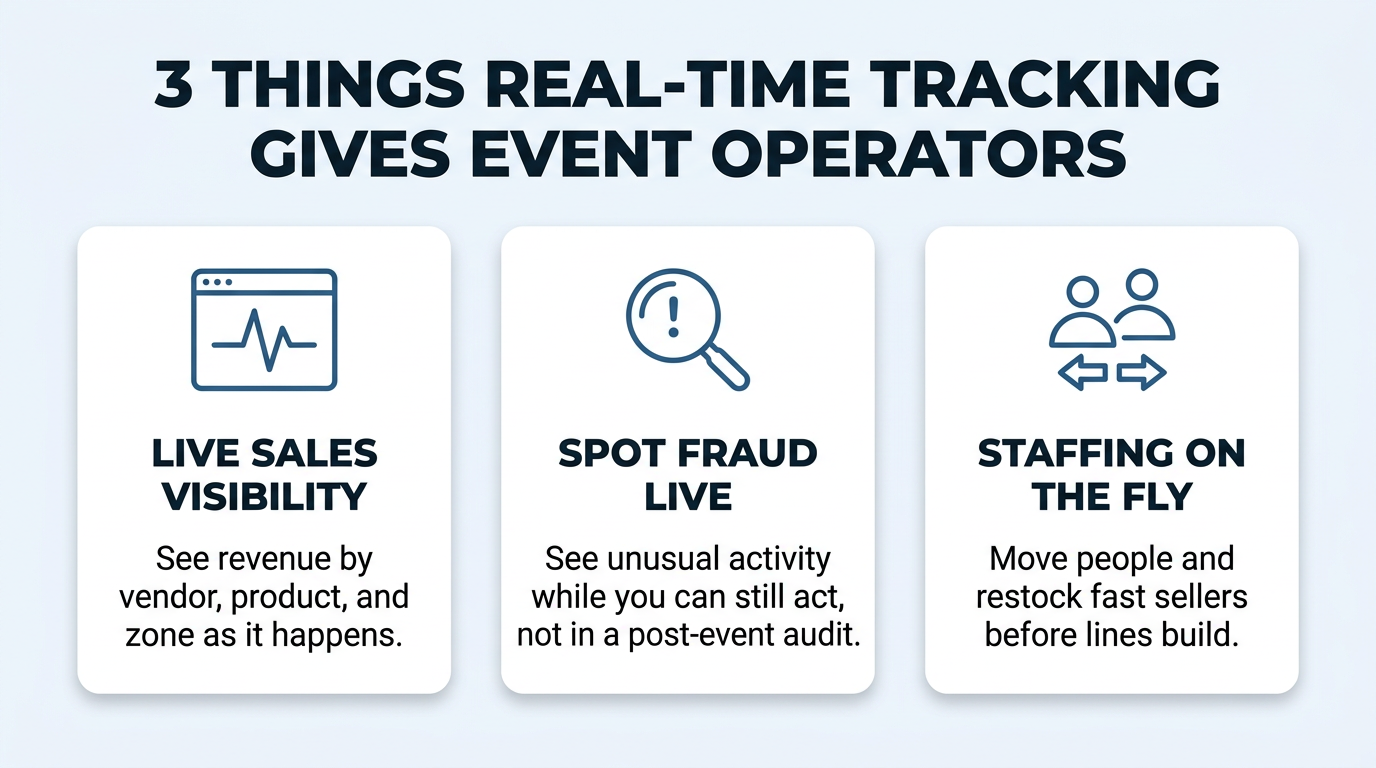
- Live dashboards show which vendors are selling, what is moving, and where bottlenecks are forming while the event is still happening.
- Real-time sales tracking lets operators reposition staff, restock fast sellers, and adjust on the spot instead of reacting the next morning.
- Live anomaly detection flags unusual patterns the moment they appear, shrinking the window fraud has to do damage.
- Closed-loop contactless systems capture first-party data that bank and processor reports never hand back to the operator.
If your payment system only tells you what happened after the gates close, you are running your event blind.
A mid-size festival can push tens of thousands of payments through its bars and food stalls in a single afternoon. Every one of those taps is a decision point: which vendor is slammed, which product is about to sell out, which line is backing up. The trouble is that most operators only learn the answers once the event is over, when the numbers finally reconcile. Consumers have moved decisively toward tapping a card or phone to pay, with mobile payments climbing year over year, and the payment hardware at live events has quietly become one of the richest live data sources on the floor.
Real-time contactless transaction tracking is what turns that hardware into a control room. The gap between a system that merely records transactions and one that surfaces them live is the difference between hindsight and command. This guide breaks down how real-time contactless transaction tracking works at events, why operators are prioritizing it, and what separates a genuine live monitoring platform from a terminal that just batches data overnight.
What Is Real-Time Contactless Transaction Tracking?
At its core, this is the live capture, processing, and display of every contactless payment as it happens, rather than in an end-of-day summary. The real-time part is the differentiator. Plenty of systems collect transaction data. Far fewer make it visible while you can still do something about it.
How Does Live Tracking Actually Work During an Event?
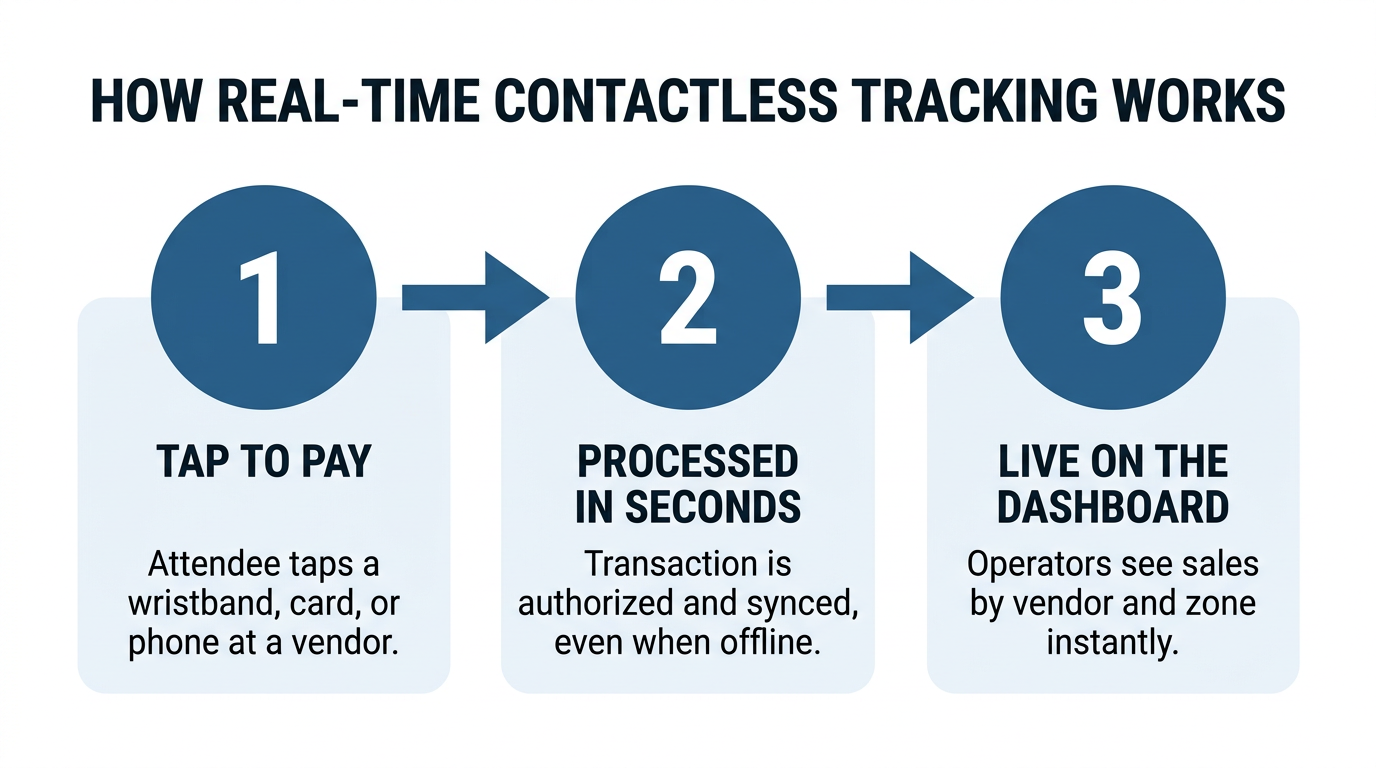
When an attendee taps a wristband, card, or phone at a vendor stand, the terminal authorizes the purchase and writes the transaction to a central system within seconds. At high-volume events, closed-loop setups keep processing payments even when connectivity drops, then sync the moment the network returns.
The same feed powers operator dashboards, vendor reporting, and top-up kiosks at once, so the picture stays consistent everywhere it appears. The result is a continuously updating view of sales across every location. Operators watch revenue accumulate by vendor, by product, and by zone on a single screen instead of waiting for a stack of nightly reports. That live feed is the engine behind real-time contactless transaction tracking, and it only works when capture, processing, and display are tightly connected.
What Makes It Different From a Standard POS Report?
A standard point-of-sale report is a rearview mirror. It tells you what sold yesterday. A real-time sales tracking POS collapses that delay to near zero, so a spike in beer sales at the north stage shows up while the stage is still packed. That immediacy is what converts payment data from an accounting artifact into an operational tool. For a closer look at how these systems fit alongside ticketing, access control, and inventory, see our breakdown of integrating contactless POS with event technology.
Why Do Event Operators Need Live Transaction Visibility?
Visibility is not a vanity metric. At an event, the cost of not knowing compounds by the minute, because the window to act on any given problem closes the moment the crowd moves on.
How Does It Protect Revenue While the Event Is Live?
Contactless payment is no longer a niche convenience. The global contactless payment market already measures in the tens of billions of dollars and is projected to keep climbing through the next decade. For operators, that adoption means more of the money flowing through their venues is digital, traceable, and actionable. When real-time sales tracking shows a vendor running low on a top seller, an operator can authorize a restock before the line collapses and revenue walks away. When a register's average ticket suddenly dips, that is a signal worth investigating before the trend hardens into lost sales.
How Does It Improve Staffing and Crowd Flow?
Live transaction monitoring at events doubles as a heat map of human behavior. Dense clusters of purchases reveal where crowds are concentrating, which entrances are jammed, and where staff are standing idle. Operators use that to move people in real time, pulling cashiers from a quiet corner to a swamped bar. The same data feeds smarter decisions long after the crowd goes home, as we cover in our guide to the ROI of cashless event technology.
What Can Operators Learn From Live Spending Patterns?
Beyond headcount, the stream of purchases tells operators what the crowd actually wants in the moment. A surge toward frozen drinks signals the afternoon heat is biting. A run on a single menu item exposes a pricing or supply gap worth correcting before it spreads. Because every transaction is tied to a location and a timestamp, operators can compare zones side by side and shift promotions toward the areas with the most foot traffic. Decisions that once waited for a post-event debrief now happen while they can still move the numbers.
How Does Real-Time Tracking Strengthen Fraud Detection?
Speed cuts both ways. The faster money moves, the faster fraud can move with it, which makes live oversight a security feature and not only an operations one.
Why Does Catching Anomalies Live Matter?
Payments fraud remains stubbornly common. More than three-quarters of organizations reported attempted or actual payments fraud in a recent industry survey, and the firms gaining ground are the ones using tools that flag suspicious activity as it happens. At an event, a wristband behaving strangely, a terminal ringing up impossible volume, or a refund pattern that does not add up can all be surfaced the instant they occur. Catching that during the event, rather than in a post-event audit, is the difference between a blocked card and a written-off loss.
How Do Closed-Loop Systems Limit Exposure?
Closed-loop contactless systems add another layer of protection, since funds stay inside a controlled ecosystem instead of being exposed across open networks. Card details are tokenized at the point of sale, so the sensitive data that fraudsters chase never sits on the device. Spend can be capped per account, refunds can require operator approval, and any account showing irregular behavior can be frozen mid-event. Paired with a live dashboard, those controls turn fraud response from a slow forensic exercise into a same-day action.
5 Things Real-Time Dashboards Let Event Operators Do
The value of a live dashboard shows up in the actions it unlocks. Here are five moves that only become possible when transaction data arrives in real time.
- Reposition staff on the fly. When transactions per minute spike at one bar while another sits quiet, operators redeploy cashiers and runners before lines turn into walkouts.
- Restock before you sell out. A real-time sales tracking POS shows inventory drawing down against par levels, triggering a replenishment run before a top seller hits zero.
- Catch fraud as it happens. Real-time monitoring flags velocity spikes and duplicate-charge patterns the instant they appear, closing the gap a next-day audit leaves wide open.
- Settle vendor payouts faster. With every vendor's sales consolidated in one feed, operators reconcile and distribute funds without chasing separate registers.
- Brief sponsors with live numbers. Real-time figures on traffic and spend make sponsor activations measurable while the event is still underway, not weeks later.
What Should You Look for in Contactless Payment Tracking Platforms?
Not every system that calls itself real-time delivers the same depth, so the quality of real-time contactless transaction tracking varies widely between contactless payment tracking platforms. When evaluating options, operators should look past the marketing and pressure-test a few specifics.
- Granularity. Can you drill from total revenue down to a single vendor, product, or terminal, or does the dashboard only show top-line numbers?
- Offline resilience. Does the system keep processing and tracking when connectivity drops, then sync cleanly once it returns?
- Device fleet visibility. Can you monitor terminal health, battery, and connectivity across hundreds of units from the same screen?
- Data ownership. Does the operator keep first-party transaction data, or does it vanish into a processor's reporting?
That last point matters more than it first appears, and it is the dividing line we unpack in our comparison of cashless versus contactless payment systems. The strongest contactless payment tracking platforms also unify payment data with vendor management, so one dashboard shows the full picture instead of scattered feeds. They make historical and live data live in the same place, which means a spike during today's event can be read against last weekend's baseline without exporting anything. For more on how that unified view reshapes operations, see how cashless event tech is transforming payments.
FAQ
Which Systems Provide Real-Time Contactless Transaction Tracking?
Purpose-built event and venue POS platforms with live operator dashboards provide it, as opposed to generic retail terminals that batch data overnight. The feature to confirm is a continuously updating view that shows sales by vendor, product, and location as transactions happen, paired with offline processing so tracking survives connectivity gaps.
What Is Real-Time Contactless Payment Tracking, in Plain Terms?
It is the ability to see contactless payments the moment they occur instead of in an end-of-day report. Each tap of a card, phone, or wristband is captured, processed, and displayed live, giving operators an up-to-the-minute view of revenue and activity across the entire venue.
Can Contactless Payment Systems Track Sales in Real Time Across Many Vendors?
Yes. Platforms built for multi-vendor environments consolidate every vendor's transactions into one live feed. Operators see which stands are performing, distribute funds, and resolve disputes from a single source of truth rather than reconciling separate registers after the fact.
How Does Live Transaction Monitoring Help During an Event?
It shortens the gap between a problem appearing and a decision being made. Whether the issue is a sold-out product, an understaffed bar, or a suspicious transaction, live transaction monitoring surfaces it immediately so the operator can respond while it still changes the outcome.
Real-Time Visibility Is the New Baseline for Live Events
The events that run smoothest are rarely the ones with the most staff or the biggest budgets. They are the ones whose operators can see what is happening and act on it before the moment passes. Real-time contactless transaction tracking is how that visibility gets built, turning every payment into a signal instead of a delayed line item on a reconciliation sheet.
Billfold builds cashless and contactless POS systems with live dashboards designed for exactly this: high-volume events where every minute of visibility counts. Reach out to the Billfold team to see what real-time tracking looks like on your event floor.
