
Event POS Systems: The Guide for Festivals, Venues, and Stadiums

Key Takeaways
A live event payment platform is defined by the shape of the demand it absorbs, not by the feature list on a spec sheet.
- Retail point of sale assumes steady traffic across a business day, while live events compress hours of sales into the minutes around doors, intermission, and the headliner.
- Cashless, contactless, RFID credentials, and self-service kiosks are layers inside one platform, not competing categories you pick between.
- Festivals, permanent venues, and stadiums share one architecture but weight connectivity, vendor count, and credential strategy very differently.
- Reporting and settlement decide how fast money reaches dozens of vendors once the last sale clears.
Judge every platform against your worst fifteen minutes, because that window is where the revenue is won or lost.
The live business is not shrinking. Live Nation reported that fan attendance climbed 5 percent to 159 million in 2025, and all of that growth lands on the same bars, food stands, and merch tents that were already stretched thin. Every guest is a transaction waiting to happen, and the technology behind event payments decides how many of those transactions ever clear.
An event POS system is the hardware and software running those sales: menus and pricing, payment acceptance, vendor permissions, staff controls, and the reporting that follows. It looks superficially like the terminal at a coffee shop, and that resemblance is where most bad purchasing decisions begin. This guide covers what separates the category from retail point of sale, how the payment layers stack under one roof, how requirements shift across festivals, venues, and stadiums, and what to demand from reporting and settlement.
What Is an Event POS System and How Does It Differ From Retail POS?
Point of sale is an enormous, mature category. Grand View Research valued the global point-of-sale terminal market at USD 123.2 billion in 2025, with a forecast of USD 226.8 billion by 2033. Almost none of that installed base was designed for a muddy field with forty thousand people standing in it, and the gap is structural rather than cosmetic.
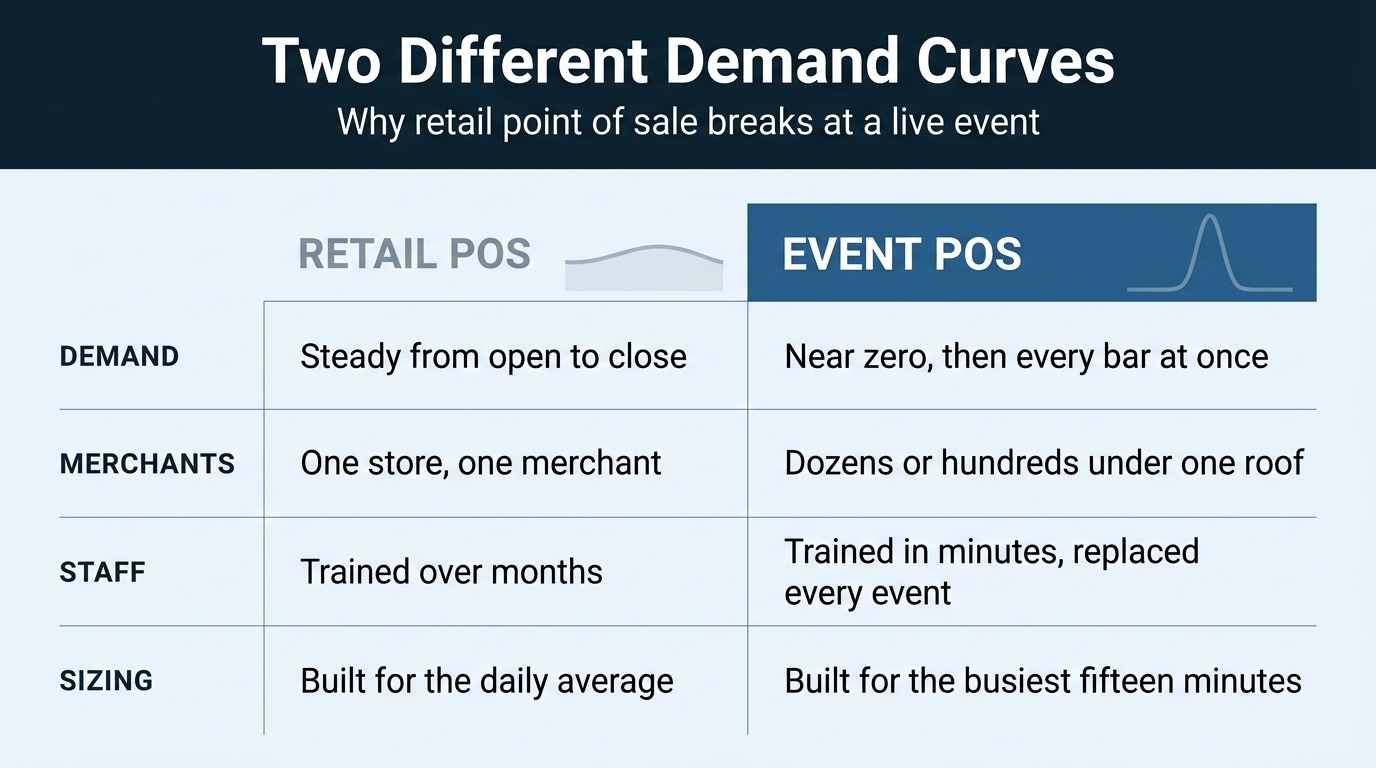
Why the Demand Curve Is the Real Specification
A coffee shop sells from open to close. Traffic rises in the morning, dips after lunch, and never asks the terminal to do anything it was not sized for. A live event inverts that. Sales sit near zero while the headliner is on, then every bar in the building gets slammed the second the set ends, and the whole rush is over before a retail system has finished thinking about it.
That single fact drives most of the engineering difference. Sizing an event POS system against the peak instead of the daily average changes how many terminals go out and where they sit. Menus have to clear an order in a handful of taps, and networks have to hold up while thousands of phones fight for the same tower. A platform built around an average looks impressive in a demo and fails in the only fifteen minutes that mattered.
What Temporary Operations Require That Permanent Ones Do Not
Retail hires staff who work the same register for months. Events hire crews who meet the hardware an hour before doors and may never touch it again. Interface simplicity stops being a design preference and becomes an operational requirement, because training time is measured in minutes and turnover between events is total.
The commercial structure differs too. A store is one merchant. An event is often a landlord running dozens or hundreds of independent businesses under one roof, each needing its own catalog, its own staff permissions, and its own share of the money afterward. Retail platforms have no native concept of that relationship, so operators end up reconciling separate accounts by hand.
Which Payment Methods Belong Inside One Event POS System?
Buyers often approach this as a shortlist of competing technologies, as though the job were to crown a winner between contactless cards and wristbands. That framing causes trouble. These are layers in one stack, and a serious platform runs all of them simultaneously rather than asking guests to conform to whichever one it does best.
Cashless and Contactless Describe Two Different Decisions
The terms get used interchangeably and they should not be. Contactless describes how a guest pays: a tap of a card, a phone, or a credential instead of a swipe. Cashless describes an operating policy, meaning the site no longer takes currency at the counter. Plenty of venues run contactless acceptance for live events while still taking cash through a transition, and the two decisions carry different consequences. Contactless is a hardware and processing question. Going fully cashless is a guest access question, with legal considerations in some jurisdictions and a real population of attendees who arrive holding bills. A cashless POS rollout that skips the second question tends to discover the problem at the busiest bar on the busiest night.
Where RFID Credentials Change the Equation
RFID wristbands and cards move the payment credential onto the guest. Instead of reaching for a wallet, an attendee taps the band already on their wrist, which removes the pocket search that slows a line more than the payment itself. The same credential can carry entry rights, so one object handles both the gate and the bar. Wristbands also force an architectural choice, because a credential can sit on top of the standard card networks or run inside a system the operator controls. The comparison of closed-loop and open-loop payment systems walks through those tradeoffs, and it is worth settling before you choose hardware rather than after.
Why Cash-to-Card Kiosks Still Belong in a Cashless Build
Self-service kiosks are the piece most first-time buyers leave out of the plan. Cash-to-card units, sometimes called reverse ATMs, let a guest feed in bills and receive a prepaid card that works at any terminal on site. They are an industry-standard bridge rather than a novelty, because a fully cashless policy without one simply turns paying customers away. Top-up and self-order units earn their place the same way, by removing a task from a counter where seconds are expensive.
How Do Festival, Venue, and Stadium Requirements Actually Differ?
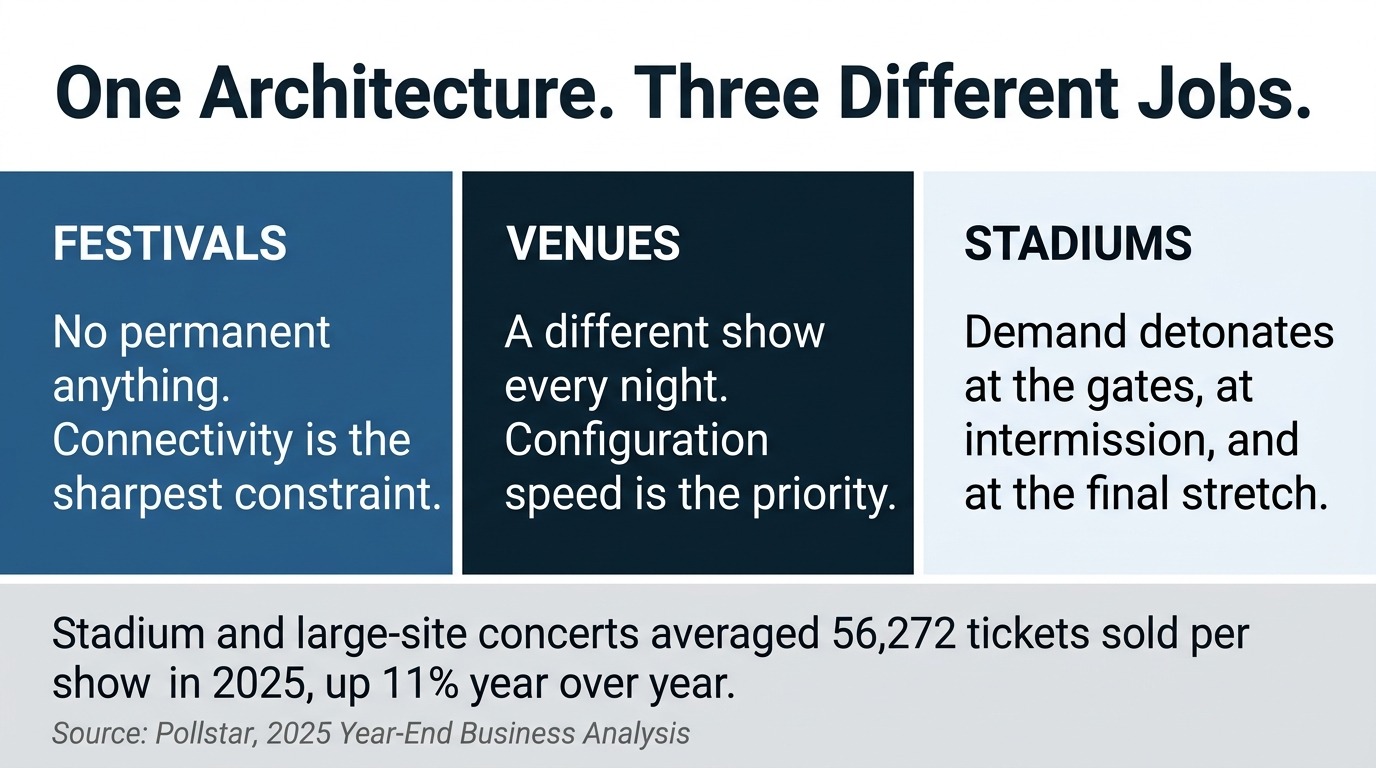
The three environments share one architecture and pull it in different directions. A festival POS system fights a completely different set of problems than a downtown club does, even when the brochure looks identical. A platform tuned for one environment and sold into the others usually shows the strain by its second season.
Festivals Build and Break Their Infrastructure Every Time
A festival site has no permanent anything. Power, connectivity, and the entire vendor footprint get built in a few days, run hard, and torn down. Connectivity is the sharpest constraint, because temporary networks degrade as crowds arrive and cellular capacity was never sized for a small city appearing in a field. Vendor count is the second pressure, since one festival may run more independent food, drink, and merchandise businesses than a shopping center. Choosing a festival POS system therefore comes down to how the platform behaves when the network wobbles and how cleanly it manages many merchants at once.
Permanent Venues Trade Chaos for Repetition
A nightclub, theater, or amphitheater has the infrastructure a festival lacks: wired connectivity, permanent bars, fixed power. The problems move elsewhere. Venue POS decisions revolve around repetition, because the same room runs a different show every night with different capacity, demographics, and often a different promoter taking a cut. That makes configuration speed the quiet priority, since menus, pricing tiers, service charges, and staff permissions must change between events without rebuilding the setup each time. A venue POS that reports only nightly totals also wastes the advantage of recurring guests.
Stadiums Run on a Fixed Clock
Stadiums compress everything. Demand detonates at the gates, at each intermission, and in the stretch before the result is decided, and the crowd is enormous. Pollstar's 2025 year-end analysis found that concerts at stadiums and other large sites averaged 56,272 tickets sold per show among the top 100 worldwide touring artists, running 11 percent above the 2024 figure. Those guests reach the concourse in waves rather than a stream. Sports adds a wrinkle, since those audiences skew older and hold onto cash longer, which makes the kiosk conversation less optional. The guide to stadium and arena payment needs breaks that environment down further.
7 Criteria for Evaluating Any Event POS System
Vendor demos are designed to look good. These are the questions that tell you what happens after the demo ends and the doors open.
- Peak sizing, not daily averages. Ask how the vendor calculates terminal count and throughput. If the answer references total attendance rather than the busiest window, they are sizing the wrong number.
- Many merchants, one platform. Every vendor, bar, and cart should live inside a single system with shared catalogs and unified reporting, rather than a separate account per operator that someone reconciles by hand at 3am.
- Credential strategy decided first. Whether guests pay by card, wallet, or wristband changes hardware, onboarding, and guest communications. Settle the architecture before you evaluate devices, because reversing it later is expensive.
- Network behavior under load. Push the vendor on what happens when connectivity degrades mid-rush, what the documented limits are, and how transactions reconcile afterward. Vague reassurance here is a red flag.
- Support model on event day. Establish who picks up the phone at 10pm on a Saturday, whether spare hardware sits on site, and what the response time actually is once the room is full.
- Integration with the rest of the stack. Ticketing, access control, inventory, and accounting all touch payment data. Confirm what connects out of the box and what turns into a spreadsheet someone maintains by hand.
- Onboarding measured in minutes. Temporary crews learn the interface on the day. Watch someone unfamiliar with the system complete a full order during the demo, including a refund and a split payment, and time it.
What Should Reporting and Settlement Deliver After the Last Sale?
Payment acceptance is the visible half of the job. The half that decides whether operators renew usually happens after the crowd leaves, when numbers have to turn into decisions and money has to reach the people who earned it.
Reporting That Answers Operational Questions
Most platforms report revenue. Fewer report what an operator can act on: which locations moved the most volume per hour, where lines built and stalled, what sold out and when, and how spending differed by zone or session. That granularity turns a payment record into a planning tool for next season's layout, staffing, and vendor mix. Timing matters as much as depth, because data that surfaces mid-event lets a manager restock a stand before guests give up and walk away.
Settlement Across Dozens of Merchants
Settlement is the least glamorous part of the evaluation and the one that generates the most friction. When a hundred independent vendors trade under one operator, someone has to calculate each share, apply the agreed commission, resolve disputed lines, and move the funds. Done badly, that consumes weeks of staff time and strains every vendor relationship the operator depends on.
Ask specific questions. How are commissions applied per vendor? What does a vendor see in their own dashboard while the event is running? How quickly do payouts land, and what happens when a vendor disputes a total? The answers say more about a platform's maturity than any feature list, because settlement is where the accumulated complexity of a multi-vendor event finally has to resolve.
FAQ
What Counts as an Event POS System?
It is a point-of-sale platform built for live event conditions, and it usually arrives as a bundle rather than a single product: terminals, software licensing, payment processing, and some level of on-site support. Buyers coming from retail are often surprised that one contract covers all four, since a shop typically buys hardware and a subscription and handles the rest itself. The bundling exists because a food vendor cannot troubleshoot a frozen terminal alone at 11pm with forty people in line.
Can I Use a Standard Retail Terminal for a Small Event?
Often, yes. With reliable connectivity, a single operator, and modest volume, a standard terminal is a reasonable starting point and nobody should oversell the alternative. The threshold arrives when you add multiple independent vendors, unpredictable connectivity, or a crowd large enough to create real peak pressure. Past that, manual reconciliation and missing multi-vendor controls cost more than the platform would.
Do Guests Need an App or a Wristband to Pay?
No. A well-configured cashless POS accepts standard cards and mobile wallets alongside any event-specific credential, so guests who ignored every pre-event email can still buy a drink. Wristbands and apps speed things up and unlock better data when guests adopt them, but they should never be the only path to a purchase.
How Far Ahead Should I Choose a Payment Platform?
Earlier than most teams do. Hardware has to be provisioned, staff need training materials, guests need communication if you are introducing a credential, and finance needs settlement terms agreed before money starts moving. Teams that treat payments as a load-in item rather than a planning item usually pay for it in the first hour of doors.
Buy for the Peak, Not the Average
The whole evaluation collapses into one question. Retail point of sale is built for a demand curve live events do not have, and every requirement that follows, from throughput sizing to multi-vendor settlement, traces back to that difference. Size the system for the rush, and confirm the payment coverage, the multi-merchant architecture, the network behavior, and the settlement terms before the contract, because none of them are fixable once doors open.
Billfold builds event POS systems for exactly these conditions, combining card, mobile wallet, cash, and RFID acceptance with multi-vendor management, real-time reporting, and remote device control across the fleet. See how the cashless and contactless POS platform fits your operation, or reach o ut to the Billfold team to get started.
