
Festival POS Systems: Comparing the Top 3 Options in 2026

Key Takeaways
Not all festival POS systems are built for festivals — and choosing the wrong one will cost you revenue, uptime, and credibility.
- General retail POS systems (Square, Clover) are cheap upfront but built for storefronts, not high-volume outdoor events — connectivity failures, transaction fees, and limited multi-vendor control are common pain points.
- Open-loop contactless systems (NFC/tap-to-pay) offer flexibility but depend on internet authorization, making them vulnerable at remote or high-density festival sites.
- RFID closed-loop systems process transactions offline in under 2 seconds, eliminate fraud risk, and give organizers complete spending control — making them the proven choice for serious festival operators.
The question isn't whether to go cashless — it's which cashless festival POS system can actually handle your volume without breaking down in the mud.
The festival payments market is moving fast. Global cashless festival payment platforms reached $2.12 billion in 2024 and are forecast to grow at 16.5% annually through 2033 — a clear signal that event organizers worldwide are leaving cash behind. But the technology you pick to power that shift matters as much as the decision to go cashless in the first place.
Festival POS systems are not all created equal. A system that works fine at a coffee shop or pop-up market can fall apart in the mud at a 10,000-person event — and when it does, the damage hits your revenue, your reputation, and your attendees all at once. The right POS choice impacts transaction speed, customer experience, inventory management, and real-time data in ways that compound across every vendor, every bar, and every hour of your event. To make a smart decision, you need to understand what separates the three main categories of cashless festival POS technology and where each one breaks down under pressure.

What Makes Festival POS Systems Different From Standard Retail POS?
Most point-of-sale technology was designed for stable environments — a shop with reliable wifi, a single checkout counter, consistent staff. Festivals are the opposite. You're running dozens or hundreds of simultaneous vendor transactions across a large outdoor area, often in locations with poor mobile coverage, in heat, rain, and dust, with staff who may have trained for exactly one day. The operational demands are fundamentally different, and systems that ignore those demands will fail when the pressure is highest.
Why standard retail POS breaks down at events
Retail POS platforms like Square or Clover are built around a cloud-authorization model — every transaction pings a remote server before completing. That architecture works fine with a reliable internet connection. At an outdoor festival, that connection is never guaranteed. Thousands of smartphones, vendor tablets, and payment terminals all competing for the same cell towers creates the kind of network congestion that bogs down transactions or takes them offline entirely. The result is long queues, frustrated attendees, and lost sales.
Beyond connectivity, retail POS systems are designed for a single-operator environment. They don't natively support the kind of multi-vendor, multi-bar, multi-zone oversight that a festival requires. You end up with fragmented data, manual reconciliation, and no clean picture of what happened across your event until after it's over.
What festival-specific POS requirements look like
A true festival POS system needs to handle offline transaction processing as a baseline, not a bonus feature. It needs to support pre-loaded spending accounts or wristbands so transactions aren't dependent on live bank authorization. It needs to give organizers real-time visibility across every vendor simultaneously. And it needs hardware that can survive the physical reality of an outdoor event — weather, drops, and constant heavy use. Understanding these requirements is the starting point for evaluating RFID payment for festivals against the alternatives.
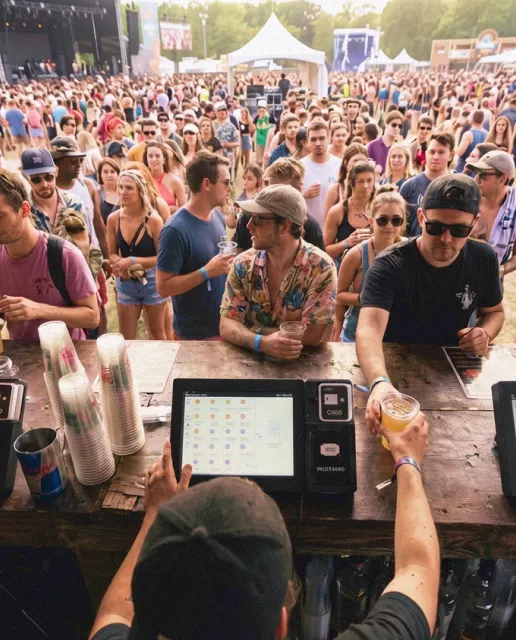
Built for Peak-Hour Traffic
Built for high-volume festivals where speed, offline capability, and operational visibility matter most.
Explore Festival POSWhat Are the 3 Main Types of Festival POS Systems?
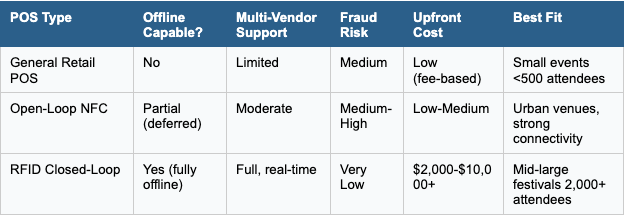
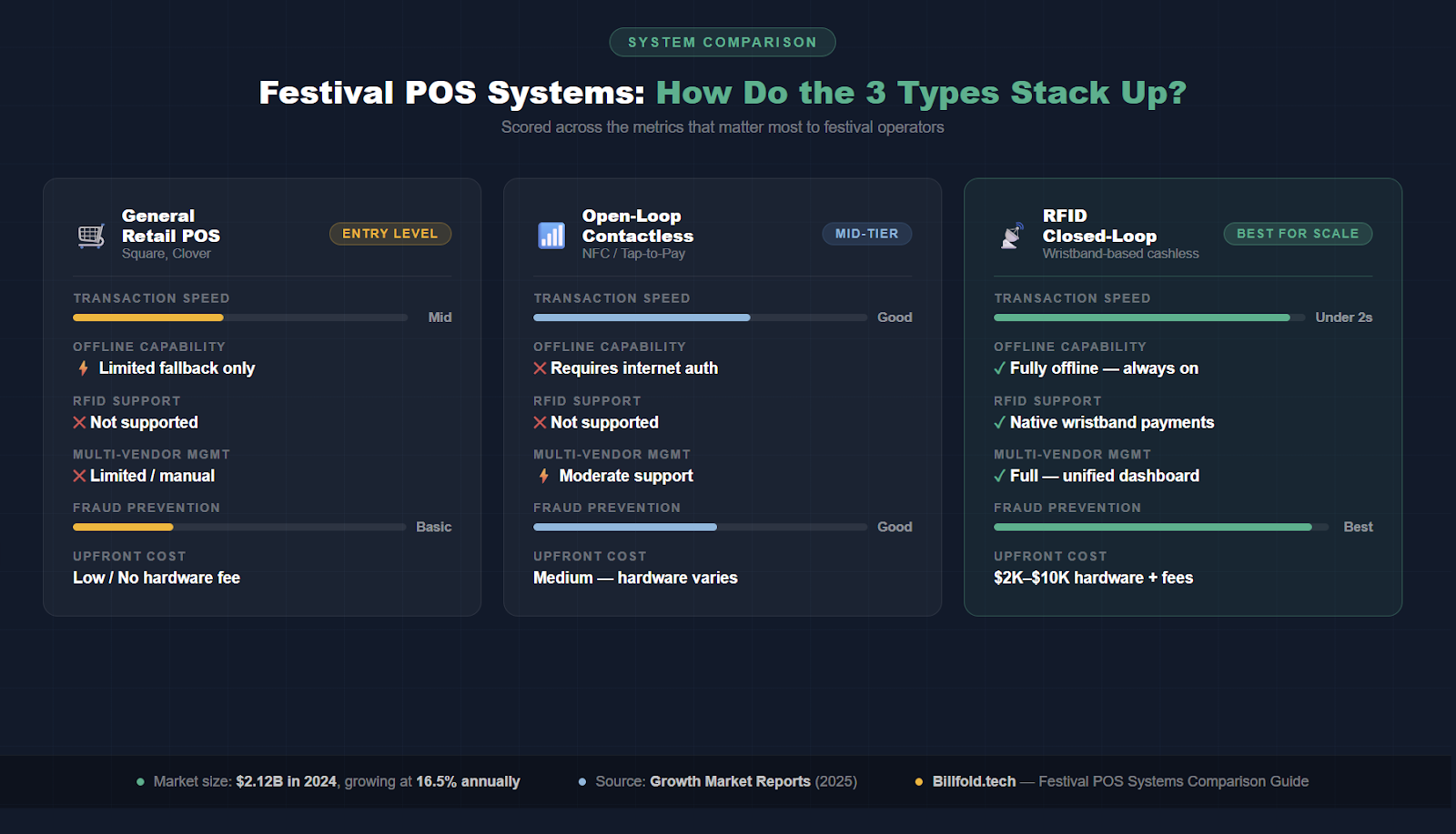
When evaluating festival payment technology, the market breaks down into three distinct approaches. Each has a different architecture, a different cost model, and a different set of tradeoffs. Here's how they compare.
Option 1: General Retail POS (Square, Clover, SumUp)
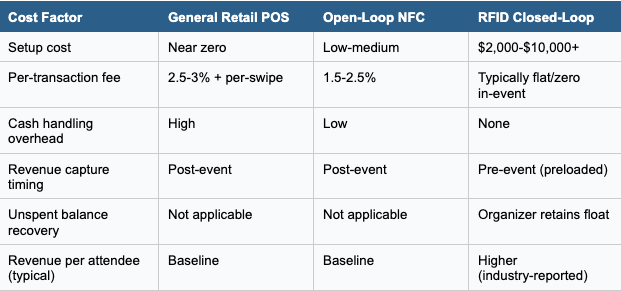
Retail POS platforms are the default choice for smaller or first-time events because the barrier to entry is almost zero. You download an app, plug in a card reader, and you're taking payments within minutes. The transaction fee model — typically 2.5% to 3% plus a per-swipe charge — means no large upfront investment, which is appealing when you're managing a tight budget.
The tradeoff is that these systems were never designed for festival conditions. They require internet connectivity for every authorization, they lack native multi-vendor management, and their consumer-grade hardware wasn't built for outdoor durability. At small events under a few hundred attendees, these limitations are manageable. At anything approaching festival scale, they become operational liabilities.
Option 2: Open-Loop Contactless (NFC / Tap-to-Pay)
Open-loop systems accept standard contactless cards and mobile wallets — Apple Pay, Google Pay, Visa payWave. The appeal is obvious: attendees don't need to preload anything, and there's no new technology for them to learn. These systems reduce cash handling and can integrate with existing payment infrastructure fairly easily.
The problem is the authorization dependency. Open-loop NFC transactions require real-time bank authorization just like standard card payments. That means the same connectivity vulnerabilities apply. At a large outdoor festival in a remote location, network congestion and dead zones are a practical reality. Offline fallback strategies exist for these scenarios, but they involve manual reconciliation, deferred processing, and elevated fraud risk — none of which are ideal for a multi-day event with thousands of transactions.
Option 3: RFID Closed-Loop Systems
RFID closed-loop systems operate on a fundamentally different model. Attendees load funds onto an RFID wristband before or at the event. Every transaction debits from that preloaded balance directly — no bank authorization required, no internet dependency. Transactions process in under 2 seconds, which is the benchmark that keeps lines moving at a busy festival bar. This architecture is explored in depth in guides on how RFID POS systems streamline event payments.
Because funds are preloaded, organizers capture revenue upfront and eliminate the possibility of declined transactions or overdrafts during the event. Fraud risk drops to near zero — there are no card numbers to steal, no contactless interception vulnerabilities, and no cash to mishandle. Spending controls let organizers cap alcohol purchases, restrict zones by wristband type, and track everything in real time across every vendor simultaneously.
How Do Festival POS Systems Handle Security and Fraud Prevention?
Payment fraud at events happens in more ways than most organizers expect. It's not just card skimming — it's cash theft at vendor booths, employee over-rings, unauthorized refunds, and physical hardware that goes walkabout between setup and teardown. The architecture of your festival POS system determines how exposed you are to each of these risks.
Cash and open-loop vulnerabilities
Any system that involves physical cash or standard card transactions introduces audit gaps. Cash reconciliation at the end of a long event day is imprecise, especially with high staff turnover and multiple vendor locations. Open-loop contactless systems process legitimately but create a post-event reconciliation problem — deferred transactions, chargebacks, and disputed amounts that take weeks to resolve. Neither approach gives you real-time, transaction-level visibility while the event is actually running.
How RFID closed-loop removes the most common fraud vectors
Closed-loop RFID systems remove most of these attack surfaces at the architecture level. There's no cash to steal, no card data to intercept, and no way to process a transaction that isn't logged against a specific wristband in real time. Organizers can see exactly what's being sold, where, and by whom — and can flag anomalies immediately. The wristbands themselves can be instantly deactivated if reported lost or stolen, protecting attendees without any manual process. This is part of why contactless POS for festivals has become the standard for large-scale events where fraud exposure compounds with every additional vendor and transaction.
Festival hardware faces weather, dust, and physical wear at every event — and downtime during an event is not a recoverable situation. Purpose-built festival POS hardware is designed with IP-rated enclosures and local transaction storage that preserves data through power interruptions, network drops, and device failures. That durability isn't a nice-to-have — it's the difference between a hiccup and a crisis.
What Does Festival POS Pricing Actually Look Like?
Pricing for festival POS systems is one of the most opaque parts of the buying process. The sticker price rarely tells the whole story, and the real cost comparison shifts significantly depending on your event size, transaction volume, and how you account for revenue leakage.
Retail POS: low upfront, high per-transaction cost
General retail POS systems charge between 2.5% and 3% per transaction plus a flat per-swipe fee. At low transaction volumes, this is genuinely inexpensive. At festival scale — tens of thousands of transactions across multiple vendors — those fees add up fast. A festival generating $500,000 in vendor revenue on a 2.75% rate pays $13,750 in transaction fees alone, before any monthly subscription or hardware costs. There's also no control over what happens to float or unspent balances.
RFID closed-loop: higher upfront, better economics at scale
RFID systems typically involve a setup cost in the range of $2,000 to $10,000 or more depending on event scale, plus per-wristband costs. That sounds like more, but the math changes when you factor in eliminated cash handling, reduced shrinkage, faster transaction throughput, and — critically — preloaded revenue that you collect before the event begins. Industry data consistently shows that cashless payment adoption at festivals drives higher average spend per attendee, with RFID users ordering more frequently than those using traditional payment methods.
Food festival vendors consistently report that streamlined payment systems reduce queue times and increase throughput — which means more transactions completed per hour and higher total revenue per vendor. When you're evaluating cost, the real question isn't which system is cheapest to deploy. It's which system generates the most revenue per attendee, at the reliability level your event requires.
5 Questions to Ask Before Choosing a Festival POS System
Before committing to any festival POS platform, these are the questions that separate a good demo from a good decision.
- What happens when the internet goes down? This is the most important question you can ask. If the vendor's answer involves waiting for connectivity to be restored, that system will fail you at some point. The only acceptable answer is that transactions process locally and sync when connectivity returns.
- How does the system handle multiple vendors simultaneously? A festival isn't a single point of sale. You need real-time visibility across every vendor, bar, and zone — not a patchwork of individual systems that have to be reconciled manually after the fact.
- What does the hardware durability look like? Ask specifically about IP ratings, operating temperature ranges, and what happens if a terminal loses power mid-transaction. Festival hardware faces conditions that consumer-grade devices aren't designed for, and your SLA should reflect that.
- How is attendee data protected? Closed-loop RFID systems have a fundamental security advantage — no payment card data is transmitted or stored. For open-loop and retail systems, ask specifically about PCI compliance, data storage practices, and what happens to transaction data after the event.
- What does onboarding and on-site support look like? A system is only as good as the support behind it. Ask what training is provided for event staff, whether there is on-site technical support during the event, and how quickly issues are resolved during live operations. A payment failure during peak hours has no pause button.

Which Festival POS System Is Right for Your Event Size?
The right system for a 500-person community festival is not the right system for a 15,000-person multi-day event. Matching the technology to your operational reality is what separates smooth event payments from a disaster recovery situation. This is covered in depth in the guide to RFID wristbands for events and how they scale with event complexity.
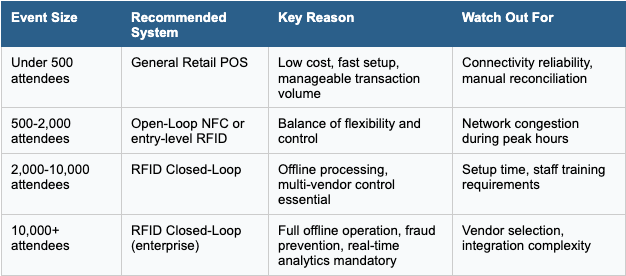
The threshold where RFID closed-loop stops being optional and starts being necessary is roughly the 2,000-attendee mark. Below that, the operational complexity of a closed-loop system may outweigh the benefits. Above it, the risks of relying on connectivity-dependent payment infrastructure become too significant to ignore.
FAQ
What is a festival POS system and how is it different from a regular POS?
A festival POS system is a point-of-sale platform designed specifically for the operational demands of live outdoor events. Unlike retail POS systems built for stable, connected environments, festival POS platforms need to handle offline transaction processing, multi-vendor management across dozens or hundreds of simultaneous sales points, and rugged hardware that survives outdoor conditions. The core difference is reliability under pressure — festival POS systems are built to keep working when connectivity drops, hardware gets wet, and transaction volumes spike.
How do RFID wristbands work with a festival payment system?
RFID wristbands are loaded with a prepaid balance — either before the event through an online portal or at on-site top-up stations. When an attendee makes a purchase, the vendor taps the wristband to a terminal, the balance is debited locally, and the transaction completes in under 2 seconds without any internet authorization required. The data syncs to a central management platform whenever connectivity is available, giving organizers a real-time view of spending across every vendor and zone at the event.
Can festival POS systems work without internet?
RFID closed-loop festival POS systems are designed to operate completely offline — transactions process against locally stored wristband balances and sync when connectivity is restored. Open-loop contactless systems and general retail POS platforms are dependent on real-time internet authorization and will fail or degrade significantly without it. If your event takes place in a remote location, a large outdoor space, or anywhere with unpredictable cell coverage, offline capability should be a non-negotiable requirement in your evaluation.
What are the typical costs for a festival POS system?
General retail POS systems charge 2.5% to 3% per transaction with minimal upfront cost, which works for small events but becomes expensive at scale. Open-loop NFC systems typically run 1.5% to 2.5% per transaction. RFID closed-loop systems involve upfront setup and hardware costs ranging from roughly $2,000 to $10,000 or more depending on event size, plus per-wristband costs — but eliminate per-transaction fees and generate preloaded revenue before the event begins. The right cost comparison accounts for total revenue impact, not just deployment cost.
How long does it take to train staff on a festival POS system?
Training time varies significantly by system type. General retail POS platforms are familiar to most staff and require minimal training. RFID closed-loop terminals are designed to be simple for vendor staff — the transaction flow is typically just a wristband tap and a confirmation. The more complex training requirement is for back-of-house staff managing the system console, reviewing analytics, and handling exceptions. Most purpose-built festival POS providers include structured onboarding and dedicated on-site support during the event, which reduces the training burden on your team.
The Bottom Line on Festival POS Systems
The technology powering your payments is not a background decision. It determines how fast your lines move, whether your vendors stay operational when the network goes down, how much revenue you capture before the gates open, and whether your post-event reconciliation takes hours or weeks. General retail POS systems are a reasonable starting point for small events, but they're designed for a different world. Open-loop contactless is a legitimate step up, but the internet dependency is a real operational risk that doesn't disappear just because it's inconvenient to think about.
For events where reliability and revenue optimization actually matter, RFID closed-loop is the architecture that delivers. Billfold builds RFID cashless payment systems designed specifically for festivals and events — offline-first, multi-vendor, with real-time analytics and the kind of operational support that makes the difference when your event is live. If you're evaluating your options for an upcoming event, reach out to the Billfold team to see how it works in practice.
