
Closed Loop Digital Wallet for Venues: Stored Value and Top-Up

Key Takeaways
A venue wallet turns event spending into a balance the venue controls, changing what operators see, keep, and act on.
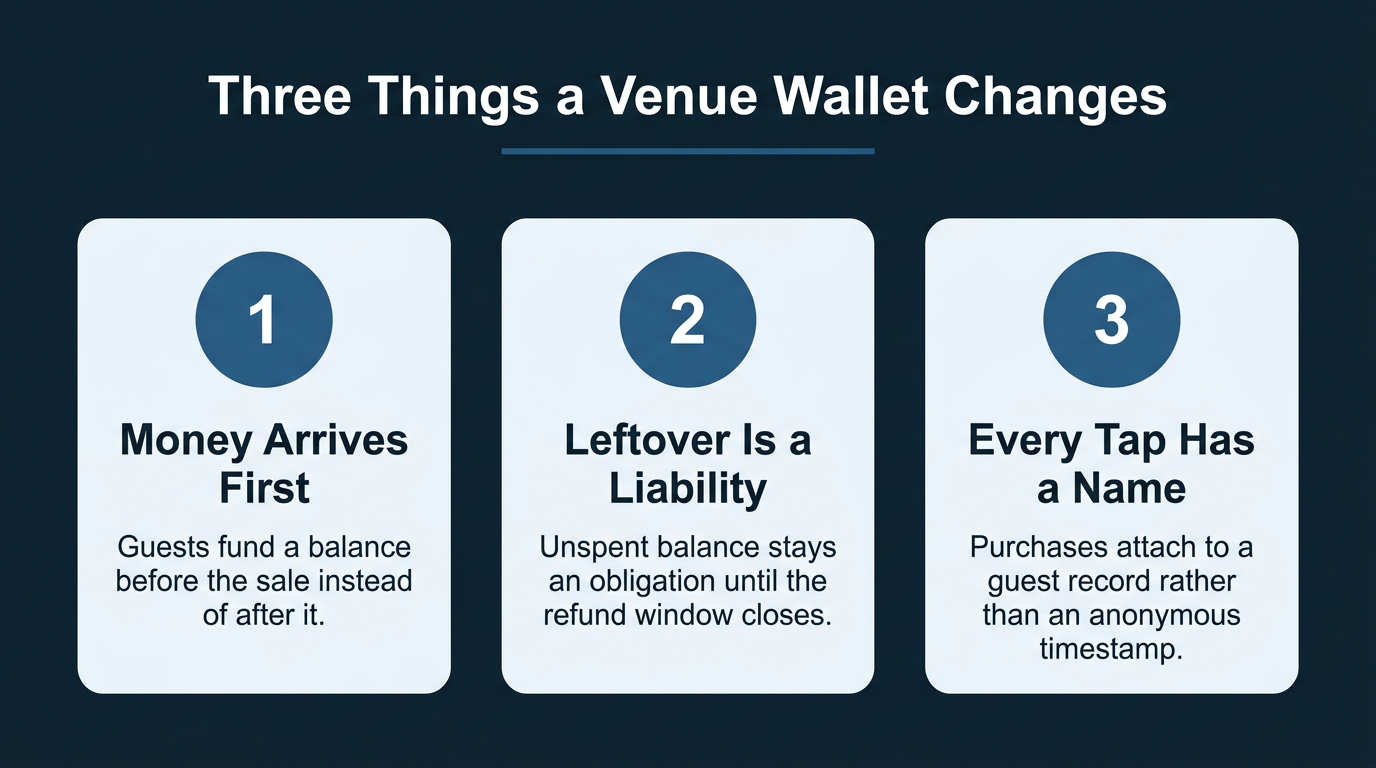
- Stored value moves the funding decision ahead of the purchase, so guests spend against money already committed.
- Unspent balance should return automatically rather than quietly expiring, and that policy drives adoption more than any feature does.
- Attaching identity to every transaction turns an anonymous concession receipt into a customer record usable between events.
- Public per-cap comparisons against open loop cards are thin, so judge the mechanism and the contract, not a slide.
Ask two questions before signing: who owns the guest data, and what happens to balances nobody spends.
Ask a venue operator where their money actually sits during an event and the answer gets vague fast. It is somewhere between a processor, a vendor terminal, and a settlement file that lands days later. A closed loop digital wallet replaces that vagueness with a single number the venue controls. Guests fund a balance, every tap draws it down, and the venue holds the money in between. Cards carry the bulk of American spending, with the Federal Reserve counting 236.6 billion noncash payments in 2024 and cards making up over three quarters by number in its most recent payments study. Handing your economics to the card networks is still a choice.
This is the model behind festival wristbands, resort charge accounts, and a growing set of payment platforms built for live entertainment. What follows covers how stored value and top-ups function, what happens to money nobody spends, and where the wallet sits inside a venue payment network.
What Is a Closed Loop Digital Wallet for a Venue?
Money goes in once and can only be spent inside your walls. The details underneath that sentence are where operators get surprised.
How the Wallet Differs From a Card on File
A card on file is a pointer. It stores a token that lets you charge a guest's bank later, and every purchase still travels to an issuer for approval. A closed loop digital wallet stores actual funds, so a purchase is a ledger entry inside your system rather than a request sent to somebody else's. That lets the venue set spending limits, age gating, comps, and vendor allocation. It also creates a real obligation, since the balance is guest money on your books.
Where the Wallet Lives in the Guest Journey
The credential is usually a wristband, card, or app profile. At multi-day events, RFID wristbands carry the balance and double as an entry credential, which is why the model spread through live music first. The form factor is a delivery choice, and the wallet is the part that matters. Guests meet it at four moments: funding, spending, topping up, and leaving with money still on it. Most demos cover the first two and skate past the last.
How Do Stored Value, Top-Ups, and Auto-Reload Work?
Three mechanics carry the model. Get one wrong and the wallet becomes the thing guests complain about.
Loading the First Balance
Pre-event loading is the version operators want, since funds land before anyone reaches the gate and the venue opens with revenue already banked. The trade is adoption, since it only works if the prompt reaches guests beforehand. On-site loading catches everyone else through staffed points, kiosks, and tap-to-load at any terminal. A stored value wallet at events works best when funding is available everywhere rather than concentrated at one counter that becomes its own queue.
Top-Ups and Auto-Reload During the Event
Mid-event top-ups are the pressure test. A guest at a bar with a zero balance during a headline set is a lost sale unless reloading takes seconds. The strongest implementations let guests reload from their phone in line, and let staff reload at the terminal without abandoning the sale. Guest top-up wallet flows that force a walk to a separate kiosk cost you money. Auto-reload refills against a stored card at a set threshold, which deserves clear consent and an obvious off switch.
Refunding Unspent Balance
Money left on a balance is the part nobody markets. Stored value has a documented habit of going unclaimed, and a survey of American consumers found 43 percent hold at least one unused gift card, gift voucher, or store credit, averaging 244 dollars per person. Guests bring that suspicion to your wallet on day one, and the answer is an automatic refund of leftover balance to the original funding source, with no request, form, or deadline. Treating unclaimed balance as found revenue trades long-term adoption for short-term money.
Does a Venue Digital Wallet Change How Guests Spend?
This is where the industry gets loose with numbers. It is worth separating what is known from what is being sold.
Why Prepaid Balances Change Purchase Behavior
Once a guest funds a balance, the money is already committed, so the decision at the bar becomes what to buy rather than whether to spend. Strip out the wallet fumble, the PIN, and the receipt, and you strip out the friction that makes people skip a second round. Onsite spending is clearly the lever operators are pulling: Live Nation reported that onsite food and beverage spending rose by high single digits year over year at its large U.S. amphitheaters and across its European arenas and theaters through the first half of 2026.
Where the Comparison to Open Loop Cards Gets Overstated
Vendors routinely quote per-cap lift figures for a venue digital wallet against ordinary card payments. Treat those with suspicion, because almost none are published or controlled, and a wallet rarely arrives alone. It usually lands alongside new menus, new terminals, and more selling positions. The architecture difference between open loop and closed loop payment systems is real and needs no inflated statistics propping it up. The honest case for event wallet payments rests on control: you decide the funding flow, the fee structure, the spending rules, and the data model.
6 Questions to Ask Before Launching a Closed Loop Digital Wallet
Procurement tends to fixate on hardware and pricing. These six questions surface what determines whether the program survives its second season.
- Who owns the guest data? Ask whether the venue holds the records or licenses access, and what happens if you switch vendors.
- What happens to unspent balance? Confirm whether refunds are automatic, how long they take, and who absorbs the processing cost.
- How fast can a guest reload at the bar? Walk it on a live terminal, not a demo screen, and count the taps from empty balance to completed sale.
- Which outlets sit outside the network? Branded concessionaires and third-party bars often come with their own contracts and terminals, so map every outlet and decide who is in scope before launch.
- How are payouts and disputes handled? Settle the payout cadence and the escalation path for disputed transactions before the first event, since both get harder to renegotiate mid-season.
- What happens when connectivity drops? Ask how the system behaves during an outage and how transactions reconcile afterward. Get it in writing.
What Data Does a Venue Owned Wallet Return That Cards Do Not?
For enterprise operators this is the part that justifies the project. Payment mechanics are table stakes, and the data layer is the differentiator.
Identity Attached to Every Transaction
A card transaction tells you a beer sold at a stand at a given minute. A wallet transaction tells you which guest bought it, that it was their third purchase, and that they returned the next night. Purchases tie to a persistent identity because the guest funded a balance under an account. Slow revenue centers become visible while the event runs, and sponsors can be shown real purchase behavior instead of impressions.
Loyalty and Re-Engagement Between Events
The balance itself is a reason to come back. Residual credit, early access tied to wallet status, and offers built from purchase history become possible once identity attaches to spend, and venues moving to fully cashless operations tend to lean on this hardest by year two. That comes with a duty of care, so disclosure should be plain, opt-outs should work, and retention policies should be written down.

How Does the Wallet Fit Inside a Closed Loop POS Network?
A wallet without a network behind it is a gift card with better branding. The model works because every selling position reads the same balance.
One Balance, Every Revenue Center
Guests should never have to think about which balance applies where. Beverage, food, merchandise, and premium areas all authorize against one account, which only works when every terminal runs on one contactless POS platform rather than a patchwork of vendor-supplied readers. One station that will not take a balance undermines the whole system. Unified infrastructure is also what makes alcohol caps, zone restrictions, and staff credits a configuration setting.
Vendors, Settlement, and Reporting
Large events run on dozens or hundreds of independent operators, and event wallet payments only work commercially if each vendor sees their own sales and gets paid without a drawn-out reconciliation. A closed loop digital wallet on a unified network makes that possible, since every transaction is logged against a location and a vendor. Operators planning a cashless rollout should treat payout mechanics as a primary requirement, since live reporting is what turns a wallet into an operating tool.
FAQ
What Is a Closed Loop Digital Wallet in Plain English?
It is a prepaid balance that only works inside one venue or event. Guests put money on a band, card, or app account, then tap to spend anywhere on the property. The venue holds the funds and processes purchases internally rather than routing them to a bank.
Do Guests Get Their Unspent Money Back?
It depends entirely on the operator. Well-run programs return leftover balance automatically after the event, but some convert it to credit toward a future event and others let it lapse. Ask what the policy is before you load money onto a band.
Is a Stored Value Wallet at Events Better Than Taking Cards?
It depends what you are optimizing for. Cards need no guest education, while a wallet gives the venue control over fees, spending rules, and customer data. High-volume venues with many vendors and a repeat audience gain the most.
Can a Venue Run a Wallet and Card Payments at the Same Time?
Yes, and most do. A common setup uses the wallet for in-event purchases while accepting contactless cards and phone payments for ticketing and top-ups. Guests who never fund a balance still pay normally.
What Does a Guest Top-Up Wallet Cost a Venue to Run?
Costs fall into hardware, software licensing, payment processing, and onsite support, depending on whether you rent or own equipment. Economics shift as volume rises, since internal authorization removes some per-transaction cost. Ask any platform to model your actual volume, not a blended rate.
The Wallet Is a Commitment, Not a Feature
Running a wallet means accepting that you hold your guests' money and their purchase history. That responsibility is also the source of every advantage the model offers. Venues that treat it as a revenue trick, banking on forgotten balances and vague terms, get one good season before adoption stalls. Venues that treat it as infrastructure build something guests fund willingly.
Billfold builds the closed loop payment infrastructure behind that approach, with RFID wristband payments, prepaid balances and refunds, direct card linking, and real-time reporting across every vendor. Every payment type is accepted, including cash. Reach out to the Billfold team to map a wallet program to your venue.
