
How to Implement Cashless Payment Systems for Events: A Guide
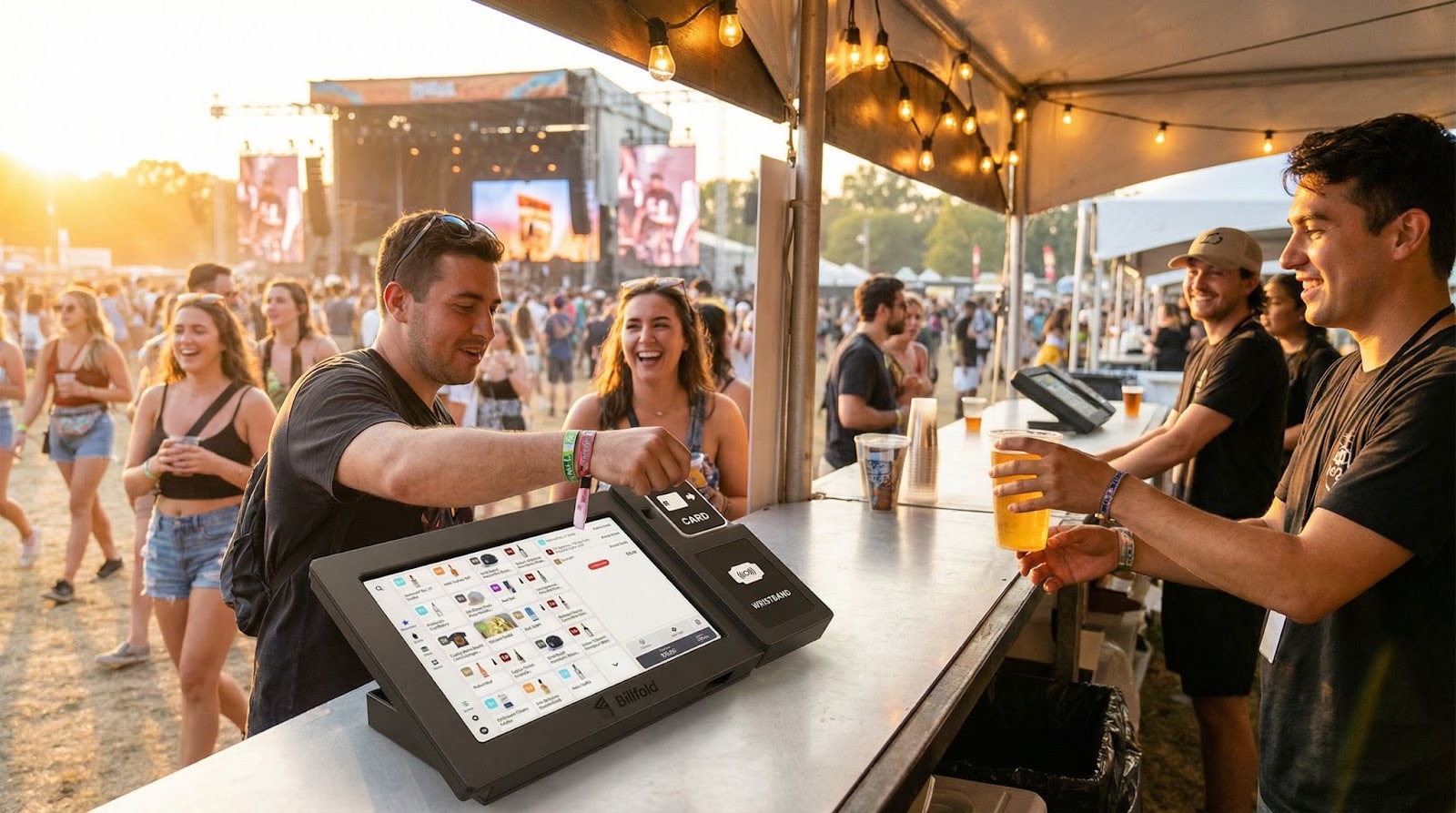
Cashless payment systems are the single biggest operational upgrade event organizers can make in 2026, and the implementation process is more accessible than most realize.
- The global RFID market is projected to grow from $17.12 billion in 2025 to $37.71 billion by 2032, with event industry adoption driving a significant portion of that expansion.
- Successful cashless rollouts follow a structured timeline spanning 8–12 weeks, with stakeholder alignment and vendor onboarding as the most critical early milestones.
- Open-loop, closed-loop, and hybrid payment models each serve different event profiles, and choosing the wrong one is the most common implementation mistake organizers make.
- Events that implement cashless payment systems with proper planning consistently report faster transaction speeds, stronger per-attendee revenue, and richer post-event data.
If your event still relies on cash or fragmented card terminals, this guide gives you the exact framework to implement cashless payment technology the right way.
Every year, event organizers lose revenue to slow transactions, long lines, and disjointed payment infrastructure. The global payments industry generated $2.5 trillion in revenue from 3.6 trillion transactions in 2024, and a growing share of that volume is flowing through cashless systems purpose-built for live experiences.
Festivals, stadiums, conferences, and multi-day venues are leading this shift because the operational pain points of cash handling, from theft risk to reconciliation headaches, directly cut into margins. With the global music event market valued at $250.8 billion and projected to nearly triple by 2035, the revenue at stake for organizers who fail to modernize their payment infrastructure is enormous.
The decision to go cashless is no longer a question of "if" but "how." And the "how" matters enormously. A poorly planned rollout creates attendee frustration, vendor confusion, and technology failures that damage your brand. A well-executed one transforms your entire operation. This guide walks through the complete process of building a cashless event strategy from scratch, covering system selection, infrastructure planning, vendor training, attendee communication, and post-event optimization.
Whether you're running a 500-person food festival or a 50,000-capacity music event, the principles are the same. The scale changes, but the framework doesn't.
Why Should Event Organizers Implement Cashless Payment Systems?
The case for going cashless extends well beyond convenience. When you implement cashless payment infrastructure, you're fundamentally changing how money, data, and people flow through your event.
Cash handling is expensive. Counting, securing, transporting, and reconciling physical currency requires dedicated staff, secure storage, and insurance. For multi-day festivals, those costs compound quickly. Cashless systems eliminate this entire operational layer while simultaneously reducing fraud and shrinkage. When every transaction is digitally recorded, accountability becomes automatic rather than aspirational.
How Do Cashless Payments Affect Attendee Spending?
Transaction speed is the revenue lever most organizers underestimate. When a purchase takes 2 seconds instead of 30, attendees spend more time buying and less time waiting. The psychological friction of handing over physical cash also disappears with tap-to-pay systems, which means impulse purchases increase. Concession stands, merchandise booths, and bar areas all benefit from this reduced friction, with cashless payment systems consistently driving higher average transaction values across event environments.
The data advantage is equally significant. Cashless platforms show which vendors are busiest, which products are selling fastest, and where bottlenecks are forming in real time. This intelligence allows organizers to make in-event adjustments, like opening additional bars during peak periods or redirecting foot traffic away from congested areas, that directly impact both revenue and guest satisfaction.
The festival cashless payment platforms market reached $2.12 billion in 2024 and is projected to hit $9.89 billion by 2033, growing at 16.5% annually. That growth reflects organizers across every event vertical recognizing that cashless infrastructure pays for itself through measurable spending increases and operational savings.

What's Driving the Market Shift Toward Cashless Events?
The numbers tell a clear story. Fortune Business Insights projects the global RFID market, spanning retail, logistics, healthcare, and live events, will reach $37.71 billion by 2032, growing at a CAGR of 11.9%. Event industry adoption is a primary accelerant, as organizers recognize that RFID-enabled cashless systems solve multiple problems simultaneously: payments, access control, attendee tracking, and sponsor activation.
Consumer expectations are accelerating this shift faster than most organizers anticipate. Juniper Research projects that contactless payment transactions will reach $15.7 trillion globally by 2029, more than doubling from $7.4 trillion in 2024. That growth is being driven by soft POS systems and mobile wallet adoption, and attendees who use tap-to-pay for groceries, transit, and coffee now expect the same frictionless speed at festivals. Younger demographics, in particular, view cash-only or card-only environments as outdated and inconvenient. Meeting these expectations is becoming table stakes for competitive events.
What Are the Different Types of Cashless Event Payment Systems?
Before you can bring cashless technology to your event, you need to understand the three primary system architectures. Each model has distinct advantages, cost structures, and operational requirements that align differently depending on your event's size, duration, and audience.
What Is an Open-Loop Payment System?
Open-loop systems accept standard payment methods: credit cards, debit cards, Apple Pay, Google Pay, and other digital wallets. Attendees pay using whatever card or device they already carry, and the infrastructure requires contactless payment terminals at each vendor location connected to external banking networks.
The advantage is familiarity. Attendees don't need to learn a new system or pre-load funds. The disadvantage is dependency on network connectivity for every transaction and limited control over the data you capture. Open-loop works well for single-day events and corporate gatherings where attendees are less likely to adopt a closed ecosystem.
What Is a Closed-Loop Payment System?
Closed-loop systems create a self-contained payment ecosystem within your event. Attendees load funds onto an RFID wristband, event card, or mobile account, then tap to pay at any vendor. All transactions process internally without relying on external banking networks, which means they work offline and process faster than open-loop alternatives.
The tradeoff is that closed-loop requires more attendee onboarding: pre-event top-ups, on-site activation stations, and a clear refund policy for unused balances. But the benefits are substantial. You control the entire transaction environment, capture granular spending data, and eliminate per-transaction processing fees from external payment networks. For multi-day festivals and high-volume events, the economics of closed-loop RFID systems are compelling.
When Does a Hybrid Payment Model Make Sense?
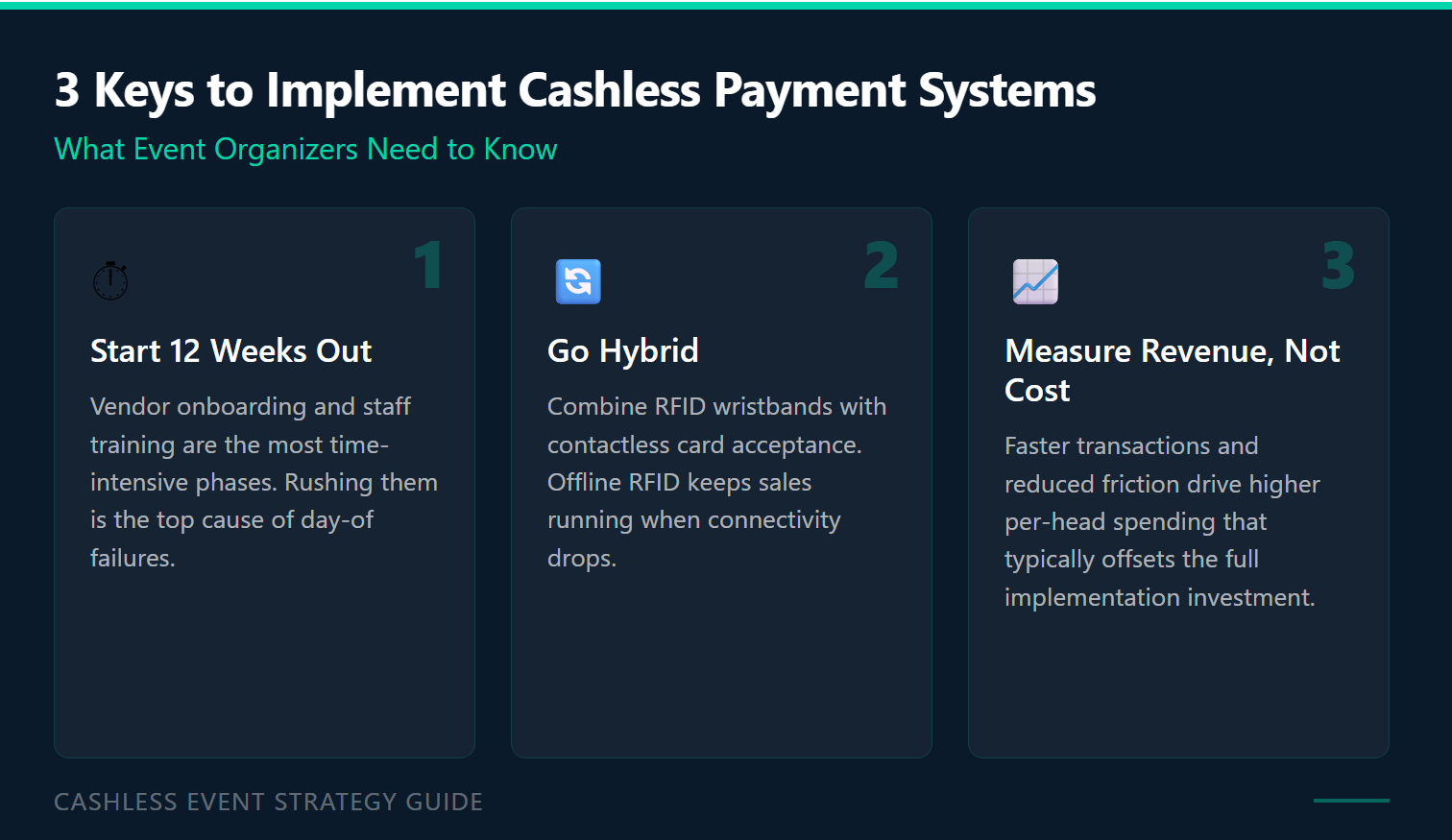
Most experienced event operators are now gravitating toward hybrid models that combine open-loop and closed-loop capabilities into a single platform. Attendees who want the convenience of their own card can tap and pay. Those who prefer preloading funds onto an RFID wristband for faster transactions and budget control can do that instead.
Hybrid payment systems give organizers the best of both worlds. They eliminate the "what if my card doesn't work?" anxiety while still offering the speed and data advantages of closed-loop RFID. They also provide a natural fallback: if the cellular network struggles during peak hours, RFID transactions continue processing offline while open-loop terminals wait for connectivity to restore.
How Do You Plan a Cashless Event Strategy From Scratch?
A solid implementation plan starts months before the gates open. The biggest implementation failures happen when organizers treat cashless as a plug-and-play purchase instead of an operational transformation that touches every department.
Who Needs to Be Involved in the Planning Phase?
Stakeholder alignment is the first and most critical step. Your operations team, vendor management team, marketing team, finance department, and IT/technology lead all need to be at the table early. Each group has different requirements that shape the implementation plan.
Operations cares about hardware logistics and day-of troubleshooting procedures. Vendor management needs to communicate system requirements to food, beverage, and merchandise partners. Marketing owns attendee communication, from pre-event emails to on-site signage. Finance needs to understand the fee structure, reconciliation process, and reporting capabilities. And IT evaluates network infrastructure, integration requirements, and security protocols.
What Does a Realistic Budget Look Like?
Cashless implementation costs vary widely depending on your event's scale and the system architecture you choose. Budget categories typically include hardware (terminals, wristbands, kiosks), software licensing, network infrastructure, staff training, and attendee communication materials. For RFID-based closed-loop systems, wristband costs add a per-attendee component that must be factored into ticketing strategy.
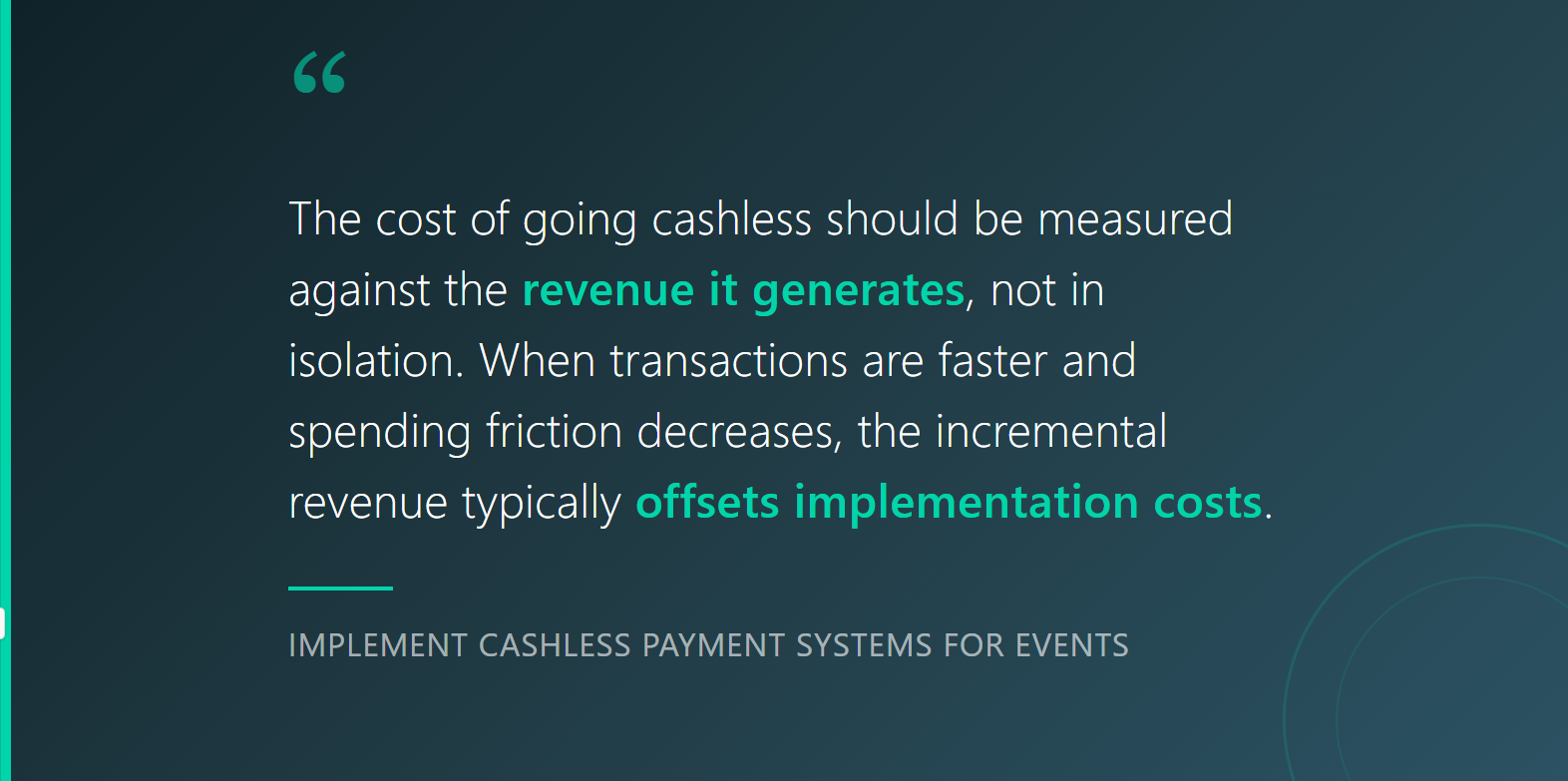
The critical budget insight most organizers miss: the cost of going cashless should be measured against the revenue it generates, not in isolation. When transactions are faster and spending friction decreases, the incremental revenue typically offsets implementation costs, often significantly. Events running for the first time should plan for a slightly higher investment in training and communication, then expect those costs to decrease sharply in subsequent years.

How Far in Advance Should You Start Planning?
For a first-time cashless implementation, begin the planning process at least 12 weeks before the event. Experienced operators running repeat events can compress this timeline to 8 weeks, but rushing the vendor onboarding and staff training phases is the most common source of day-of problems. The technology itself is reliable. The human elements, making sure every bartender, food vendor, and gate attendant knows how the system works, are where preparation pays off.
What Does the Payment Systems Setup Process Look Like?
The payment systems setup phase is where your planning becomes tangible. This is the technical backbone that determines whether transactions flow smoothly or grind to a halt when 5,000 people hit the bar between sets.
What Hardware and Infrastructure Do You Need?
Your hardware requirements depend on the system model you've chosen. Open-loop deployments need contactless payment terminals with cellular or WiFi connectivity at every point of sale. Closed-loop RFID systems require wristband or card activation stations, RFID-enabled POS terminals, and self-service top-up kiosks. Hybrid setups combine both terminal types at each vendor location.
For outdoor festivals and remote venues, hardware durability matters. Terminals need to withstand sun exposure, dust, and occasional weather. Battery life or power infrastructure must sustain multi-day operations. And you need redundancy: backup terminals, spare wristbands, and contingency power sources.
How Do Software Integrations Work?
Your cashless platform needs to integrate with several existing systems. Ticketing platforms connect attendee profiles to payment credentials. Inventory management systems sync product catalogs to POS terminals. Accounting software receives settlement data for vendor payouts. Access control systems share wristband credentials for unified entry and payment experiences.
The depth of these integrations varies by provider. Some platforms offer built-in access control, analytics, and vendor management within a single ecosystem. Others require third-party connectors. Prioritize platforms that minimize the number of separate systems you need to manage, because every integration point is a potential failure point on event day.

Point of Sale Built for Live Events
See how Billfold POS keeps sales moving across bars, F&B, merchandise, and other points of sale, with centralized control built for event operations.
Explore Billfold POSWhy Is Network Planning Critical for RFID Event Planning?
Network infrastructure is the most overlooked element of rfid event planning. Closed-loop RFID systems process transactions offline, which provides essential resilience, but your dashboards, reporting, and top-up kiosks still need connectivity. Open-loop terminals require constant connectivity for bank authorization.
Map your venue's cellular coverage before committing to a connectivity strategy. High-density events in remote locations often need dedicated WiFi networks or mesh networking solutions. Plan for peak concurrent usage, because tens of thousands of people on their phones during a headliner changeover can saturate local cell infrastructure.
Large-scale RFID deployments use distributed network architectures that keep each vendor zone operational even if the backhaul connection drops.
What Are the 7 Steps to Successfully Implement Cashless Payment at Your Event?
Here is the step-by-step implementation framework that covers the full lifecycle from vendor selection to post-event analysis:
- Select your cashless platform and system architecture. Evaluate providers based on your event size, payment model preference (open, closed, or hybrid), integration requirements, and offline capabilities. Request demos and reference checks from events similar to yours.
- Build your implementation timeline and assign ownership. Create a detailed project plan with milestones for hardware procurement, software configuration, vendor onboarding, staff training, and attendee communication. Assign a dedicated cashless coordinator who owns the timeline.
- Configure your vendor ecosystem. Set up product catalogs, pricing tiers, vendor commission structures, and reporting access for each food, beverage, and merchandise partner. Each vendor should have visibility into their own sales data in real time.
- Deploy and test all hardware on-site. Install terminals, kiosks, and networking equipment with enough lead time for comprehensive testing. Simulate peak transaction volumes to identify bottlenecks before real attendees arrive.
- Train every person who will touch the system. This includes bartenders, cashiers, gate staff, vendor managers, and your own operations team. Role-specific training is more effective than generic overviews. A bartender needs different knowledge than a venue manager.
- Execute your attendee communication plan. Pre-event emails, social media content, FAQ pages, and on-site signage should all explain how the cashless system works, how to load funds (if applicable), and where to get help. Clear communication reduces friction and support requests on event day.
- Monitor, adjust, and analyze in real time. Use your dashboard to track transaction volumes, identify underperforming vendor locations, and respond to technical issues immediately. After the event, conduct a thorough analysis of spending patterns, system performance, and vendor satisfaction to improve future implementations.
What Should Your RFID Event Planning Timeline Include?
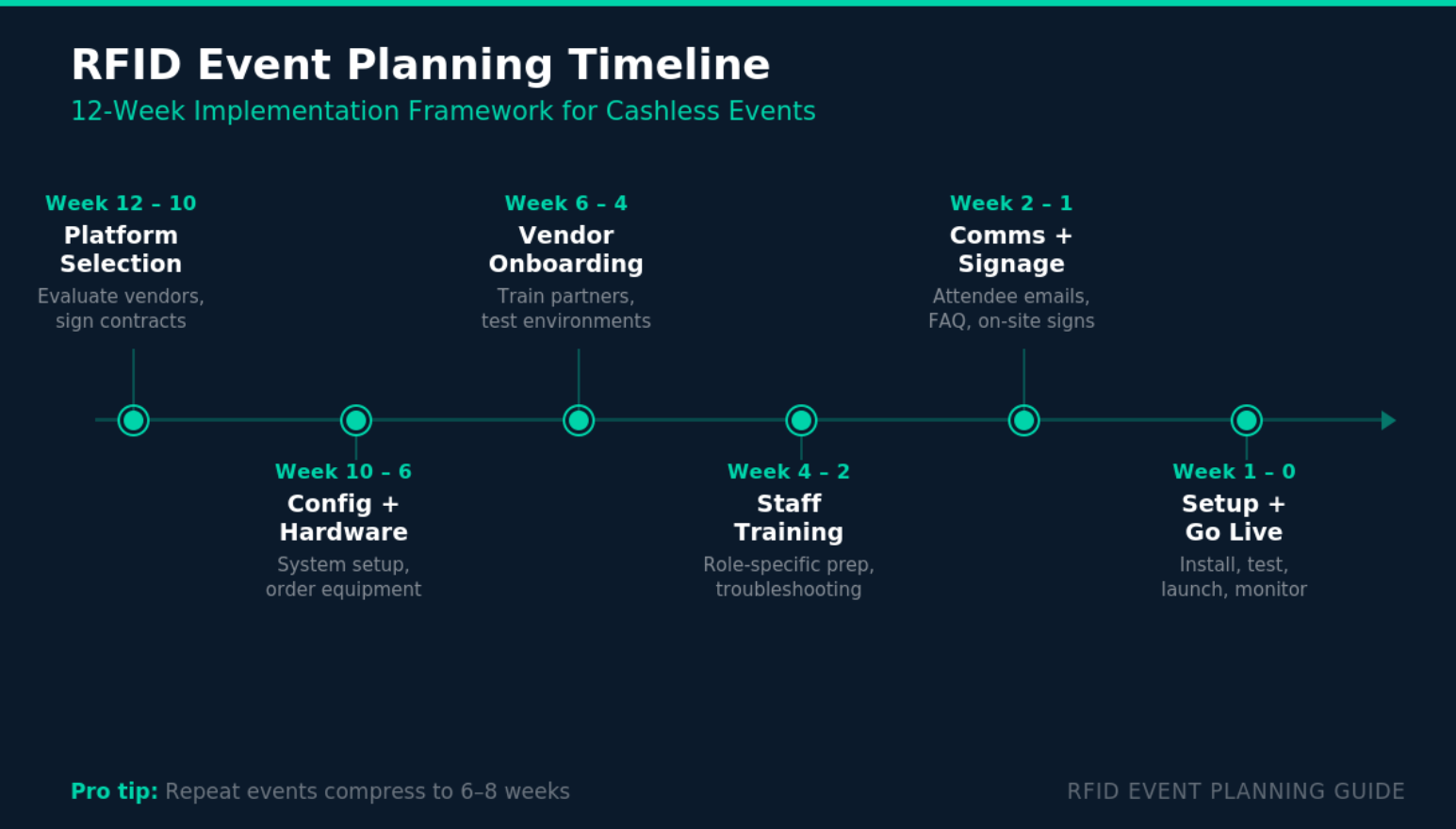
Proper RFID-based implementation requires a structured timeline with clear milestones. Here's a reference framework for first-time implementations:
Weeks Before Event
Milestone
Key Activities
12–10
Platform Selection
Evaluate providers, sign contract, define system architecture
10–8
Configuration
Set up event in platform, configure vendor accounts, define products and pricing
8–6
Hardware Procurement
Order terminals, wristbands/cards, kiosks, networking equipment
6–4
Vendor Onboarding
Train vendor partners, distribute hardware guides, set up test environments
4–2
Staff Training
Role-specific training sessions, troubleshooting protocols, escalation procedures
2–1
Attendee Communication
Email campaigns, social media posts, FAQ page publication, on-site signage design
1–0
On-Site Setup & Testing
Install hardware, network testing, full system rehearsal, load testing
Event Day
Live Operations
Real-time monitoring, support team deployment, issue resolution
Post-Event
Analysis & Settlement
Vendor payouts, refund processing, data analysis, performance review
For repeat events, this timeline can compress to 6–8 weeks as your team, vendors, and attendees already understand the fundamentals. The biggest time savings come from vendor onboarding, which moves dramatically faster after the first successful implementation.
How Do You Handle Common Cashless Implementation Challenges?
Every cashless rollout encounters friction points. Anticipating and planning for these challenges is what separates smooth implementations from chaotic ones.
What If Attendees Resist the Cashless System?
Attendee resistance almost always stems from unfamiliarity rather than genuine opposition. The solution is proactive communication that starts well before the event. Explain the benefits in attendee terms: shorter lines, faster service, no need to carry cash, and easy balance management through a mobile app.
For events transitioning from cash to cashless for the first time, consider deploying cash-to-card conversion stations on-site. These kiosks allow attendees who arrive with only cash to load funds onto a wristband or prepaid card. This inclusivity measure addresses accessibility concerns while still achieving your cashless operational goals.
How Do You Prepare for Connectivity Issues?
Build your system around the assumption that connectivity will fail at some point. Choose a platform with offline processing capabilities, where RFID terminals store transactions locally and sync when connectivity restores. This ensures that a network hiccup during peak hours doesn't stop sales across your entire venue.
For open-loop components that require real-time bank authorization, establish redundancy through backup cellular providers or satellite connectivity. The cost of redundant connectivity is minimal compared to the revenue impact of a system-wide outage during your busiest hour.
How Do You Get Vendors Comfortable With New Technology?
Vendor buy-in is earned through simplicity and transparency. Provide hands-on training sessions where vendors practice taking orders and processing transactions on the actual terminals they'll use. Create simple, laminated quick-reference guides for common scenarios: processing a sale, handling a refund, troubleshooting a failed tap.
Give vendors access to their own real-time sales dashboards. When partners can see exactly what they're selling and earning throughout the event, their confidence in the system grows and they become advocates for cashless technology at future events.

Frequently Asked Questions
How long does it take to implement cashless payment systems for an event?
First-time implementations typically require 8–12 weeks of preparation, covering platform selection, hardware procurement, vendor onboarding, staff training, and attendee communication. Repeat events can compress this to 6–8 weeks since vendors and staff already understand the fundamentals. The most time-intensive phases are vendor onboarding and staff training, which should never be rushed regardless of overall timeline.
What is the minimum event size where cashless payments make financial sense?
Events with 300 or more attendees generally begin seeing meaningful returns from cashless implementation, including increased per-head spending, reduced cash handling costs, and improved operational efficiency. As event size increases beyond 1,000 attendees, the financial case becomes even stronger because the operational complexity of managing cash at scale grows disproportionately.
Can you implement cashless payment systems without requiring RFID wristbands?
Yes. Open-loop cashless systems accept standard contactless cards and mobile wallets without any event-specific hardware for attendees. Hybrid systems offer RFID wristbands as an option while still accepting cards and digital wallets. The choice depends on your event's goals: RFID wristbands provide richer data and faster transactions, while open-loop systems minimize attendee onboarding friction.
What happens if the network goes down during an event using cashless payments?
RFID-based closed-loop systems process transactions offline by storing payment data on the wristband chip and syncing with the central system when connectivity restores. This means sales continue uninterrupted during network outages. Open-loop card payments require connectivity for bank authorization, which is why hybrid systems that include RFID as a fallback are recommended for outdoor festivals and venues with unreliable connectivity.
Ready to Bring Cashless Technology to Your Next Event?
The shift to cashless events is accelerating, and the implementation process is more structured and proven than ever. Whether you're planning a boutique food festival or a multi-stage music event, the framework outlined in this guide gives you a clear path from planning through execution.
The key is starting early, choosing the right system architecture for your specific event, and investing time in the human elements, vendor training, staff preparation, and attendee communication, that make the technology work in practice rather than only on paper.
Billfold provides end-to-end cashless payment infrastructure built specifically for live events, combining RFID, contactless POS, real-time analytics, and vendor management in a single platform. Get in touch with the Billfold team to see how a tailored cashless solution can transform your next event.
