
What Is a Contactless POS System? A Guide for Event Venues
Key Takeaways
Tapping a card, phone, or wristband to pay is what defines contactless checkout, and for event venues it is the difference between fast-moving lines and lost revenue.
- Contactless POS systems use NFC and RFID to process a tap in about a second, with no swipe, insert, or signature for most purchases.
- The core stack is four parts: a contactless terminal, a secure reader or antenna, payment software, and a backend that settles funds and reports on sales.
- For festivals, stadiums, and venues, the payoff is shorter lines, higher per-cap spend, and live sales data instead of a shoebox of receipts.
- Closed-loop RFID setups keep processing even when the network drops, which matters when 20,000 people tap at once.
If your venue still runs on swipe terminals and cash boxes, a contactless checkout is the upgrade that pays for itself in throughput alone.
Walk up to a bar at a music festival, tap a wristband, and walk away with a drink in under two seconds. That interaction runs on a contactless POS system, and it has quietly become the default way people pay at live events. Tapping to pay is no longer a novelty: the global contactless payment market is on track to more than double by 2034, and the habit consumers build at the grocery store comes with them through the gate. If you have been wondering what is contactless POS technology and whether it belongs at your venue, the short version is that it is a checkout built around a tap instead of a swipe.
This guide breaks down what this technology actually is, how it works, the components involved, and why event venues in particular have moved away from swipe-and-sign terminals. If you operate a festival, stadium, or permanent venue and you are weighing an upgrade, event payment technology has changed enough in the past few years that the old playbook no longer applies. The stakes are higher at a venue than at a corner store, because the cost of a slow line scales with the size of the crowd.
What Is a Contactless POS System, Exactly?
At its simplest, this is a point-of-sale setup that accepts payment when a customer taps or waves a card, phone, smartwatch, or RFID wristband near a reader. There is no swiping a magnetic stripe and no inserting a chip. The terminal and the payment device exchange encrypted data over a short-range radio signal, and the sale clears in about a second. Adoption has been steep, too.
In-person contactless card payments in the U.S. doubled between 2021 and 2022 as terminals and cards finally caught up to demand, and the curve has only continued upward since.
How Does a Contactless Payment Actually Work?
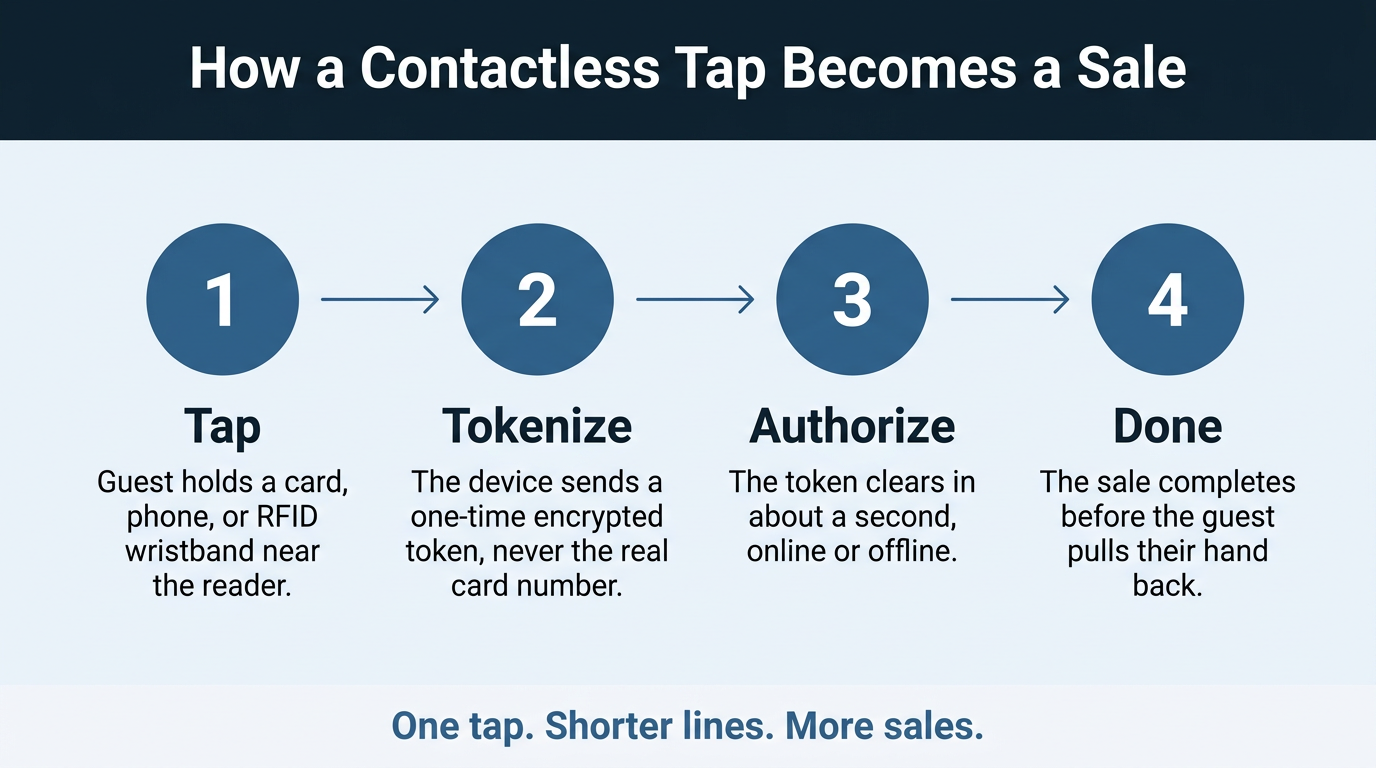
Every tap follows the same short sequence. The customer holds their card or device within a few inches of the reader, which broadcasts a low-power radio field. The payment device wakes up, transmits a one-time encrypted token instead of the raw card number, and the terminal sends that token off for authorization. Because the credential is tokenized, the actual card data never sits on the terminal, which is part of why pos contactless transactions are considered as secure as chip payments. Most small purchases clear with no PIN at all, while larger amounts may still prompt for verification. The whole exchange usually finishes before the customer has pulled their hand back.
What Are the Core Components of a Contactless Point of Sale?
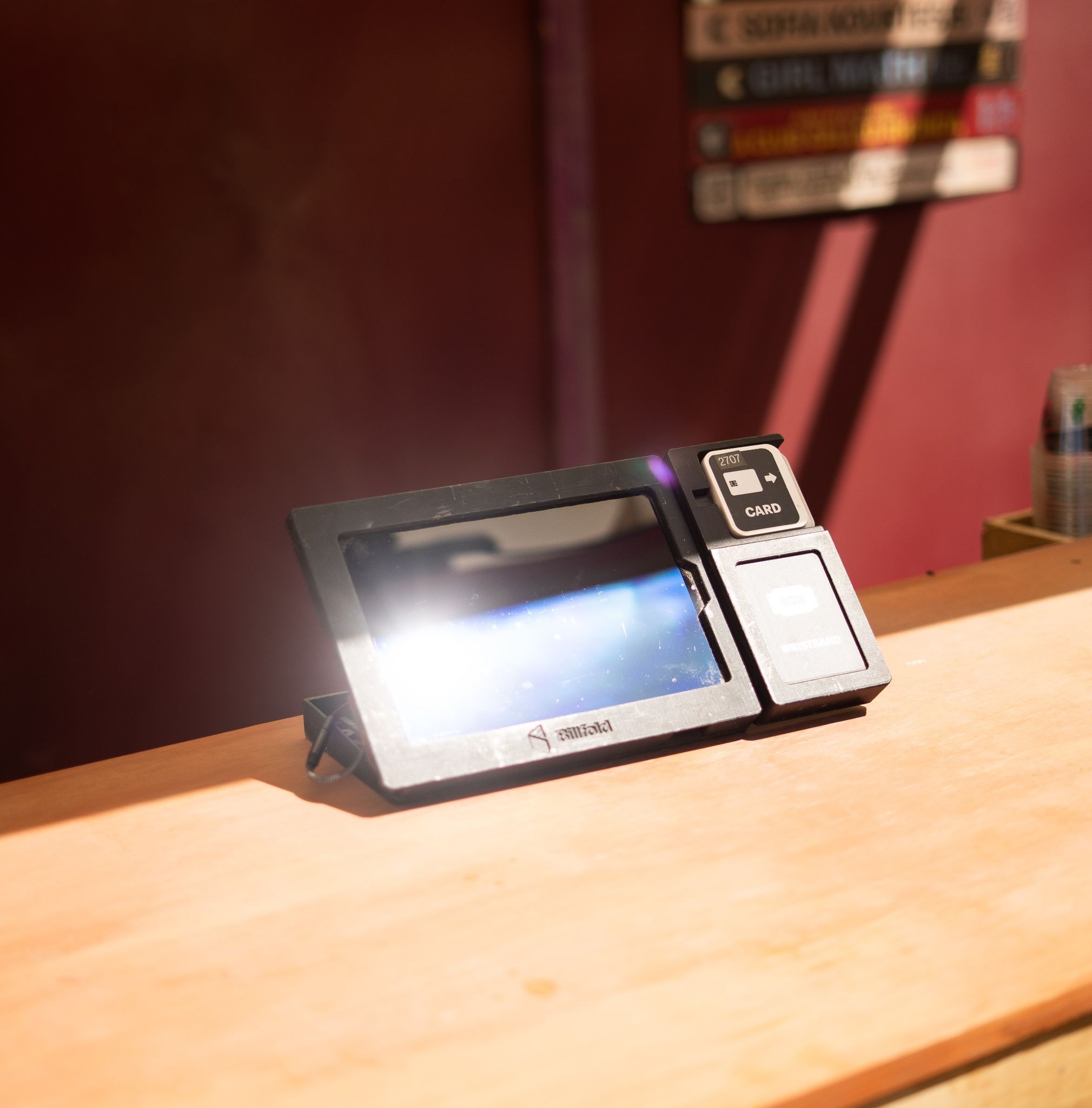
A working contactless setup is really four layers stacked together. First is the terminal hardware: the physical device a customer taps, whether that is a handheld unit, a fixed counter terminal, or a phone running tap-to-pay.
Second is the contactless reader or RFID antenna inside it, the part that actually picks up the signal. Third is the payment software that builds the cart, applies pricing, and formats the transaction. Fourth is the backend that authorizes payments, settles funds, and feeds reporting dashboards. Knowing the difference between RFID, NFC, and EMV technologies helps here, because a single terminal often supports all three at once. At a venue, each of those layers has to hold up under load that a coffee shop will never see.
How Is a Contactless POS Different From Cashless and Traditional Payments?
People use cashless and contactless interchangeably, but they describe different things. Contactless is about the method, the tap itself. Cashless is about the operating model, an event or venue that does not take physical currency at all. A venue can be cashless without being fully contactless, and the reverse is true too. That mix-up matters, because the two choices carry different costs, data implications, and hardware needs. If you want the full breakdown, the distinction between cashless and contactless payments is worth getting right before you buy anything.
Contactless Tap vs Swipe and Insert
The practical gap shows up at the counter. A swipe or chip-insert transaction takes several seconds and asks the customer to do something: orient the card, hold it still, wait for the prompt, maybe sign a screen. A contactless reader collapses all of that into a single tap. At a venue running dozens of registers at once, the gap between a multi-second insert and a one-tap payment is the gap between a line that keeps moving and one that stalls. That mechanical difference is why venues treat checkout speed as an engineering problem rather than a convenience.
Where Do RFID and NFC Fit In?
NFC is the technology behind tapping a phone or contactless card, and it is a close cousin of RFID. RFID wristbands take the same idea further by putting the payment credential on the attendee's wrist instead of in their pocket. That is why so many large events lean on wristbands: there is nothing to pull out, drop, or hand over, and the band can double as an entry credential and a loyalty token. For a deeper look at how the wearable side works, the mechanics of RFID payment technology are covered in detail elsewhere on this blog. The short version is that the band carries a tokenized credential the reader can resolve in a fraction of a second.
Why Do Event Venues Need a Contactless POS System?
Retail stores adopted contactless for convenience. Event venues adopted it because the old way actively cost them money. Consumers now reach for a tap by default: U.S. shoppers averaged 11 mobile phone payments a month in 2024, up from just four in 2018, and they expect the same speed the moment they walk through a gate. A stadium concourse or a festival bar is a high-volume, time-compressed environment where every extra second at the register multiplies across tens of thousands of guests. That is where contactless payment stops being a nicety and becomes core infrastructure.
Faster Lines and Higher Per-Attendee Spend
The single biggest reason venues switch is throughput. When the friction of paying disappears, people buy more often: a second drink, an extra slice, a spur-of-the-moment shirt between sets. Shorter lines also mean fewer guests who give up and abandon a purchase entirely because the wait is not worth it. The result is a measurable lift in per-cap spending, which is the metric most operators watch closest. Faster checkout is one of the few levers that improves the guest experience and the bottom line at the same time, which is rare in event operations.
Reliability When the Network Goes Down
Cellular networks buckle when a crowd that size all connects at once, and a payment system that needs live bank authorization for every tap will stall right when the bar is busiest. This is where closed-loop RFID earns its place, because it can keep processing offline by storing balances on the wristband chip and syncing later. The trade-offs between open loop vs closed loop payment systems decide whether your venue keeps selling during an outage or grinds to a halt. For a marquee event, that single design choice can be worth hundreds of thousands in captured sales. It also protects the guest experience, since nothing sours a night faster than a register that will not take payment.
Vendor Management and Live Data
Most large events run dozens or hundreds of independent vendors. A contactless system that ties them together gives the operator one transparent view of every revenue center, real-time visibility into what is selling and where, and automated settlement instead of a week of manual reconciliation. Cash events operate blind until the final count; a connected contactless setup shows the full picture while the event is still live. For festivals specifically, choosing the right contactless POS for festivals comes down to how well it handles this multi-vendor reality at scale. The same data that closes the books faster also tells you which vendors to invite back next season.
5 Things to Look For in a Contactless POS Terminal
Not every pos contactless setup is built for the demands of a live venue. When you evaluate options, weigh these five factors before anything else, because the right call here saves you from an expensive switch mid-season.
- Offline-first architecture. Verify it rather than assume it. The terminal should finish a sale with no live connection and reconcile later, so a dropped signal never stops the line.
- Hardware built for the environment. Outdoor events punish gear designed for a countertop. Look for a contactless pos terminal rated for heat, rain, and all-day battery, because a dead device is a closed register.
- Fleet visibility. When you run hundreds of units, you need one dashboard that flags a terminal overheating in the sun or running low on battery before it fails, not after.
- Payment flexibility. The system should accept cards, phones, and RFID wristbands, with a cash fallback, so no guest is ever stuck at the counter without a way to pay.
- Settlement and support. Check how quickly vendors get paid out and whether the provider ships gear for self-setup or staffs your event onsite, since that choice shapes your operating cost.
Frequently Asked Questions
What Is a Contactless POS System?
A contactless POS system is a point-of-sale setup that accepts payment when a customer taps or waves a card, phone, or RFID wristband near a reader, with no swipe or chip insert. It uses NFC or RFID to exchange encrypted payment data in about a second. At event venues, it is the standard way to keep lines short and capture sales data in real time.
Is Contactless Payment Secure?
Yes. Contactless transactions replace your real card number with a one-time encrypted token, so the sensitive data never sits on the terminal itself. Modern contactless pos terminals meet the same security standards as chip-and-PIN devices. For most purchases under a set limit, no PIN is even required, which speeds checkout without weakening protection.
What Is the Difference Between Contactless POS and Cashless POS?
Contactless refers to how a payment is made: a tap instead of a swipe. Cashless refers to whether physical currency is accepted at all. A venue can run a cashless operation that still uses contactless taps, and most modern event setups combine both. Getting the distinction right matters when you scope out a system.
Do Event Venues Need Internet for a Contactless Point of Sale?
Not always. Open-loop systems that route every tap through a bank do need a live connection, but closed-loop RFID setups can process payments offline and sync once the network returns. For large venues where networks get overloaded, that offline capability is often the deciding factor. It is the main reason festivals favor RFID wristbands over standard tap-to-pay cards.
Can You Use Contactless Payments at a Small Event?
Yes. The same technology scales down to a single bar or a one-day community event, often running on just a few handheld terminals. Smaller events still benefit from faster lines and clean sales data, even if they do not need full RFID wristbands. The deciding factor is usually transaction volume and whether the operator wants to own its customer data.
Choosing the Right Contactless Setup for Your Venue
A contactless point of sale is no longer the differentiator; it is the baseline guests expect the moment they walk in. The real decision is which system fits your scale, your vendor mix, and your tolerance for risk when the network gets shaky. Get those questions answered before you sign anything, because the wrong setup quietly costs revenue every minute your lines run long. The best systems disappear into the background, so guests notice only that paying was effortless.
That is the gap Billfold was built to close, with closed-loop RFID, offline-first processing, multi-vendor management, and real-time analytics designed specifically for festivals, stadiums, and high-volume venues. If you are evaluating a contactless POS system for your next event or season, reach out to the Billfold team to map it to your operation.
