
RFID vs NFC vs EMV: Which Event Payment Technology Fits Your Venue?
Key Takeaways
RFID, NFC, and EMV are not three competing products. They are three layers of the same stack, and most venues end up running more than one of them at the same counter.
- RFID is a family of radio technologies split across frequency bands. NFC is one specific standard inside the high frequency branch of that family.
- EMV is a rulebook for authenticating card payments, and a contactless card tap delivers EMV rules over the same short range radio link NFC uses.
- The real trade-off is control. A credential you issue keeps the transaction and the data inside your venue. A credential your guest already owns routes both through the card networks.
- Connectivity, event length, and crowd habits predict the right answer better than any feature comparison.
Choose a default rail for resilience and data, then accept everything else so nobody gets turned away at the bar.
Walk any busy concourse and you will see three payment technologies working within twenty feet of each other. Someone taps a wristband at a beer stand, the person behind them holds up a phone, and the next one dips a card. Those are three genuinely different systems, and any platform running payments for live events has to handle all of them without staff behind the counter thinking about it.
The RFID vs NFC vs EMV question matters because each option changes what happens after the tap. Payments data on in-person general purpose card payments shows that in 2022, 87.5 percent of them involved a chip while 19.7 percent were contactless. Chip is the floor almost everyone already meets. Contactless is the part still climbing. At events, a third option sits alongside both: the credential the venue issues itself.
What Does RFID vs NFC vs EMV Actually Mean at an Event?
These three terms get stacked side by side as though they were rival products on a shelf. One is a broad radio family, one is a specific standard inside that family, and one is a set of rules for proving a card payment is legitimate. The RFID vs NFC part is a family relationship, not a rivalry.
RFID Is a Family, Not a Single Product
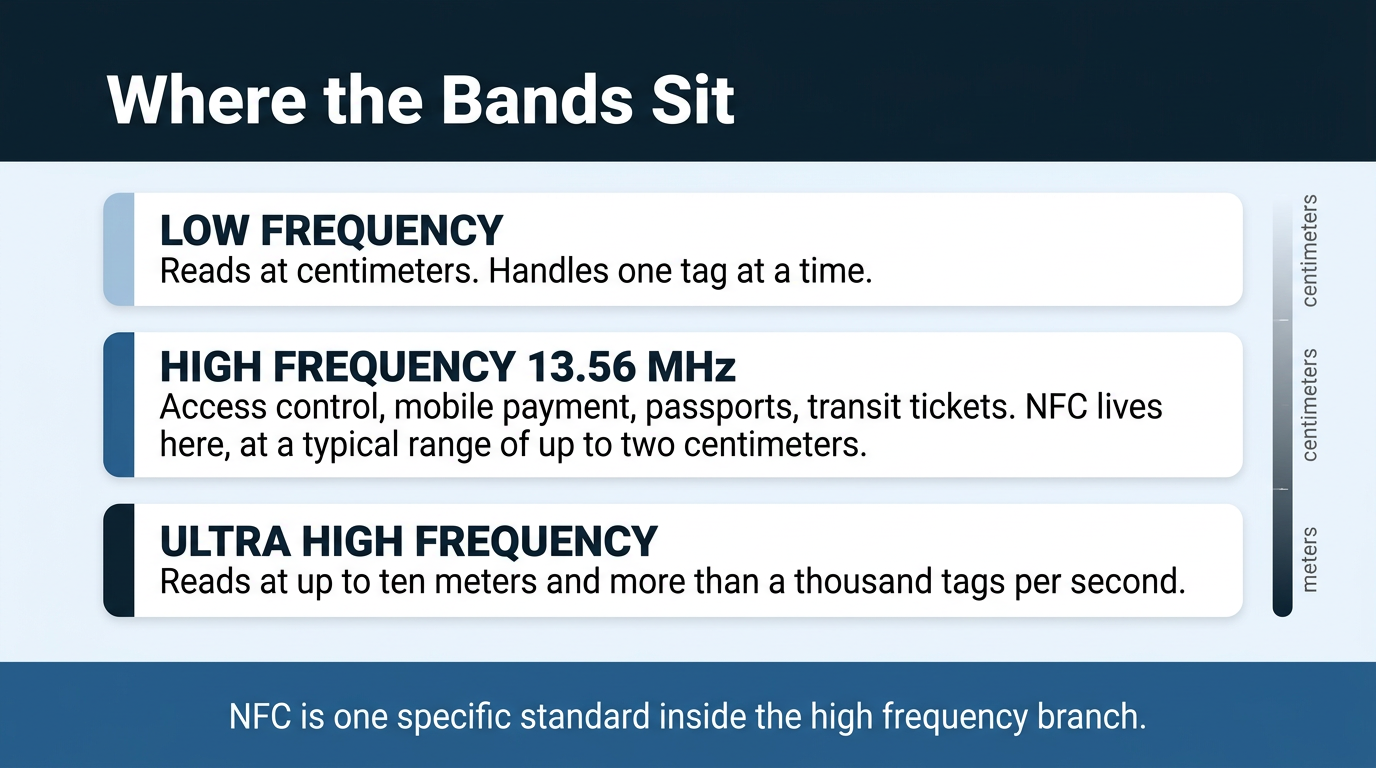
Radio frequency identification is a category, not one technology, and the frequency band is what separates its members. The industry alliance for passive ultra high frequency RFID lays out how the frequency bands differ: low frequency reads at centimeters and handles one tag at a time, high frequency is commonly used for access control, mobile payment, passports, and transit tickets, and ultra high frequency reads at up to ten meters and more than a thousand tags per second. That last band belongs in a warehouse, not at a bar counter.
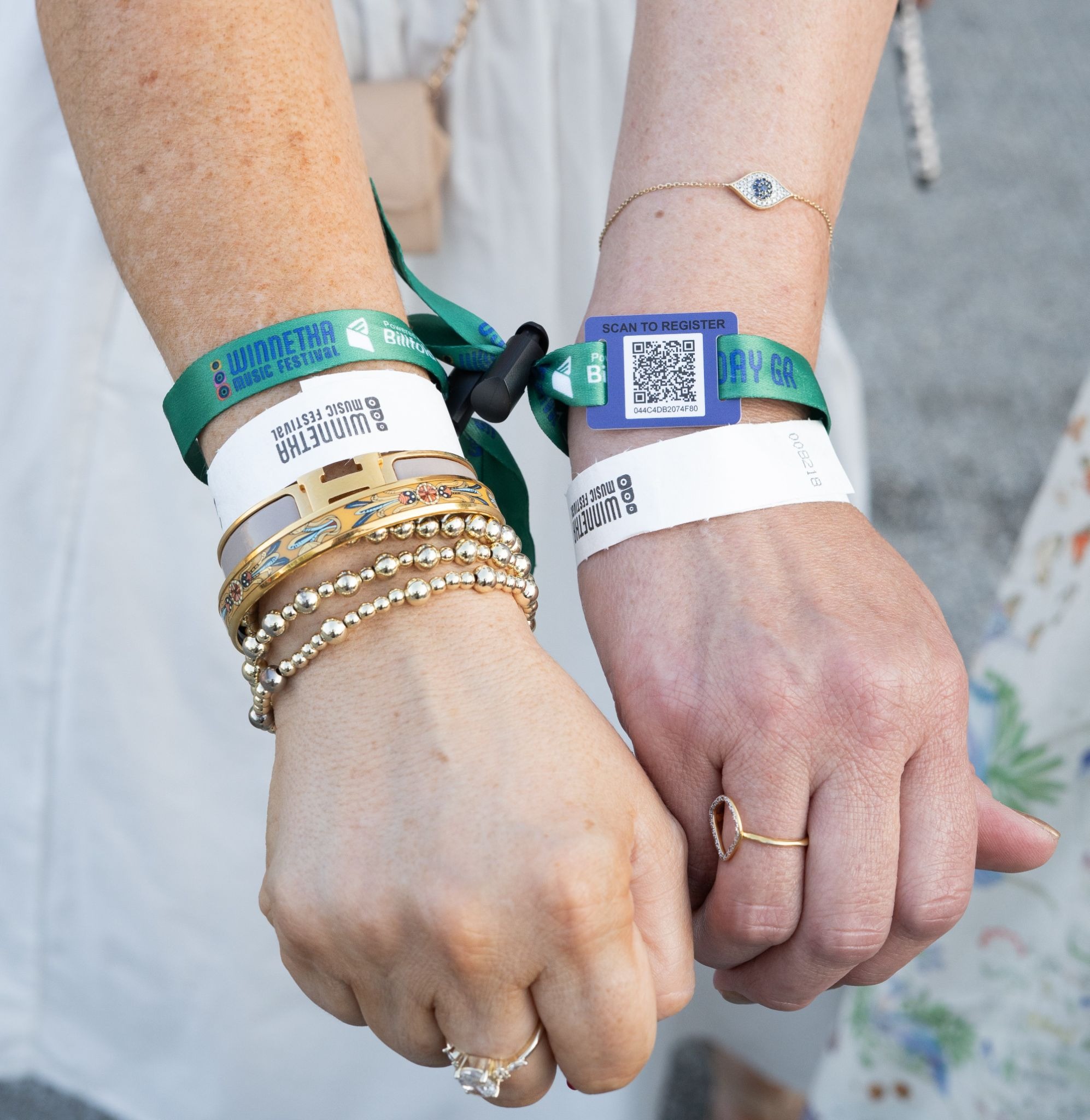
Tags also split into passive and active. Passive tags need no battery and draw power from the reader instead, while active tags carry their own and reach much further as a result. The RFID wristbands issued at events are typically passive high frequency tags, which is why they survive a four day weekend without charging and cost little enough to hand out at the gate.
NFC Is the Short Range Branch Guests Already Carry
Near field communication is one specific standard inside that high frequency branch. The body that publishes its specifications describes NFC operating at 13.56 MHz with a typical range of up to two centimeters. That tiny range is the point: it makes accidental reads nearly impossible and forces a deliberate tap.
NFC also defines a card emulation mode, which lets a phone or smartwatch behave like a contactless card as far as the terminal is concerned. When that emulation runs through a secure element inside the device, the specification puts it at the same security level as a contactless smart card. Every guest with a modern phone already carries a credential you never had to issue.
EMV Is the Rulebook Behind the Chip
EMV is not a radio technology at all. It is the global specification for how a chip card proves a transaction is genuine, named after the three card companies that wrote the first version. The chip runs a cryptographic exchange with the terminal that makes a cloned card useless. When a guest taps instead of dipping, the exchange still follows EMV rules and simply travels over a radio link.
This is where the EMV vs NFC confusion starts. They are not alternatives. Those same specifications list ISO/IEC 14443 among the protocols NFC devices speak, and that is exactly the protocol contactless cards use. Contactless EMV is EMV rules delivered by NFC radio, which is why one reader handles a tapped card and a tapped phone identically.
Where Does Each Technology Live at Your Venue?
The abstract comparison stops being useful the moment you order hardware. What matters then is which objects your guests hold and which readers sit behind your counters.
The Credentials Your Guests Carry
A wristband is a credential you issue and control, down to what it unlocks and what happens to leftover balance. A phone or bank card is a credential somebody else issued, and every transaction on it answers to the card networks, which changes your reporting, your fees, and your ability to fix problems on site. A lost wristband is a support ticket your team clears at a booth. A declined card is a conversation with a bank you have no relationship with.
The Readers, Terminals, and Gates You Deploy
At the counter, an EMV vs NFC distinction is mostly academic, because one terminal reads both and most event hardware adds the high frequency band wristbands use. Gates are where the paths separate, since access control is a different deployment from a payment tap at a bar. Contactless payment types at events converge at the point of sale and diverge everywhere else, which is why the cashless and contactless POS platform behind the hardware matters more than the terminal spec sheet.
How Do Speed, Cost, and Offline Behavior Compare?
Vendors love quoting reader speed. It is the least interesting number in the room, because the handshake is almost never the bottleneck. What sets your line length is everything after it.
Speed Is About the Round Trip, Not the Tap
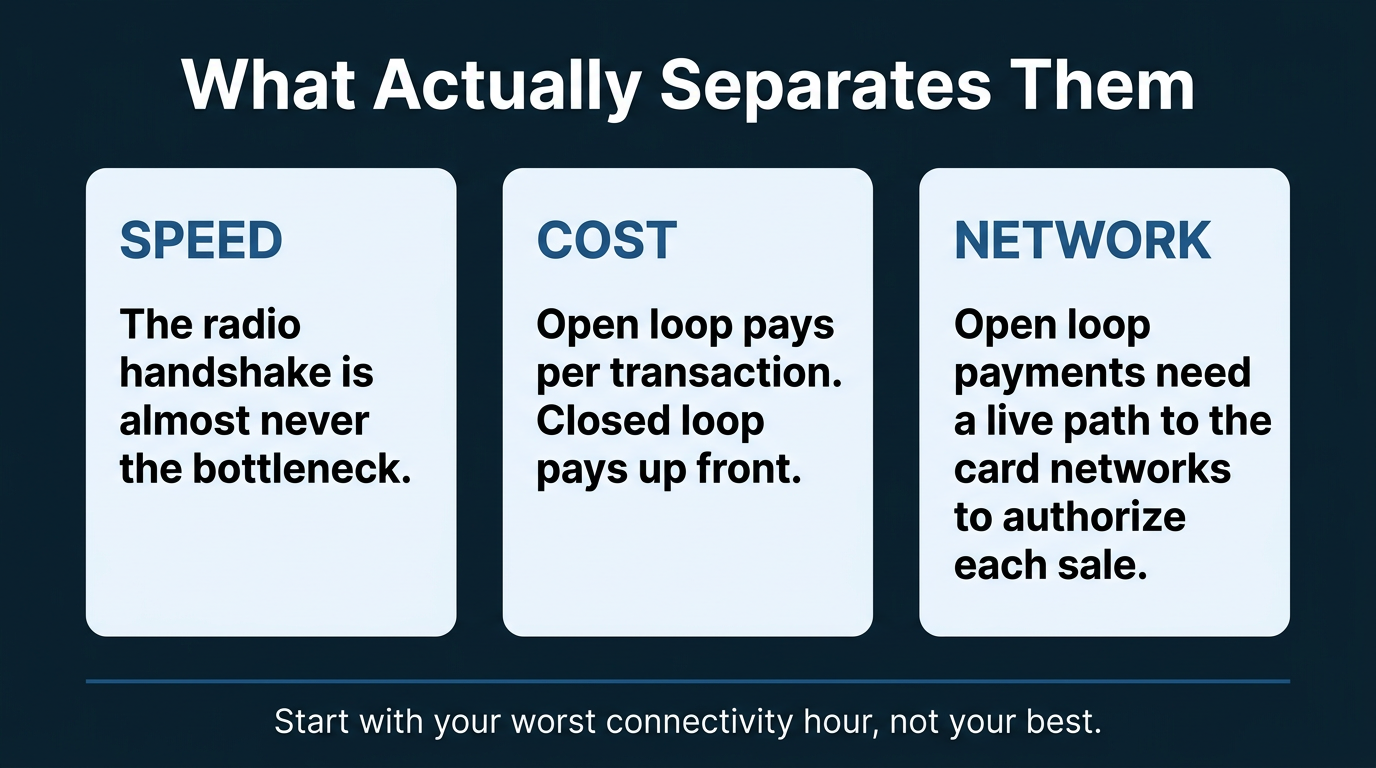
A contactless tap and a chip dip both finish their exchange with the terminal quickly. What comes next is the difference. An open loop transaction has to reach an issuing bank and come back before the sale completes, across whatever network you have on site. A closed loop transaction resolves against a balance the venue already holds, so the trip is short by design. In a quiet indoor bar that gap barely registers. During a set change, with thousands of people on one cell tower, it becomes your queue.
Cost Sits in Completely Different Places
Open loop taps carry per transaction network costs and almost no upfront investment. Closed loop credentials invert that: you pay for bands, activation infrastructure, and the platform, then spend less per transaction once volume is real. A one night club show lands on the opposite side of that math from a four day festival, so the open loop and closed loop trade-offs are worth working through before you sign anything.
What Happens When the Network Drops
This is where the RFID vs NFC vs EMV comparison stops being academic. Open loop payments need a live path to the card networks to authorize each sale, and if that path disappears the sale goes with it. Closed loop architectures authorize against a balance held inside the venue's own system, which is why they became the default at outdoor sites where connectivity is a gamble. Any honest event payment technology decision starts with your worst connectivity hour, not your best.
5 Questions That Settle the RFID vs NFC vs EMV Decision
Most of this collapses into five questions. Answer them honestly and the architecture largely picks itself.
- What happens to money left on a credential? Preloaded balances create an obligation. Settle whether leftovers get refunded, converted, or donated, and publish the rule before tickets go on sale.
- Who staffs activation at the gate? Issued credentials need people handing them out and registering them, and that labor lands squarely in your busiest hour. It does not exist when guests tap their own cards.
- How long does the event run? A single evening rarely justifies issuing anything. A multi day festival spreads the cost across four days of taps and re-entries.
- Does the credential need to do more than pay? If the same object handles entry, age verification, and restricted zones, you are describing a wristband, not a bank card.
- How will cash-preferring guests pay? Some share of every crowd shows up with cash and nothing else. Decide whether you keep a cash lane or offer a conversion point before you print signage that says cashless.
Why Do Most Venues Run a Mix Instead of Picking One?
Guests do not arrive sorted by payment method. A venue that only accepts wristbands turns away the walk up guest who bought a ticket an hour ago and never registered. A venue that only accepts phone and card taps has nothing to offer the guest whose battery died somewhere around the second set. Running both is redundancy, not indecision.
What makes a mix workable is the layer underneath. Three separate systems means three reconciliations and three arguments at settlement. One platform that treats all of them as inputs to a single ledger removes that. The RFID vs NFC vs EMV choice then becomes a question of defaults rather than exclusions: which rail you steer guests toward, and what you accept from everybody else.

Which Setup Fits Your Venue Type?
Venue type predicts the answer better than any feature comparison, because it sets connectivity, dwell time, and crowd behavior at once. Three profiles cover most operators.
Festivals and Multi Day Outdoor Events
Wristbands dominate here for reasons that have little to do with payment elegance. Connectivity is unreliable, dwell time is long, and one credential can carry entry, re-entry, and spending across four days. Operators comparing contactless POS options for festivals are choosing a default rail rather than eliminating alternatives.
Stadiums and Arenas
Connectivity is generally better and dwell time is shorter, so open loop taps carry a larger share of volume. The pressure here is compressed demand, since everybody wants a beer during the same six minute break, so counter speed matters more than credential issuance. Venues working through what stadiums and arenas need from a point of sale prioritize throughput and multi stand coordination.
Bars, Nightclubs, and Permanent Venues
Permanent sites have stable networks and repeat guests, which favors open loop taps for casual visits and issued credentials for members and season programs. The mix here is about loyalty more than resilience, and a credential that recognizes a returning guest beats a marginal gain in transaction speed.
FAQ
Is NFC the Same Thing as RFID?
Not quite. NFC is a specific standard built on high frequency RFID, so every NFC device uses RFID, but plenty of RFID is not NFC. The RFID vs NFC confusion comes from one containing the other. Ultra high frequency RFID, used for inventory, sits in a different band and reads from meters away rather than centimeters.
Can a Contactless Card and a Phone Use the Same Reader?
Yes. Cards and phone wallets communicate over the same short range protocol, so one terminal handles both with no configuration difference. That is the practical answer to most EMV vs NFC questions. The phone is emulating the card, so the terminal does not need to know which one it is talking to.
Do RFID Wristbands Work Without Internet?
Closed loop wristband systems authorize against a balance the venue holds rather than a bank, which is what allows sales to continue when connectivity fails. Open loop taps cannot, because every transaction needs a live authorization path back to the issuing bank.
Do I Have to Choose One Technology for the Whole Venue?
No, and most operators do not. The common pattern is one primary rail chosen for resilience and data ownership, with the other contactless payment types at events accepted at the same terminals for anyone who prefers them.
Choosing the Right Mix for Your Venue
The RFID vs NFC vs EMV debate has a fairly boring answer, and boring answers tend to be the correct ones. RFID gives you a credential you control. NFC gives you a credential your guests already carry. EMV gives you the rules that make card payments trustworthy anywhere. None of the three is obsolete on its own. The decision worth making is which becomes your default, and that follows from connectivity, event length, and how much you care about owning the data.
Billfold builds event payment technology that accepts RFID wristbands, phone and card taps, QR codes, and cash through a single platform, with real time reporting across every vendor and revenue location. Reach out to the Billfold team to work out which mix fits your venue.
