
Reverse ATM Kiosks: How They Work, Costs, & Venue Compliance

Key Takeaways
A reverse ATM has stopped being a courtesy for cash-carrying guests. In a growing list of jurisdictions, it is the legal mechanism that lets a venue stay cashless at all.
- New York's cash acceptance law exempts a business only if it puts a device on site that converts cash into a prepaid card usable at that business.
- The statute writes the fee model for you: no conversion charge, a minimum load of a dollar at most, no expiry, and no ceiling on card use.
- If the machine fails, the venue has to take cash at the register and post a sign saying so, which makes uptime a compliance question rather than a service preference.
- The commercial case holds on its own, because a meaningful share of any crowd either has no bank account or leans on cash by choice.
Spec the kiosk as one node on your payment network, not as a standalone box bolted to a concourse wall.
A venue that stops accepting cash has not eliminated cash. It has relocated the problem to the gate, where a guest holding two twenties and no card becomes somebody's operational headache. A reverse ATM solves that by taking bills and issuing a card balance the guest can spend at any register on site. What has changed recently is why operators install one. It used to be a service decision. It is now, in a growing number of markets, the condition attached to running a digital-only operation.
The population these machines serve is larger than most concourse managers assume. Federal Reserve research into how underserved households manage money found that more than 18 percent of US households are either unbanked or underbanked, and that participants valued cash for its immediacy and its freedom from transaction fees. This guide covers how the machines work, what they cost, what the compliance backdrop demands, and how conversion connects to the rest of your payment stack.
What Is a Reverse ATM and How Does It Work?
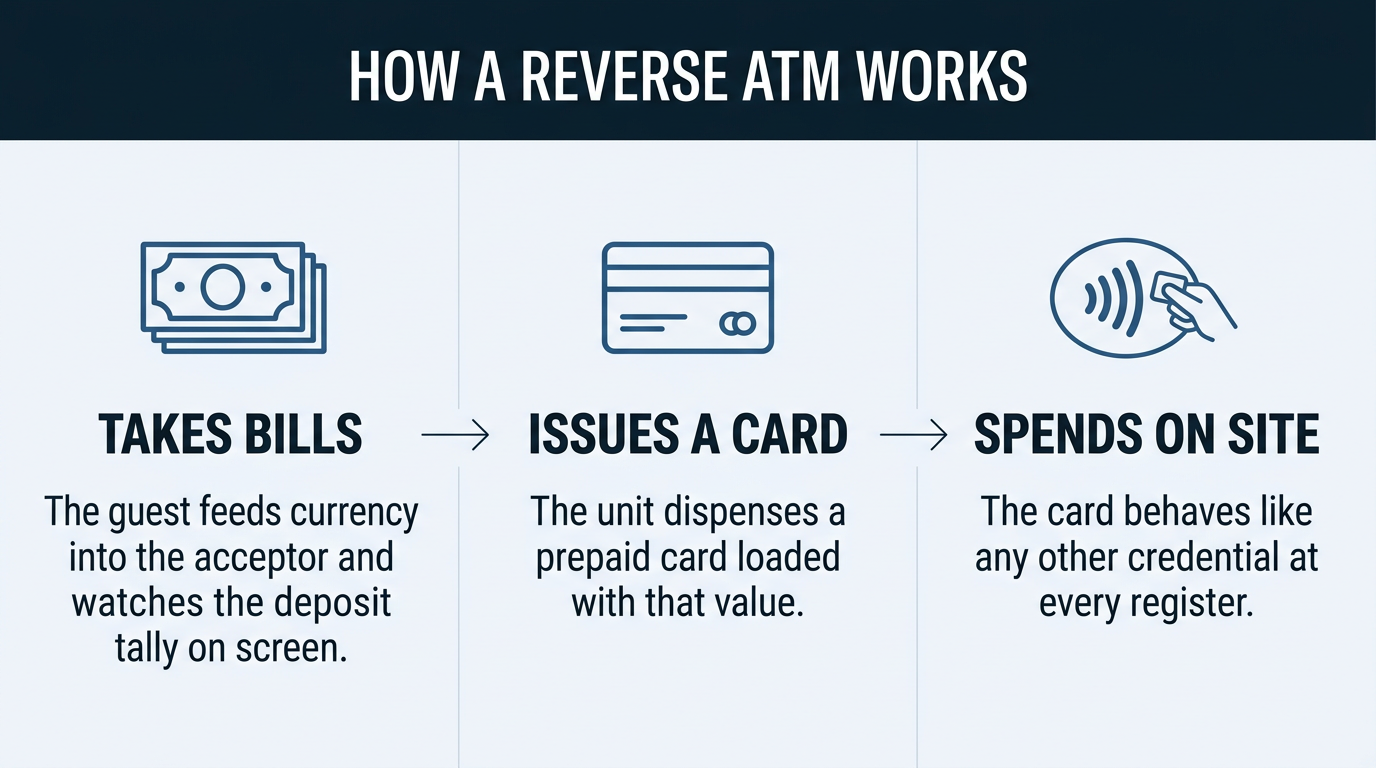
A bank ATM takes an account balance and gives you cash. This machine runs the transaction backward, taking currency and returning spendable value on a card. The mechanics explain in a sentence. The details underneath decide whether the deployment holds up on a sold-out night.
The Conversion Loop, Step by Step
A guest feeds bills into the acceptor and watches the deposit tally on screen. On confirmation the unit dispenses a prepaid card loaded with that value, typically without collecting personal information. The exchange should finish faster than the concession line the guest is about to join.
From there the card behaves like any other credential on site. The guest taps at a bar, a merch stand, or a food truck, and the balance draws down. Whether leftover value travels home or stays trapped in the venue depends on the card product behind the machine, a decision to make deliberately rather than inherit from a hardware vendor.
What Sits Inside the Cabinet
The hardware is a bill validator, a card dispenser, a small computer, and a touchscreen in an enclosure sized for wherever it has to live. Enclosure specs and kiosk placement and deployment patterns deserve their own treatment. The software layer is what operators underweight during procurement, because it governs card issuance, load limits, receipting, and the reporting feed. It decides whether the unit is a visible part of your operation or a black box you reconcile by hand at the end of the night.
Why Are Cash Acceptance Laws Driving Reverse ATM Adoption?
For most of the last decade, going cashless was a free choice. Legislatures have been closing that door, and the mechanism is the same nearly everywhere: mandate cash acceptance, then carve out an exception for businesses that provide a conversion device. That carve-out is why this category exists at the scale it does.
What the New York Statute Actually Says
New York's statewide law makes it unlawful for a food store or retail establishment to refuse cash from consumers, with narrow exceptions for bills above twenty dollars and for telephone, mail, or internet transactions that do not happen on the premises. Penalties reach one thousand dollars for a first offense and fifteen hundred for each one after that, per the text of the enacted bill. A stadium concourse, a festival bar, and an arena merch stand all sit squarely inside those definitions.
Charging more for cash is barred too, which forecloses the workaround most finance teams reach for first.
The Kiosk Exemption and Its Fine Print
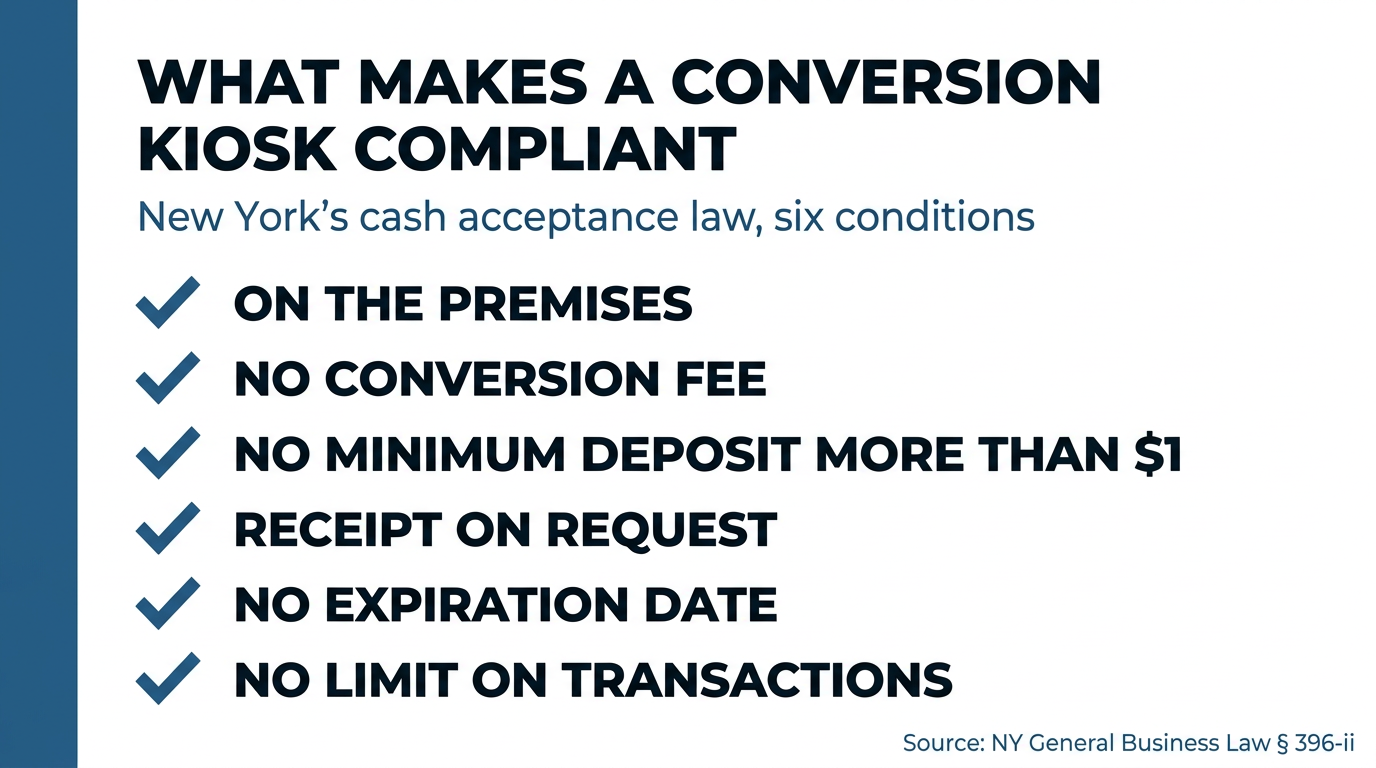
The exception is where the conversion machine enters the picture. The law does not apply to an establishment that provides an on-premises device converting cash into a prepaid card the guest can use to complete a purchase there. New York City enforces a comparable rule of its own, and the city's guidance states plainly that businesses must accept cash unless they have a conversion machine on site. The precedent in the country's largest venue market is already years old.
The fine print is where operators get caught. The device cannot charge a fee. It cannot require a minimum deposit greater than one dollar. It has to produce a receipt on request showing the amount deposited. The balance cannot carry an expiration date, and there can be no limit on how many transactions the card runs. Miss one of those and the exemption evaporates, leaving the venue back on cash at every register while still paying for hardware that no longer buys it anything.
What Does a Reverse ATM Cost, and Who Pays the Fee?
Every deployment answers one question early: who absorbs the cost of turning a guest's bills into card value. For years that came down to margin. In regulated markets it is now a constraint, and portfolio operators have to reconcile the two.
Operator-Pays Versus Guest-Pays
Under operator-pays, the venue eats the conversion cost and a twenty in the slot becomes twenty on the card. It is the cleaner guest proposition, because charging someone to spend their own money at a place that refuses their money reads as a penalty for being unbanked. The venue recovers the cost through spend it would otherwise turn away at the counter.
Under guest-pays, the machine deducts a flat or percentage fee before loading the card. It lowers the operator's line item and sours the exact guests the machine exists to serve. Federal Reserve focus group research is blunt here: prepaid card users complained specifically about fees charged to load money onto them, while praising products that kept fees low and transparent. Charging at conversion targets the one friction point that population already names as a grievance.
Why the Fee Model Is Sometimes Decided for You
In a jurisdiction with a cash acceptance mandate, guest-pays forfeits the exemption. A fee-charging reverse ATM machine does not qualify, so the venue pays for hardware and still owes cash acceptance everywhere. Operators spanning several states usually land on operator-pays across the board, because one guest-facing standard is cheaper to administer than a patchwork of per-site fee rules.
The cost picture extends past the conversion fee. Hardware, card stock, cash-in-transit for the bills the machine collects, and the labor to service units mid-event all sit on the ledger, and they belong in the same model as every other line of payment infrastructure you fund.
Where Should a Cashless Conversion Kiosk Go, and Who Has to Reach It?
A machine nobody finds goes unused, and one nobody can physically operate is a liability. Placement, accessibility, and uptime usually get handled as three separate workstreams. They belong together.
Where the Units Belong
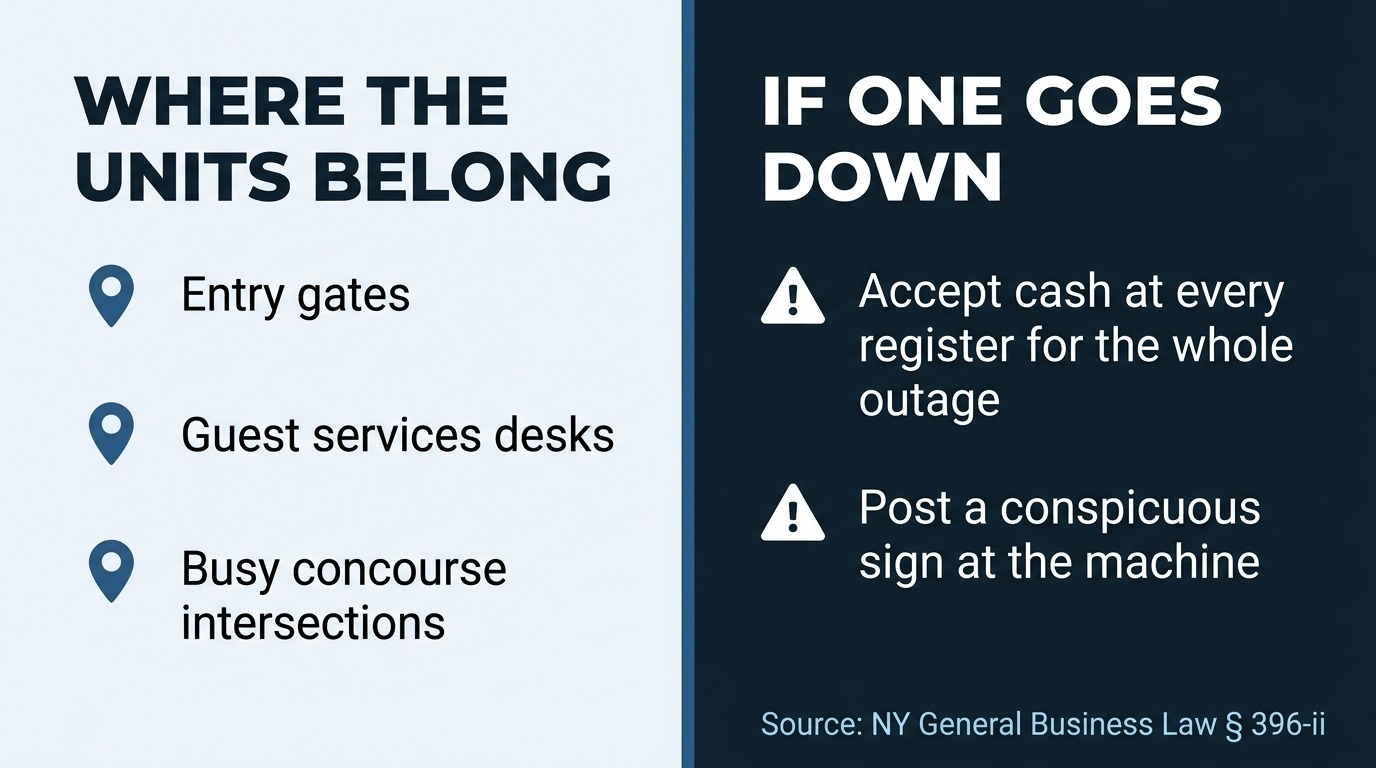
The governing principle is that a cash-carrying guest should meet a conversion point before a register, not after being refused at one. That puts units at entry gates, guest services desks, and busy concourse intersections. Stadiums and festivals need different answers from there. The cash to card kiosk stadiums install at gate level absorbs a compressed arrival surge, while the unit a festival tows onto a field chases foot traffic that moves all weekend.
Capacity follows arrival patterns rather than square footage. Operators who have already moved an arena fully cashless tend to overbuild at the gates in year one and rebalance later, which is the cheaper mistake.
Accessibility and the Uptime Requirement
Any self-service machine open to the public has to work for guests with disabilities, which shapes screen height, reach, clear floor space, and non-visual operating modes. Specify accessible units during procurement rather than retrofitting after a complaint, and confirm your placement preserves the clearance the unit needs. A staffer standing nearby is no substitute for a machine a guest can work independently.
Uptime carries a legal weight most operators miss. Under the New York statute, when the conversion device malfunctions the establishment has to accept cash for the entire period it is down, and post a conspicuous sign at the machine saying so and pointing consumers to where they can report a violation. A jammed bill acceptor becomes a compliance event, which makes your service plan and escalation path part of your regulatory posture.
5 Questions to Ask Before Signing a Cash to Card Kiosk Contract
Most procurement conversations fixate on price per unit. These are the questions that decide whether the deployment works on event day and holds up under a regulator's reading.
- Who absorbs the conversion fee, and does that survive a move across state lines? A contract written for a no-fee market should not quietly flip to guest-pays when you open somewhere without a mandate.
- What is the minimum deposit? Anything above one dollar disqualifies the machine from the New York exemption, as do expiring balances and transaction caps, all of which ship as vendor defaults on some prepaid programs.
- What is the uptime commitment and the escalation path during an event? Ask who clears a jam at 9pm on a Saturday and how long it takes, because that answer sets how long you are legally back on cash.
- Does kiosk activity report into the same dashboard as your POS sales? If conversion volume arrives as a separate monthly file, you lose any view of where cash-preferring guests actually spend, and you cannot confirm the card clears at every vendor you host.
- Who owns the bills the machine collects? Cash-in-transit, reconciliation, and shortage liability need a named owner in writing before the first event.
How Does the Kiosk Connect to the Rest of the Payment Network?
A conversion point is only as useful as the network behind it. If the card fails at one bar, the guest experiences your venue refusing their money twice in a night. Integration is where these deployments quietly succeed or fall apart.
Open-Loop Cards Versus Closed-Loop Balances
Open-loop cards ride the major networks, clearing at any standard terminal on site and holding value the guest spends elsewhere afterward, which removes the end-of-night refund line. Closed-loop value lives on the venue's own platform instead, keeping spend and guest data unified but usually tying the balance to that property. Choose on purpose, because the decision also sets how a cash to card kiosk fits your refund policy and your data model.
Reporting Across the Whole Operation
The strongest argument for treating conversion as part of the payment stack is visibility. When loads and register sales land in one system, you can see how much converted cash gets spent, where, and how much walks out unspent. Same discipline as a well-run cashless payment rollout at an event, where every terminal, credential, and revenue center reports to one place.
Run it the other way and the machine becomes a reporting orphan. Conversion volume sits in a vendor statement, register sales sit in your dashboard, and nobody can say whether the program paid for itself.
FAQ
How Is a Cash to Card Machine Different From a Bank ATM?
A bank ATM withdraws currency from an account. This machine runs the other direction, exchanging bills for card value the guest spends on site. The practical difference for operators is ownership: a bank ATM is usually a third-party revenue share, while a conversion unit is a cost center you fund to protect your right to stay digital.
Does a Reverse ATM Machine Let a Venue Legally Stay Cashless?
In New York, yes, provided the device satisfies every statutory condition. The wrinkle operators miss is that the exemption attaches to the establishment, so on a property where independent vendors ring their own sales, each of those sellers has its own exposure. Confirm with counsel that your coverage reaches every business operating on site, and remember that other jurisdictions word their carve-outs differently.
Can a Venue Charge Guests a Fee to Convert Cash?
Commercially yes, and some operators do it in unregulated markets. Legally it forfeits the exemption anywhere the mandate requires fee-free conversion, so the venue owes cash at every register despite having bought the hardware. Worth separating two rules operators tend to conflate: the conversion fee is one question, and the flat ban on charging cash payers a higher price for the same item is a different one that applies whether or not a kiosk is on site.
What Happens If the Cashless Conversion Kiosk Breaks Mid-Event?
The venue falls back to accepting currency at every register for the whole outage, and has to flag that obligation on signage at the unit. Build for it: a spare on site, a documented service path, and a shift lead who knows to open a drawer without waiting for approval. Downtime is legal exposure, not inconvenience.
Treat the Conversion Point as Infrastructure, Not an Amenity
The venues that get this right stop treating the machine as a gesture toward guests who have not caught up. It is payment infrastructure with a regulatory obligation attached, a fee model that may already be written for you, and an uptime requirement carrying legal consequences. Spec it that way and it captures revenue a digital-only operation would otherwise refuse at the door.
None of it pays off without a payment network that recognizes the card everywhere it is presented. Billfold builds the cashless and contactless POS backbone that live events, festivals, and venues run on, with RFID wristband payments, multi-vendor management, and real-time reporting across every revenue center. Reach out to the Billfold team to map a cashless deployment to your operation.
