
Multi-Venue Payment Operations: Running Cashless Across a Venue Portfolio

Key Takeaways
Running cashless across a portfolio is an operating discipline, not a hardware purchase, and it lives in configuration, device management, and reporting standards.
- Device provisioning causes most night-of failures, and it happens weeks before anyone taps a wristband.
- A master catalog with deliberate local overrides lets a new site open at the same service level as the flagship.
- Consolidated reporting answers portfolio questions and per-site reporting closes the books, and both need one dataset.
If every venue runs its own payment stack, you do not have a portfolio. You have one-off events that share a logo.
One venue with a payment problem is an inconvenience. Nine venues with the same payment problem is a business risk. That gap is the entire subject of multi-venue payment operations. Ticket sales across the top 100 worldwide tours slipped 3.7 percent in 2025 while the average show sold a record 19,104 tickets, according to year-end touring data, which means revenue is concentrating into fewer, denser nights. Denser nights punish operators whose payment setups vary from building to building.
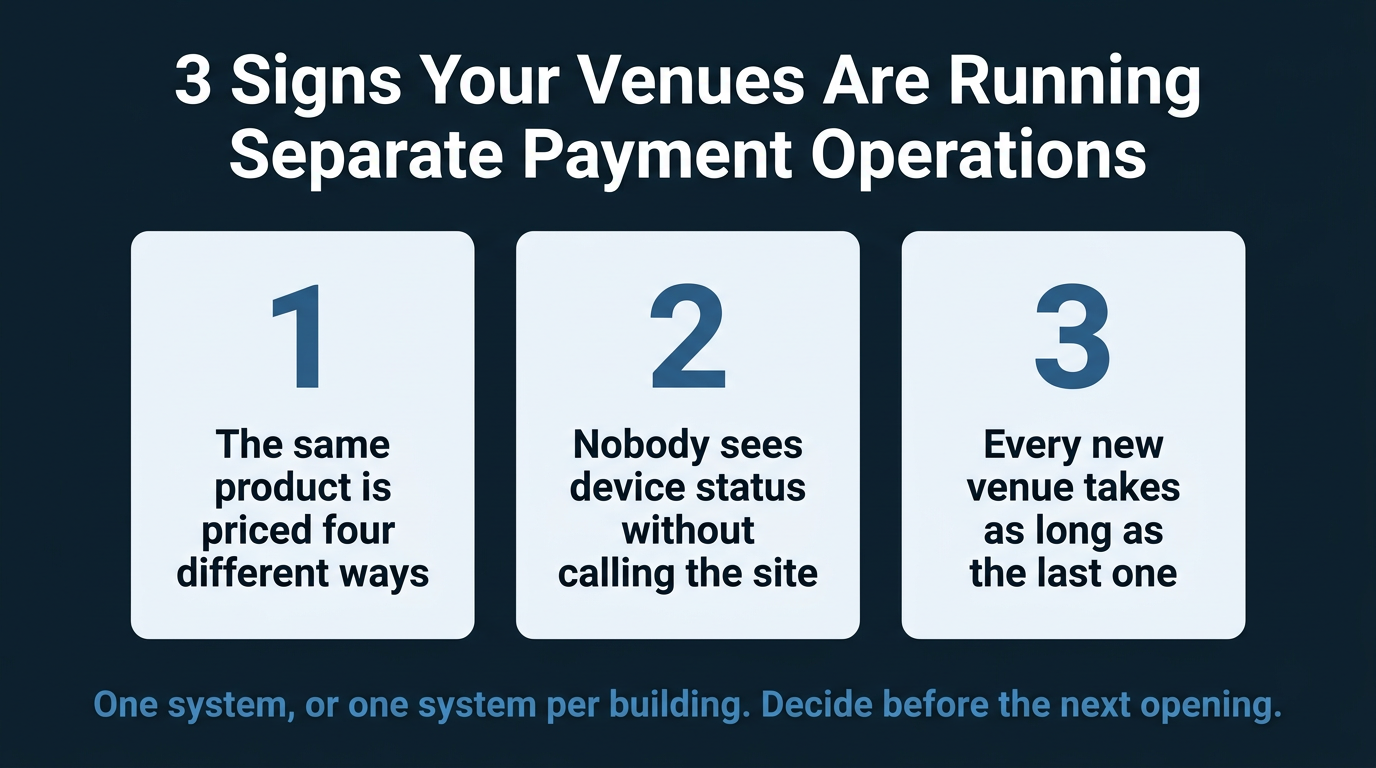
Event groups, venue portfolios, and concessionaires know the symptoms. Terminals arrive unconfigured. One site's pricing drifts out of sync. Settlement runs a week late at the venue that came with an acquisition and its own hardware. Operators comparing cashless payment platforms for live events usually start with the terminal, when the real difference sits a layer above it: device fleet provisioning, catalog and payout standardization, and the reporting split between portfolio and site.
What Are Multi-Venue Payment Operations?
Multi-venue payment operations is the practice of running payment acceptance, device management, catalog configuration, and reconciliation as one system across every site in a portfolio, instead of as a separate project at each one. The distinction matters because most operators arrive at a portfolio by accretion, adding venues one at a time, each carrying whatever setup made sense the year it opened.
Where Single-Site Thinking Falls Apart
A single venue absorbs an enormous amount of manual work. One general manager knows which terminal is flaky and which vendor always disputes the sales figure. That knowledge lives in someone's head, and it holds up right until you need it in four buildings on the same weekend. Portfolios fail at the seams: the new site, the seasonal festival, the venue acquired with its own hardware. Every seam is where pricing drifts and reconciliation slows down.
Who Actually Owns Portfolio Cashless Operations
In most organizations nobody does, which is the underlying problem. Finance owns settlement, IT owns devices, and each venue's operations lead owns the floor. Portfolio cashless operations works only when one function holds authority over configuration standards across all sites, with local leads requesting exceptions rather than inventing them. That is an organizational decision as much as a technical one, and the platform either supports it or quietly pushes every site back to its own way of working.
Why Does Payment Device Fleet Management Break Before Doors Open?
Most payment failures at live events are not payment failures. They are configuration failures that surfaced under load. Payment device fleet management is where a portfolio either saves itself weeks of labor per season or spends those weeks again and again.
Provisioning a Cashless Payment Device Fleet at Scale
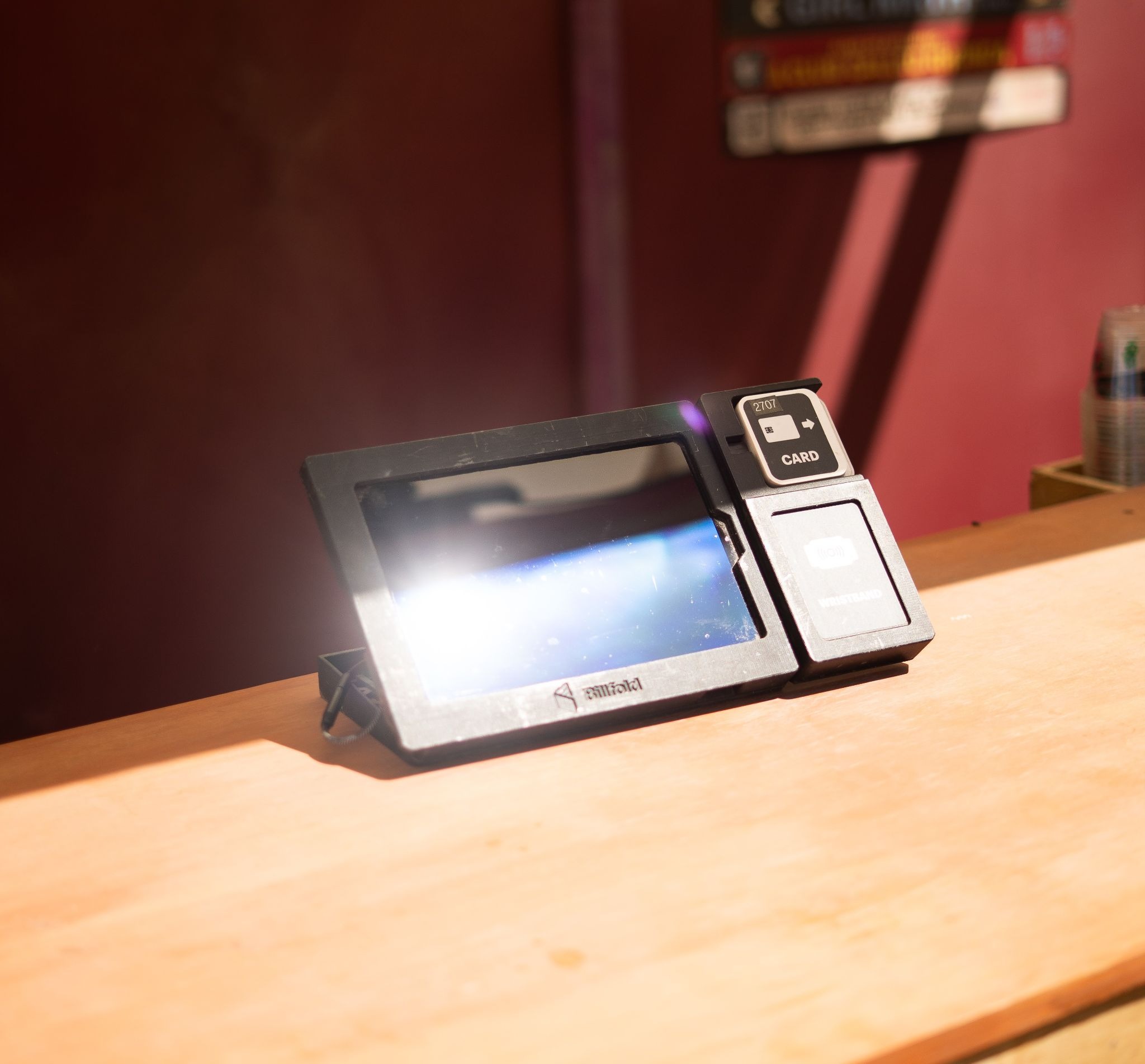
Provisioning means getting every terminal to the right venue, loaded with the right catalog, assigned to the right revenue center, and connected before anyone taps anything. At one venue, a competent person does this by hand in an afternoon. Across a cashless payment device fleet spanning hundreds of terminals and a dozen sites, hand configuration becomes the bottleneck and the error source at once. The approaches that survive scale share a pattern:
- Device profiles built once and applied to groups, so new terminals inherit venue and revenue center settings
- Catalogs and pricing pushed centrally instead of typed at each station
- Staff permissions tied to roles, so adding a bartender does not mean touching every device
- A readiness view showing which units are online, updated, and assigned before gates open
Monitoring and Remote Configuration During Service
Once doors open, the question shifts from whether devices are configured to whether they work. Remote visibility matters because the alternative is a runner walking the site. Useful monitoring surfaces which units dropped offline, which report connectivity or power problems, and which revenue centers have gone quiet against their normal pace. A stand that stops selling at 9:40 pm should register as an alert during service, not as a question in the review.
Cost pressure is what pushes this up the priority list. Seventy-two percent of surveyed venue technology leaders named lowering operating costs their biggest challenge for the year ahead, up from 64 percent the year before. Central configuration is one of the few levers that cuts labor without cutting service.
How Do You Standardize Pricing, Menus, and Payouts Across Venues?
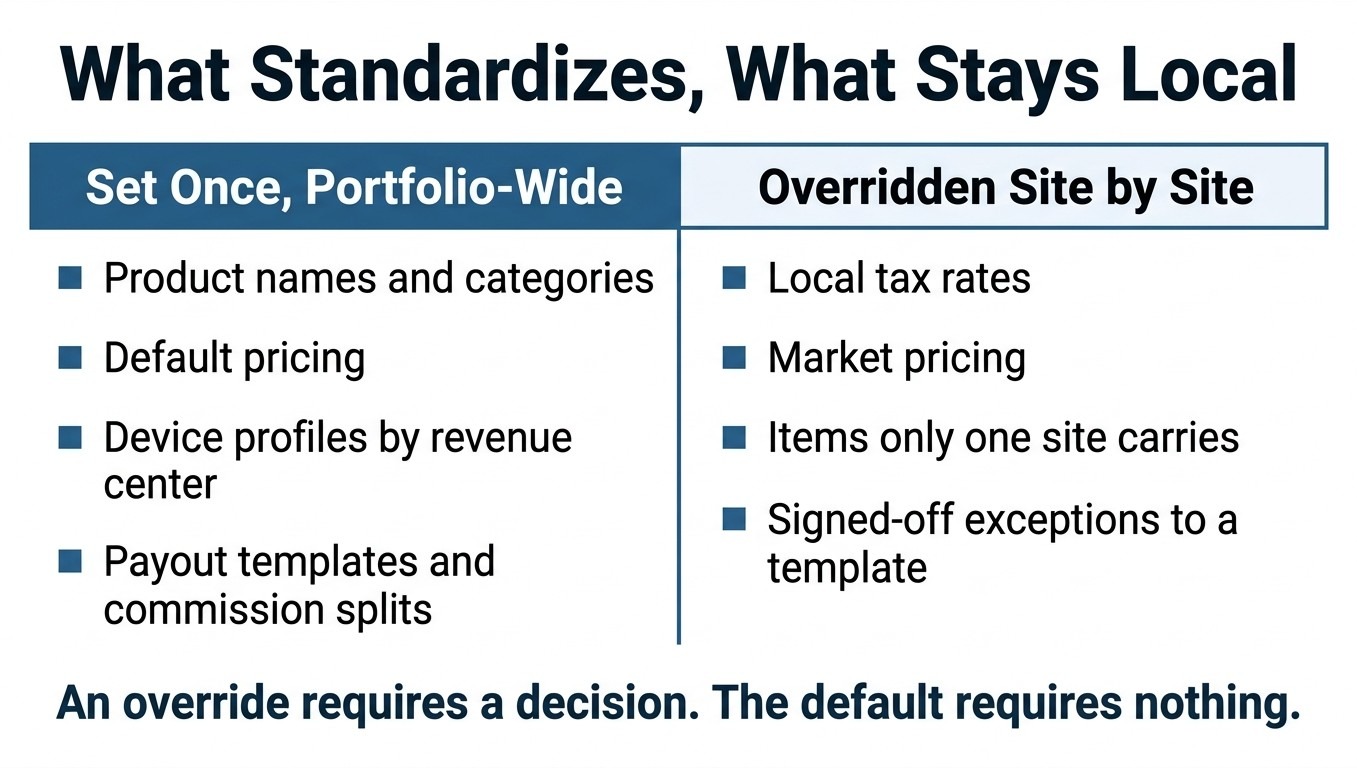
Standardization sounds like flattening, and it is closer to the opposite. A shared baseline makes local variation deliberate instead of accidental, which is what separates multi-venue cashless operations from a group of venues that happen to share a terminal brand.
One Catalog, Many Local Overrides
Build the master catalog at the portfolio level: product names, categories, tax treatment, default pricing. Then allow venue-level overrides for what genuinely differs, such as local tax rates, market pricing, and items only one site carries. The working rule is that an override requires a decision while the default requires nothing. Operators who skip this step end up with the same beer listed four ways across four venues, which makes portfolio-level product analysis impossible and turns every menu change into a four-place edit.
Payout Programs That Travel
Vendor terms, commission splits, and service charges are where portfolio operations get politically complicated. A concessionaire working across your sites notices immediately when terms differ by building without a reason. Standardizing payout programs means defining the few deal structures you actually use, applying them as templates, and treating anything else as a signed-off exception. Settlement speeds up, because finance reconciles against known structures instead of reading contracts. It is worth studying how vendor onboarding and settlement work across multi-vendor events, since payout logic and reporting logic are the same system viewed from opposite ends.
Consolidated or Per-Venue Reporting: Which Does Your Portfolio Need?
Both, and the common mistake is treating it as a choice. The two views answer different questions for different people, and they need to come from one dataset instead of being assembled from exports after the fact.
What Consolidated Reporting Answers
Consolidated reporting is how an operator sees pattern instead of anecdote. Which venues over-index on merchandise. How per-head spend at the newest site compares with the flagship at the same point in the calendar. Which vendor performs everywhere and which one works in one market only. None of that is visible when each venue reports in its own format. Live transaction visibility during an event extends the same idea into the night itself, while staffing and stock decisions still change the outcome.
What Per-Venue Settlement Still Has to Do
Consolidation does not remove the per-site obligation. Each venue has its own vendor payouts, tax jurisdiction, and often its own ownership structure. The reporting layer has to slice cleanly to one site, one revenue center, one terminal, one shift, without a manual rebuild. Architecture shapes how easy that is, because closed-loop and open-loop payment models differ in where transaction data lives and how quickly records reach the operator.
7 Questions to Ask Before You Standardize Multi-Venue Payment Operations
Use these when evaluating a platform, or as an audit of the multi-venue cashless operations you already run.
- Can configuration be applied to device groups? If settings go in terminal by terminal, provisioning time grows with every venue and never comes back down.
- Can a terminal be reassigned from one venue to another without a rebuild? Portfolios move hardware between sites constantly, and reassignment should be a change of profile rather than a reset.
- Can catalog and pricing changes be pushed centrally the same day? A pricing decision that takes a week to reach every site is a decision you will eventually stop making.
- Does one screen show device status across every venue during service? Portfolio-wide status turns a floor problem into an alert instead of a discovery.
- Can reporting slice from portfolio to a single revenue center without exporting? If the answer involves spreadsheets, you are rebuilding their reporting layer yourself.
- Are vendor payout terms templated and reusable? Templates let a concessionaire relationship transfer to a new venue without renegotiating the mechanics.
- What happens at a site with unreliable connectivity? Every portfolio eventually adds a location with bad service. Find out before you sign, not during a sellout.
What Does Operational Control Mean at the Payments Layer?
Operational control gets used loosely, so define it as something testable. At the payments layer it means four things: you can change configuration everywhere without traveling anywhere, see current state across the portfolio without asking anyone, trace any dollar to a venue, vendor, terminal, and time, and open a new site to full standard on a known timeline. A unified cashless and contactless POS layer either delivers those four or it does not. Everything past that is a feature list.
That level of control is becoming a baseline expectation rather than a differentiator. The cashless payments market for sports venues alone was valued at 5.72 billion dollars in 2024, with analysts projecting sustained double-digit growth through 2033. Multi-venue payment operations is the discipline that keeps a growing portfolio legible to the people running it.
FAQ
What Is the Difference Between Multi-Venue Payment Operations and Just Using the Same POS at Every Site?
Buying the same product for every venue is procurement. The operating layer on top is what makes it a system: shared configuration standards, central device management, one reporting model, templated payout terms. Two venues can run identical hardware and still have nothing in common operationally.
How Long Should It Take to Bring a New Venue Onto a Standardized Payment Setup?
It depends on catalog complexity, network conditions, and vendor count, so treat any single number with suspicion. The honest framing is that the second venue is the expensive one and the tenth should be routine, because the templates already exist by then. If each new site takes as long as the last, the standardization work never happened.
Do We Still Need Consolidated Reporting If Each Venue Has Its Own Finance Team?
Yes. Site-level finance closes the books, pays vendors, and handles local tax, which is a different job from comparing sites against each other. Consolidated reporting is what shows you which venues outperform, where a vendor relationship is worth expanding, and whether the newest site is tracking ahead of or behind its peers.
Is Payment Device Fleet Management Worth It for a Portfolio of Only Three or Four Venues?
Usually yes, and the tipping point is simpler than operators expect. The moment the same person cannot physically be at two sites on the same night, you need remote visibility and central configuration. Three venues with overlapping calendars create more coordination load than eight that never run at once.
Portfolios Are Won at the Configuration Layer
The operators who scale cleanly are rarely the ones with the most venues. They are the ones who decided early that payments would be a portfolio system rather than a venue-by-venue purchase, then held that line through every acquisition and opening. The work is unglamorous: catalogs, device groups, payout templates, reporting hierarchies. It is also the difference between adding a venue and absorbing one.
Billfold builds cashless and contactless POS infrastructure for exactly this environment, with remote device management, real-time multi-vendor reporting, and staff onboarding fast enough to keep up with a portfolio calendar. Reach out to the Billfold team to map what a standardized setup would look like across your venues.
