
Scaling RFID Payment Systems for Large Festivals and Events

Key Takeaways
Scaling RFID systems for large events is an infrastructure problem: the architecture determines whether your payment system holds or collapses under real festival conditions.
- Offline processing is the most critical capability for large outdoor venues: systems that depend on live connectivity will fail at peak demand.
- Distributed reader networks eliminate bottlenecks by processing transactions locally, so tens of thousands of simultaneous attendees do not create a queue at a central server.
- Real-time operational data lets organizers respond to demand spikes and inventory shortfalls before they damage attendee satisfaction and revenue.
- Festival payment infrastructure built around RFID generates richer operational intelligence than cash or open-loop card systems, shaping both live decisions and future event planning.
If your payment infrastructure is not designed for large-scale outdoor environments, you will not find out it has failed during testing. You will find out during your busiest hour.
Running a festival at scale changes everything about how payment infrastructure has to work. The same setup that handles transactions fine at a 2,000-person event will buckle under a 30,000-person crowd without throwing an obvious error. It just slows down, drops connections, and loses the narrow windows when attendees are actively spending.
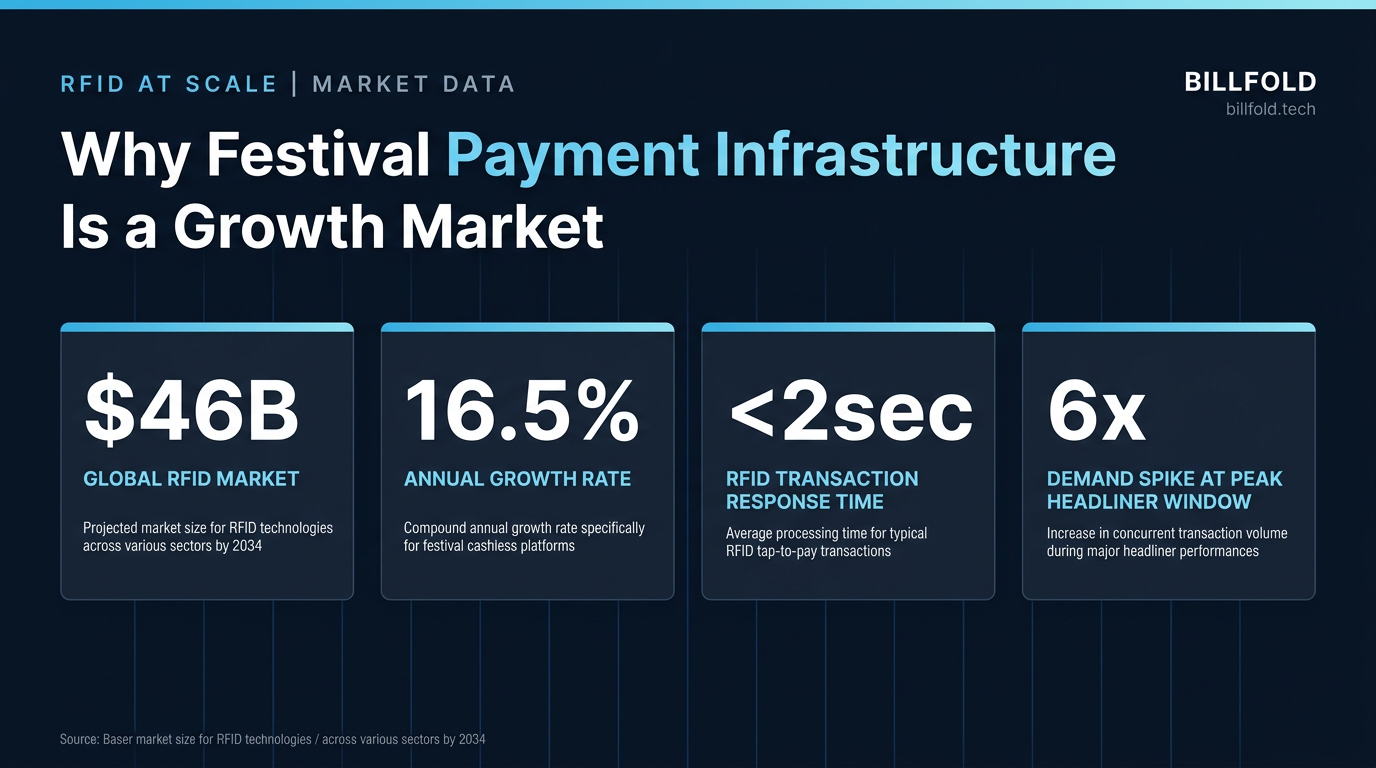
For event organizers evaluating RFID systems for large events, the core question is not whether RFID technology works. It does. The question is whether the specific architecture deployed is designed to hold under the conditions your attendees will create. According to Fortune Business Insights, the global RFID market is projected to grow from $19.01 billion in 2026 to $46.2 billion by 2034, with live events and entertainment among the fastest-growing segments.
Growth Market Reports puts the festival cashless payment platforms market at $2.12 billion in 2024, on track to reach $9.89 billion by 2033 at a 16.5% annual growth rate. Both figures reflect organizers who have discovered that payment technology directly determines whether large-scale events run smoothly or fall apart.
This guide covers the infrastructure decisions that separate scalable RFID systems for large events from deployments that fail under pressure: offline architecture, distributed reader networks, what event scalability for payments requires at the component level, and what operational control looks like when your festival is live.
What Makes RFID Systems for Large Events Architecturally Different?
Not all RFID deployments are built the same way. The architecture that handles a 500-person corporate gathering is fundamentally different from what festival payment infrastructure needs to manage 50,000 people across multiple stages, hundreds of vendors, and multi-day operations. Architectural limitations do not show up during setup or quiet periods. They show up when you are under load.
Centralized vs. Distributed Processing
Standard payment systems route every transaction through a central server or external network. That creates a single point of failure. When network congestion peaks during a headliner window, the central processor bottlenecks and transactions queue or drop. Distributed RFID architecture processes transactions locally at each reader, stores data on the device, and syncs to central systems when connectivity allows. The load spreads across every terminal rather than concentrating at one point.
This is why closed-loop RFID cashless systems consistently outperform open-loop card networks in high-density outdoor environments. Closed-loop systems do not depend on bank authorization chains for every transaction. Payment validation happens against locally stored account data, so an attendee tapping their wristband gets a response in under two seconds regardless of what is happening to network traffic across the venue.
Reader Coverage and How It Scales
RFID reader placement is a planning decision, not a setup task. High-traffic vendor areas need multiple readers to prevent queue formation during peak service windows. A single overloaded reader near a stage exit or concession cluster creates the same bottleneck as a centralized server: transactions stack, attendees wait, and revenue walks away. A proper site survey maps every high-demand location and calculates reader density based on peak transaction volumes, not averages.
Large events benefit from combining short-range readers at payment terminals with longer-range readers at entry gates, where fast throughput matters more than precision. This layered approach lets the same RFID systems for large events serve both payment processing and access control without either function compromising the other.
How Does Festival Payment Infrastructure Hold Up When Connectivity Fails?
Cellular networks at large outdoor events face a problem no infrastructure investment fully solves: too many people, in the same place, doing the same things at the same time. When a headliner takes the stage and tens of thousands of attendees pull out their phones, cellular bandwidth degrades for everyone, including payment systems that depend on it. This is the baseline operating condition of major festivals, not a worst-case scenario.
True Offline Processing vs. Degraded Modes
Degraded mode means a system keeps functioning at reduced capability when connectivity fails, perhaps processing stored-value transactions while declining new top-ups. True offline processing means the system operates identically with or without network access. RFID payment terminals with local transaction storage achieve this because payment validation requires only the locally cached account balance, not a live server connection. Battery-powered readers with onboard storage process thousands of transactions before requiring any sync. When network access returns, all data syncs automatically and financial records stay complete.
For event organizers weighing festival cashless payment options, this distinction matters more than any other specification on a vendor's sheet. A system that requires connectivity will fail at peak demand. A system built for true offline operation keeps working.
Layered Connectivity and Mesh Networking
Advanced RFID systems for large events use mesh networking protocols that let readers share data directly with adjacent devices, independent of a central network connection. When primary WiFi or cellular fails across part of a venue, readers in the affected area communicate through mesh links and maintain coordination without routing back to central infrastructure. Redundant connectivity layers wired connections for permanent vendor structures, dedicated WiFi isolated from guest traffic, and cellular routers with multi-carrier backup for remote locations. Each layer provides a fallback when the layer above it degrades.

What Does a Scalable On-Site RFID Deployment Actually Look Like?
Event scalability for payments comes down to decisions made before a single attendee arrives. Getting these right during planning is far easier than fixing them under live conditions when every delay costs revenue.
Terminal Density and Peak Planning
Terminal density is the most commonly underestimated variable in a cashless event rollout. The right number of readers depends on peak transaction throughput, not average throughput. A food vendor serving 200 people per hour during normal periods might face 600 per hour in the 20 minutes after a set ends. Size for the peak demand window, not the median. High-traffic bars and food vendors typically need two to three readers minimum.
Centralized device management platforms give deployment teams real-time visibility into every terminal's transaction volume so they can spot underperforming locations and respond before queue times become visible to attendees.
Power, Redundancy, and Wristband Provisioning
Hot-swappable battery packs keep terminals running when shore power is unavailable. Solar charging handles remote vendor locations. Generators back central coordination systems for multi-day operations. Every tier of power redundancy removes a failure mode that would otherwise take down payment processing across part of the venue.
Wristband distribution speed at entry also shapes the attendee experience before anyone has made a purchase. Slow provisioning at the gate creates friction from the start. Adequate top-up kiosk density ensures attendees can reload without leaving vendor areas or missing performances. Provisioning is part of the event payment rollout, not an afterthought to it.
6 Infrastructure Components Every Large-Scale RFID Deployment Needs
These are the baseline requirements for RFID systems for large events that hold under real operational conditions, each addressing a specific failure mode that emerges at festival-scale transaction volumes.
- Offline-capable distributed readers. Every terminal must process and store transactions locally without a live network connection. This eliminates the primary failure mode that brings systems down at peak demand.
- Mesh network communication. Reader-to-reader data sharing independent of internet access maintains coordination across large venue footprints when central network access degrades.
- Hot-swappable power systems. Battery packs replaceable without taking terminals offline eliminate power failures as a cause of payment downtime during extended operations.
- Centralized device management. A unified dashboard with real-time visibility into every terminal's status and transaction volume enables proactive management instead of reactive troubleshooting.
- Real-time analytics integration. Live transaction feeds, vendor performance data, and inventory tracking in a single dashboard transform event management from guesswork into data-driven decisions.
- Scalable cloud backend. Infrastructure that scales processing capacity automatically based on transaction load ensures consistent performance whether the venue is at 20% capacity or fully sold out.
How Does Event Scalability for Payments Improve Multi-Day Festival Operations?
At a multi-day festival, day one is a live test of every assumption built into your operational plan. The data it generates should directly reshape day two. This is where RFID systems for large events create a compounding advantage: every day gets better because every day generates the data to improve the next.

Day-Over-Day Operational Learning
Transaction data from day one reveals which vendors faced the highest demand and where queue times peaked. Staffing, vendor placement, and top-up kiosk positioning can all be adjusted before day two opens. Cash or standard card systems provide no real-time visibility into these patterns. The operational intelligence generated by RFID wristbands transforms multi-day festivals from reactive operations into continuously improving ones. Automatic inventory depletion tracking tells vendors precisely what to restock overnight. Products that sold faster than expected get prioritized. Items that moved slowly can have pricing adjusted or promotions pushed through the platform before the next day opens.
Vendor Coordination and Reconciliation
Managing dozens of independent vendors through unified payment infrastructure creates coordination challenges that only technology solves cleanly. Each vendor needs individual accounting and visibility into their own sales data while organizers maintain a consolidated view. RFID platforms handle this through vendor-level segmentation: each operator sees their own data while organizer dashboards aggregate everything.
When RFID cashless payment data provides a complete audit trail of every transaction tied to every terminal, reconciliation disputes disappear. Vendors get paid on the actual transaction record, not on manual cash counts that introduce error.
Security Across a Large Venue
Large festivals are high-value fraud targets. Wristbands that can be reported lost and instantly deactivated, combined with encrypted transaction data and complete audit trails, provide security that cash operations cannot match. The guide to RFID event payment security covers the specific protocols that protect both attendee accounts and event revenue at the infrastructure level.
Frequently Asked Questions
How many attendees do you need before RFID systems for large events make sense?
There is no single threshold, but events with more than 5,000 attendees and multiple vendor locations consistently benefit from dedicated RFID infrastructure. The business case strengthens as attendance increases because the complexity of coordinating cash or card payments across many vendors compounds quickly. Multi-day festivals of any size benefit from the day-over-day data and vendor coordination that RFID platforms provide.
What happens to transactions when the internet goes down at a festival?
RFID systems built with true offline capability continue processing transactions normally. Each terminal stores transaction data locally and syncs with central systems when connectivity resumes. Attendees tap their wristbands and receive responses in under two seconds regardless of network status. The only functions requiring live connectivity are real-time dashboard updates and new top-up transactions that depend on external processing to load funds.
How do you manage wristband top-ups when on-site connectivity is unreliable?
Pre-event online top-ups loaded before attendees arrive require no on-site connectivity. On-site kiosks with wired ethernet connections provide stable top-up capability at the venue perimeter. Mobile top-up staff with cellular-connected terminals can serve remote areas as a supplementary layer. Stacking all three ensures attendees can reload regardless of which connectivity tier is degraded at any given moment.
Can RFID payment systems handle multiple zones with different pricing or access tiers?
Yes. Modern RFID platforms support venue segmentation with different pricing structures, access permissions, and account types within a single event. VIP areas can use separate account tiers with distinct balances and credentials. Restricted zones enforce access control independently of payment permissions. This makes RFID well-suited to festivals with tiered ticketing or sponsored activation zones requiring separate operational management.
What is a realistic deployment timeline for large festival RFID infrastructure?
Most mid-size festivals can complete equipment staging, network setup, terminal placement, and staff training over two to three days before gates open. Larger festivals with complex multi-stage footprints typically require four to five days. Working with a deployment team experienced in comparable events significantly reduces setup time and day-of issues.
Build the Payment Infrastructure Your Event's Scale Actually Demands
Payment infrastructure is not a detail you figure out after selling tickets. It is a foundational operational decision that determines the throughput, revenue capture, and attendee experience your event can deliver. RFID systems for large events solve the specific problems that scale creates: connectivity failures, transaction bottlenecks, cash handling complexity, and the operational blindness that comes from not knowing what is happening across your venue in real time.
The architecture decisions in this guide, offline processing, distributed readers, redundant power, centralized device management, and real-time analytics, are the baseline for any event expecting significant attendance and serious operational demands. Events that get these right run more smoothly, generate more revenue, and give organizers the data to improve every subsequent event.
Billfold delivers enterprise-grade RFID payment infrastructure built specifically for the scale and complexity of large festivals and live events. From wristband provisioning through real-time analytics dashboards, every component is engineered for the conditions that break standard systems. Reach out to the Billfold team to discuss your requirements and get a deployment plan built for your specific scale.
