
How Cashless Event Tech Is Transforming Payments Globally

Cashless event tech is accelerating a global shift in how festivals, stadiums, and venues process transactions and engage attendees.
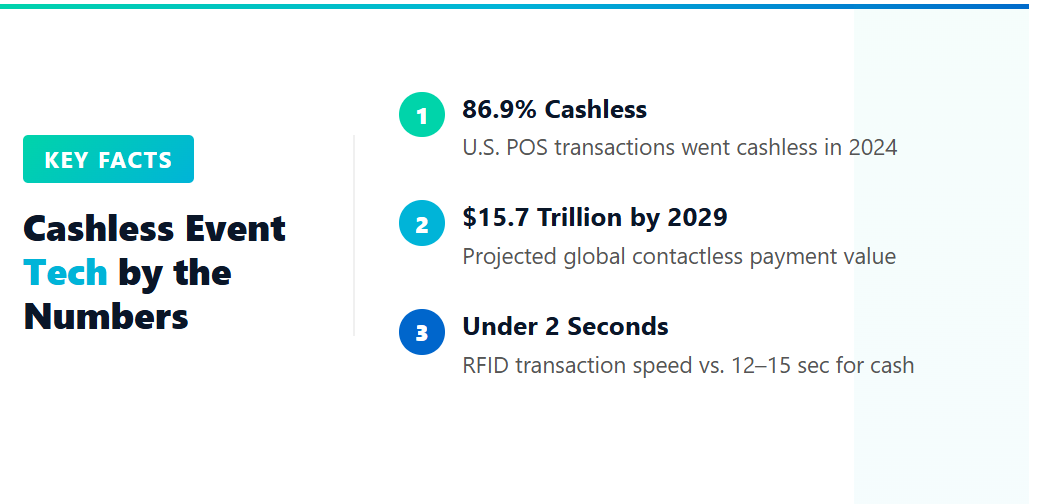
- Contactless payment transaction values are projected to reach $15.7 trillion globally by 2029, with event applications driving significant growth.
- RFID wristband systems process payments in under two seconds while operating fully offline, eliminating the connectivity problems that plague outdoor events.
- Events deploying cashless systems report per-attendee spending increases of 15 to 30 percent, alongside dramatic reductions in cash handling costs and theft.
- If your event still runs on cash, you're leaving revenue on the table and creating friction your competitors have already eliminated.
The global transition from cash to digital payments isn't slowing down. According to the Capgemini World Payments Report 2025, non-cash transaction volumes are increasing year over year, with the shift now described as moving from a "less cash" to fully "cashless" global economy. Nowhere is this transformation more visible than in the live events industry, where cashless payment technology is rewriting the rules on how organizers generate revenue, manage operations, and create memorable experiences.
Cashless event tech encompasses everything from RFID wristbands and NFC tap-to-pay systems to mobile wallets and QR code payments at event POS terminals. What makes this technology compelling for festivals, stadiums, and multi-day events is its ability to solve problems traditional payments never could: network failures, long queues, cash theft, and zero real-time spending data.
What Is Driving Global Adoption of Cashless Event Tech?
Several converging forces are pushing this technology into the mainstream across every major market. Consumer expectations have fundamentally shifted, with attendees now arriving at events assuming they can pay with a tap of a wristband or phone. The infrastructure supporting those expectations has matured rapidly, and the economics make the investment increasingly difficult to ignore.
How Have Consumer Expectations Changed?
Attendee behavior has moved decisively toward digital payments across every demographic. Research from CoinLaw's 2025 cashless economy analysis shows that 86.9 percent of U.S. point-of-sale transactions were cashless in 2024, with global POS cashless adoption reaching similar levels. Mobile wallet adoption among consumers rose to 91 percent in 2025, up from prior years. When someone taps their phone 15 times a day for coffee, groceries, and transit, fumbling with cash at a festival food vendor feels like a step backward. Gen Z is particularly decisive, with frequent digital wallet usage jumping from 24 percent to over 40 percent in monthly use between 2023 and 2025.
What Role Does Infrastructure Play?
The technology stack supporting contactless payment adoption has become significantly more reliable and affordable. Soft POS systems that turn any smartphone into a contactless payment terminal have lowered the barrier for smaller vendors. Juniper Research projects that contactless payment transaction values will reach $15.7 trillion globally by 2029, driven in part by expanding acceptance infrastructure. For event organizers, RFID and NFC hardware costs have dropped while capabilities have expanded, making comprehensive cashless deployments viable for events of all sizes.
How Does RFID Technology Power Modern Event Payment Innovation?
RFID sits at the center of most sophisticated cashless payment strategies because it solves problems other contactless methods cannot.
Why Does Offline Capability Matter So Much?
Standard contactless card payments require a stable internet connection for bank authorization on every transaction. At an outdoor music festival with 50,000 attendees, cellular networks get overwhelmed and Wi-Fi strains under load. RFID wristband systems sidestep this entirely by processing transactions offline through pre-loaded funds stored directly on the wristband's chip. The system syncs transaction data when connectivity is available, but the payment itself happens instantly regardless of network conditions. This offline reliability is why major festivals consistently choose RFID-based contactless payment systems over other alternatives.
How Fast Are RFID Transactions Compared to Alternatives?
Speed differences between payment methods compound dramatically at scale. Consider a concession stand that processes 60 cash transactions per hour. RFID systems can double that throughput because each transaction takes under two seconds rather than 12 to 15 seconds for cash handling. During peak demand windows, that capacity expansion converts directly to captured revenue. Event organizers report that the speed advantage transforms vendor economics, allowing fewer staff to serve more customers while reducing attendee frustration.
Payment Method
Avg. Transaction Time
Network Required
Offline Capable
Event Suitability
Cash
12–15 seconds
No
Yes
Low (theft risk, slow)
Contactless Card
5–8 seconds
Yes
No
Medium (network dependent)
Mobile Wallet (NFC)
4–6 seconds
Yes
No
Medium (phone battery risk)
RFID Wristband
Under 2 seconds
No
Yes
High (durable, fast, offline)
What Are the Biggest Revenue Benefits of Global POS Solutions?
The financial case for going cashless extends well beyond faster transactions. Modern global POS solutions create revenue opportunities that are impossible with cash-based operations.
Why Do Attendees Spend More With Cashless Systems?
The psychology of spending changes when physical currency leaves the equation. Attendees using cashless systems consistently spend more because the friction of counting bills and waiting for change disappears. The tap of a wristband feels effortless, and that translates into more impulse purchases at food stalls, merchandise booths, and premium upgrades. Events implementing comprehensive cashless systems see per-attendee spending increases of 15 to 30 percent.

How Do Operational Savings Add Up?
Cash handling at events involves expensive, labor-intensive steps: armored transport, cash room staffing, counterfeit detection, manual reconciliation, and loss prevention. Each of these costs disappears with cashless systems. Staff previously dedicated to cash management can be redeployed to customer service roles. End-of-shift reconciliation becomes automated verification. For multi-vendor environments common at large festivals, unified digital transaction systems also reduce disputes between organizers and vendors about actual sales volumes.
What Does Real-Time Data Actually Enable?
Every cashless transaction generates a data point that feeds into a real-time operational picture. Organizers can see which vendors are experiencing high traffic, which products are selling fastest, and where bottlenecks are forming. This enables dynamic resource allocation during events, from redirecting staff to high-demand areas to adjusting vendor inventory based on consumption patterns. Post-event, the data informs future planning decisions about vendor placement, pricing, and crowd management.
5 Contactless Festival Trends Reshaping Live Events
The broader landscape of event payment innovation is evolving rapidly. Here are five contactless festival trends defining how live events operate in 2025 and beyond.
- Unified wristband ecosystems. RFID wristbands now serve as entry credentials, age verification tools, loyalty program trackers, and social media connectors through a single wearable that attendees never need to remove during multi-day events.
- Pre-event fund loading. Organizers are shifting toward models where attendees load funds before arriving, reducing on-site bottlenecks and securing revenue in advance. This pre-commitment also incentivizes attendees to spend remaining balances rather than leave money unused.
- AI-powered crowd analytics. Advanced contactless payment platforms now use transaction data combined with machine learning to predict crowd density and optimize staffing in real time.
- Hybrid payment acceptance. The most forward-thinking events accept RFID, NFC, contactless cards, and mobile wallets simultaneously, recognizing that different attendees prefer different methods.
- Sustainability integration. Cashless systems eliminate thousands of paper tickets, physical tokens, and printed receipts per event, aligning organizer operations with attendee values around environmental responsibility.
How Are Different Regions Approaching Event Payment Innovation?
Adoption of cashless event tech looks different depending on where you operate. Understanding regional patterns helps organizers benchmark their readiness.
What Does the Global Landscape Look Like?
Region
Cashless Adoption Level
Dominant Event Tech
Key Drivers
North America
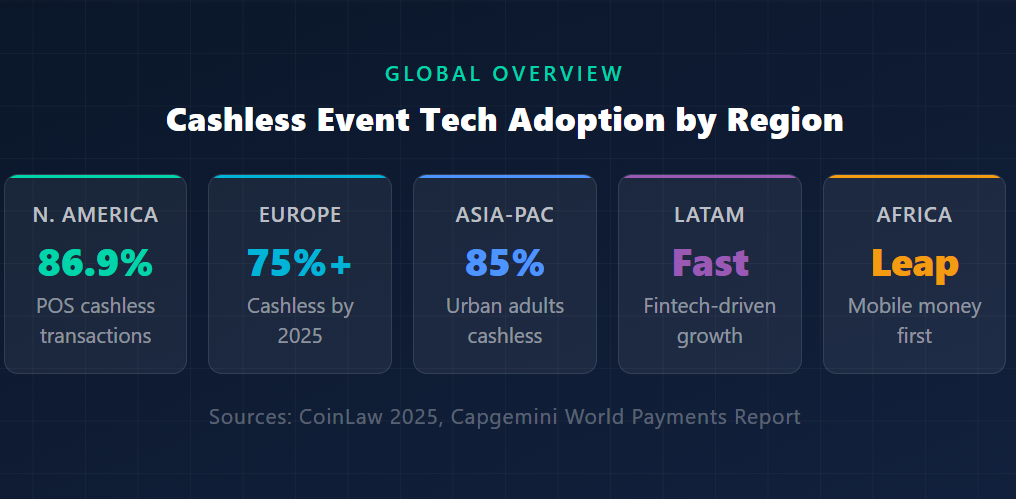
86.9% of POS transactions cashless
RFID wristbands, contactless cards
Stadium mandates, festival culture
Europe
75%+ cashless by 2025
NFC, mobile wallets, RFID
Regulatory support, consumer preference
Asia-Pacific
85% of urban adults use cashless
QR codes, mobile wallets, NFC
Mobile-first economies, UPI/WeChat Pay
Latin America
Rapidly accelerating
Mobile wallets, QR codes
Fintech innovation, unbanked populations
Africa
Leapfrogging cash to digital
Mobile money, QR codes
M-Pesa influence, smartphone adoption
Asia-Pacific stands out as the fastest-growing region for contactless event payments, with mobile-first economies in China, India, and Southeast Asia creating ecosystems where QR code payments and digital wallets are the default transaction method. India's UPI network processes thousands of transactions every second, and that digital payment maturity is flowing directly into the event space.
European markets have reached a different maturity. Nordic countries have pushed cash usage into the single digits, normalizing cashless operations across nearly every commercial interaction. The EU's regulatory environment actively supports digital payment infrastructure, creating favorable conditions for organizers deploying contactless systems.
North America remains the leading market for RFID-specific event deployments. Stadiums have been particularly aggressive, with venues like BMO Stadium in Los Angeles and Red Rocks Amphitheatre in Colorado operating fully cash-free.
What Should Event Organizers Know Before Going Cashless?
Transitioning to contactless event payments requires more than purchasing hardware. Successful implementations share common planning elements that prevent pitfalls.
How Do You Handle Cash-Preferred Attendees?
Inclusivity matters. The most effective cashless events provide on-site kiosks where attendees can convert physical currency to prepaid digital cards or wristband credits without fees. Red Rocks Amphitheatre uses exactly this model, and it has become the standard approach for venues committed to going fully cash-free without excluding anyone.
What Infrastructure Decisions Matter Most?
Three infrastructure choices determine whether a cashless deployment succeeds or creates new problems:
- Redundant connectivity. Even with offline-capable RFID systems, plan for cellular boosters, dedicated Wi-Fi networks, and backup protocols so data syncs reliably.
- Scalable hardware. Choose global POS solutions that handle peak transaction volumes, and deploy enough readers and top-up stations to prevent new bottlenecks.
- Staff training. Technology only works if operators understand it. Invest in training that covers routine operations and troubleshooting.
FAQ
What is cashless event tech?
It refers to payment technologies used at events to eliminate physical currency transactions. This includes RFID wristbands, NFC tap-to-pay systems, mobile wallets, QR code payments, and contactless card readers integrated into event POS terminals. Attendees make purchases by tapping a wristband, phone, or card.
How much does it cost to implement cashless payments at an event?
Implementation costs vary based on event size, technology choice, and infrastructure requirements. Many cashless platform providers offer flexible pricing models that scale with event attendance, and the revenue increases and operational savings typically offset the investment within the first event cycle.
Can cashless event systems work without internet access?
Yes. RFID-based cashless systems are designed to operate offline. Transactions process instantly using pre-loaded funds stored on the wristband chip, with data syncing to the backend when connectivity becomes available. This is why RFID technology dominates at outdoor festivals and remote venues.
What happens to unused funds on RFID wristbands after an event?
Most modern cashless event platforms allow attendees to request refunds for unused balances through an online portal after the event. The refund process typically involves registering the wristband to a personal account linked to a bank card or digital wallet. Some events also offer the option to donate remaining balances to charity partners.
The Future of Cashless Event Tech
The trajectory is clear. Cashless event tech is moving from competitive advantage to baseline expectation. Biometric authentication, blockchain-based payment verification, and AI-driven personalization represent the next wave, but the foundational shift needs to happen first. Events still debating whether to make the move are already falling behind.
For event organizers ready to make the shift, Billfold provides a comprehensive cashless POS platform built specifically for the demands of live events, festivals, and venues. Get in touch with Billfold to learn how their technology can transform your next event.
