
Festival POS Systems: The Complete 2026 Guide

Key Takeaways
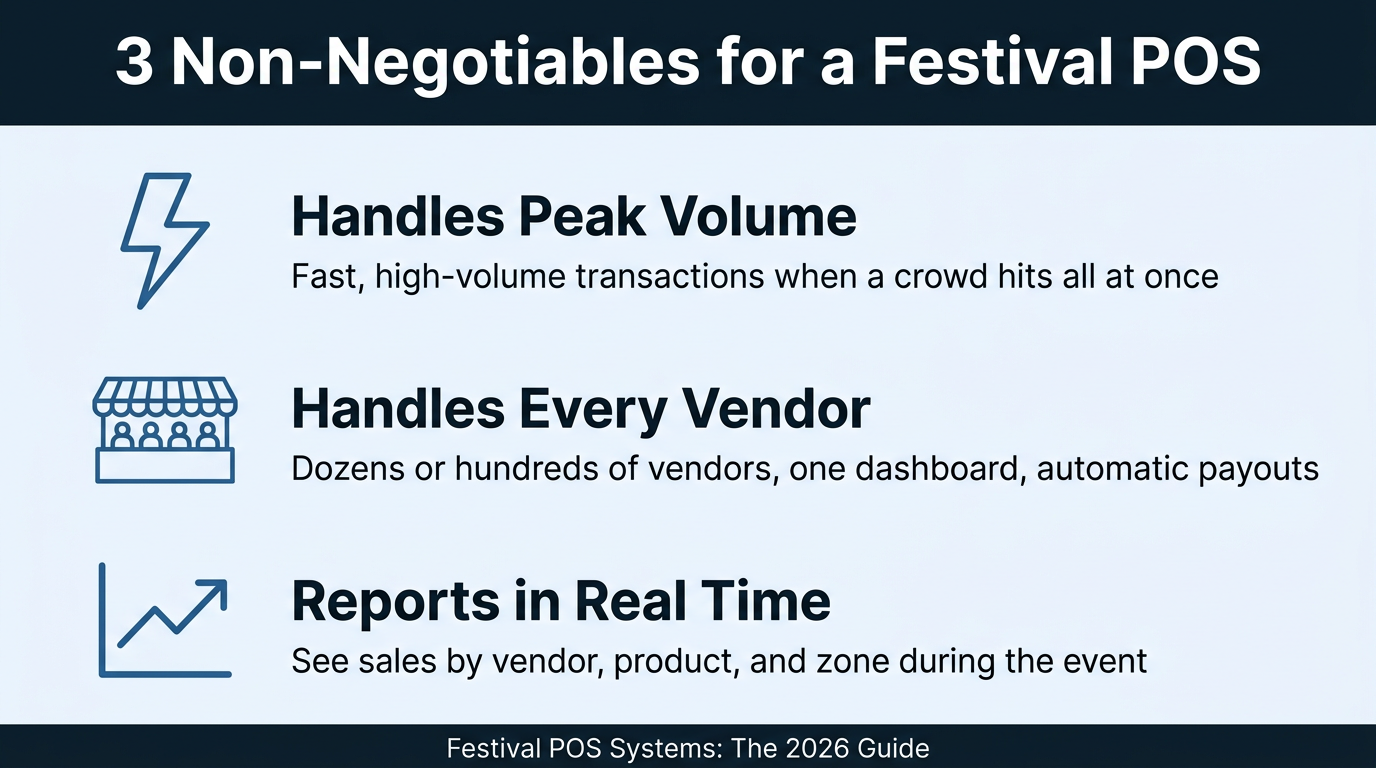
A festival POS is the payment and data backbone of a live event, engineered for outdoor conditions, unreliable connectivity, and hundreds of vendors that standard retail systems were never built to handle.
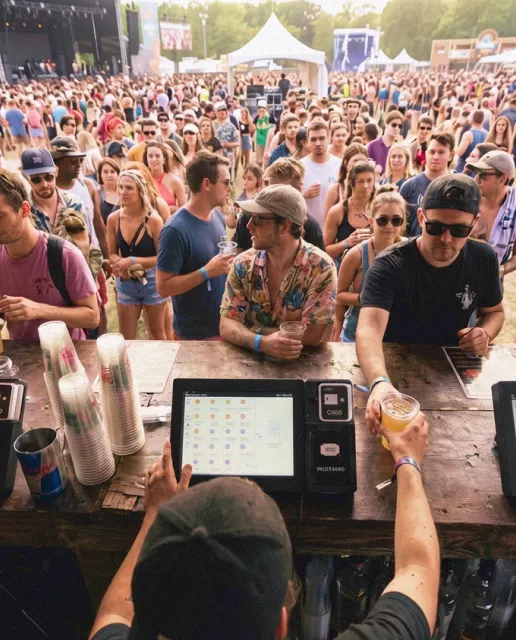
- Purpose-built festival point of sale hardware runs transactions offline, survives weather and heavy use, and processes taps in seconds during peak demand.
- RFID wristbands turn a single credential into a wallet, a ticket, and a data trail, keeping payments flowing even when networks fail.
- Multi-vendor management consolidates dozens or hundreds of operators into one real-time dashboard with per-location reporting and automated payouts.
- The strongest platforms integrate with ticketing and reporting, so operators see sales by vendor, product, and zone while the event is still happening.
If your event still runs on borrowed retail hardware and a single network uplink, 2026 is the year to reassess the risk to your revenue and your reputation.
Music festivals are booming, and the money moving through them is bigger than ever. The global live music market was worth around USD 34.84 billion in 2024 and is on track to nearly double by 2034, driven by festivals, touring, and fans who spend more on live experiences than ever. That growth lands hard on one unglamorous piece of infrastructure: the payment system. A festival POS is what stands between a packed bar at peak set and a line that quietly kills your revenue.
This guide breaks down what festival payment technology actually is, the hardware and software behind it, how it coordinates hundreds of vendors, and what to verify before you sign a contract for 2026. Retail systems built for a coffee shop or a single storefront tend to crack under festival conditions, which is exactly why dedicated event payment platforms exist. Whether you run a 2,000-person community gathering or a 60,000-person weekender, the same principles apply: speed, offline reliability, vendor control, and data you can act on before the gates close.
What Is Festival POS, and Why Does It Break Standard Retail Systems?
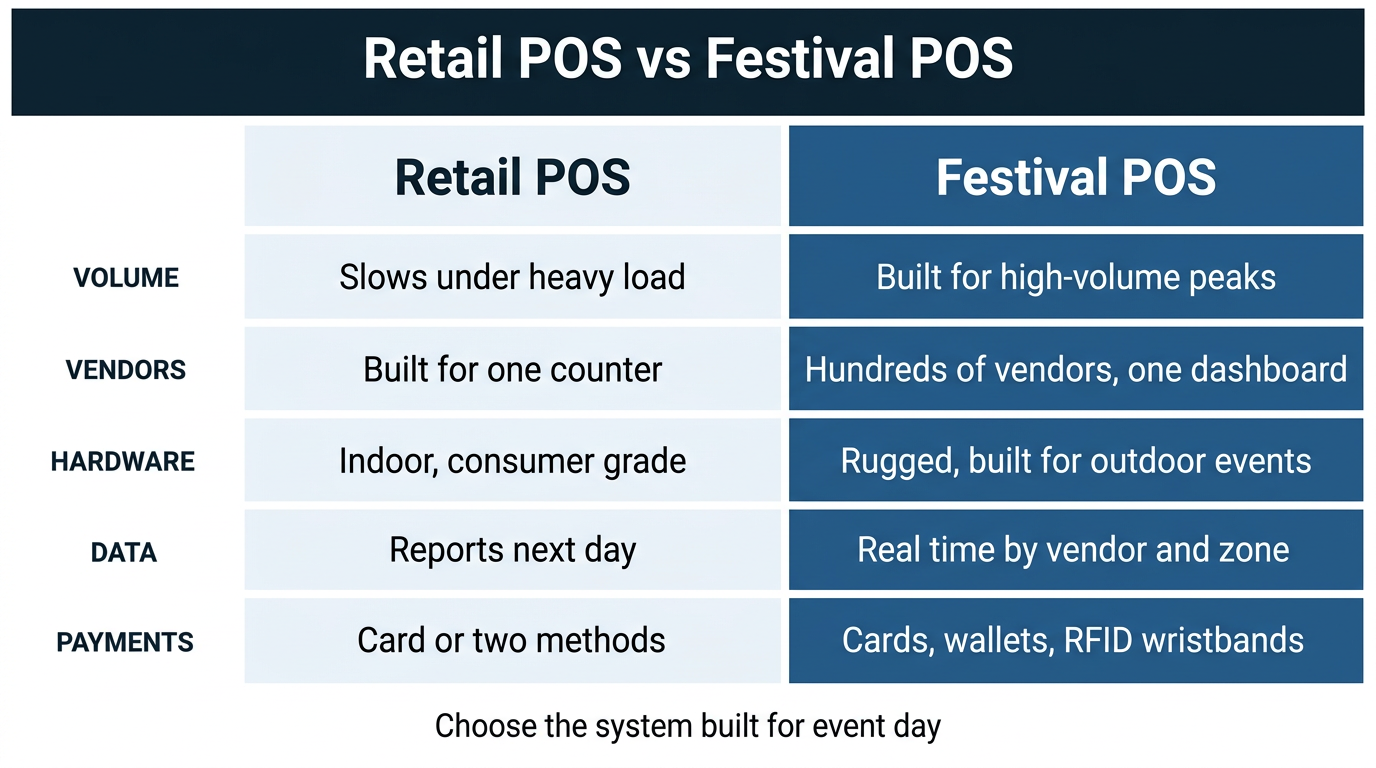
Festival POS is the combination of hardware, software, and payment processing that runs every sale at a live event, from the beer tent to the merch booth to the entry gate. It earns its own category because a festival is not one store. It is dozens or hundreds of independent vendors operating under a single event umbrella, in a temporary outdoor location, hit with concentrated demand in short, brutal windows. Standard retail point of sale assumes stable internet, a fixed counter, and a handful of trained staff. A festival assumes none of those things.
Why Do Retail POS Systems Struggle at Festivals?
Outdoor festival sites were never built with digital infrastructure in mind. Cellular towers get overwhelmed when tens of thousands of phones compete for bandwidth at once, and temporary Wi-Fi degrades as the day wears on. A retail system that simply queues transactions when the network drops leaves vendors unable to sell during the busiest hour of the night, which is the most expensive failure an event can suffer.
Then there is the physical reality. Heat, rain, dust, and drops finish off consumer-grade tablets designed for a climate-controlled counter. Add hundreds of vendors who each need their own catalog, pricing, and payout, and a tool built for one storefront collapses under the coordination load. The result is lost sales, frustrated attendees, and a reconciliation nightmare when the weekend ends.
How Is the Shift to Cashless Changing Festival Payments?
The broader move away from cash is already reshaping how events take money. The shift toward a cashless economy is well under way, with non-cash transaction volumes rising year over year across every major region. At festivals, that shows up as attendees who expect to tap a card, a phone, or a wristband and keep moving. A modern festival point of sale is built around that expectation, accepting contactless cards, mobile wallets, EMV chip, and RFID wristbands through the same terminal at the same speed. Festival payment processing that can only handle one or two methods becomes the bottleneck the moment a crowd hits a single vendor.
What Hardware and Software Go Into a Festival Point of Sale Stack?
Every festival payment platform is really two layers working together: the physical hardware on the ground and the software that ties it into one system. Understanding both helps operators separate marketing claims from what actually performs on event day, when there is no time to troubleshoot.
What Hardware Does a Festival Need?
Festival-grade terminals are built to survive what retail hardware cannot. They carry ingress protection ratings against rain and dust, operate across wide temperature ranges, and run on extended-life or swappable batteries so a dead unit does not take a vendor offline mid-rush. The best hardware accepts every payment type without forcing attendees down a single channel, so a contactless card, a phone wallet, and an RFID wristband all clear at the same reader.
Beyond the terminals themselves, most deployments include RFID readers, top-up kiosks or wallet activation points for onboarding attendees, and networking gear that segments payment traffic away from public Wi-Fi. Getting the underlying network, power, and hardware plan right is often the difference between a smooth event and a payments outage at peak.
What Does the Software Platform Handle?
The software is where the system earns its keep. It manages the product catalog and pricing for every vendor, processes and records each transaction, and pushes sales data into a central dashboard in real time. A strong platform treats offline transaction processing as a baseline rather than a premium add-on, queuing and reconciling sales automatically when connectivity returns.
It also handles device management at scale, letting a small operations team monitor and update hundreds of terminals across a large site from one screen. When operators evaluate a music festival POS, the depth of the software usually matters more than the spec sheet of the hardware, because the software is what turns a pile of terminals into a coordinated system.
How Does a Festival POS Handle Hundreds of Vendors?
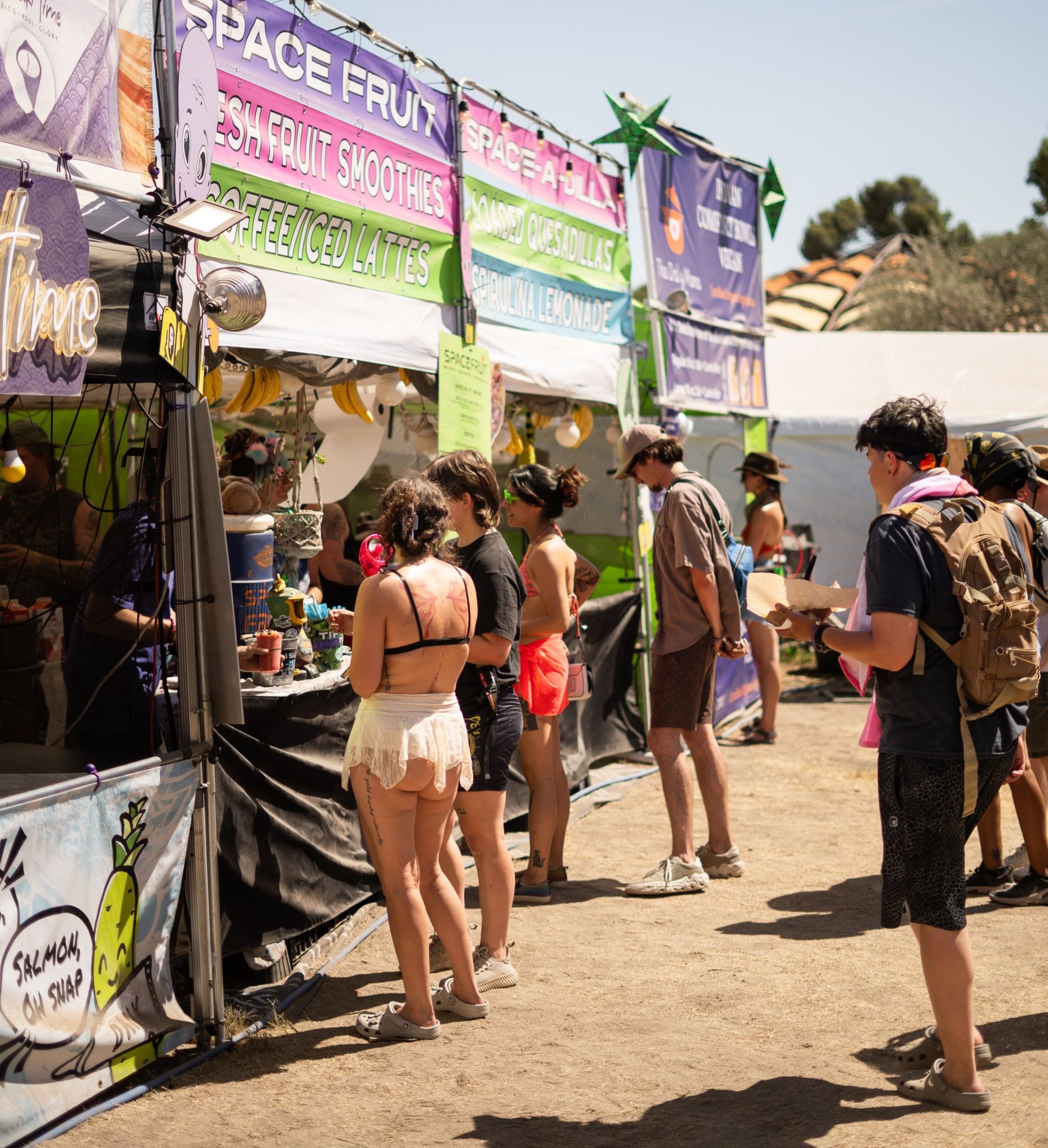
Vendor coordination is the single hardest operational problem at a large event, and it is where purpose-built systems separate themselves most clearly from retail tools. A festival is not one business with one till. It is a marketplace of independent food trucks, bars, and merch stands, each with its own products, pricing, staff, and payout terms, all expected to work as one on event day.
How Does Multi-Vendor Management Work?
Multi-vendor management consolidates all of those separate operators into one platform while keeping their books cleanly separated. Each vendor gets its own catalog, its own sales view, and its own settlement, while the organizer sees everything rolled up into a single real-time picture. That means an operator can watch which locations are selling, which products are moving, and which stands are running short while the event is still live.
It also collapses end-of-night reconciliation from a manual, hours-long tally of paper receipts into an automated report. Because the platform already holds itemized sales for every stand, payouts to each vendor become faster and far more accurate, which removes one of the biggest sources of post-event friction and disputes.
Why Does Real-Time Visibility Matter During the Event?
A standard sales report is a rearview mirror that tells you what happened yesterday. Real-time transaction tracking collapses that delay to near zero, so a spike in beer sales at the north stage shows up while the crowd is still there. That immediacy turns payment data from an accounting artifact into an operational tool: operators can reposition staff, restock fast sellers, and adjust pricing or promotions on the spot. The teams that treat their festival POS as a live control room, rather than a nightly report, are the ones that capture the most revenue.
How Do RFID Wristbands Integrate With Festival Payment Processing?
At most large festivals, the RFID wristband has become the center of the payment system. It authenticates entry at the gate, stores or links funds for spending, and creates a clean data trail connecting purchases to attendee behavior, all from a single credential on the wrist. Collapsing entry, payment, and data into one wearable is why RFID has become the default at the biggest events on earth.
How Does RFID Payment Work at a Festival?
Each wristband contains a small chip and antenna. When an attendee taps near a reader, the reader powers the chip and completes the transaction in seconds, faster than cash or a chip-and-PIN card. The technology behind it is worth understanding in depth, and our guide to RFID payment technology covers how the chips, readers, and encryption fit together.
Systems generally run in one of two models. Closed-loop setups pre-load funds onto an event account and write balances to the wristband, so transactions clear locally and keep working during a network outage. Open-loop setups link the wristband to a regular bank card, which is simpler but depends on live authorization. Closed-loop architecture is the main reason the largest outdoor festivals keep selling even when connectivity fails.
Does Cashless Actually Increase Spending?
There is solid research behind the revenue case for going cashless. A large meta-analysis of 71 studies across 17 countries found a consistent cashless effect, where consumers tend to spend more when paying by card or digital methods than with physical cash. Counting out notes makes spending feel real, while a tap does not. At a festival, where funds are often pre-loaded and start to feel like event money, that effect compounds across thousands of transactions. Faster service reinforces it: an attendee who would have skipped a second round because the line looked long will happily tap and buy when the queue moves quickly.
Can Your Payment System Connect to Ticketing and Reporting?
A payment system that lives in isolation leaves value on the table. The strongest festival POS platforms connect payments to the systems around them, starting with ticketing and access control and extending into post-event reporting, so the whole event runs on one data spine instead of a patchwork.
How Does Integration With Ticketing Work?
When the same credential handles entry and payment, the attendee experience gets simpler and the operator gets a unified data picture. A wristband or digital credential can carry the ticket, age verification, VIP access level, and payment link at once. Our look at RFID cashless ticketing explains how tying entry to the payment credential speeds up gates and cuts fraud. Integration also lets an organizer connect spending behavior back to ticket tiers, learning which audiences drive the most revenue on-site.
What Should Real-Time Reporting Show?
Good reporting answers operational questions while there is still time to act on them. It should show live sales by vendor, by product, and by zone, flag anomalies as they appear, and export cleanly for settlement. After the event, that same data becomes the basis for planning: which vendors to keep, where to place stands, and how to staff the next edition. Reporting that only arrives the morning after is reporting you cannot use to change the outcome of the event you just ran.
Built for Peak-Hour Traffic
Built for high-volume festivals where speed, offline capability, and operational visibility matter most.
Explore Festival POSThe 2026 Festival Payment Buyer's Checklist
Before committing to a platform, run every option against the same criteria. These are the questions that separate a system built for festivals from a retail tool wearing a festival label. If you want a side-by-side view of the main approaches on the market, our comparison of the top options breaks them down, and a purpose-built festival payment platform should clear every item below.
- Offline transaction processing. Confirm the system authorizes sales locally when the network drops, rather than queuing them and hoping. This is the single most important capability at an outdoor event, and it is where most retail systems quietly fail.
- True multi-vendor support. The platform should onboard dozens or hundreds of vendors, give each its own dashboard, and settle payouts automatically. Retail tools bolt this on as an afterthought; festival systems are built around it.
- Every payment type at one reader. Attendees should be able to pay with contactless cards, mobile wallets, EMV chip, and RFID wristbands without being routed to a specific lane or terminal.
- Rugged, weatherproof hardware. Look for ingress protection against rain and dust, wide operating temperatures, and swappable or extended-life batteries built to last a full festival day in direct sun.
- Real-time reporting. You need live sales by vendor, product, and zone during the event, not a summary the next morning. Confirm the data also exports cleanly for settlement and accounting.
- Ticketing and access integration. The payment credential should connect to entry, age verification, and VIP access, ideally through a single RFID wristband or digital wallet the attendee already wears.
- Scalable device management. A small team should be able to monitor and update every terminal on-site from one screen, so a fleet of hundreds does not require a fleet of technicians to keep running.
Frequently Asked Questions
What Is the Best POS System for a Festival?
There is no single best music festival POS, because the right fit depends on your size, vendor count, and connectivity. The systems that consistently perform share a few traits: offline processing, real-time multi-vendor management, rugged hardware, and RFID support. Match those capabilities to your event rather than chasing a brand name, and prioritize offline reliability above everything else.
How Much Does a Festival POS System Cost?
Costs vary widely and usually combine hardware, whether rented or purchased, software licensing per device, and payment processing fees, sometimes with on-site support. Larger events often bundle these into a single package. The more useful question is total value, because faster transactions, higher per-attendee spend, and automated settlement typically offset the cost at scale.
Do Festivals Still Need to Accept Cash?
Many festivals now run fully cashless, while others keep cash top-up stations so no attendee is left out. The trend is clearly toward digital, but the right call depends on your audience and local norms. A flexible festival payment system can support both models, letting you phase out cash on your own timeline instead of all at once.
How Does Festival Payment Processing Work Without Reliable Internet?
Purpose-built systems process payments offline by authorizing transactions locally, most often by writing balances directly to an RFID wristband in a closed-loop model. Sales continue during outages and reconcile automatically once connectivity returns. This is the core reason large outdoor festivals favor RFID over network-dependent card terminals.
Can One System Handle Both a Small Festival and a Large One?
Yes. The better platforms scale from a few thousand attendees to tens of thousands without changing the underlying approach. What changes is the number of terminals, vendors, and top-up points, not the architecture. Look for a system that can grow with your event across seasons instead of one you outgrow in a year.
Choosing the Right Festival POS for 2026 and Beyond
The festival payment decision is no longer a back-office detail. It shapes how fast your lines move, how much your attendees spend, how cleanly you settle with vendors, and how much you actually learn about your event. A system built for retail will keep working right up until the moment 20,000 people arrive and the network buckles. A system built for festivals is designed for exactly that moment.
As you evaluate options for the next season, the priorities stay consistent: offline reliability, real vendor management, rugged hardware, and reporting you can act on in the moment. Billfold builds cashless payment and RFID technology purpose-made for festivals, venues, and live events, from wristband onboarding to real-time dashboards. Reach out to the Billfold team to see how it fits your next event.
