
Festival Cashless ROI: What Operators Actually Earn Back

Key Takeaways
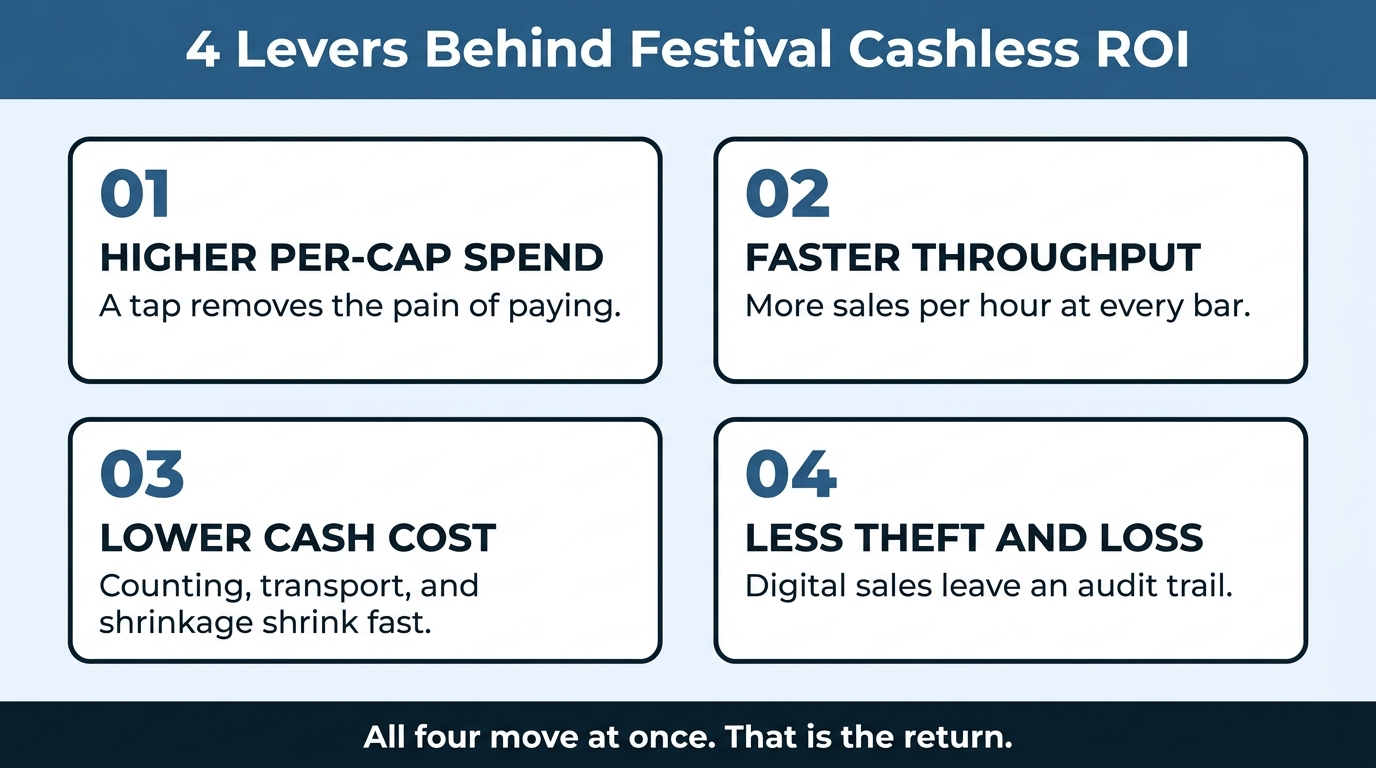
Festival cashless ROI comes from four levers pulling at once: higher per-cap spend, faster throughput, lower cash-handling cost, and less theft and loss.
- Removing payment friction reliably pushes per-attendee spending up, because a tap feels nothing like counting out cash.
- Faster checkouts mean more sales per hour at every bar and food stall, and that gain compounds across a multi-day festival.
- Cash quietly costs 4.7% to 15.3% of every dollar it touches once you add up counting, transport, and shrinkage.
- About half of concerts already run cashless, so this is a proven operating model rather than an experiment.
Run your own attendance, per-cap, and cash mix through a simple model before you sign, because that is the only way to see your real payback.
Every festival operator eventually runs the same math in their head. The gates are packed, the bars are three deep, and somewhere in that crowd is revenue you either capture or lose to a slow line. The question of festival cashless ROI is really a question about that gap: how much more money a contactless setup puts in your account versus what cash leaves on the table. It is a fair thing to ask before spending on hardware, and the answer has gotten clearer now that half of concerts have gone cashless and operators started sharing what changed. A purpose-built cashless payment platform is now closer to standard infrastructure than a gamble.
This piece breaks down where that return actually comes from, lever by lever, and hands you a model you can run against your own event. No hand-waving and no vendor hype. Just the sources of value and the costs they offset, so you can decide whether the numbers work for your festival.
What Is Festival Cashless ROI, and Where Does the Return Come From?
Festival cashless ROI is the net financial gain an event earns by moving payments from cash to contactless, measured against the full cost of the system. The return is rarely one big number. It stacks up from several smaller wins that most operators underestimate until they see them side by side.
The Four Levers Behind the Return
Four forces do most of the work. The first is higher per-attendee spend, because friction at the point of sale quietly suppresses purchases. The second is throughput, since faster transactions let each vendor serve more people during the same peak window. The third is cost reduction, as cash handling carries labor and security expenses that mostly disappear. The fourth is loss prevention, covering theft, skimming, and counting errors that shrink cash revenue before it ever reaches the books.
Get all four moving in the same direction and the combined effect is what makes the cashless festival revenue lift meaningful. Any single lever might look modest on its own. Together they change the economics of the event.
How Much Does Cashless Actually Lift Per-Cap Spend?
Per-cap spend, the average amount each attendee spends on site, is where the cashless festival revenue lift shows up most visibly. The mechanism is behavioral, and it is well documented across events of every size.
Why a Tap Loosens Wallets
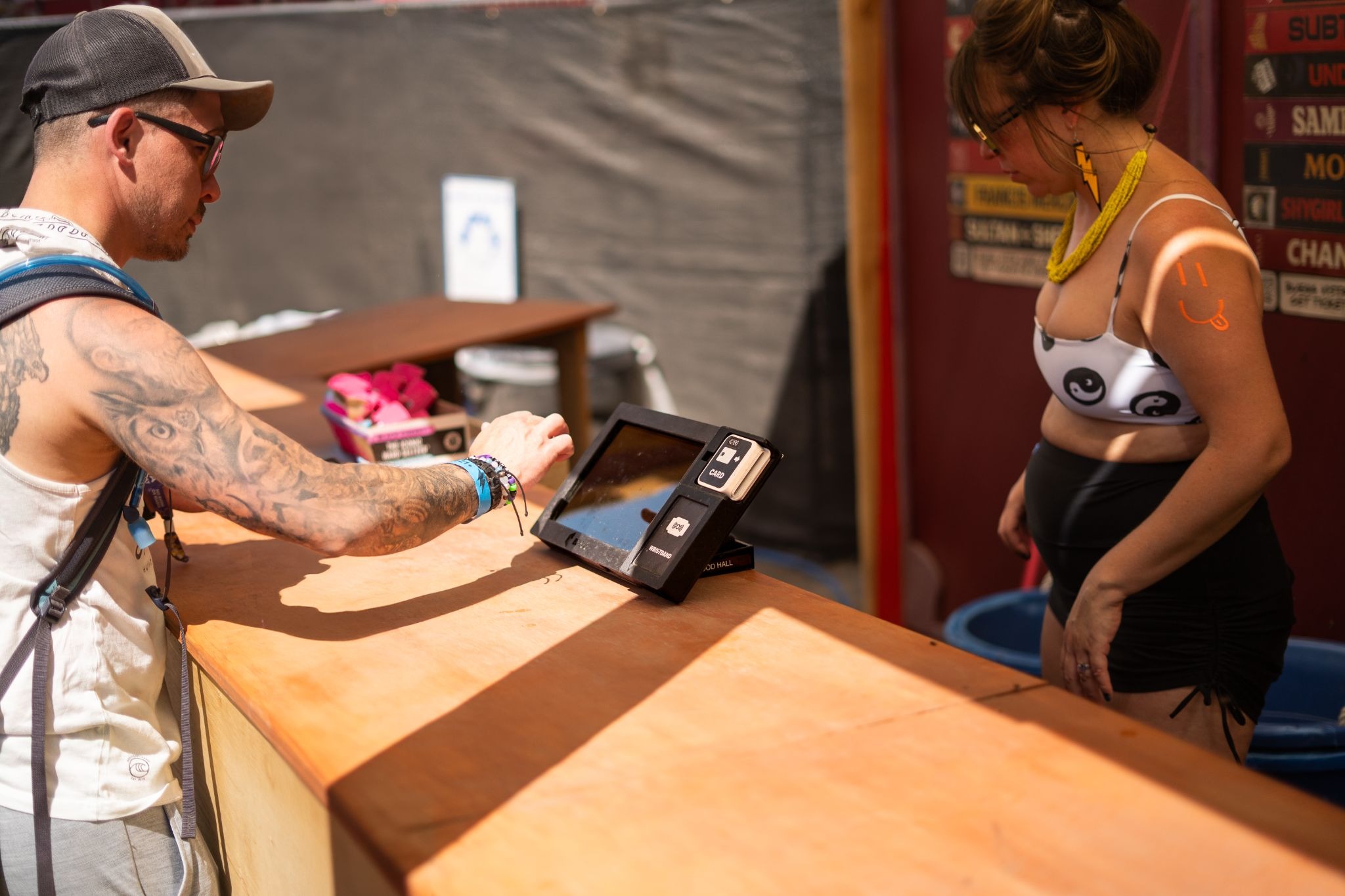
Handing over cash triggers what behavioral economists call the pain of paying. You physically watch money leave your hand, and that friction makes you think twice about a second round or an extra piece of merch. A tap removes that moment almost entirely. When funds are preloaded onto a wristband, the money already feels spent, so attendees draw it down freely rather than guarding it.
Speed reinforces the effect. When a line moves fast, the person who would have skipped a drink because the queue looked hopeless now steps up and taps. This is why events that move to cashless payments tend to report higher spending per head, especially at food and beverage, where impulse drives most of the volume.
The honest way to size this for your event is with your own history. Take last year's per-cap, apply a conservative lift you would be comfortable defending to a skeptic, and multiply by attendance. Even a modest bump on a five-figure crowd turns into real money, which is the heart of any music festival cashless cost benefit case.
Does Faster Throughput Really Add Revenue?
Throughput is the lever operators forget to price, and it may be the most direct of the four. Every transaction that clears faster is capacity you can resell during the same busy hour.
The Math of Seconds Saved
A cash sale takes the better part of a minute once the customer finds their wallet, hands over a bill, and waits for change. A tap clears in seconds. Multiply that time saved by the number of transactions at a single bar during a headliner set, and you free up room for a meaningful number of extra sales per station.
Now scale that across every revenue center for every hour the festival is open. Throughput gains compound in a way a flat per-cap figure hides. A cashless system built for festivals is engineered to hold that speed through heat, crowds, and shaky connectivity, which is exactly where general retail hardware tends to fall down.
What Does Cash Actually Cost a Festival to Handle?
Cash looks free because no one sends you an invoice for it. The real cost is buried in labor, security, and shrinkage, and it is larger than most operators expect. Weighing it properly is central to any music festival cashless cost benefit review.
The Hidden Cost of Every Dollar
Independent research puts the true cost of handling cash at 4.7% to 15.3% of the transaction value once you account for counting, reconciliation, bank deposits, and theft risk. On a large festival moving serious volume, that range becomes a heavy line item that cashless largely erases.
The savings are concrete. You need fewer staff hours counting drawers and reconciling at 2 a.m. You cut or eliminate armored transport runs. You remove the counting errors and quiet skimming that shrink cash totals at the vendor level before anyone notices.
Breakage and Other Quiet Gains
Closed-loop systems, where attendees preload a balance, introduce another factor called breakage: small unused balances that go unredeemed. Handled transparently and with a clear refund path, breakage becomes a minor additional recovery rather than a liability. It is not the core of the case, but it belongs in an honest festival POS return on investment tally.
How Do You Calculate Festival POS Return on Investment?
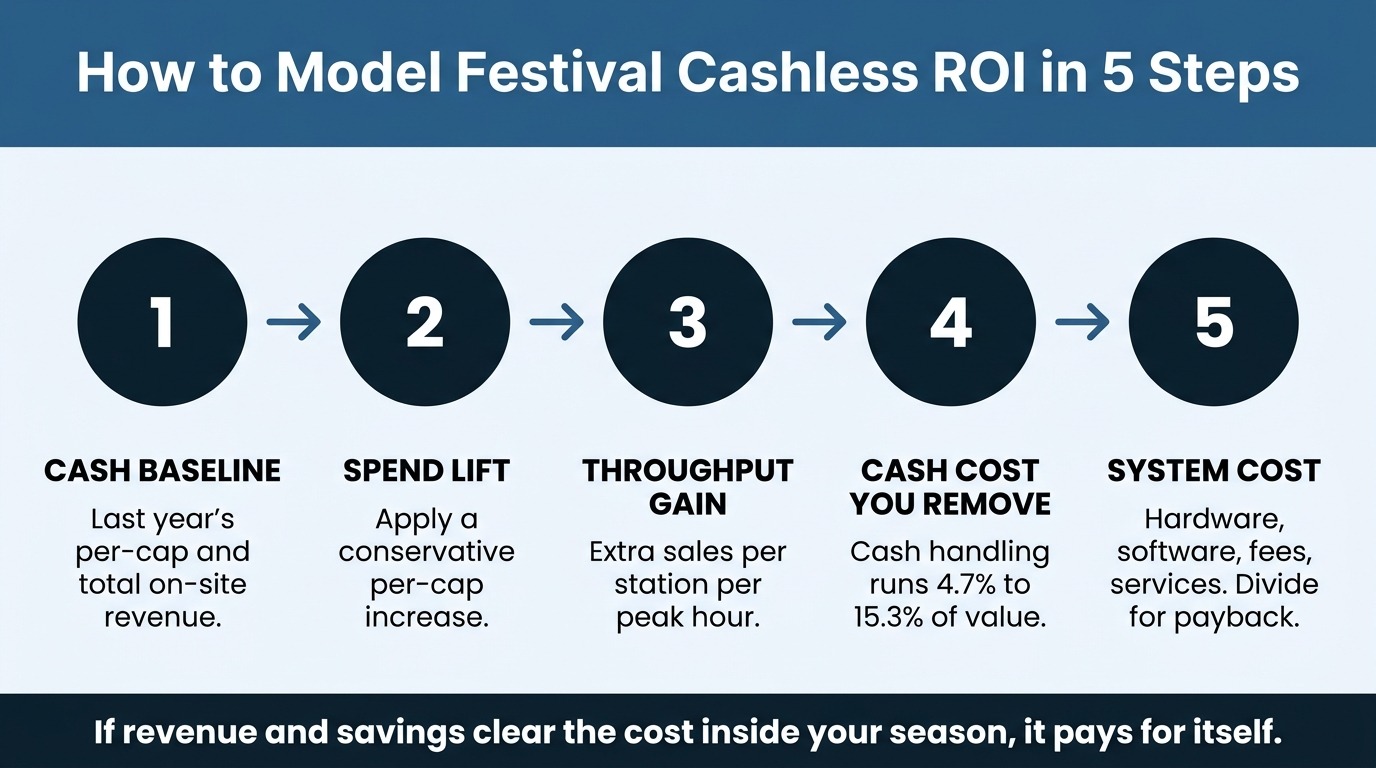
A credible festival POS return on investment estimate is built from your numbers, not a vendor's slide. The model below turns the four levers into a repeatable calculation you can run in a spreadsheet before you commit to anything. Here is how to model the return in five steps.
- Set Your Cash Baseline. Pull last year's per-cap spend and total on-site revenue under cash. This is the number every gain gets measured against, so start from real history rather than a guess.
- Estimate a Conservative Spend Lift. Apply a per-cap increase you would defend to a skeptic, then multiply by projected attendance. Model a low case and a high case so you see the range instead of a single rosy figure.
- Add Your Throughput Gain. Estimate the extra transactions per station per peak hour that faster checkout allows, multiply by average ticket and active stations, and add it to the revenue side.
- Subtract the Cash Cost You Remove. Apply the cash-handling cost from the section above to the volume shifting off cash, and count the staff hours, transport, and shrinkage you no longer pay for.
- Compare Against Total System Cost. Add hardware, software licensing, processing fees, and any on-site services, then divide to find your payback period. If revenue and savings clear that cost inside your event or season, the system pays for itself.
As an illustration, picture a two-day event of 20,000 attendees with a cash per-cap of 40 dollars. A conservative spend lift, plus throughput gains at the bars, plus the cash-handling cost you stop paying, can outrun a typical system cost well inside a single season. Your actual figures will differ, which is exactly why you run the model rather than trust a headline percentage.
When Does a Festival Cashless System Pay for Itself?
Payback is not a fixed number. It hangs on how much volume you move, how much of that volume shifts off cash, and what the system costs to run. You find the answer by stacking your own gains against that cost rather than trusting a vendor's average.
Reading Your Payback Window
Your festival cashless ROI turns positive at the point where the stacked revenue and savings exceed total system cost. For a large festival with heavy food and beverage sales, that crossover can land inside a single event. For a smaller gathering, it may take a season, which is still a reasonable horizon for infrastructure you will reuse year after year.
The wider market has effectively voted on this question. The festival cashless payment platforms market reached 2.12 billion dollars in 2024 and is projected to hit 9.89 billion by 2033, a trajectory that reflects how many operators have already concluded the model earns its keep. If you are still weighing the call, the detailed case for RFID wristbands is the logical next read.
Frequently Asked Questions About Festival Cashless ROI
These are the questions operators raise most often when they sit down to run the numbers for their own event.
Does Going Cashless Actually Make a Festival More Money?
Yes, for most high-volume events. The gain comes from higher per-attendee spend, faster lines that fit in more sales, and lower cash-handling costs. The size of that gain depends on your crowd and how much they spend on food, drinks, and merch.
How Long Does It Take for a Cashless Festival System to Pay for Itself?
It varies with scale. A large festival with heavy bar and food revenue can recover the cost within a single event, while a smaller gathering may take a full season. Modeling your own attendance and per-cap is the only reliable way to find your payback window.
What Are the Hidden Costs of Running a Cash Festival?
Cash carries labor for counting and reconciliation, armored transport, and losses from theft and counting errors. Industry research shows those hidden costs can eat a meaningful share of every dollar collected. They are easy to overlook because no vendor ever bills you for them directly.
Is RFID or Contactless Card Better for Festival ROI?
Both improve ROI, and many events use them together. RFID wristbands shine at large, multi-day festivals because they run offline when connectivity drops and combine access and payment in one credential. Open-loop card and mobile taps work well for shorter shows where preloading funds is unnecessary.
Do Attendees Really Spend More When They Pay With a Wristband?
They tend to, yes. Preloaded balances feel like money already committed, so people spend them down instead of guarding cash. Combined with faster lines that capture impulse buys, that behavior is what drives the per-cap increases operators report.
The Bottom Line on Festival Cashless ROI
The return on going cashless is real, but it is not a single magic percentage. It is the sum of higher spend, faster service, lower cash costs, and less loss, weighed honestly against what the system costs to run. The operators winning this decision are the ones who modeled it before they signed, using their own attendance and per-cap rather than a headline number.
Billfold builds cashless and RFID payment systems for exactly this kind of high-volume festival environment, with real-time reporting and vendor management designed to turn that ROI into something you can watch happen live. If you want help running the numbers for your next event, reach out to the Billfold team to get started.
