
Are RFID Wristbands for Events Worth It in 2026?

RFID wristbands deliver measurable ROI for mid-size events through faster transactions, increased per-attendee spending, and real-time operational data.
- Wristband hardware costs between $1 and $12 per attendee depending on materials and features, with most mid-size events landing in the $2 to $5 range
- Events that adopt cashless payment systems consistently report higher per-attendee spending compared to cash-only operations
- Real-time analytics from RFID transactions give organizers actionable insights into crowd flow, vendor performance, and inventory management
- Mid-size events (1,000 to 15,000 attendees) stand to gain the most from RFID adoption because the technology scales without proportionally increasing staffing costs
If your event still relies on cash and traditional card swipes, 2026 is the year to seriously evaluate RFID wristbands as a revenue and operations upgrade.
Every event organizer eventually faces the same question: is it time to ditch cash? The global RFID market is projected to grow from $17.12 billion in 2025 to $37.71 billion by 2032, and the event industry is a significant driver of that expansion. Meanwhile, the festival cashless payment platforms market reached $2.12 billion in 2024 and is forecast to hit $9.89 billion by 2033. Attendees at festivals, food events, and multi-day gatherings now expect frictionless payment experiences. RFID wristbands for events have moved from experimental luxury to operational standard at major festivals like Coachella, Tomorrowland, and EDC. But the real story in 2026 isn't about mega-festivals. It's about mid-size events in the 2,000 to 15,000 attendee range, where the economics of cashless event technology finally make sense for organizers without enterprise budgets. So let's break down whether RFID wristbands are actually worth it for your event.
What Makes RFID Wristbands for Events Different From Other Payment Methods?
RFID wristbands aren't another form factor for the same old payment process. They fundamentally change how transactions happen at events.
Traditional payment methods create bottlenecks. Cash requires counting, change-making, and end-of-day reconciliation. Standard card terminals need reliable connectivity, and each transaction takes considerable time to process. RFID wristbands complete a transaction with a simple tap, dramatically faster than cash or card alternatives. That speed difference compounds across thousands of transactions over a weekend.
How Does the Technology Actually Work?
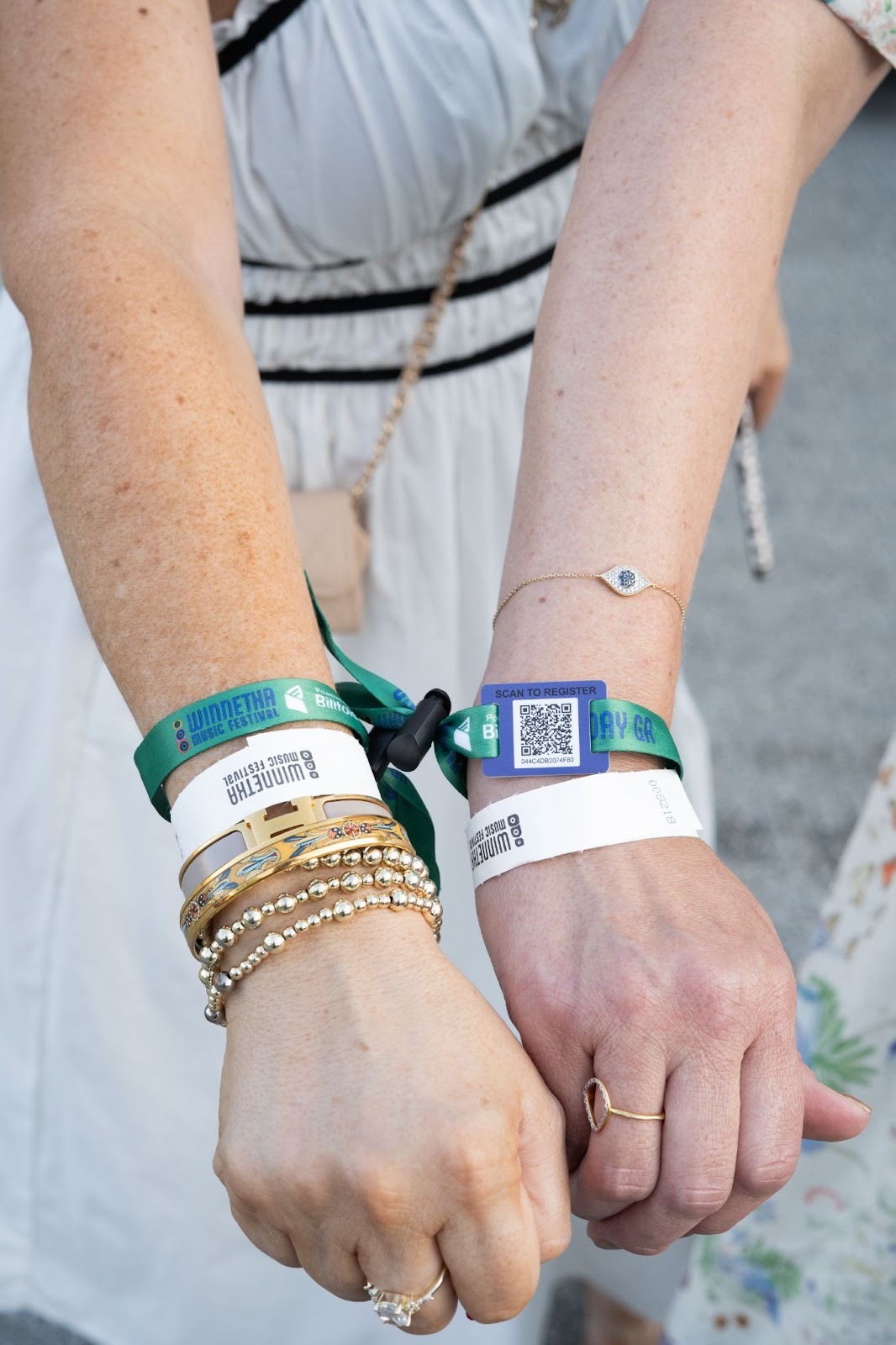
Each wristband contains a small passive RFID chip and antenna. When an attendee taps their wrist near a reader, the reader's radio waves power the chip, which transmits encrypted payment data almost instantly. There's no battery required in the wristband itself, which keeps costs down and eliminates failure points. Modern systems support both closed-loop models (where attendees preload funds onto the wristband) and open-loop models (where the wristband links to a credit or debit card). The closed-loop approach tends to drive higher spending because preloaded funds feel psychologically different from swiping a credit card.
What About NFC and Mobile Payments?
NFC (Near Field Communication) is actually a subset of RFID technology, operating at the same 13.56 MHz frequency. For event payments, both function similarly at the point of sale. However, RFID wristbands offer advantages that phones can't match in a festival environment: they're waterproof, don't run out of battery, and are always accessible on the attendee's wrist. For a deeper comparison, understanding the differences between RFID, NFC, and EMV payment systems helps organizers choose the right approach.
How Much Do RFID Wristbands Actually Cost?
Cost is usually the first concern for mid-size event organizers, and understandably so. The investment goes beyond wristband hardware.
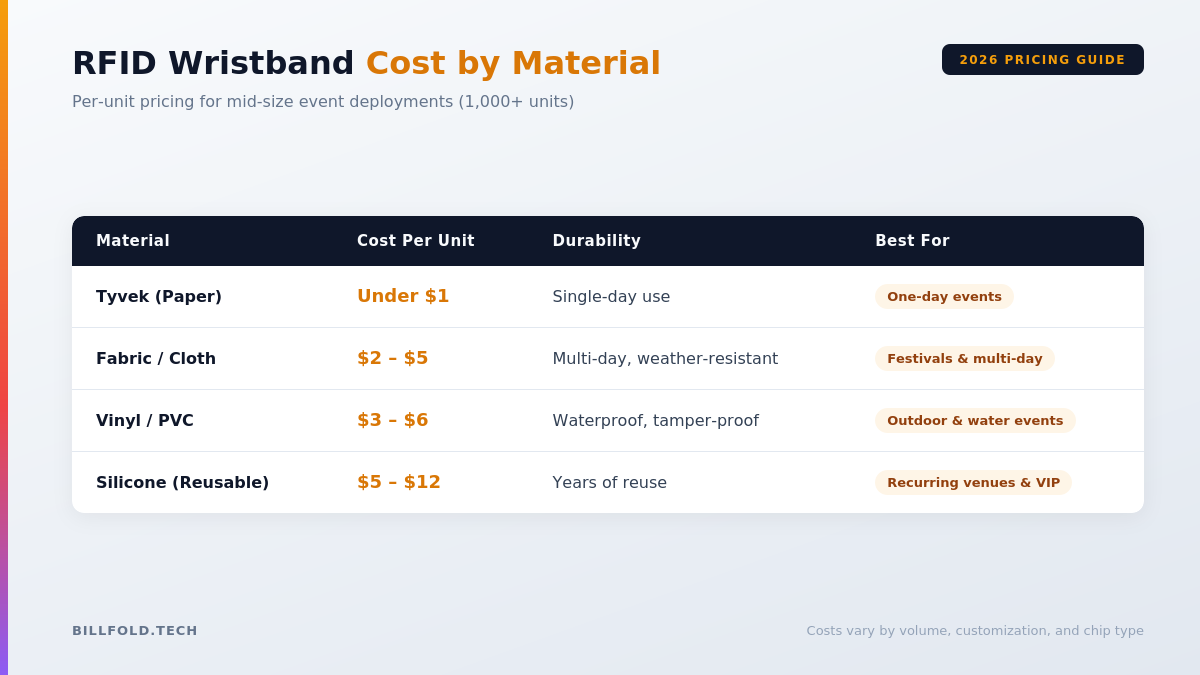
Wristband unit costs vary by material and customization. Basic disposable Tyvek RFID wristbands run under $1 each in bulk. Fabric festival-style wristbands with custom branding typically land between $2 and $5 per unit. Premium silicone or custom-designed wristbands can reach $8 to $12 for high-end events. For a mid-size festival of 5,000 attendees, wristband hardware alone might run $10,000 to $25,000 depending on material choices.
What Are the Hidden Costs Beyond Wristbands?
Hardware is only part of the picture. A complete RFID payment for festivals deployment includes POS terminals (readers), software licensing, staff training, on-site technical support, and network infrastructure. Some providers bundle these into per-transaction fees rather than upfront costs, which can make the technology more accessible for events with tighter budgets. You'll also need to budget for attendee onboarding stations where guests link their wristbands to payment accounts or load funds. For events evaluating the full cost of implementing RFID payments, the total investment depends heavily on the provider model and event scale.
Does the Math Work for Smaller Events?
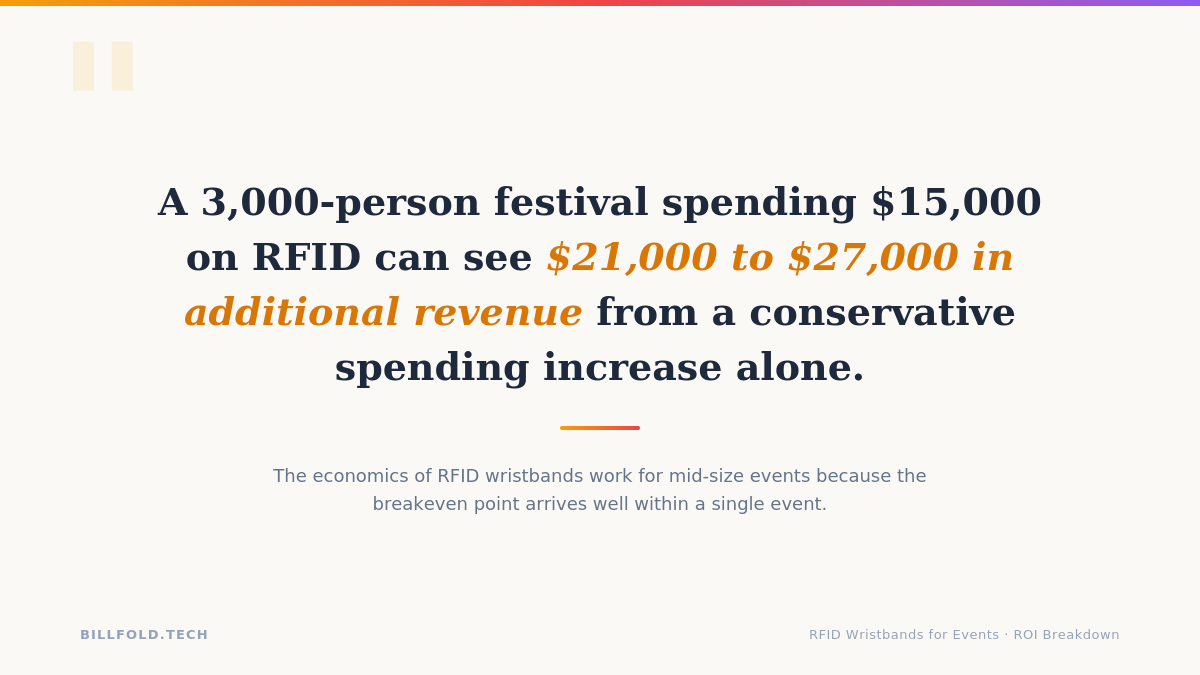
This is where the calculation gets interesting. A 3,000-person food festival spending $15,000 on RFID infrastructure might seem steep. But if cashless wristbands increase average per-attendee spending by even 15 to 20%, an event where guests previously spent $45 each on food and drinks now sees $52 to $54 per head. That's $21,000 to $27,000 in additional gross revenue, which more than covers the technology investment in a single event. The economics improve further when you factor in reduced cash handling labor, eliminated theft and shrinkage, and the value of transaction data for future event planning.
What Revenue Benefits Do RFID Wristbands for Events Deliver?
The spending increase from cashless systems is one of the most consistently documented benefits in event technology. A 2025 Payments Dive report found that roughly half of all U.S. concerts have gone cashless, and that number keeps climbing because the financial results speak for themselves.
Why Do Attendees Spend More With Wristbands?
The psychology is straightforward. Tapping a wristband doesn't trigger the same "pain of paying" that handing over physical cash does. Behavioral economics research consistently shows that the more abstract a payment method becomes, the more freely people spend. Preloaded cashless accounts amplify this effect. When attendees load $100 onto a wristband before the event, that money is mentally "spent" already, and they're more likely to use the full balance than request a refund.
Transaction speed also plays a direct role in revenue. When checkout happens in seconds instead of a lengthy card or cash process, attendees are more willing to make impulse purchases. They'll grab that second drink, pick up a merch item, or try another food vendor because the line moves fast enough that it doesn't feel like a commitment. This is why RFID adoption has been especially impactful at food festivals where spending per guest can increase significantly.
What About Operational Savings?
Revenue gains are only half the equation. Cashless wristbands reduce operational costs in several ways. Cash handling requires dedicated staff for counting, reconciling, and securing money throughout the event. RFID systems automate that entire workflow. Vendor settlements happen digitally with complete transaction records that eliminate disputes. Theft and shrinkage from cash handling effectively disappear in a cashless environment, and staff that would otherwise manage cash logistics can be redeployed to guest experience roles.
5 Reasons Mid-Size Events Are Adopting Cashless Wristbands in 2026
Mid-size events are hitting a tipping point for RFID adoption. Here's why:
- Lower entry costs than ever. The wearable event tech market has matured enough that providers offer flexible pricing models including per-transaction fees, hardware rentals, and bundled packages that reduce upfront investment. A 5,000-person event can deploy a full cashless system without a six-figure budget.
- Attendee expectations have shifted. Guests who've experienced cashless systems at larger festivals now expect the same convenience everywhere. Organizers who still run cash-only or card-only operations risk looking outdated and losing repeat attendees to competitors who offer smoother payment experiences.
- Data insights drive smarter decisions. RFID transaction data reveals which vendors are performing, what times see peak sales, and how attendee traffic flows through the event. This intelligence helps organizers optimize layouts, adjust vendor mixes, and negotiate better sponsorship deals for future events. Understanding the benefits of RFID payment for festivals goes well beyond faster lines.
- Scalability without proportional staffing increases. A cash-based event with 50 vendor points might need 10 to 15 dedicated cash management staff. An RFID system serving the same footprint can operate with a fraction of that support team because transactions are automated and reconciliation is digital.
- Sponsor activation opportunities. RFID wristbands create new revenue channels through sponsor-branded loading bonuses, loyalty rewards triggered by purchase behavior, and data packages that sponsors value for their own marketing insights.
What Wearable Event Tech Trends Should Organizers Watch in 2026?
The wearable event tech landscape is evolving fast, and RFID wristbands are at the center of several converging trends.
AI-powered analytics represent the biggest leap forward. Instead of reviewing transaction reports after the event ends, organizers can now access predictive insights in real time. Systems flag underperforming vendor locations, suggest staffing adjustments based on crowd density, and identify inventory shortfalls before they cause stockouts. This is the next frontier for cashless payment systems dominating the event space.
Hybrid payment models are also gaining traction. Rather than forcing attendees into a single payment method, the most successful 2026 deployments let guests choose between RFID wristband taps, contactless card payments, and mobile wallet scans through one unified system. This flexibility reduces onboarding friction and accommodates attendees who are new to cashless wristbands.
Where Is the Technology Heading?
Sustainability is becoming a purchasing factor. Organizers are increasingly requesting recyclable or biodegradable wristband materials, and manufacturers are responding with eco-friendly options that maintain the durability needed for multi-day events. Reusable silicone wristbands that can be reprogrammed for multiple events are gaining popularity among venues and recurring festival brands. Integration depth is expanding too. Modern RFID systems for festivals connect directly with access control, age verification, VIP zone management, and even social media activations. A single wristband tap can verify a guest's age at a bar, grant entry to a restricted area, and trigger a personalized push notification, all within the same transaction.
How Do You Decide If RFID Payment for Festivals Fits Your Budget?
Making the call on RFID wristbands for events requires looking beyond the line-item cost of wristband hardware. The real question is whether the combined revenue increase, operational savings, and data value justify the total deployment cost.
Start by calculating your current per-attendee spending and estimating a conservative 15% increase from cashless adoption. Compare that projected revenue lift against the all-in cost of an RFID system. For most mid-size events, the breakeven point arrives well within the first event.
Consider the competitive landscape too. If similar events in your region have already gone cashless, attendees will compare experiences. And if you're running a recurring event, the data you collect from year one becomes a strategic asset that compounds in value, informing vendor selection, pricing strategies, and layout optimization. Don't overlook the vendor experience either. Food and beverage operators, merchandise sellers, and activity providers all benefit from faster transactions and simplified settlements. Happy vendors are more likely to return and recommend your event.
Frequently Asked Questions
How long does it take to set up RFID wristbands for a mid-size event?
Most RFID providers can deploy a full system within 4 to 8 weeks, including wristband production, hardware shipping, software configuration, and staff training. Recurring events with established infrastructure can set up in as little as 2 weeks.
Can attendees get refunds on unused wristband balances?
Yes. Modern RFID systems offer multiple refund channels including on-site kiosks, online portals, and automatic refunds to the original payment method. Offering easy refunds is considered a best practice for maintaining attendee trust and encouraging higher initial top-ups.
What happens if an RFID wristband stops working during the event?
Quality RFID wristbands have very low failure rates. Most deployments include on-site support stations where staff can issue a replacement wristband and transfer the attendee's account balance within minutes. The account data lives on the server, not the physical wristband.
Are RFID wristbands secure enough for processing payments?
RFID payment wristbands use encrypted communication protocols similar to contactless credit cards. Each wristband contains a unique identifier that cannot be cloned, and transaction data is encrypted end-to-end. Lost or stolen wristbands can be remotely deactivated immediately.
Ready to Make the Switch to Cashless Event Payments?
The evidence is clear. RFID wristbands for events deliver measurable returns through higher spending, faster operations, and actionable data. The technology has matured past the early-adopter phase, and the economics work for events well below the mega-festival scale. Mid-size organizers who invest in cashless systems now position themselves ahead of competitors still relying on outdated payment infrastructure. Billfold provides turnkey RFID payment solutions designed specifically for events and festivals of all sizes, with flexible deployment models that match your budget. Get in touch with Billfold to explore how cashless wristband technology can work for your next event.
