
Event Payment Solutions: How to Choose the Right System for Your Venue

Key Takeaways
Choosing among event payment solutions comes down to matching hardware, software, pricing, and support to how your venue actually operates, not to the longest feature list.
- Hardware has to survive real event conditions: heat, crowds, spotty connectivity, and thousands of taps per hour.
- Pricing spans hardware, software licensing, processing fees, and on-site services, so compare total cost rather than the headline rate.
- Offline capability, real-time reporting, and multi-vendor management separate event-grade systems from repurposed retail POS.
- The right questions during evaluation reveal more than any demo, so bring a checklist to every vendor call.
Score every option against your operational reality, and the strongest fit becomes obvious fast.
Picking the right payment setup for a live event is a revenue decision disguised as a hardware purchase. Event payment solutions now range from repurposed retail terminals to closed-loop RFID platforms built for festival scale, and the gap between them shows up the moment a line stalls at the bar. The stakes keep climbing: the global cashless event payments market sat at USD 3.8 billion in 2024 and is projected to reach USD 11.9 billion by 2033. Purpose-built event platforms have moved from novelty to baseline, which is exactly why the evaluation deserves real scrutiny.
This guide walks through how to evaluate these systems the way experienced operators do: by criteria, by cost structure, by red flags, and by the questions that expose whether a vendor understands live events at all. No brand pitches, just a framework you can apply to any shortlist.

What Should You Look for in Event Payment Solutions?
The best event payment solutions share a short list of traits that rarely make it onto a glossy spec sheet. They prove themselves under load, when twenty thousand people all want a drink at the same time. Start your evaluation with the fundamentals below before the flashy add-ons pull your attention.
Hardware Built for Event Conditions
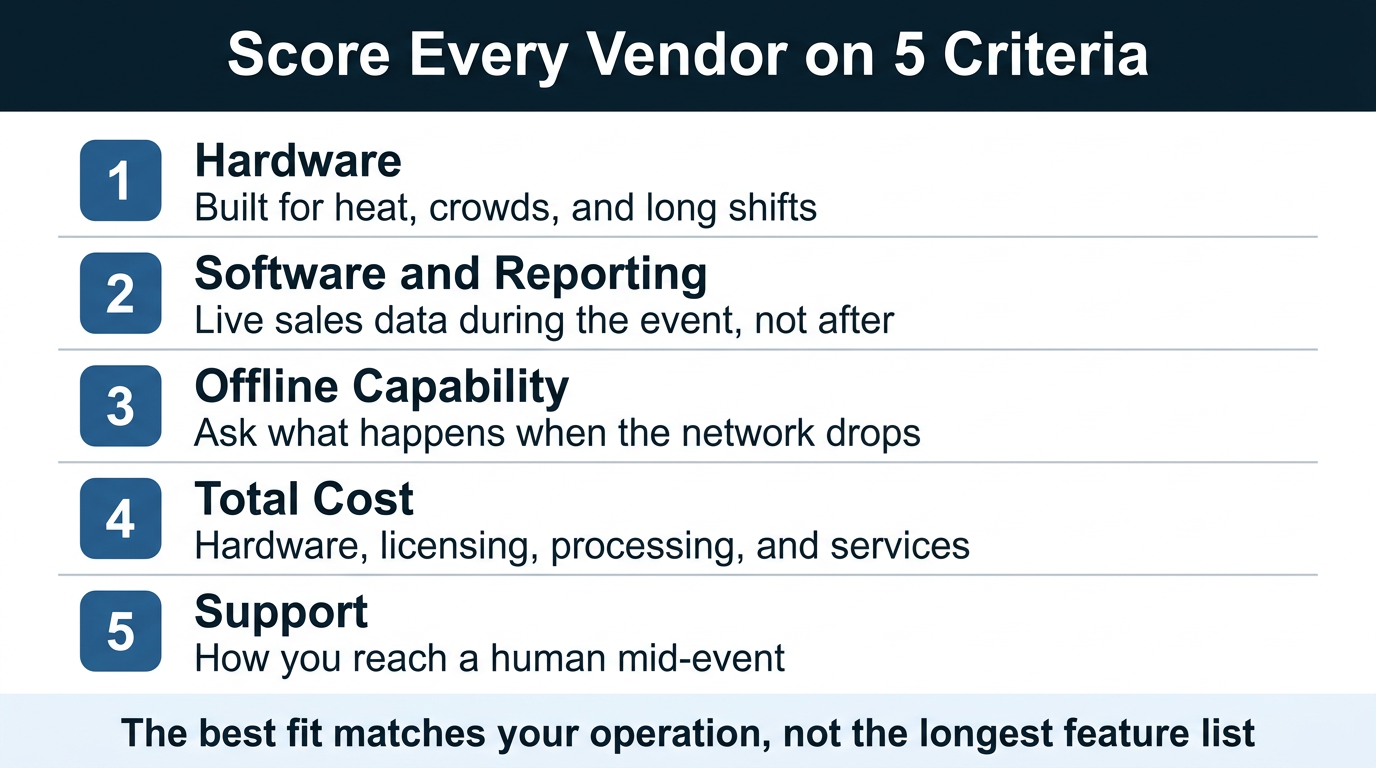
Retail terminals are designed for a countertop, a wall outlet, and a reliable internet line. Events offer none of those. Devices sit in direct sun, run on batteries through long shifts, and take thousands of taps across a weekend. Look for rugged hardware, sensible battery life, and remote device management so your team can catch a low battery or an overheating unit before it goes dark. A system that lets you monitor and control an entire fleet from one dashboard turns a pile of terminals into something you can actually run at scale.

Software and Real-Time Reporting
The software layer is where a system earns its keep. You want a fast checkout flow, flexible menu and pricing controls per location, and reporting that updates while the event is live rather than after it ends. Real-time visibility into which bars are selling, which items are moving, and where lines are forming lets you shift staff and stock on the fly. A unified cashless and contactless POS brings checkout, reporting, and vendor management into one place, so you react during the show instead of on Monday.
Offline Reliability and Payment Flexibility
Outdoor sites overwhelm cellular networks and strain Wi-Fi, so ask how a system behaves when connectivity drops. Closed-loop RFID setups can keep processing offline by storing balance data on the wristband, then sync once the network returns. Understanding the difference between cashless and contactless payments helps here, because the two describe different things and carry different hardware and data implications. The strongest systems accept every method your guests actually use: tap-to-pay cards, mobile wallets, and RFID wristbands.
How Do You Compare an Event Payment System Across Vendors?
Once you know what good looks like, comparing vendors becomes a structured exercise rather than a gut call. Two areas trip up most buyers: the true total cost of the system, and the quality of support when something breaks at nine on a Saturday night.
Pricing Models and Total Cost
An event payment system rarely comes with a single sticker price. Costs typically break into hardware (rental or purchase), software licensing per device, payment processing fees, and optional on-site professional services. A low processing rate can hide steep hardware minimums, and a cheap device fee can come paired with thin support. Add every line together for a realistic total, then ask how funds settle and how fast vendors get paid, because slow payouts create their own headaches. The broader hardware market offers useful context: the contactless payment terminals market was valued at USD 39.93 billion in 2024 and is expected to reach USD 83.59 billion by 2029, so hardware options keep widening.
Support, Onboarding, and Vendor Management
Software breaks and people fix it, so the speed and quality of support matter as much as any feature. Ask exactly how you reach a human during an event and how fast they respond. For multi-vendor operations, onboarding is its own challenge: a strong platform lets you bring hundreds of vendors under one umbrella, give each its own dashboard, and distribute funds in real time. If you are weighing a full contactless POS system, confirm that vendor management and settlement are built in rather than bolted on afterward.
7 Questions to Ask Before Choosing a Payment Solution for Events
The fastest way to separate a real event platform from a repackaged retail tool is to ask pointed questions. Bring this checklist to every vendor call and score the answers, because a good payment solution for events will have clear responses ready.
- Does It Work Offline? Confirm whether transactions continue during a network outage and how the system reconciles once connectivity returns.
- How Does It Handle Peak Load? Ask for throughput numbers and how the setup performs when thousands of taps land in the same few minutes.
- What Does Total Cost Actually Include? Get hardware, software, processing, and services itemized so the headline rate cannot mislead you.
- Who Owns the Data? Clarify whether transaction data stays in your ecosystem or routes to a third party you never hear from again.
- How Fast Do You Get Paid? Settlement timing shapes cash flow, so confirm payout speed and whether faster access costs extra.
- Can It Manage Many Vendors at Once? For festivals and multi-vendor venues, confirm per-vendor dashboards and real-time fund distribution.
- How Do You Reach Support During an Event? Get the escalation path and response time in writing before you commit to anything.
What Are the Red Flags to Avoid?
Some warning signs surface early if you know to watch for them. A vendor that dodges any of the questions above is telling you something, and a few patterns should give any operator pause before signing.
The costliest problems tend to surface only under load, when it is too late to switch providers, so the goal is to spot them during evaluation. Treat the list below as disqualifiers worth raising directly with any vendor. Planning the rollout matters just as much, so review how to implement a cashless system well before your gates open.
- Hardware that needs constant connectivity to take a single payment.
- Pricing that looks great until every line item is totaled.
- Contracts with steep early-termination fees or vague data-ownership terms.
- No clear plan for refunds, lost wristbands, or a stalled line at peak.
- Support that routes you to a chatbot in the middle of a live event.
How Do You Match the System to Your Venue?
The right choice depends on your event's size, duration, and audience. A one-day community festival and a permanent arena have very different needs, and the best event point of sale for one may be overkill or underpowered for the other.
Smaller or single-day events often prioritize quick setup and familiar tap-to-pay, while large multi-day festivals lean on RFID wristbands for speed, offline reliability, and richer data. Consumer habits push every venue in the same direction: the mobile payment market was valued at USD 88.5 billion in 2024 and is projected to reach USD 587.5 billion by 2030, so guests increasingly expect to tap and go. Match the payment system for events to how your guests already pay, then layer on the event-specific capabilities your operation truly needs. An RFID payment platform makes the most sense when speed and data sit at the top of your list.
FAQ
What Is the Best Event Payment System for a Festival?
For large festivals, closed-loop RFID systems tend to win because they process payments in seconds, keep working when networks fail, and generate detailed spending data. Smaller events can run well on contactless card terminals. The best fit depends on your crowd size, connectivity, and how much of your data you want to keep.
How Much Does a Payment System for Events Cost?
A payment system for events usually combines hardware, software licensing, processing fees, and optional on-site support, so there is no single price. Rental models lower upfront cost, while purchasing can work out cheaper across multiple events. Always compare the full total rather than the advertised processing rate alone.
What Is an Event Point of Sale System?
An event point of sale system is the hardware and software that takes payments and tracks sales at a live event. Unlike retail POS, it is built for high volume, offline operation, and multi-vendor settlement. It commonly handles food, beverage, merchandise, and sometimes access control in one place.
Can One System Handle Cards, Wallets, and Wristbands?
Yes. The strongest event payment solutions accept tap-to-pay cards, mobile wallets like Apple Pay and Google Pay, and RFID wristbands within a single setup. Hybrid systems let guests use whatever they carry while giving organizers the speed and data of RFID. That flexibility reduces friction at checkout and captures more sales.
Choosing Event Payment Solutions That Fit Your Venue
The right system is the one that matches your venue's reality: the crowd size, the connectivity, the vendor mix, and the data you want to keep. Score every option against the criteria and questions above, and the strongest candidates rise to the top quickly. A demo can look flawless, but an RFP answered in writing tells you how a vendor will behave when the pressure is on.
For venues and festivals that need speed, offline reliability, and real-time vendor management in one platform, Billfold builds event payment infrastructure designed for exactly that scale. Reach out to the Billfold team to see how it fits your next event.
