
Bar POS Contactless: Faster Nightclub Service in 2026
Key Takeaways
Bar POS contactless technology is the difference between a line that keeps moving and one that empties your bar an hour before last call.
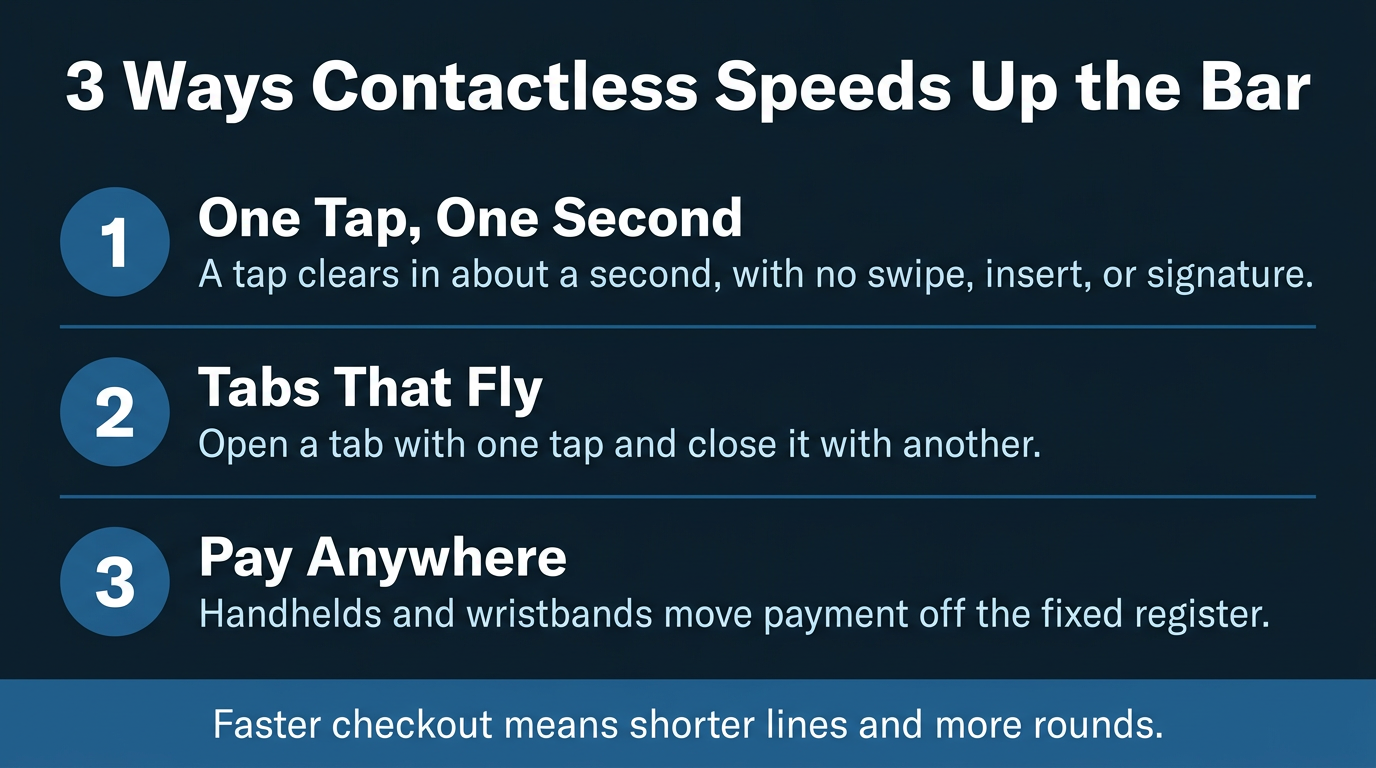
- A single tap clears in about a second, while a swipe or chip insert eats several, and that gap multiplies across every guest during a peak-hour rush.
- Nightclubs need a POS built for chaos, not a retail terminal, with fast reorders, pre-authorized tabs, and wristband or mobile payment at every station.
- VIP and bottle service run cleaner when large tabs, splits, and table-side closeouts happen on the same contactless system as the main bar.
- Younger crowds already pay by tap, so a venue still running cash registers asks its best-spending guests to use a method they barely carry.
If your bar still stalls at the register on a Saturday night, the fix is not more bartenders. It’s faster checkout.
Picture the last thirty minutes before a headliner hits the stage. Three hundred people want a drink at once, and every one of them stands between your bartenders and the register. The bottleneck is almost never the pour. It is the payment. A bar POS contactless setup attacks that exact moment, collapsing the slowest part of every sale into a single tap. One contactless payment tool grew 200% in a single year, and guests now expect that speed the second they reach your bar.
This piece breaks down how bars and nightclubs use contactless payment technology to speed up service, from tap-to-pay at the main bar to wristband programs and bottle service. The shift is not cosmetic. The best purpose-built event payment platforms treat checkout speed as an engineering problem, and the operators who solve it serve more guests with the same staff. The venues doing it well are not adding bartenders. They are removing seconds from every sale. Here is what actually moves the line.
What Makes Bar POS Contactless Faster Than Cash or a Swipe?
Speed at the bar comes down to how many seconds each transaction steals from the next one. Cash and chip cards both add friction that a tap removes, and at volume, those seconds decide whether your line clears or grows. Hospitality is now one of the fastest-growing segments of the contactless payment market, so the bar next door is very likely solving this already.
How Does a Single Tap Cut Transaction Time?
A contactless payment moves the credential across in about a second, with no swipe, no insert, and no signature on most purchases. Compare that to a chip transaction, where the guest orients the card, holds it steady, waits for the prompt, and sometimes signs a screen. Multiply that difference by a few hundred guests in a compressed window and you get the gap between a bar that keeps serving and one that stalls. That mechanical edge is the whole reason venues treat how contactless POS systems work as an operational lever rather than a nicety. Mobile wallets add another layer of speed, since a phone or watch authorizes with a glance and clears just as fast as a contactless card.
Why Do Lines Form at the Bar in the First Place?
Lines rarely form because drinks take too long to make. They form because payment, tab management, and card handling pile up at the register while the pour waits. A bar POS contactless flow removes the two slowest culprits: fumbling with a physical card and manually keying a total. When the payment step disappears, bartenders spend their time pouring and reading the room instead of babysitting a card reader. Fewer stalls at the register also means fewer guests who walk away thirsty because the wait was not worth it.
Why Do Nightclubs Need a Different POS Than Restaurants?
A restaurant turns tables over across a leisurely two hours. A nightclub slams hundreds of orders into a twenty-minute window between sets, then does it again. The crowd also skews young, and nearly 80% of Gen Z already lean on digital wallets, so a room still running cash registers asks its best-spending guests to pay in a way they barely use. That pace and that expectation break retail-grade systems, which is why a nightclub POS system has to be built for speed and chaos rather than table service.
How Do Wristband Programs Speed Up Club Cashless Payments?
RFID wristbands push contactless one step further by putting the payment credential on the guest's wrist instead of in a pocket. A tap of the band clears the sale, and because the balance can live on the chip, club cashless payments keep flowing even when the venue's network hiccups. For a packed room where nobody wants to dig for a phone, the wristband is the fastest path from order to next order. It also builds a clean data trail that ties spending to behavior across every bar in the building, the way nightclubs running dual-screen POS terminals already track their busiest stations.
Can Contactless Handle VIP and Bottle Service?
Bottle service is where a lot of POS systems fall apart, because the tabs are large, the splits are messy, and the service happens at the table rather than the bar. A strong bar POS contactless system runs those high-value tabs on the same rails as the main bar, with table-side closeouts on a handheld and pre-authorized cards that protect against walkouts. At a rooftop pool party with VIP cabanas, that means a host can open, add to, and settle a bottle tab without the guest ever leaving the couch. The result is a cleaner night for the staff and a smoother one for the guest paying the check.

How Do Operators Bust Lines During Peak Hours?
Peak-hour throughput is the metric that actually pays the bills, because every guest who gives up on a line is a drink you never sold. Contactless is the foundation, but the operators who win pair a contactless checkout built for high-volume venues with a few deliberate tactics on the floor.
What Does Peak-Hour Throughput Look Like in Practice?
The busiest venues plan their whole floor around the register. They add handheld devices so staff can take payment anywhere instead of funneling everyone to a fixed terminal, and they spread bar stations out to keep any single point from becoming the choke point.
A Manhattan rooftop concert venue running dozens of dual-screen terminals across multiple bar stations, all accepting tap-to-pay, is engineered so the line never piles up in one place. Real-time sales data helps too, because a manager who can see which bar is backing up can move staff or open another station before the line becomes a wall. The lesson scales down to a small room: spread the payment points out, watch where guests bunch up, and make each register as fast as it can be.
5 Ways Contactless Speeds Up Bar and Nightclub Service
If you are evaluating a contactless POS for bars, these are the levers that move the line fastest during a rush.
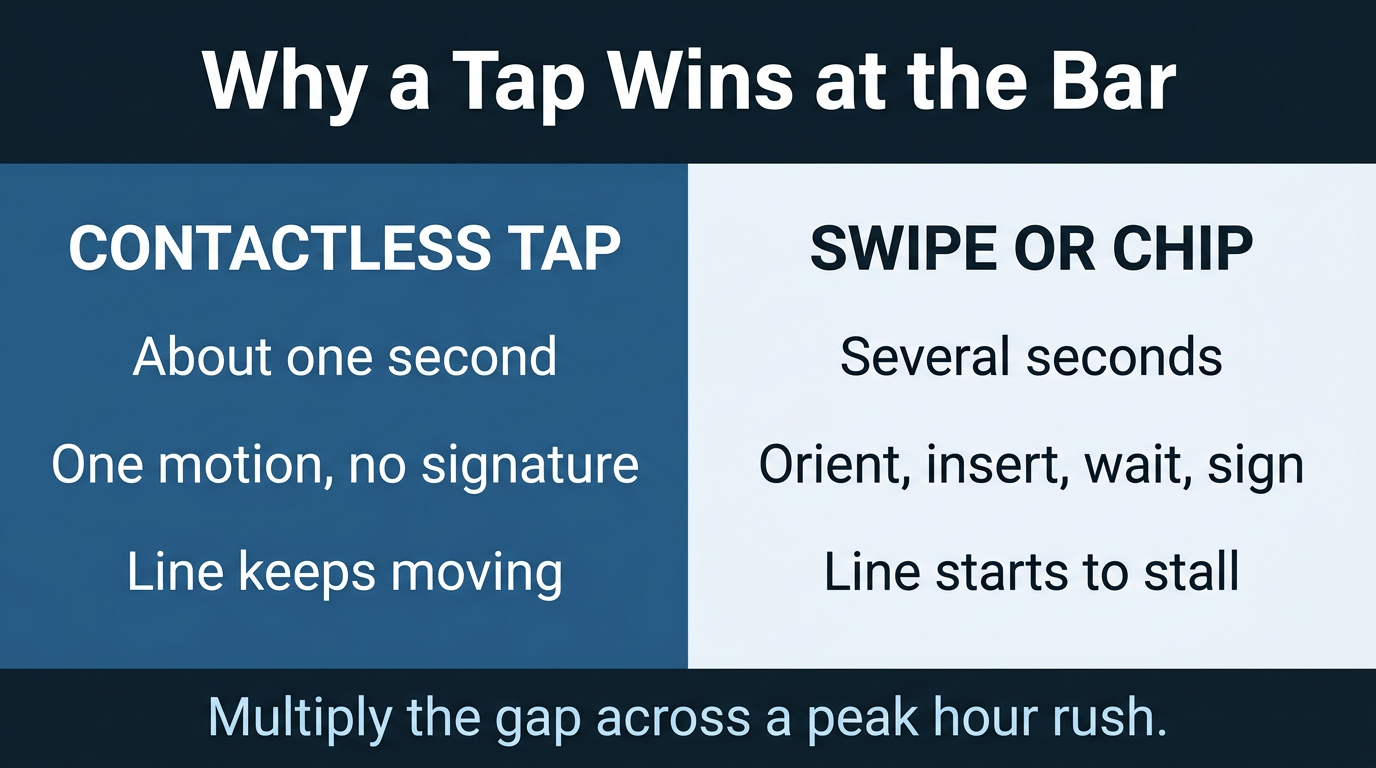
- One-Tap Pre-Authorized Tabs. Opening a tab with a single tap, then closing it with another, removes the two slowest moments of the night and protects against walkouts.
- Handheld Devices Everywhere. Mobile terminals let bartenders and servers take payment on the floor, at the rail, or table-side, so guests never bunch up at one register.
- Wristband or Mobile Credentials. RFID bands and digital wallets clear faster than physical cards and keep club cashless payments moving even when connectivity drops.
- Image-Based, One-Touch Menus. Ringing a house pour in one touch instead of three keeps the bartender's hands on drinks rather than buried in the screen.
- Offline Processing. When the venue's network stumbles mid-rush, a system that keeps taking payment locally is the difference between a sale and a shrug.
FAQ
What Is a Bar POS Contactless System?
It is a point-of-sale setup that lets guests pay by tapping a card, phone, or wristband instead of swiping or inserting. The tap clears in about a second, which is why a bar POS contactless flow moves lines faster than cash or chip cards. Most systems accept mobile wallets, contactless cards, and RFID bands through the same terminal.
Is Contactless POS Worth It for a Small Bar?
Yes, if you ever have a rush. The value of a contactless POS for bars shows up whenever a line forms, because faster checkout means more drinks sold in the same window. Even a single handheld device that takes tap payment on the floor can clear a bottleneck at a busy rail.
How Do Nightclub Wristband Programs Work?
Guests link a payment method to an RFID wristband, then tap the band to pay at any bar in the venue. Because the balance can live on the chip, club cashless payments keep processing even if the network drops mid-set. It is the fastest option for a packed room where nobody wants to dig for a phone or a card.

Can a Nightclub POS System Handle Bottle Service?
A capable nightclub POS system runs bottle service on the same rails as the main bar, with table-side closeouts on handhelds and pre-authorized cards to prevent walkouts. That keeps large VIP tabs organized and lets hosts settle without the guest leaving their table. The same system reports every sale in real time, so the floor manager can see which sections are spending.
The Real Fix for a Stalled Bar
Faster service at a bar or nightclub is rarely a staffing problem. It is a checkout problem, and contactless is the most direct way to solve it. When the payment step shrinks to a tap, every other part of the night speeds up with it: shorter lines, more rounds, cleaner reporting, and guests who stay in the room instead of giving up at the rail.
Billfold builds contactless and RFID payment technology designed for exactly this environment, from the main bar to VIP bottle service. If your venue is ready to stop losing sales at the register, reach out to the Billfold team to map it to your space.
