
RFID Event Technology: Implementation Challenges and How to Solve Them

Key Takeaways
The most common RFID implementation challenges at large events are predictable, and every one of them is solvable with the right planning timeline and vendor partnership.
- Hidden infrastructure costs are the most common budget surprise; multi-year planning and phased rollouts are the fix.
- Integration with existing event technology infrastructure fails most often because vendors test in staging, not under production load.
- Signal interference from metal structures and dense crowds is predictable and preventable with professional site surveys.
- Privacy compliance and multi-venue scalability require decisions made during vendor selection, not after deployment begins.
Organizers who get RFID right treat it as infrastructure, not a technology purchase for a single event.
Event organizers are sold on RFID event technology before they fully understand what deploying it involves. Faster transactions, zero cash handling, real-time analytics, stronger access control: the value proposition is clear. The path from contract to opening-day operation is not.
The global RFID market is valued at over $17 billion in 2025 and growing at nearly 12% annually, according to Fortune Business Insights. That growth signals strong industry confidence in the technology. It also means more first-time deployments by event organizers who do not yet understand the operational complexity involved. As cashless events become the industry standard, the organizers who execute RFID implementation challenges well will gain a lasting operational and revenue advantage over those who rush it.
This guide covers the five most significant RFID implementation challenges that large events face, and frames each as a solvable planning problem. The goal is to help event organizers evaluate RFID event technology with realistic expectations and a framework for building deployments that hold up under real event conditions.

What Makes RFID Event Technology Implementation So Costly at Scale?
The first encounter most organizers have with RFID implementation challenges is the cost structure. Hardware and software are only part of the picture. The full investment includes layers that rarely appear in initial vendor quotes and that compound quickly as event size grows.
Where Hidden Costs Appear
Comprehensive RFID deployments require coordinated investment across wristbands or cards, reader hardware, backend software, network infrastructure, and power capacity to support the reader network. The costs that most often blindside organizers are the surrounding ones: power infrastructure upgrades, contingency hardware for equipment failures, staff training programs that require multiple sessions, and dedicated technical support during the live event. Venues frequently surface modification requirements that were never part of the initial planning conversation.
The path to positive ROI is well established. Events that implement RFID cashless payment systems report faster transaction throughput, higher per-attendee spending, and reduced revenue loss from cash handling errors. But that ROI typically plays out across multiple event cycles, not within the first deployment.
The Solution: Treat This as a Multi-Year Initiative
Organizers who achieve strong RFID ROI approach it as a strategic infrastructure investment rather than a technology purchase for a single event. The first year carries the heaviest capital burden. Reusable hardware, trained staff, and established software integrations reduce per-event costs substantially in subsequent years. Building a realistic multi-year model before signing any vendor contracts turns a daunting initial investment into a defensible business decision. Phased rollouts that begin with cashless payments at high-volume vendor areas, then expand to access control and analytics, let organizers prove ROI incrementally before committing to full-venue deployment.
How Do You Integrate RFID With Your Existing Event Technology Infrastructure?
Technical integration is the most underestimated of all RFID implementation challenges, and the one most likely to cause a failure during a live event. Events do not operate on blank slates. They run ticketing platforms, vendor management systems, inventory tools, and accounting software that must communicate seamlessly with new RFID infrastructure from the moment doors open.
Why Integration Fails
The failure mode cited most often in post-event analyses is testing under artificial conditions. Vendors test integrations in staging environments that do not simulate real transaction volume. When the event opens and peak-hour load hits, database capacity limits or synchronization conflicts cause cascading failures that never appeared in testing. Events have been forced to revert to manual cash operations hours into opening day as a result. A comprehensive RFID software integration strategy must include production load testing as a required pre-launch step, not an optional one.
The middleware layer that manages communication between RFID hardware and existing event technology infrastructure is often the most critical and least visible component. Quality middleware handles data transformation, error management, and performance optimization. Many vendors offer this as a paid add-on rather than a core platform feature. That distinction matters during procurement.
The Solution: API-First Architecture and Staged Testing
Successful integration requires a full audit of existing infrastructure before any RFID vendor is selected. Once selected, integration development should include scenario testing across all operational conditions, followed by staff training on new workflows. The long-term protection against integration failure is open architecture. Systems built on open APIs can absorb new components and replace underperforming ones without requiring complete overhauls. Locking into proprietary integration frameworks during initial deployment creates expensive constraints later.

Why Does Signal Interference Threaten RFID Deployments at Large Festivals?
Signal interference is the challenge that surprises organizers most because it is invisible during planning and disruptive during live operations. The physics of radio wave propagation mean RFID systems are consistently vulnerable to environmental conditions that are difficult to predict in advance and impossible to control during events.
The Common Sources of Interference
Metal structures are the primary culprit. Stage scaffolding, vendor booth framing, perimeter fencing, and metallic accessories worn by attendees create radio wave reflection and absorption that can significantly reduce RFID read range. Systems that perform reliably in testing may achieve a fraction of that range in a production environment filled with metal infrastructure.
Dense crowds introduce a second interference mechanism. Radio waves do not penetrate human tissue effectively, so large concentrations of people create physical barriers that block communication between tags and readers. High-traffic vendor areas that looked ideal during empty venue walkthroughs can become effective dead zones at full capacity. Environmental factors including temperature extremes and electromagnetic interference from other wireless systems on site compound the problem further. Frequency band selection matters here: understanding this tradeoff before hardware procurement, and reviewing how RFID wristband system design accounts for your venue type, prevents a category of problems that are expensive to fix after deployment.
The Solution: Professional Site Surveys Under Realistic Conditions
The most effective mitigation strategy is a professional site survey conducted under conditions that simulate actual event operations: test equipment deployed with crowd density simulation, realistic clothing and accessories on volunteers, and weather conditions that reflect what the venue typically experiences. Organizers that skip site surveys consistently face emergency troubleshooting during live events that simple preventive testing would have caught weeks earlier.
What Privacy and Compliance Requirements Apply to RFID Event Technology?
Privacy is where RFID implementation challenges intersect with regulatory obligations and attendee trust. The same comprehensive data collection that makes the technology valuable to organizers creates legitimate concerns about data use and unauthorized access that require proactive management.
Navigating the Regulatory Landscape
RFID systems at events collect movement data, purchase behavior, access patterns, and personally identifiable information linked to attendee accounts. Regulatory frameworks including GDPR in Europe and CCPA in California impose strict requirements on how that data is collected, stored, and disclosed. The PCI Security Standards Council also sets compliance requirements for payment data handling that any RFID deployment involving stored payment credentials must meet. Events operating across multiple jurisdictions face compounding compliance complexity.
Organizations that have faced the sharpest attendee backlash over RFID privacy shared a common failure: they did not communicate data practices clearly before the event. When attendees discover that location data is being tracked without explicit consent or a visible opt-out path, the reaction shapes the narrative around an event regardless of how well everything else ran.
The Solution: Transparency Built In From the Start
Events that publish clear data practice documentation during the registration and activation flow experience significantly fewer complaints. Building opt-out mechanisms for optional tracking features into the attendee-facing interface before the event removes the issue from the live event environment entirely. On the security side, RFID event payment security should include end-to-end encryption, dynamic authentication codes that change with each transaction, and automatic data deletion policies that balance analytical value against privacy obligations. These decisions are far easier to implement during initial deployment than to retrofit after systems are live.
How Do You Scale RFID Event Technology Across Multi-Venue Operations?
Single-venue RFID deployments are complex. Multi-venue operations introduce a different order of challenge: complexity scales exponentially, not linearly, with each additional location added to the network.
Where Scaling Breaks Down
Hardware management shows the strain first. A single-venue event manages a fixed inventory of readers, configuration files, and maintenance schedules. Multi-venue operations managing hundreds of readers across different locations face inventory tracking, configuration consistency, preventive maintenance coordination, and emergency replacement logistics that require dedicated infrastructure and staff.
Data synchronization is the deeper problem. Distributed RFID systems must maintain consistent attendee account information, payment authorizations, and access permissions across all venues simultaneously. Network latency, connectivity interruptions, and synchronization conflicts create conditions for serious errors including duplicate charges and valid attendee access denials. Staff knowledge management becomes a critical scaling constraint as well, as experienced personnel rotate across locations and consistent operational procedures become harder to enforce. Fleet management tools that provide real-time visibility into hardware status and operational metrics across all deployments are essential infrastructure for any multi-venue operation.
The Solution: Architecture Decisions Made at Day One
The most expensive scaling mistake is making architecture decisions during initial deployment without considering future expansion needs. Organizations that build on flexible, open API architectures can scale by adding infrastructure and operational procedures. Those locked into proprietary, single-venue systems face expensive re-platforming projects when growth demands capabilities their current event technology infrastructure cannot support. Evaluating vendor scalability before signing any initial contract, not when expansion is already on the calendar, is the move that separates well-planned event technology deployments from ones that require rebuilding.
6 Best Practices for a Successful RFID Implementation
Organizers who navigate RFID implementation challenges successfully share common practices. These six apply regardless of event size or deployment scope.
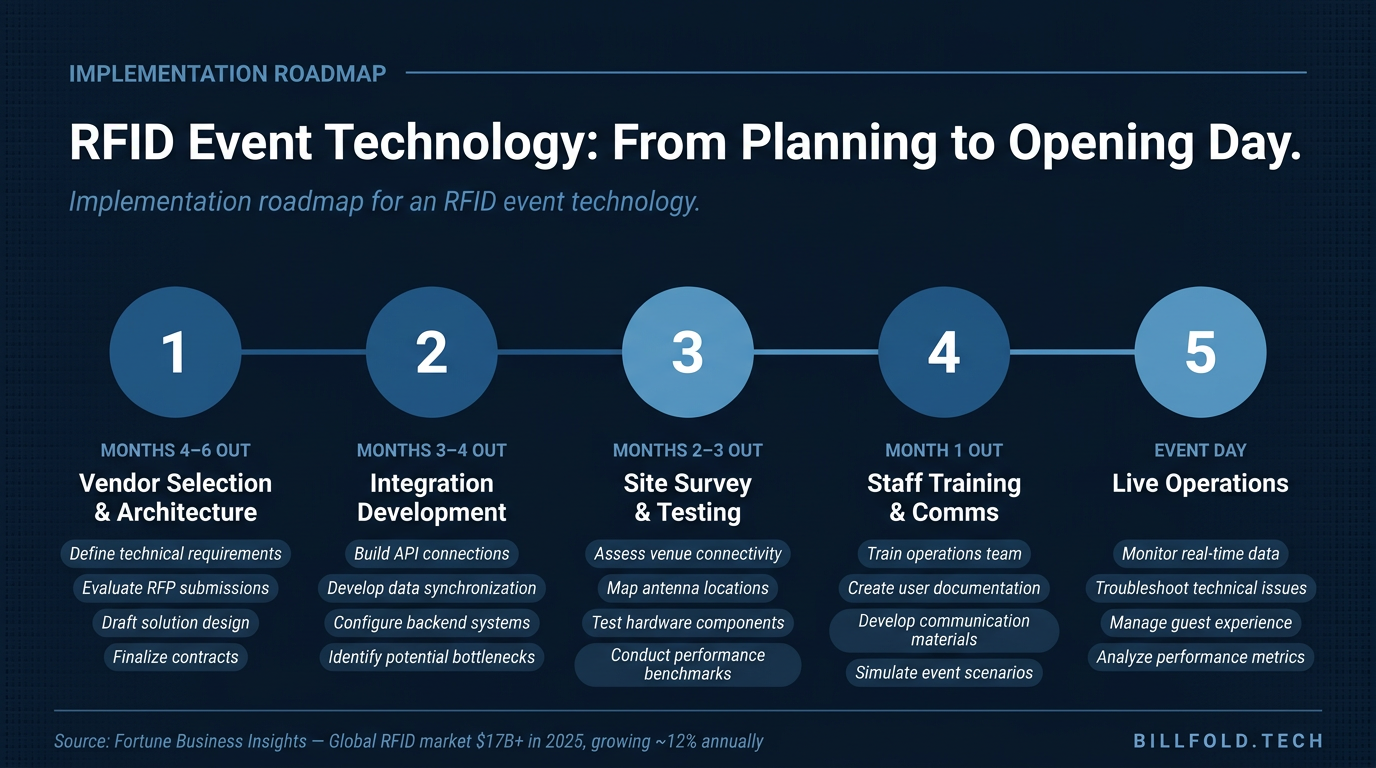
- Plan the timeline backwards from opening day. Work backwards from your first event day to establish deadlines for integration testing, staff training, site surveys, and hardware procurement. Compressing any phase increases failure risk during live operations.
- Test integrations under production load, not staging conditions. Require vendors to demonstrate system performance under simulated peak transaction volumes before final acceptance. Staging environment testing does not reveal the capacity and synchronization issues that cause failures during live events.
- Conduct site surveys with crowd simulation. Deploy test equipment under realistic conditions with volunteer crowds in typical event attire. Interference problems identified weeks before an event cost far less to resolve than the same problems found during opening hour.
- Build data transparency into attendee communications before the event. Publish clear data practice documentation during registration and activation. Attendees who understand what is collected and how it is used before they arrive are far less likely to generate issues during the event.
- Evaluate vendor architecture for future scalability alongside current event needs. Open API structures, centralized fleet management, and multi-venue contract flexibility are worth prioritizing even at single-venue deployments. Retrofitting these capabilities later is expensive.
- Budget for the full cost picture, not the headline price. Power infrastructure, contingency hardware, staff training, and technical support during the event all belong in the initial model. A realistic multi-year amortization schedule turns a large upfront investment into a defensible business case.
Frequently Asked Questions
How long does RFID event technology implementation take for a large festival?
Large festivals should plan for several months of lead time at minimum, covering vendor selection, integration development, hardware procurement, staff training, site surveys, and comprehensive testing under realistic conditions. Implementations that compress this timeline by skipping critical phases experience significantly higher failure rates during live operations.
What causes RFID systems to fail during live events?
The most frequent causes are integration failures under production load that were never caught in staging environment testing, coverage gaps from insufficient reader placement identified by inadequate site surveys, and signal interference from metal structures or dense crowds. Inadequate staff training is a consistent contributing factor at scale. Most of these failures are preventable with thorough pre-event preparation.
Can smaller events afford RFID event technology?
Smaller events have more options than the full custom deployment model that large festivals pursue. Shared infrastructure models, phased implementations focused on high-revenue vendor areas, and event-as-a-service pricing from some vendors convert significant capital expenditures into operational costs. The right approach depends on expected ROI timeline and whether the event plans to expand RFID usage over subsequent years.
How do event technology infrastructure choices affect long-term RFID scalability?
Architecture decisions made during initial deployment either enable or prevent future scaling. Open API-based systems can absorb additional venues, new hardware, and evolving software requirements without full rebuilds. Proprietary, single-venue systems typically require expensive re-platforming projects when expansion demands capabilities they were not designed to support. This is why scalability evaluation belongs in the vendor selection process, not the expansion planning process.
What should event organizers prioritize when evaluating RFID vendors?
Beyond pricing, the critical criteria are a demonstrated track record at comparable event scales, open API architecture that supports future integration needs, transparent pricing that includes all infrastructure and support costs, and responsive technical support during live events. Reference checks with organizers running comparable operations provide more reliable signal than vendor marketing materials alone.
Build Your RFID Implementation to Hold Up When It Counts
The five RFID implementation challenges described here are not reasons to avoid the technology. They are the predictable obstacles that separate well-prepared deployments from expensive cautionary tales. Events achieving strong results from RFID share a common posture: they invest adequate time in planning and testing, choose vendor partners based on proven track record rather than lowest bid, and treat RFID as multi-year infrastructure rather than a one-event technology purchase.
Event organizers who go into the process with realistic expectations about cost structure, integration complexity, and the time required to test properly are the ones who end up with deployments that hold up from opening day forward. The questions worth asking are not whether RFID is right for your event; at scale, it is. The questions worth asking are whether your vendor can handle production load, whether your event technology infrastructure is ready for integration, and whether your planning timeline gives your team enough runway to test before the first attendee arrives.
Billfold is built specifically for the demands of festivals, stadiums, and live events, with the infrastructure, integration capability, and operational experience that large-scale RFID implementations require. Reach out to the Billfold team to discuss your event's specific implementation challenges and what a deployment built to last actually looks like.
