
RFID Wristbands for Hotels and Resorts: All-Inclusive Cashless Payments Explained

Key Takeaways
A hotel RFID wristband program turns a single wearable into a room key, a payment method, and a live data stream across an entire resort.
- Guests tap one band to open their room, buy dinner, and book activities, with every charge flowing to a prepaid balance or a linked card.
- An all-inclusive RFID resort setup replaces cash, plastic key cards, and paper tickets with a closed-loop system operators actually control.
- Tying the band to the property management system keeps folios, reporting, and checkout clean across every outlet.
- Multi-location resorts gain real-time visibility into what sells, where, and who is buying it.
If your property still runs on cash and plastic key cards, a hotel cashless wristband is the upgrade guests now quietly expect.
Picture a guest arriving at an all-inclusive resort. They check in once, snap a band around their wrist, and stop carrying anything else for the rest of the week. That band opens their room, settles the bar tab, books the sunset catamaran, and covers the spa treatment, all with a quick tap. That single wearable is an RFID wristband hotel credential, and it is quietly becoming the operating system for how resorts handle access, spending, and guest data.
The shift is riding a much larger wave. The smart hospitality market is projected to reach nearly $200 billion by 2033, with hotels and resorts leading adoption as properties chase smoother stays and tighter back-office control. Purpose-built cashless payment platforms now let a resort fold room access, dining, retail, and activities into one credential. This guide breaks down how an all-inclusive RFID resort actually assembles that, from the band on a guest's wrist to the reconciliation that closes out their folio at checkout.
What Is a Hotel RFID Wristband Program?
A hotel RFID wristband program swaps the plastic key card and the physical credit card for one water-resistant band worn on the wrist. Inside that band sits a small radio-frequency chip that communicates with readers placed at guest room doors, bar counters, restaurant stations, retail shops, and activity desks. Every tap does one of two things: it grants access, or it records a charge against the guest's account. The entire system runs on infrastructure the property controls rather than a patchwork of outside terminals.
How Guests Use One Band for Everything
The appeal for guests is simple. One credential replaces a wallet, a room key, a stack of drink tickets, and the mental math of tracking a tab. A guest taps to enter their room, taps again for lunch, and taps a third time to rent a kayak, without breaking stride or fishing for a card. Because the interaction takes about as long as reaching for a door handle, spending feels frictionless, which is exactly why resorts see guests reach for the band more often than they would a card.
The Closed-Loop Balance Behind the Tap
Underneath the convenience sits a closed-loop model. Instead of routing every purchase through an outside card network in real time, the resort links each band to a prepaid balance, a credit card on file, or both. Guests can preload funds during booking or at a top-up station, and unused balances are refunded at the end of the stay. This closed-loop structure is what separates a true resort RFID payment system from a simple contactless card. If you are still mapping out an architecture, the difference between cashless versus contactless payments is worth understanding before you commit.
How Do All-Inclusive Resorts Use RFID for Room Charges, Dining, and Activities?
The all-inclusive model and RFID were practically built for each other. When most of the stay is prepaid, the wristband becomes the thread that ties every touchpoint together and captures the incremental spending that sits outside the package.
Room Access and Prepaid or Linked Balances
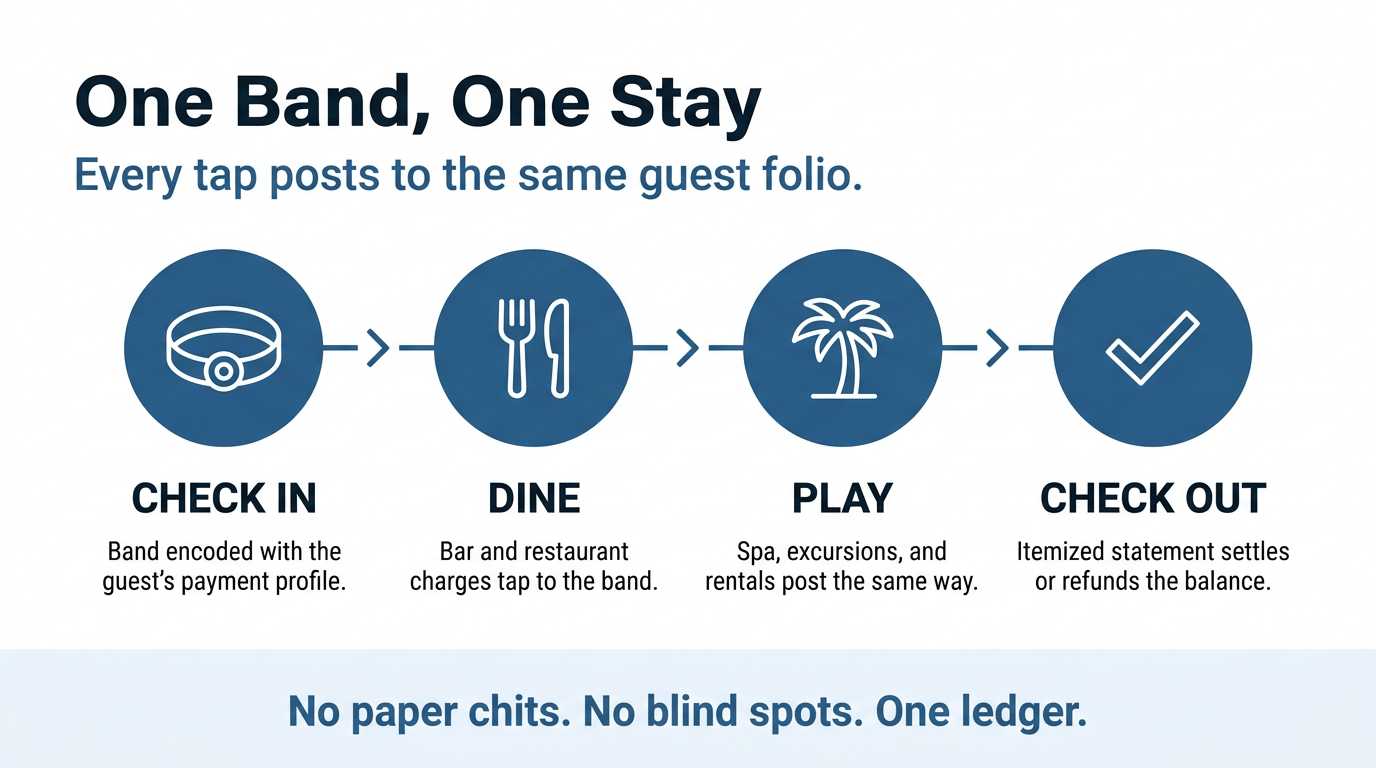
At check-in, the band is encoded with the guest's room assignment and payment profile. From there it functions as the room key and the payment method at once. Premium upgrades, late checkouts, or cabana reservations can be encoded onto the same chip, so a guest's access rights and spending power travel with them across the property. For families, parents can cap or disable spending on a child's band while keeping room access active.
Dining, Bars, Retail, and On-Site Activities
Beyond the room, the band handles the parts of a resort stay that generate real margin: specialty dining, top-shelf drinks, spa services, excursions, and merchandise. Guests tap at each outlet and the charge lands on their balance or linked card instantly. This wearable-first approach is not experimental anymore. The wearable payment devices market was valued at USD 56.8 billion in 2023 and is growing at more than 21% a year, and Disney's MagicBand turned tap-to-pay on the wrist into a mainstream guest expectation long before most hotels caught on. An all-inclusive RFID resort simply applies that same playbook across a single property.

RFID Wristbands vs Traditional Resort Wristbands: What Is the Difference?
Resorts have handed out wristbands for decades, so it is fair to ask what changes when a chip goes inside. The short answer: a traditional band proves who you are, while an RFID band lets you do things. That gap gets significant once you map it against day-to-day operations.
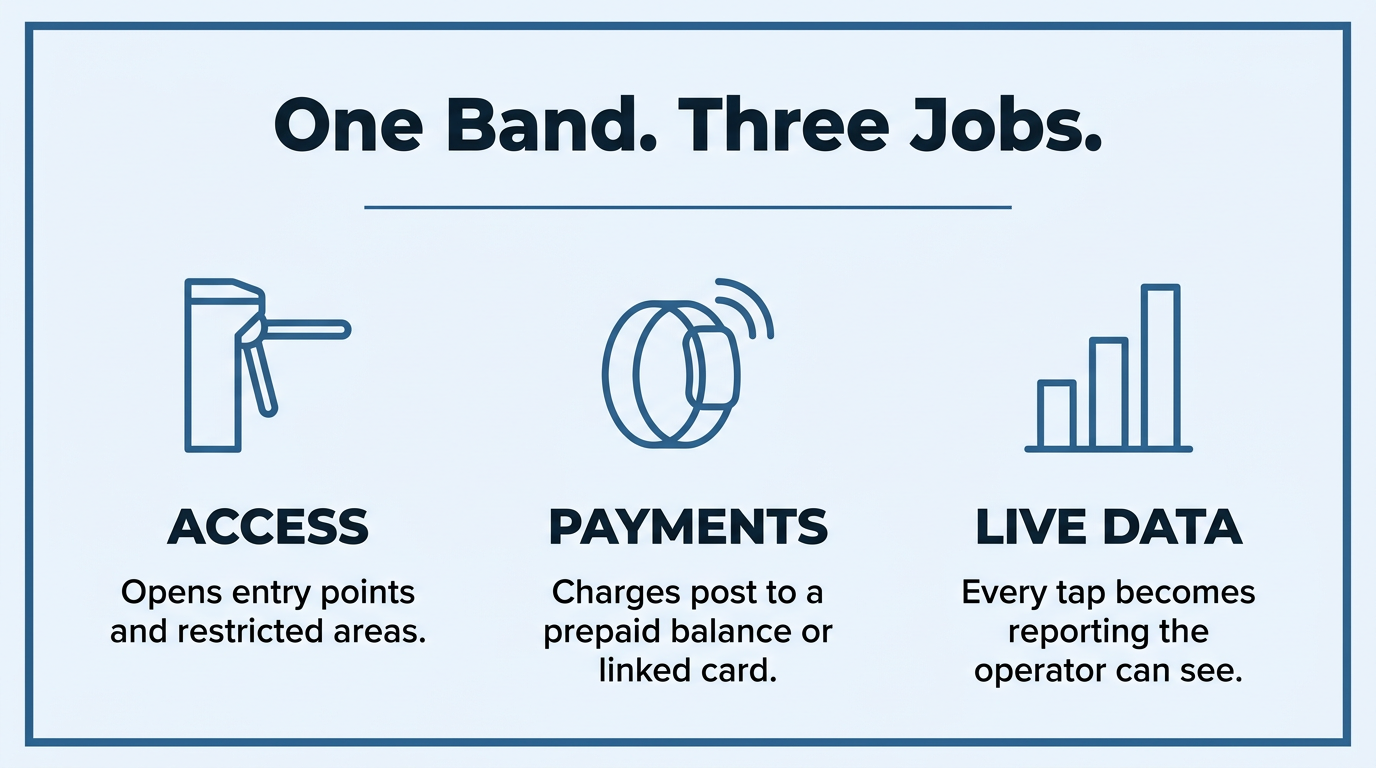
A traditional paper or silicone resort wristband is essentially a visual credential. Staff glance at a color or a printed label to confirm a guest belongs, and that is the end of its usefulness. It cannot carry a balance, open a door, or feed data back to the property. An RFID band collapses several of those jobs into one credential:
- Access. The same band that identifies a guest also unlocks their room, pool gate, or VIP area.
- Payments. Charges post to a prepaid balance or linked card with a tap, so no cash or loose cards circulate on property.
- Data. Every tap becomes a data point, showing operators which outlets, times, and offers actually drive spending.
- Control. A lost band is deactivated in seconds and reissued, something a paper band can never offer.
A traditional band is a sticker. A hotel cashless wristband is infrastructure.
How Does a Hotel RFID Wristband System Connect to Your PMS?
None of this works in a vacuum. The wristband is only as useful as its connection to the property management system, or PMS, that already runs reservations, folios, and guest profiles. Integration is where an RFID rollout either becomes seamless or turns into a reconciliation headache.
When the RFID platform talks to the PMS, a tap at any outlet posts directly to the correct guest folio in real time. The front desk sees a live, itemized record instead of a stack of paper chits to key in at 2 a.m. Guest profiles, loyalty status, and package entitlements flow both directions, so the band always reflects the guest's current standing. This is the same integration logic that mature contactless payment POS for hotels already rely on for room service and in-room charges.
The operational upside compounds at scale. As the broader RFID market is projected to grow from about $17 billion in 2025 to more than $32 billion by 2031, the integrations and middleware that connect bands to hotel systems keep maturing, which lowers the barrier for properties that once saw this as a custom engineering project. A well-integrated resort RFID payment stack means the data captured at the bar is the same data the revenue team reviews the next morning.
5 Things to Check Before Launching a Hotel Cashless Wristband
Before you encode a single band, pressure-test the rollout against these five questions.
- PMS and POS Integration. Confirm the platform posts charges to your existing property management and point-of-sale systems in real time, not through a nightly batch that creates reconciliation gaps.
- Balance and Refund Handling. Decide whether guests preload funds, link a card, or both, and make sure unused balances are refunded cleanly at checkout without manual work.
- Offline Behavior. Ask how the system behaves when connectivity drops in a beach bar or a remote activity hut, since a closed-loop design should keep processing locally rather than stall the line.
- Multi-Location Reporting. Verify you get one dashboard across every outlet and property, not siloed reports you have to stitch together after the season.
- Lost Band and Fraud Controls. Require instant deactivation of lost bands, PIN protection on higher-value purchases, and encryption so a cloned tag is worthless.
What Happens at Checkout, and Is It Secure?
Guests judge a resort by two moments: the welcome and the goodbye. A cashless wristband should make the goodbye effortless while giving operators airtight numbers. Security and reconciliation are where the model proves itself.
Reconciliation Across Every Outlet
Because every tap posts to a central ledger, checkout becomes a review rather than a reconstruction. The guest sees an itemized statement, settles any balance owed or receives a refund on unused prepaid funds, and leaves. Operators get a clean, outlet-by-outlet picture of revenue without chasing paper. Cash-only resorts run blind until the final count, while a connected resort RFID payment system shows the full picture while the guest is still on property.
Security, Lost Bands, and Multi-Property Deployments
On security, closed-loop RFID keeps sensitive card data off the band itself, relying on tokenized references and, where configured, PIN verification for larger purchases. Because credentials are tokenized rather than stored in the clear, a cloned or stolen band is far less useful to a bad actor than a physical card would be. For resort groups running several properties, a single platform can standardize bands, reporting, and reconciliation across locations, so a guest profile and its data stay consistent whether they are at the flagship or a sister property. To go deeper on the underlying technology, the RFID payment technology guide covers encryption, tag types, and reader infrastructure in detail. Properties weighing a broader upgrade can also review how high-volume hospitality environments handle throughput at scale.
FAQ
Can Guests Still Use a Credit Card at an RFID Resort?
Yes. Most RFID resort programs let guests link a credit card to their band, preload a prepaid balance, or use both. The band becomes the tap-to-pay method on property, while the underlying card still handles settlement. Guests who prefer to pay at the outlet can usually still present a physical card where staff allow it.
What Happens if a Guest Loses Their RFID Wristband?
A lost band is deactivated the moment it is reported, which freezes any balance or linked card tied to it. Staff issue a replacement band and transfer the existing balance and access rights to it. Because the sensitive payment data is not stored on the band itself, a found or cloned band is effectively useless to anyone else.
Do RFID Wristbands Work Without an Internet Connection?
It depends on the architecture. Closed-loop RFID systems are often designed to keep authorizing purchases locally when connectivity drops, then sync transactions once the network returns. That resilience is a major reason resorts with beachfront bars and remote activity huts favor closed-loop setups over connectivity-dependent card terminals.
How Long Does It Take to Roll Out a Hotel RFID Wristband Program?
It depends on the size of the property and how cleanly the platform connects to your existing PMS and POS. The technology itself deploys quickly, so the real timeline is driven by integration, band encoding workflows, and training staff at every outlet. Most operators start with a single property or a phased pilot, then expand once the reconciliation and guest experience are proven.
The Wristband Is the New Front Desk
The resorts pulling ahead treat the wristband as core infrastructure, not a novelty. Get the closed-loop balance, the PMS integration, and the reconciliation right, and one credential quietly lifts spending, tightens security, and hands the revenue team data it never had access to before. The properties still running on plastic key cards and cash boxes are the ones guests now quietly downgrade in their heads.
Billfold builds this kind of closed-loop RFID and POS system for high-volume venues, events, and resorts, with direct card linking, real-time reporting, and multi-vendor payouts unified in one platform. Reach out to the Billfold team to map a hotel RFID wristband rollout to your property.
