
RFID Wristband Replacement at Events: Refunds and Recovery
Key Takeaways
A festival wristband is only a key, not the wallet, so a lost band at a cashless event is a quick fix and almost never lost money.
- A lost RFID wristband can be deactivated in seconds, and the balance stays safe in the attendee's cloud account rather than on the chip.
- Most events replace a lost band on-site after a quick identity check, then re-link the existing balance to the new wristband.
- Unspent balances are refunded after the event through the operator's claim window, usually back to the original payment method.
- Registering the wristband or account is the single most important step for both refunds and fraud protection.
Before any cashless event, confirm the operator's replacement, refund, and registration policy. It is the difference between a five-minute fix and a lost weekend of spending.
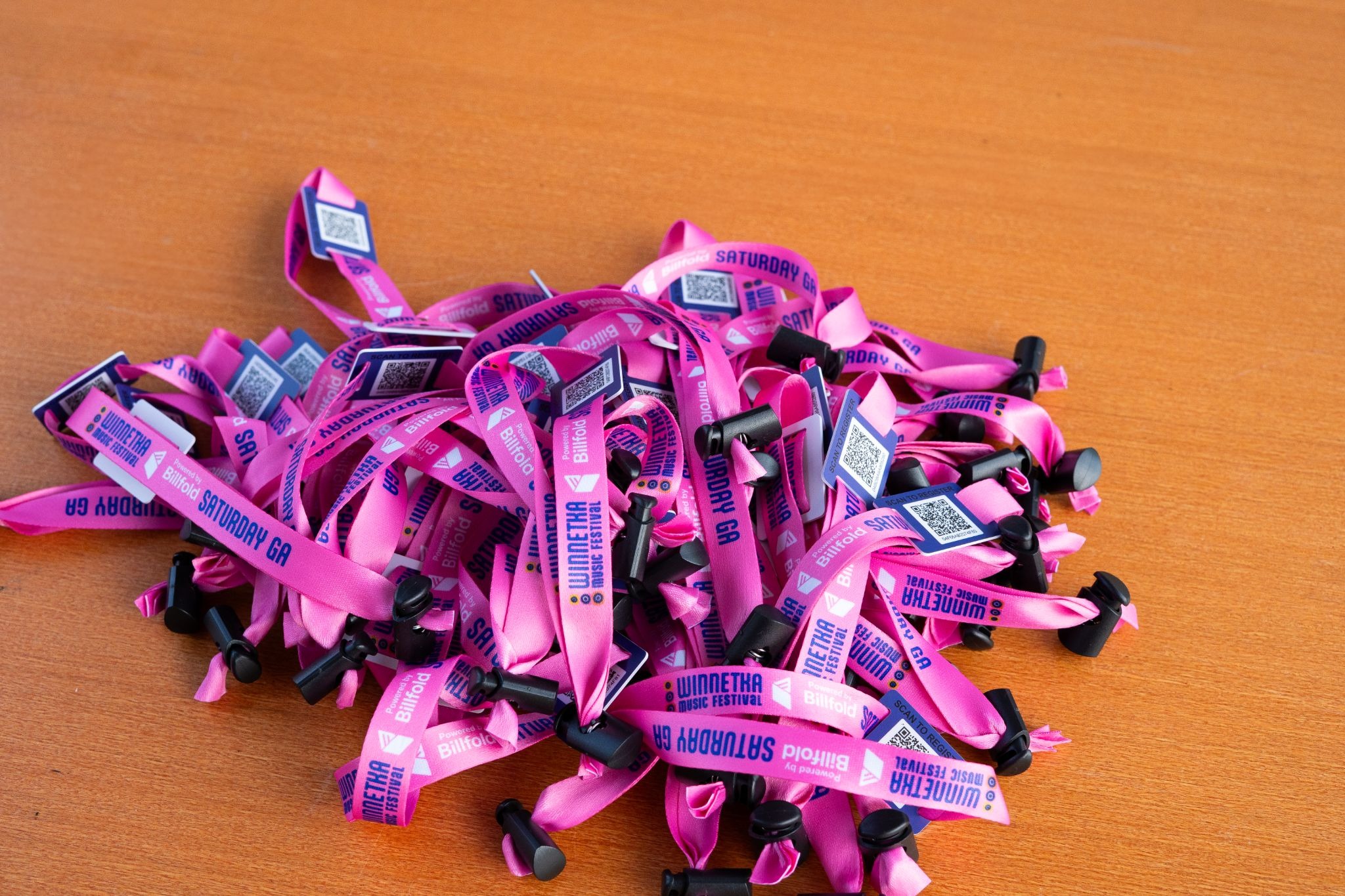
Losing a wristband mid-set is the scenario every attendee pictures the moment an event announces it has gone cashless. You loaded a balance, you are three songs into a great night, and suddenly your wrist feels lighter than it should. The good news is that this fear is mostly misplaced. As more festivals, stadiums, and venues adopt event payment technology, the systems behind those wristbands have gotten very good at handling exactly this problem. The cashless payments for events market sat at USD 7.6 billion in 2024 and is on track to roughly triple by 2033, which means refund and replacement processes are now a standard part of running an event rather than an afterthought.
This guide walks through how RFID wristband replacement at events actually works, from the moment you report a band missing to the refund that lands in your account after the gates close. We will cover what happens to your balance, how the refund process runs, how operators stop someone else from claiming your money, and what on-site support should look like when something goes wrong. If you organize events, it doubles as a checklist for the policies your attendees will expect you to have.
What Is RFID Wristband Replacement at Events, and Why Does It Matter?
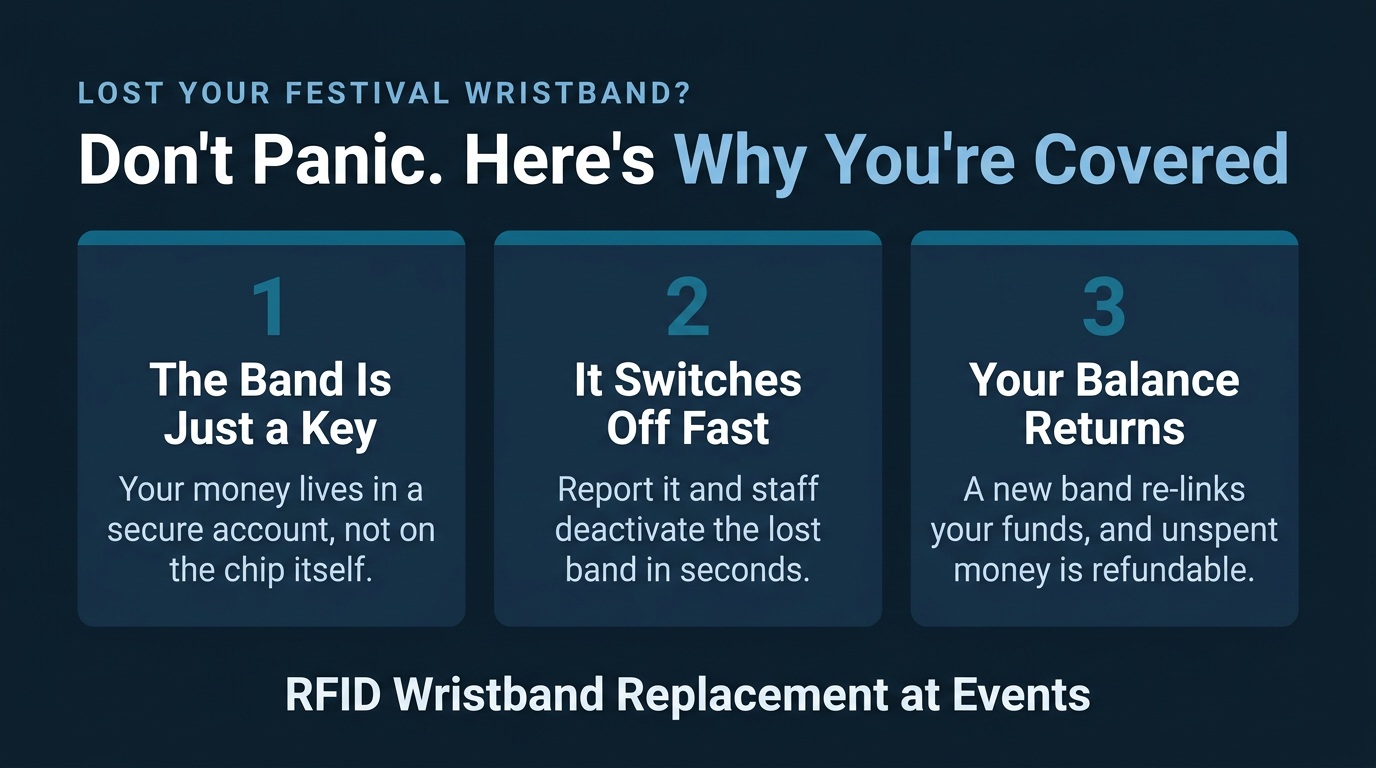
RFID wristband replacement at events is the process an operator uses to cancel a lost, stolen, or broken wristband and issue a new one without the attendee losing access or money. It sounds simple, and when the technology is set up correctly, it is. Understanding why it works requires knowing one thing about how these wristbands actually store value.
The Wristband Is the Key, Not the Wallet
The most important detail about any RFID wristband is that it does not hold your money. The chip inside carries a unique identifier and nothing else. Your balance, your linked card, and your full transaction history live in a secure cloud account that the operator manages, and the wristband simply points to that account.
When you tap to pay, the reader sends the chip's ID to the system, which checks the matching account and approves the purchase. This is the same principle behind how RFID payment technology works across retail, transit, and live events. Because the value sits in the account instead of on the band, a lost wristband does not take your balance with it.
Why a Lost Band Is Not the Same as Lost Cash
Cash has a brutal rule: once it leaves your pocket, it is gone, and no one can prove it was ever yours. A cashless balance works the opposite way. The money is tied to an account, the account has an owner, and the band is only a credential pointing at it. That separation is exactly why losing a wristband is recoverable and losing a twenty-dollar bill is not. The operator can switch off the missing credential and issue a new one linked to the same account, leaving your balance untouched. The faster you report it, the smaller the window for anyone else to spend against it.
What Happens to Your Balance if You Lose a Wristband Mid-Event?
The mid-event loss is the moment that worries people most, because there is still money on the account and the night is far from over. Here is the sequence that protects you when a band goes missing while the event is live.
Deactivating the Lost Band
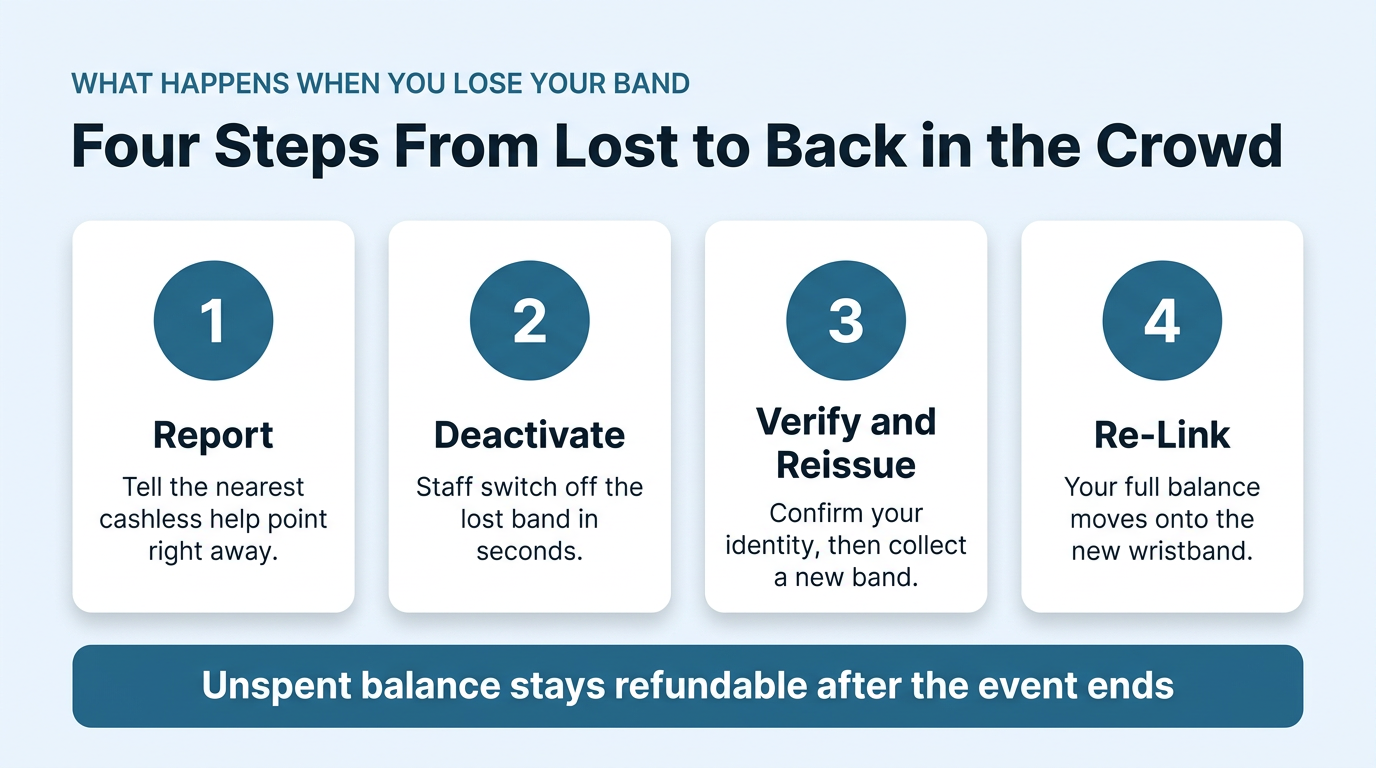
The first step is always deactivation. As soon as you report a wristband missing, on-site staff flag the credential in the system and switch it off, which stops any further taps from being approved. This is the cashless equivalent of freezing a debit card, except it happens in seconds rather than the hours a bank might take. Some operators let you trigger this yourself from a companion app the instant you notice the band is gone. Either way, deactivation is what closes the door on anyone using your remaining balance.
Recovering and Re-Linking Your Balance
Once the old credential is dead, staff issue a fresh wristband and link it to your existing account, which moves your full balance onto the new band. You walk away able to keep spending as if nothing happened. This re-link is only possible because the balance lived in the account the whole time, a core advantage of cashless payment with RFID over any system that tries to store value on the device itself. The entire fix usually takes a few minutes at a help point, and your spending history carries over intact.
How Does the Lost RFID Wristband Refund Process Work?
Replacement handles the live event. The refund handles everything you did not spend. Most attendees load more than they use, and the lost RFID wristband refund process is how that leftover money comes back to you after the event ends.
Claiming Unused Balance After the Event
After an event closes, operators open a refund window during which you can claim any unspent balance. You typically log into the same account or portal you used to top up, confirm your details, and request the remaining funds back to your original payment method. The RFID event refund process runs on a clear deadline, often a couple of weeks, so the operator can reconcile and close out the event. Miss the window and the unclaimed balance may be forfeited under the event's terms, which is why reading the refund policy before you go matters.
Registered vs. Unregistered Wristbands
Whether you can get a refund at all usually comes down to one thing: did you register the band. A registered wristband is tied to your name, email, or payment card, so the operator knows the balance is yours and can return it. An unregistered band topped up with cash on-site is much harder, and sometimes impossible, to refund, because there is no record connecting the money to a person. The same logic governs replacement. If you want to replace a lost cashless wristband and recover the balance, registration is what makes you the provable owner.
How Do Events Prevent Fraud on a Replaced Wristband?
Every replacement process has to answer an obvious question: what stops a stranger who finds your band from claiming it as their own. Operators take this seriously, because payments fraud is a real and persistent threat across every industry. A 2026 survey found that more than three-quarters of U.S. organizations faced attempted or actual payments fraud in the prior year, and events are not exempt from people trying to game the system.
Identity Verification at the Help Desk
When you report a lost band, staff do not simply hand over a new one. They verify that the account is yours first, usually by checking the name, email, or card on file, or a code you saved when you set up the wristband. Only after that check passes do they deactivate the old credential and issue the replacement. This verification step is the same reason faster, safer event entry works through RFID in the first place: the credential is tied to a verifiable identity rather than to whoever happens to be holding it.
Why Registration Is the Real Security Layer
Registration is what turns a found wristband from a payout into a dead end. Because a registered band is tied to a verified identity, staff can confirm the real owner before issuing any replacement, which blocks someone from walking up and impersonating you. It also means that the moment you report a band missing, the system locks it to your account alone, so a stranger who picks it up off the ground has nothing left to spend. This is the quiet reason operators push registration so hard: it removes the incentive to grab a loose band in the first place.
What Does On-Site Support Look Like at a Festival?
Policies only matter if attendees can actually reach help quickly when a band goes missing during a packed event. On-site support is where a good replacement and refund system proves itself, or falls apart.
Help Tents and Staffing
Most large events run a dedicated RFID or cashless help point, often a clearly marked tent or booth, staffed by people who can deactivate bands, verify identities, and issue replacements on the spot. Placement and signage matter, because an attendee who cannot find help may simply give up and lose access to their balance for the rest of the night. Well-run events position these points near entrances and high-traffic areas and staff them heavily during peak hours. Smooth support like this is a big part of how operators improve the guest experience and keep attendees spending.
Self-Service Kiosks and the Wallet Profile
Beyond staffed tents, many operators add self-service kiosks and app-based tools that let attendees handle problems without waiting in a line. A kiosk can reissue a band or reactivate an account in minutes, and a saved wallet profile lets a guest carry their setup across multiple events without starting from scratch each time. These self-service options reduce pressure on staff and shorten the time between losing a band and getting back to the music. For organizers weighing RFID wristband replacement for events, the quality of this support layer often separates a system attendees trust from one they dread.
5 Things to Check About RFID Wristband Replacement at Events
Before you load a balance onto any wristband, run through this quick checklist. It works whether you are an attendee protecting your money or an organizer auditing your own process.
- Registration requirement. Confirm whether you can and should register the band to your name, email, or card. Registration is what makes both refunds and replacements possible, so handle it before you tap once.
- Deactivation method. Find out how you report a lost band and how fast it can be switched off. The best events let you do it from an app instantly, with staffed help points as a backup.
- Refund window and deadline. Check when the refund window opens and closes after the event. The lost RFID wristband refund process almost always runs on a deadline, and missing it can mean forfeiting your balance.
- On-site help locations. Know where the cashless help points are before you need them. Locate them on the event map the same way you would locate first aid or water.
- Balance recovery terms. Verify that your existing balance transfers to a replacement band instead of being lost. A system that can replace a lost cashless wristband and carry the balance over is the one worth trusting.
Frequently Asked Questions
What Happens if I Lose My RFID Wristband at a Festival?
Report it to the nearest cashless help point right away. Staff will verify the account is yours, deactivate the lost band so no one else can use it, and issue a replacement linked to your existing balance. As long as you registered the band, your money stays safe and the whole fix usually takes a few minutes.
Can I Get a Refund for the Money Left on My Wristband?
Yes, if the band was registered and you claim it within the event's refund window. Most operators let you log into the same account you used to top up and request your unspent balance back to your original payment method. Every RFID event refund process has a deadline, so claim it soon after the event ends.
What Happens to My Balance if My Wristband Breaks or Gets Stolen?
It is treated the same as a loss. The balance lives in your cloud account, not on the chip, so the operator deactivates the damaged or stolen credential and re-links your funds to a new band. A stolen band that was registered cannot be used by the thief once you report it.
Do I Have to Register My Wristband, and What Happens if I Don't?
Registration is not always mandatory, but it is strongly recommended. An unregistered band topped up with cash can be difficult or impossible to refund or replace, because nothing connects the balance to you. Registering takes about a minute, and it is what makes your balance refundable and recoverable if the band ever goes missing.
The Bottom Line on Lost Wristbands at Cashless Events
A lost wristband at a cashless event feels like a disaster in the moment, but the technology is built to make it a minor inconvenience. The band is only a key. Your money lives in an account that can be frozen, recovered, and refunded, as long as you register and report quickly. For attendees, a few smart habits protect your balance completely. For organizers, your RFID wristband replacement, refund, and support processes are part of the experience you are selling, and attendees increasingly expect them to work flawlessly.
That expectation is exactly what the best event payment platforms are built around. Billfold designs its RFID and cashless systems so that lost bands, refunds, and replacements are handled cleanly on-site and after the gates close, keeping attendee balances safe and operators in control. Reach out to the Billfold team to see how it works for your next event.
