
Festival POS System: Complete Guide for Music Events in 2026
Outdoor music festivals demand payment infrastructure that standard retail systems cannot deliver. A festival POS system must withstand weather extremes, process thousands of transactions during headliner sets, and operate reliably across dozens of vendor locations.
- Festival-specific POS systems process transactions significantly faster than cash, eliminating revenue-killing queue lines during peak periods
- Offline capability ensures zero downtime when cellular networks become overloaded with tens of thousands of attendees
- Unified vendor management consolidates sales data, inventory tracking, and settlements across hundreds of independent operators
- Implementation costs vary dramatically based on event scale, but ROI typically materializes within the first event cycle
If you're planning a music festival in 2026, investing in purpose-built payment infrastructure separates successful events from operational disasters.
Why Do Music Festivals Need Specialized Festival POS Systems?
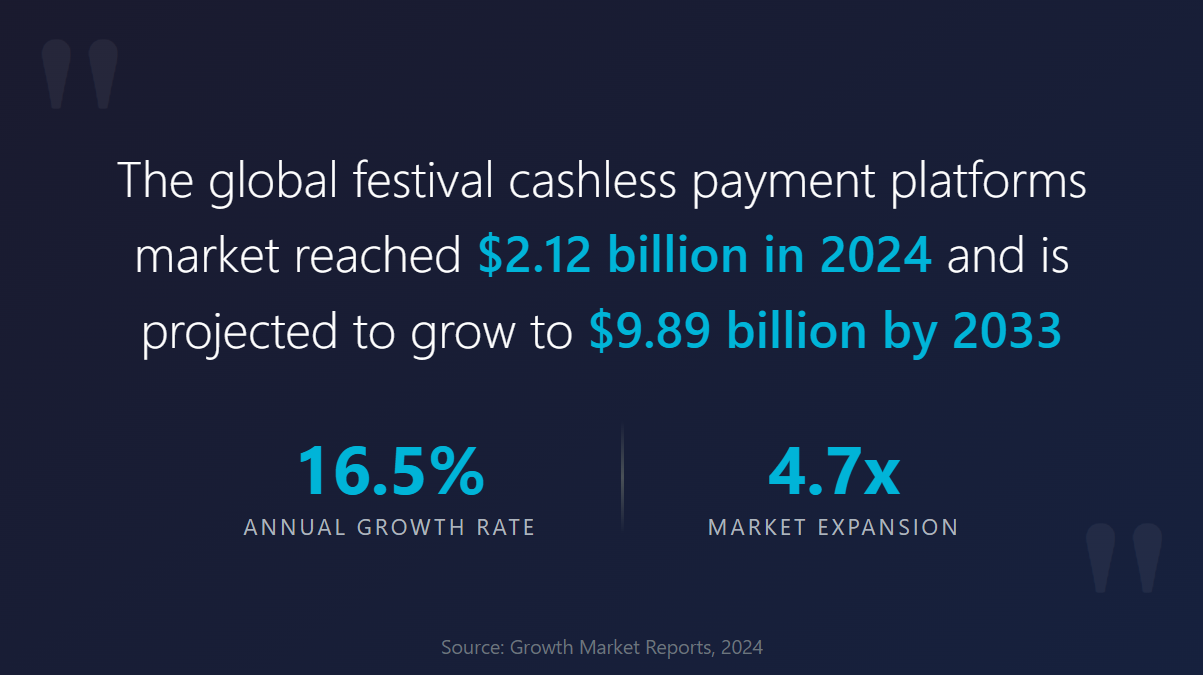
Standard point-of-sale systems designed for brick-and-mortar retail fail spectacularly when deployed at music festivals. The global festival cashless payment platforms market reached $2.12 billion in 2024, with projections showing growth to $9.89 billion by 2033 at a compound annual growth rate of 16.5%. This explosive adoption reflects hard-learned lessons from organizers who discovered that restaurant and retail POS systems create catastrophic bottlenecks in high-volume event payment environments.
Music festivals present operational challenges that most payment systems simply cannot handle. A single food vendor at a major festival might process more transactions in four hours than a typical restaurant handles in a week. When a headliner takes the stage, attendees rush to grab drinks before missing the set, creating transaction surges that overwhelm inadequately prepared systems.
What Makes Festival Environments Uniquely Challenging?
Network connectivity represents the most critical challenge facing any pos system music events deployment. Cellular towers become saturated when tens of thousands of people simultaneously stream content, text friends, and post to social media. Traditional card readers relying on real-time network authorization experience timeouts, failed transactions, and frustrated attendees abandoning purchases entirely.
Weather compounds infrastructure stress in ways retail environments never face. Afternoon thunderstorms, dust storms during dry conditions, and temperature swings from scorching daytime heat to chilly evenings test hardware durability limits. Equipment designed for climate-controlled stores malfunctions when exposed to moisture, particulate infiltration, and thermal extremes.
Vendor diversity creates additional complexity. Unlike restaurants with controlled menus and trained staff, festivals host everything from professional catering operations to small craft vendors with minimal point-of-sale experience. The festival POS system must accommodate varying technical sophistication while maintaining consistent transaction processing.

What Hardware Does a Festival POS System Require?
Building payment infrastructure for large scale event pos applications requires careful hardware selection based on specific operational requirements. The hardware investment represents a significant portion of total implementation costs, making informed purchasing decisions essential for budget management.
Terminal Requirements for Outdoor Deployment
Festival-grade POS terminals must meet durability standards that consumer devices cannot achieve. Look for hardware with IP64 or higher ingress protection ratings, indicating resistance to dust infiltration and water spray. These rugged specifications ensure equipment survives the physical demands of multi-day outdoor deployment.
Battery capacity determines operational flexibility. Terminals should provide minimum eight-hour continuous operation, with hot-swappable battery options enabling uninterrupted service during extended event hours. Screen visibility under direct sunlight often determines transaction speed, so terminals with high-brightness displays and anti-glare coatings enable staff to process orders quickly regardless of lighting conditions.
RFID Infrastructure Components
RFID wristband technology has become the standard for festival payment systems due to its speed and reliability advantages. Implementing RFID requires several infrastructure components working together seamlessly.
RFID readers positioned at each point of sale communicate with attendee wristbands to process transactions. Reader selection should prioritize reading range, allowing transactions from comfortable distances rather than requiring precise wristband positioning. Extended range readers process multiple transactions per minute more efficiently than close-proximity alternatives.
Wristband inventory planning depends on expected attendance plus contingency stock for replacements. Quality wristbands should withstand multiple days of continuous wear, exposure to water, and the physical activity typical of festival environments. Consider branded wristband options that sponsors may subsidize, offsetting hardware costs while creating collectible items attendees keep as souvenirs.
Activationstations distributed throughout the venue enable attendees to link cards to their wristbands without returning to centralized locations. Self-service kiosks reduce staffing requirements while providing convenient access points that encourage continued spending throughout the event.

How Should Organizers Budget for Festival Payment Systems?
Understanding the real cost of implementing RFID payments helps organizers plan realistic budgets and evaluate vendor proposals accurately. Payment system costs vary dramatically based on event scale, feature requirements, and vendor selection.
Fixed vs. Variable Cost Structures
Hardware represents the largest fixed cost category. Terminal purchases or rentals, RFID readers, wristband inventory, and infrastructure equipment require upfront investment before processing any transactions. Larger festivals benefit from economies of scale, with per-unit hardware costs decreasing as deployment size increases.
Transaction fees create variable costs tied directly to sales volume. Fee structures vary significantly between vendors, with some charging flat per-transaction fees while others assess percentage-based fees on transaction value. High-volume festivals should negotiate favorable transaction fee arrangements that account for expected processing volumes.
Staffing costs for system management, technical support, and top-up station operation represent ongoing expenses throughout the event. Factor in training time for vendor staff who will use the terminals daily. Systems requiring minimal training reduce pre-event labor costs and decrease error rates during operation.
Cost Recovery Strategies
Sponsorship integration offers powerful cost offset opportunities. Branded wristbands create premium sponsorship inventory that can substantially subsidize hardware costs while providing sponsors with highly visible brand placement.
Service fees passed to attendees through modest top-up charges or convenience fees can recover operational costs without significantly impacting attendee experience. Pre-event top-ups generate revenue and cash flow before gates open, with attendees who load funds in advance committing spending to your event.
What Features Matter Most for Large Scale Event POS?
Selecting the right cashless pos for festivals requires evaluating features against specific operational requirements. Not all features provide equal value for every event type, making thoughtful prioritization essential for cost-effective implementation.
The broader cashless payments market is experiencing rapid global expansion, driven by shifting consumer preferences and fintech innovation. This momentum extends into the events industry, where attendees increasingly expect seamless digital payment experiences.
Essential features for music festival deployment include:
- Offline transaction processing that maintains full functionality during network outages, critical for outdoor venues where connectivity proves unreliable
- Multi-vendor dashboard providing organizers real-time visibility across all sales points, enabling dynamic resource allocation based on demand patterns
- Real-time inventory tracking alerting vendors and organizers to stock shortages before sellouts frustrate attendees and cost potential revenue
- Automated settlement systems calculating vendor payouts based on actual sales data, eliminating manual reconciliation errors and disputes
- Flexible payment method support accepting RFID, NFC mobile payments, and traditional cards through unified terminals
- Detailed analytics reporting capturing attendee spending patterns, popular items, peak transaction times, and vendor performance metrics
Integration Capabilities
Modern festival payment systems should integrate with existing event infrastructure rather than operating as isolated systems. Hybrid payment approaches that combine multiple technologies provide redundancy while accommodating varied attendee preferences.
Ticketing system integration enables unified wristbands serving as both entry credentials and payment devices. This consolidation reduces attendee friction while providing organizers with comprehensive data linking ticket purchases to on-site spending behavior.
Vendor management platform integration streamlines onboarding, training, and settlements for the diverse operator base typical of major festivals. Systems that simplify vendor participation attract higher-quality food and merchandise operators who enhance overall attendee experience.
How Do Leading Festivals Implement Cashless Systems Successfully?
Successful pos system music events implementations share common characteristics regardless of event size or genre. Learning from established deployments helps organizers avoid common pitfalls while accelerating their implementation timeline.
Pre-Event Preparation Timeline
Payment system implementation should begin months before event dates. Hardware procurement, vendor onboarding, and infrastructure planning require substantial lead time that last-minute approaches cannot compress without compromising execution quality.
Vendor communication campaigns educate operators about system requirements, terminal operation, and settlement procedures. Comprehensive training materials and pre-event practice sessions dramatically improve first-day performance compared to rushed day-of explanations.
Attendee communication builds awareness and encourages pre-event top-ups. Email campaigns, social media content, and website information should explain the cashless system, emphasize convenience benefits, and provide clear instructions for account setup.
Operational Best Practices
Staff deployment planning should account for peak transaction periods correlated with performance schedules. Position additional support personnel near main stages during headliner transitions when beverage purchases spike dramatically.
Backup procedures documented and rehearsed ensure rapid response to equipment failures or unexpected issues. Technical support should maintain on-site presence throughout event hours with authority to make real-time decisions addressing problems as they emerge.
Post-event analysis using captured transaction data identifies improvement opportunities for subsequent events. Understanding which vendor locations underperformed, which products generated highest demand, and how attendee traffic patterns evolved informs planning refinements that compound benefits across multiple event cycles.
What's Your Festival POS System Implementation Checklist?
Organizing payment system deployment requires systematic planning that addresses infrastructure, personnel, and operational requirements. Use this checklist to track implementation progress and ensure comprehensive preparation.
12 Weeks Before Event:
- Finalize POS vendor selection and contract terms
- Determine hardware requirements based on vendor count and expected attendance
- Begin vendor recruitment and onboarding communications
- Establish sponsorship partnerships for branded wristband opportunities
8 Weeks Before Event:
- Order wristband inventory with contingency buffer
- Complete terminal and reader procurement or rental arrangements
- Develop vendor training materials and operation guides
- Create attendee communication plan and marketing assets
4 Weeks Before Event:
- Conduct vendor training sessions and system demonstrations
- Launch attendee pre-registration and advance top-up campaigns
- Test all hardware configurations and backend integrations
- Finalize staff deployment schedules and technical support coverage
Event Week:
- Complete infrastructure installation and connectivity verification
- Perform system-wide testing across all vendor terminals
- Execute final staff briefings and emergency procedure reviews
- Activate wristband distribution and account activation processes
FAQ
How long does it take to implement a festival POS system? Most implementations require 8-12 weeks for comprehensive deployment including hardware procurement, vendor onboarding, and staff training. Rushing this timeline typically results in operational problems that cost more to resolve than the time saved during preparation.
Can festival POS systems work without internet connectivity? Yes, modern festival-grade systems include offline transaction processing that stores payment data locally until connectivity restores. This capability proves essential for outdoor venues where network saturation or infrastructure limitations cause connectivity interruptions.
What happens to unused funds on attendee wristbands after the event? Most systems provide automated refund processes allowing attendees to reclaim unused balances within specified timeframes. Clear refund policies communicated before purchase help manage attendee expectations and reduce post-event support inquiries.
How do vendors receive payment for sales processed through the system? Settlement systems calculate vendor payouts based on verified transaction data, typically disbursing funds within days after event conclusion. Automated reconciliation eliminates manual counting errors and provides transparent records supporting payment amounts.
Transform Your Festival Payment Experience
The difference between seamless attendee experiences and operational chaos often comes down to payment system infrastructure. Festival POS system selection, hardware deployment, and implementation planning determine whether your event captures maximum revenue potential or loses sales to preventable bottlenecks.
Modern event RFID payment technology delivers transaction speeds, offline reliability, and data insights that transform festival operations while enhancing attendee satisfaction. Organizers who invest in purpose-built solutions gain competitive advantages that compound across multiple event cycles.
Billfold specializes in comprehensive cashless POS for festivals, offering RFID wristband integration, multi-vendor management, and real-time analytics designed specifically for the unique demands of live entertainment environments. Contact our team to discuss how we can optimize your festival's payment infrastructure for maximum efficiency and revenue growth.
