
Contactless POS Systems for Event Venues: Security, Benefits, and What to Look For

Key Takeaways
Contactless POS systems are no longer optional for event venues. They are the infrastructure layer that determines how much revenue you capture, how fast lines move, and how secure every transaction is.
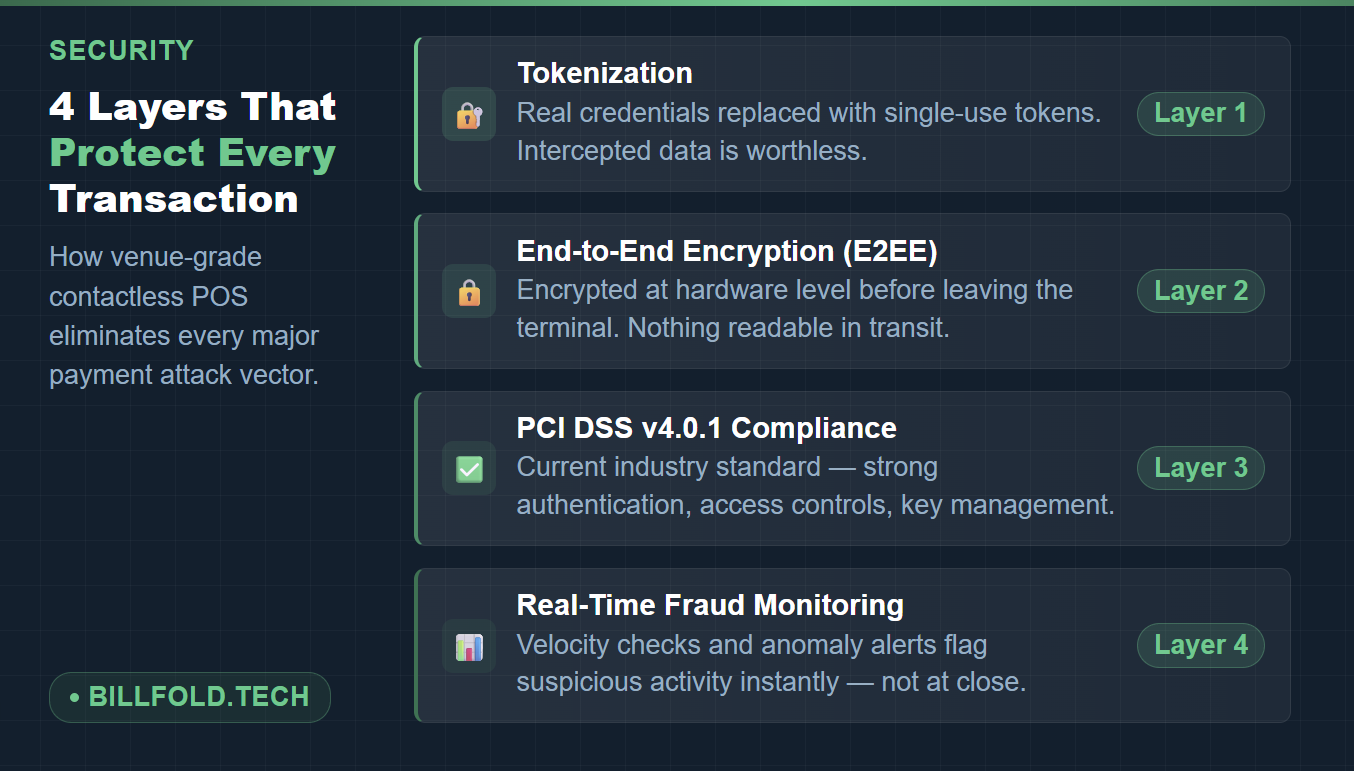
- Modern contactless POS systems use tokenization, end-to-end encryption, and PCI DSS compliance to protect every transaction at the hardware level, making them more secure than cash or basic card readers.
- RFID-enabled venue POS systems process transactions in under two seconds while capturing real-time spending data that helps operators make faster, smarter decisions during live events.
- Offline capability is a non-negotiable feature for any contactless payment POS in event environments. Systems that fail when connectivity drops are a liability.
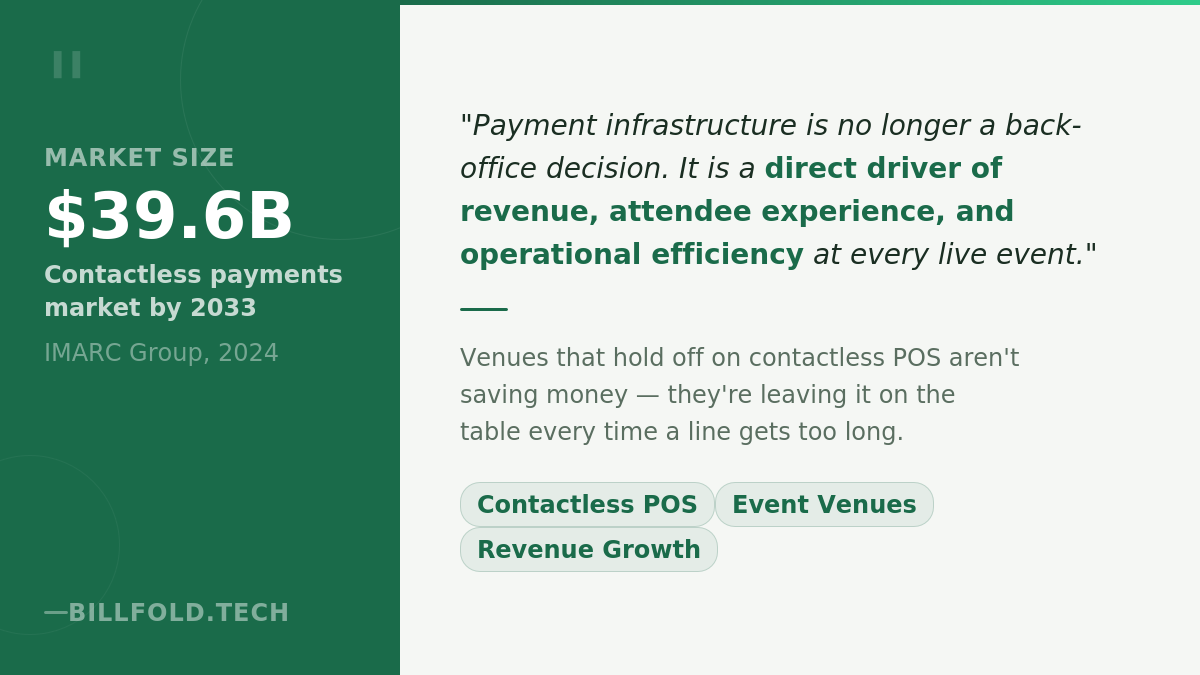
- The contactless payment market was valued at USD 16.8 billion in 2024 and is projected to reach USD 39.6 billion by 2033. Venues that delay adoption are already behind the curve.
The right contactless POS system goes beyond processing payments. It powers your entire operation.
The payment experience at your event is part of the event. Attendees who wait five minutes in a drink line because your POS system cannot keep up do not blame the line. They blame you. Venues that still rely on cash handling, slow card readers, or fragmented payment setups are leaving revenue on the table and creating friction at every transaction point. Cashless, contactless payment technology has moved from a competitive advantage to a baseline expectation, and the operators who have not made the shift yet are the ones watching their per-capita spend stagnate.
Contactless POS systems are now the standard infrastructure for any serious event venue, from multi-day music festivals to sports arenas to club venues running hundreds of transactions per hour. According to IMARC Group, the global contactless payment market was valued at USD 16.8 billion in 2024 and is projected to reach USD 39.6 billion by 2033, growing at a compound annual rate of 10% over that period. That growth is not happening in retail alone. Events and live entertainment are a core driver. This guide covers everything venue operators need to understand about contactless POS systems: how they work, why they are secure, what features matter most, and how to evaluate vendors for your specific environment.
What Are Contactless POS Systems and How Do They Work at Events?
At the core, a contactless POS system is a payment terminal that processes transactions without requiring physical card insertion or cash exchange. In an event context, this technology goes well beyond the standard tap-to-pay terminal you would find at a coffee shop. Venue-grade contactless POS systems are built for high-volume, high-speed environments where hundreds of transactions need to happen simultaneously across dozens of vendor locations.
The Technologies Behind Contactless Payments
Most contactless POS systems for events operate across three primary technologies. NFC (Near Field Communication) enables tap-to-pay with bank cards and mobile wallets like Apple Pay and Google Pay. RFID (Radio Frequency Identification) powers wristband-based systems where attendees load funds onto a wearable and tap to transact. QR code payments offer a third option, particularly useful in configurations where attendees pay through a mobile app. Understanding the distinction between cashless and contactless payments matters here. They are related but not the same thing, and the choice between open-loop and closed-loop systems has significant implications for data ownership and revenue optimization.
The practical difference in an event setting comes down to speed and control. A contactless card tap typically routes through standard payment networks, requiring connectivity and offering limited transaction data to the venue. An RFID-based system, by contrast, processes transactions at the terminal level, meaning faster speeds, offline capability, and richer data capture. For high-volume environments, that difference is measurable in both queue length and end-of-night revenue. It also determines whether your venue has access to real-time analytics during the event or is flying blind until reconciliation the next morning.
How Venue POS Differs From Retail POS
A standard retail POS system is not built for what happens at a 10,000-person festival. Event venues deal with transaction spikes that retail environments never experience: thousands of purchases compressed into a 45-minute window between sets. A contactless payment POS for events needs to handle simultaneous multi-vendor processing, real-time inventory syncing across locations, RFID wristband integration, and offline resilience when connectivity is unreliable. These are not edge cases. They are the normal operating environment. Any system that treats them as afterthoughts will fail the moment it matters most.

How Secure Are Contactless POS Systems for Event Payments?
Security is the question every venue operator and most attendees eventually ask. The short answer is that modern contactless POS systems are significantly more secure than the cash and basic card infrastructure they replace. The longer answer involves understanding exactly what security mechanisms are in play and what questions to ask when evaluating a provider.
Tokenization: The Foundation of Contactless Security
When an attendee taps a wristband or card at a contactless POS terminal, their actual payment credentials never travel across the network. Instead, the system uses tokenization, a process that replaces sensitive card data with a unique, randomly generated token that has no value outside of that specific authorized transaction. As Spreedly explains, tokenization does not simply scramble data the way encryption does. It replaces the data entirely, so even if a token is intercepted during transmission, there is nothing of value for an attacker to capture. This is the standard underpinning every tap-to-pay transaction at major events worldwide.
For RFID-based closed-loop systems, tokenization works at the wristband level. Each wristband carries a unique identifier that maps to a secure account, not raw card data. This means a stolen or lost wristband cannot be used to access the underlying payment account. Operators can simply deactivate it and issue a replacement, transferring the remaining balance instantly.
Encryption and PCI DSS Compliance
Alongside tokenization, enterprise-grade contactless POS systems use end-to-end encryption (E2EE) and point-to-point encryption (P2PE) to secure data from the moment a payment is initiated through to authorization. P2PE specifically encrypts card data at the terminal level, so even if a POS device is physically compromised, the data stored on it is unreadable.
PCI DSS (Payment Card Industry Data Security Standard) compliance is the industry benchmark for payment security. Version 4.0.1 is the current active standard, introduced as a limited revision after v4.0 came into full effect in March 2024. It introduced stronger requirements around authentication, encryption key management, and access controls. Any reputable contactless payment POS vendor should be able to confirm their PCI DSS v4.0.1 compliance status and walk you through how their system meets current standards. If they cannot, that is a serious red flag.
Fraud Detection and Real-Time Monitoring
Modern contactless POS systems built for event environments include real-time fraud detection capabilities: transaction velocity monitoring, suspicious activity alerts, and role-based access controls that limit which staff can access which data. For integrated venue payment platforms, these controls extend across the entire event ecosystem rather than operating at the level of individual terminals. This is a meaningful upgrade over the security posture of cash operations, where theft risk is diffuse, difficult to detect in real time, and nearly impossible to attribute after the fact.
Role-based permissions ensure that front-of-house staff can process transactions without having access to financial reporting, and that managers have full visibility into sales data without touching payment credentials. This layered approach to access control is standard in professional-grade contactless payment POS deployments and is one of the less-discussed but consequential security advantages over legacy systems. When something does go wrong, whether a disputed transaction or a suspected breach, the audit trail available in a properly configured contactless POS system gives operators a complete record to work from, not a gap-filled reconstruction from cash drawer logs.
What Are the Core Benefits of RFID Contactless POS for Venue Operations?
Security aside, the operational and revenue case for contactless POS systems at venues is clear and direct. The technology goes well beyond processing payments faster. It fundamentally changes the economics of running an event, improving revenue capture, operational visibility, and staff efficiency at every level.
Transaction Speed and Queue Reduction
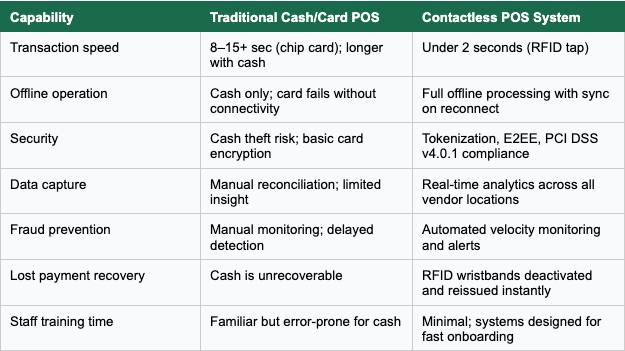
The math on transaction speed compounds quickly at scale. Contactless wristband and card taps complete in a fraction of the time required by cash — attendees tap and go while cash requires counting bills, making change, and verification steps that add significant seconds per transaction. According to Billfold's own event data, RFID payments at festivals process in under two seconds compared to chip card processing that can take 8–15 seconds or more. At a bar with a line of 20 people, that difference is the gap between attendees getting a drink before the next set starts and giving up entirely. Shorter lines mean more completed transactions, higher per-capita spend, and fewer frustrated customers walking away.
Real-Time Data and Operational Intelligence
Every transaction on a properly configured contactless POS system generates data: what sold, when, at which vendor location, and at what price. Aggregated across an event, this creates a real-time operational picture that cash and basic card systems simply cannot produce. Venue operators can see which bars are hitting capacity, which food vendors are running low on inventory, and which merchandise is moving, all before they run out. The best venue POS systems function as full operational dashboards rather than simple payment processors. That data advantage compounds over time as you build historical benchmarks for future events.
Revenue Capture and Reduced Shrinkage
Cash handling is a revenue leak. Between miscounts, theft, and reconciliation errors, venues running primarily cash operations consistently underreport their true transaction volume. Contactless systems eliminate that ambiguity. Every transaction is logged, timestamped, and reconcilable to the cent. For RFID closed-loop systems, pre-event top-ups mean revenue is captured before the gates even open, and unspent balances create additional margin. The combination of faster transactions, better data, and eliminated cash shrinkage is the core of the revenue case for contactless POS at any venue.
Staff Efficiency and Operational Simplicity
Contactless POS systems also change how staff operate during events. Bartenders and vendors spend less time on payment processing and more time on service. The fastest contactless payment POS setups require nothing more than a wristband tap or card tap from the attendee, and a confirmation on screen for the vendor. There is no change to count, no card to swipe, and no PIN to enter for standard purchase amounts. That simplicity translates directly into higher throughput per vendor station and lower error rates across the board.
7 Features to Look for in a Venue Contactless POS System
Not all contactless POS systems are built for event environments. Here are the features that separate venue-grade solutions from systems that will let you down in the field.
- Offline processing capability. Connectivity at outdoor venues and festivals is unpredictable. Any system that requires constant internet access to process transactions is a liability. Look for systems that queue and sync transactions locally, with no interruption to operations during connectivity drops.
- Multi-format payment acceptance. RFID wristbands, NFC cards, mobile wallets, chip cards: your system should handle all of them from a single terminal. Forcing attendees into one payment method creates friction and lost sales.
- PCI DSS v4.0.1 compliance. This is non-negotiable. Any vendor that cannot confirm full compliance with current PCI standards is not a serious option for a venue processing thousands of transactions per event.
- Real-time centralized reporting. You need visibility across all vendor locations from a single dashboard during the event, not a CSV download the next morning. Real-time data is what enables in-event decisions that affect revenue.
- Integration with existing event tech. Your POS for events should connect to your ticketing platform, access control system, and CRM without requiring a manual data bridge. Native API integrations eliminate reconciliation headaches and unlock cross-platform analytics.
- Scalability across vendor count and event size. A system that works for 20 vendors needs to work for 80 without performance degradation. Ask vendors directly how their platform handles scale and what their largest deployment looks like.
- Fast staff onboarding. Event staffing is often seasonal and high-turnover. A POS system that requires extended training is not realistic for the pace of live events. The best systems are designed for staff to be operational within minutes.

How Does a Contactless POS System Handle Offline Environments?
This is the question that separates venue-grade systems from everything else. Outdoor festivals, stadiums in dense urban areas, and remote event sites all deal with connectivity challenges: spotty cellular coverage, Wi-Fi that cannot handle 10,000 simultaneous connections, and dead zones in specific parts of the venue. Any contactless POS system for events that is not built for offline operation is taking a gamble with your revenue every time you run an event outdoors.
How Offline Processing Works
RFID-based contactless POS systems store transaction data locally on the device when network connectivity is unavailable. The terminal continues processing transactions against the balance stored on the wristband or pre-authorized device without needing to ping a remote server. When connectivity is restored, the system syncs queued transactions to the central platform automatically. This architecture means 100% uptime regardless of network conditions, which is exactly what high-volume event environments require.
NFC card-tap systems present a different challenge, since they typically route through standard payment networks that require connectivity. This is one of the key operational reasons why RFID closed-loop wristband systems remain the preferred choice for large-scale festivals and venues where network reliability is a concern. The pre-loaded balance model eliminates the real-time authorization dependency entirely.
Planning for Connectivity at Your Venue
Even with offline-capable hardware, network planning matters. Dedicated vendor Wi-Fi, cellular backup through multi-SIM hardware, and pre-event connectivity testing at your specific site are all standard practice for professional event operators. The question to ask any POS for events vendor goes beyond whether their system has an offline mode. Ask how the sync process works, what the transaction limits are in offline mode, and what happens in edge cases. These details matter when you are running a sold-out event and need answers before something breaks. Operators evaluating technology can also explore how maximizing revenue with modern venue POS requires getting these infrastructure decisions right from the start.
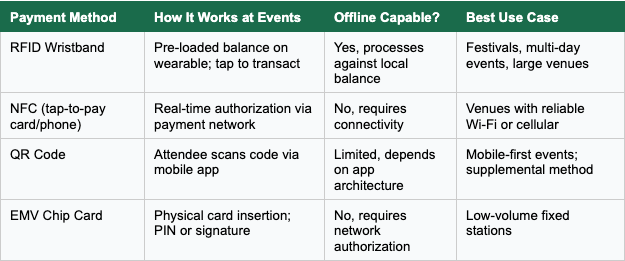
Understanding these distinctions helps venues build a payment stack that matches their environment. Many operators run a hybrid approach, using RFID wristbands as the primary transaction method with NFC card-tap as a fallback, to accommodate all attendee preferences while maintaining reliability. The integration of multiple contactless technologies into a unified platform is where modern venue POS systems prove their real value.
FAQ
How secure are contactless POS systems compared to cash at events?
Significantly more secure, for several reasons. Cash creates untrackable shrinkage risk: theft, miscounts, and reconciliation errors that are nearly impossible to audit after the fact. Contactless POS systems log every transaction with a timestamp and terminal ID, use tokenization to prevent card data from being exposed, and include real-time fraud monitoring. Lost or stolen RFID wristbands can be deactivated instantly and replaced with funds transferred to a new device. The security architecture of modern contactless payment POS platforms is purpose-built for high-volume environments where transaction integrity matters at every point of the operation.
What is tokenization and why does it matter for event payment security?
Tokenization is the process of replacing an attendee's actual payment credentials with a unique, randomly generated token that has no value outside the authorized transaction. When someone taps their wristband or card at a venue POS, the real card number never travels across the network. Only the token does. Even if a transaction is intercepted, there is nothing usable for an attacker to capture. This is the same technology underpinning tap-to-pay transactions at Apple Pay and Google Pay, and it is now standard in venue-grade contactless POS systems.
Can contactless POS systems work without internet at outdoor festivals?
Yes, but only if the system is specifically built for offline operation, and not all of them are. RFID-based closed-loop systems process transactions against a pre-loaded balance stored on the wristband itself, which means they can operate completely offline and sync transaction data to the central platform when connectivity resumes. NFC card-tap systems, on the other hand, typically require live network authorization. For outdoor festivals and remote venues, offline capability should be a firm requirement in any vendor evaluation.
What's the difference between a venue POS and a standard retail POS?
Retail POS systems are built for steady, predictable transaction volumes in fixed environments. Venue POS systems are engineered for concentrated demand spikes: thousands of transactions in minutes across dozens of simultaneous vendor locations, combined with requirements like RFID wristband integration, multi-vendor centralized reporting, offline resilience, and access control coordination. A standard retail system running at a festival will hit its limits quickly. Venue-grade contactless POS platforms are designed around the specific operational realities of live events.
How does a contactless POS system help increase revenue at events?
Through several compounding mechanisms. Faster transaction speeds mean more completed purchases per hour, especially at high-traffic vendor locations. Pre-event RFID top-ups capture revenue before the event starts. Real-time data enables in-event inventory and staffing adjustments that prevent lost sales. The removal of cash friction increases per-capita spend, since attendees are more likely to make impulse purchases when the payment process is instant. And elimination of cash shrinkage means the revenue you process actually hits your books accurately.
The Venue That Gets Payments Right Wins on Every Metric
Payment infrastructure is no longer a backroom operational decision. It is a direct driver of attendee experience, revenue per head, operational efficiency, and event security. Venues running outdated systems are actively underperforming on every metric that matters for long-term event business success. They are creating friction that costs them money at every transaction point, and the gap between them and venues running modern contactless POS systems is widening with every event.
The questions are no longer whether to adopt contactless POS systems. They are which system fits your venue's specific environment, what integration your current tech stack requires, and how quickly you can get operational. Venues that make this transition now are building infrastructure that pays dividends across every future event. Those that wait are giving ground to competitors who already have the data, the speed, and the attendee experience advantage that modern contactless POS for events delivers.
Billfold is built specifically for the demands of live events and venues, combining RFID wristband payments, NFC card-tap, mobile wallet support, offline processing, and real-time analytics in a single platform designed for high-volume environments. If you are ready to move past fragmented payment systems and start capturing the revenue your events deserve, reach out to the Billfold team and see how it works in practice.
