
Amusement Park POS System: Cashless Payments for Parks and Attractions

Key Takeaways
A park runs a dozen different businesses on one property, and the payment platform underneath them is what keeps every one of them on a single ledger.
- Stored-value and card-linked wristbands turn a guest's wrist into their wallet across rides, midways, food stands, and retail.
- Cash-to-card kiosks keep cash-carrying guests spending instead of walking away at a cashless counter.
- Zone-level reporting shows which stands, areas, and shifts are earning while the gates are still open.
- Per-cap gains come from removing friction at the register, not from raising prices.
Judge any platform by whether it can run every revenue center in the park on one system, because that is where the margin lives.
A park sells a ticket once and then spends the rest of the day selling everything else. Funnel cakes, locker rentals, midway games, plush toys, and cabana upgrades all move through registers scattered across acres of property. The demand is steady and enormous, with the top 25 theme parks worldwide drawing close to 246 million visits in 2024. The amusement park POS system underneath all of that decides whether that spending gets captured or gives up in a line.
Retail point-of-sale software was built for a store with a fixed footprint, stable power, and predictable traffic. A park is a moving target. Theme park cashless payments went from novelty to baseline expectation, and the platforms behind them had to grow up fast. This guide covers what parks need from modern payment infrastructure, how wearables carry a balance from the midway to the gift shop, why water park cashless setups follow their own rules, and what to do about cash-carrying guests.
What Makes an Amusement Park POS System Different From Retail POS?
The gap is less about features than about how many separate businesses run at once under one gate. A park looks like a shopping center that also runs a restaurant group, an arcade, and a rental company.
One Property, Many Revenue Types
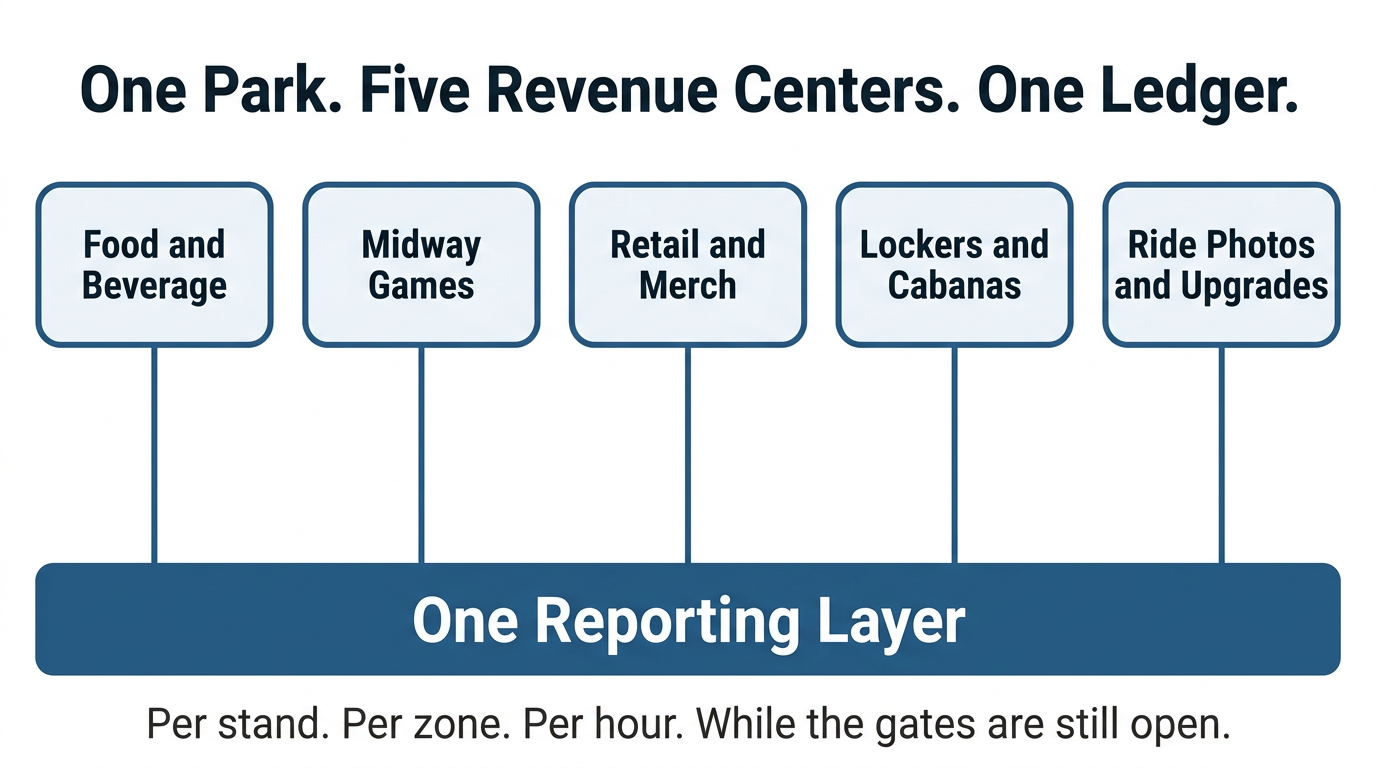
A park is a portfolio. Quick-service food, restaurants, alcohol service, midway games with prize inventory, retail, rentals, ride photos, and premium queue upgrades all carry different tax treatment, staffing, and peak hours. A retail register handles one of those. An amusement park POS platform has to handle all of them on one catalog and one reporting spine. When it does not, finance spends the off-season stitching together exports from six systems that never agreed on what a transaction was.
Peak Load Is the Whole Day
Retail has a lunch rush. A park has a parade letting out, a water ride closing for lightning, and a headliner show ending, each dumping thousands of guests onto the same food row within minutes. The system has to absorb those surges on outdoor wireless infrastructure the park built itself.
Throughput at peak is the number that matters, which is why venue POS built for crowds looks structurally different from the terminal at a coffee shop.
How Do Stored-Value Wristbands Work Across Rides and Attractions?
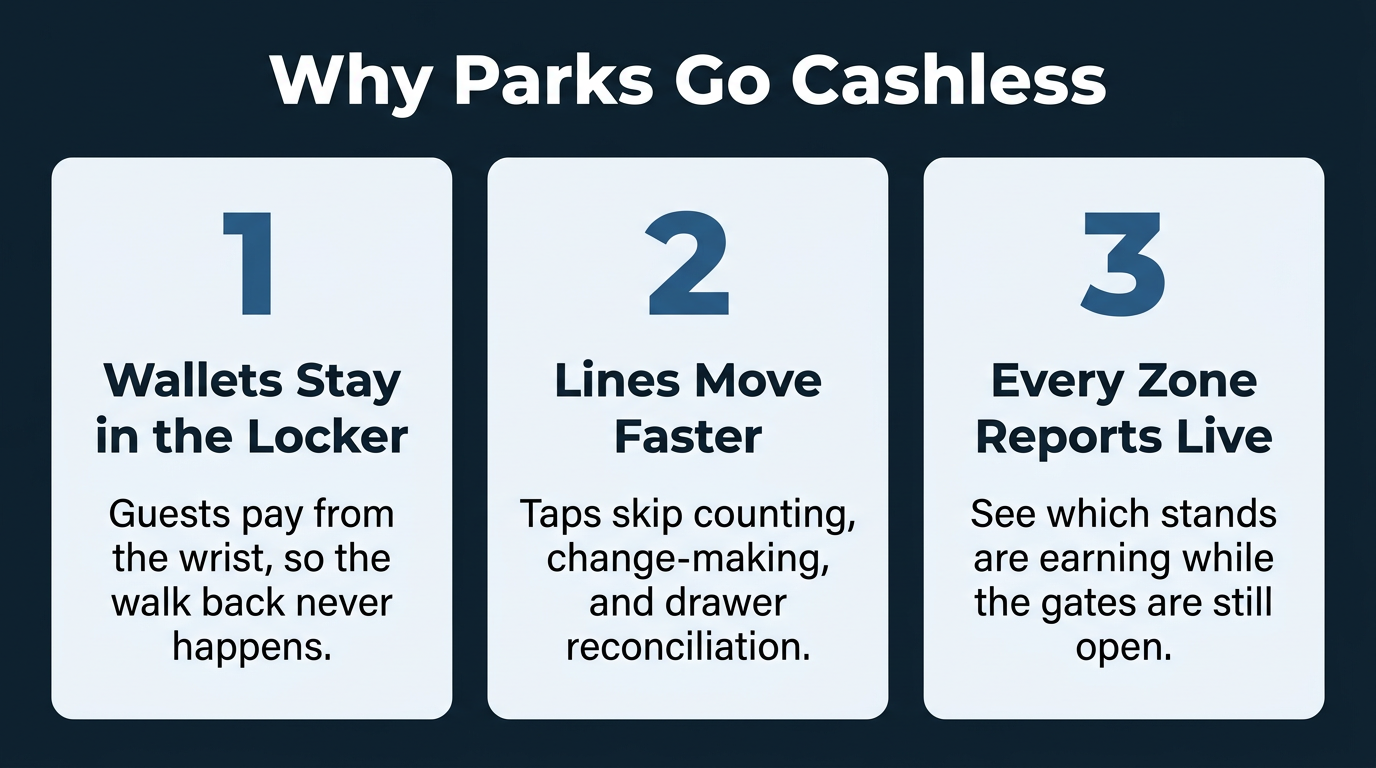
Wearables solved a problem parks have had forever: guests do not want to carry a wallet onto a roller coaster, and definitely not down a water slide.
Linking a Band to a Balance or a Card
There are two models. In a closed-loop setup, the guest loads a prepaid balance at a kiosk or in an app, taps to spend it anywhere on property, and refunds whatever is left. In a linked-card setup, the band points at a card the guest registered once, so there is nothing to top up or refund.
Plenty of parks run both. The deeper breakdown of chips, read ranges, and security layers lives in this guide to RFID wristbands for events.
Why Wearables Win in Water Parks
Water park cashless operations are the clearest case for a wearable, because swimwear has no pockets and a phone in a cubby is a phone that is not paying for anything. Operators at IAAPA Expo Europe's Waterpark Day landed on the same conclusion, treating cashless systems as a baseline requirement for water parks. A band that survives a wave pool and still works at the snack bar removes the walk back to the locker, and that walk is where a sale dies.
What Should Parks Do About Guests Who Only Carry Cash?
Going fully cashless at the register is an operational win right up until a family reaches the front of the line holding nothing but twenties. Federal survey data put 4.2 percent of U.S. households outside the banking system in 2023, and about two-thirds of those ran entirely on cash. Add the banked guests who simply prefer bills on a day out, and the answer is to give cash somewhere to convert rather than to soften the policy.
Cash-to-Card Kiosks as an Onramp
A cash-to-card kiosk, also called a reverse ATM, accepts bills and issues a prepaid card the guest can spend anywhere on property. Parks place them at main entrances, beside guest services, and along busy midway paths so conversion happens on the way in rather than after a refusal. Accessibility standards apply the same way they do to bank ATMs, and fee models split between the operator absorbing the cost and the guest paying. The full breakdown sits in this guide to cash-to-card kiosks at large venues.
Accepting Cash at the Register Still Matters
Not every park wants a hard cashless policy, and seasonal parks with older or more local audiences often should not adopt one. The practical answer is a platform that takes cash, cards, mobile wallets, and wristbands through the same workflow, so a cashier never switches devices based on how the guest pays. Theme park cashless payments work best as the default path rather than the only path.
How Does an Amusement Park POS System Lift Per-Cap Spending?
In-park spending is the metric operators live on, and it has been under pressure. IAAPA's global board reported that across North America in 2025, guests spent less once inside attractions, which limited incremental revenue across a soft season. Payment friction is one of the few variables an operator can move without touching price.
Removing the Wallet From the Decision
A guest deciding whether to buy a second lemonade is running quick math about whether it is worth digging out a card, walking back to a locker, or losing a spot in line. Every one of those steps is a chance to say no. A tap collapses the decision to a yes or no about the lemonade itself. Nobody abandons a souvenir over payment friction. Plenty of people abandon a second drink.
Shorter Lines Mean More Transactions
A food stand has a fixed number of registers and a fixed number of minutes in the lunch window. Anything that shortens the average transaction raises the ceiling on how many guests it can serve. Cutting cash handling out removes counting, change-making, and drawer reconciliation from every order. The gain compounds over dozens of outlets into revenue that would otherwise have walked away from a long line.
Seven Questions to Ask Before Buying an Amusement Park POS System
Most procurement conversations stall on feature checklists, which rarely differ much between platforms. These seven questions surface what actually does.
- Can it run every revenue center on one catalog? Food, retail, games, rentals, and upgrades should share one product hierarchy, so the season summary is not a reconciliation project.
- What happens at peak load? Ask for throughput under real park conditions, and what the failure mode looks like when connectivity degrades mid-rush.
- Does it support both stored-value and card-linked wristbands? Families use these differently, and a platform that does only one forces a policy onto guests.
- How fast can seasonal staff be trained? Parks hire hundreds of teenagers every spring, and a register that takes a day to learn costs a day per hire.
- Can you manage the device fleet remotely? Hundreds of terminals spread over acres means seeing status and pushing updates without walking the property.
- How granular is the reporting, and how live is it? Ask whether you can filter to a single stand in a single hour, and whether that data exports cleanly into the season review.
- What does settlement look like with third-party operators? Parks that lease space to concessionaires need clean per-operator splits, not a November spreadsheet exercise.

How Should a Park Handle Multi-Zone Operations and Reporting?
Zones operate like separate small venues that happen to share a parking lot, and an attraction POS system has to reflect that without forcing managers into six dashboards.
Turning Zone Data Into Same-Day Decisions
Zone-level reporting turns payment data into an operating tool. When a manager sees that the midway food row is running well behind the water park snack bar on covers, they can move staff while it still matters. Roll the same data up and it becomes the season view: which stands earn, which items move, which zones are underbuilt for their traffic. An amusement park POS that only produces end-of-day totals is a cash register with a bigger invoice.
Season Passes and Returning Guests
Season pass holders are a different customer from the day guest. They come back through the gate again and again, and what someone buys on a tenth visit rarely looks like what they bought on a first. A payment layer that recognizes a returning credential shows what a pass holder actually buys over a summer, which is the real input for pass pricing, dining plans, and member perks. Without it, the pass is a gate scan and the largest repeat-visit segment stays invisible.
FAQ
What Is an Amusement Park POS System?
It is the platform running every paid transaction inside a park, covering food stands, retail, midway games, rentals, and premium upgrades under a single product and reporting structure. Unlike a store register, it handles dozens of separate selling points spread over a large outdoor property at once, and most deployments support RFID wristbands and mobile wallets alongside cards and cash.
Do Guests Need an App to Use a Cashless Wristband?
Usually not. Most parks let a guest activate a band at a kiosk with a card or cash, and an app is optional for topping up or checking a balance. Theme park cashless payments are designed to work for the guest who never downloads anything.
Are RFID Wristbands Practical for Water Parks?
Yes, and water parks are one of the strongest use cases. Bands built for wet environments let guests pay straight off the wrist while soaking wet, which is exactly the friction that kills impulse buys at a pool deck snack bar. Water park cashless setups also make it easier to keep family groups on one account.
How Is an Attraction POS System Different From a Festival POS?
The core technology overlaps heavily, but the operating calendar does not. A festival runs for a weekend on temporary infrastructure, while an attraction POS system runs a full season on permanent property with pass holders and fixed outlets. That permanence shifts the priorities toward durability, remote device management, and reporting continuity.
Can a Park Platform Handle Third-Party Concessionaires?
Yes, provided it was built for it. Parks that lease outlets to outside operators need per-operator reporting and automated settlement, not manual splits. Ask any amusement park POS vendor exactly how it handles multiple merchants under one property.
Choosing a Payment Backbone a Park Can Grow Into
The right amusement park POS system is not the one with the longest feature list. It is the one that runs a funnel cake stand, a gift shop, a midway game, and a cabana rental on the same ledger, absorbs a parade letting out, and tells a manager which zone is falling behind before the day is over. Parks that treat payments as plumbing rebuild it in three years. Parks that treat it as operating infrastructure walk into the off-season with numbers to price against.
Billfold builds the cashless and contactless POS infrastructure behind high-volume live entertainment, with RFID wristband payments, entry-point access control, real-time multi-vendor reporting, and every payment type accepted at the same terminal, cash included. Staff are ready in minutes and the device fleet is managed remotely, which matters when a property hires a new crew every spring. Reach out to the Billfold team to map a deployment to your park.
