
Contactless POS Security for Events and Festivals

Key Takeaways
Contactless POS security at events is a layered system, not a single feature, and the layers work together to protect attendee data, vendor revenue, and organizer liability.
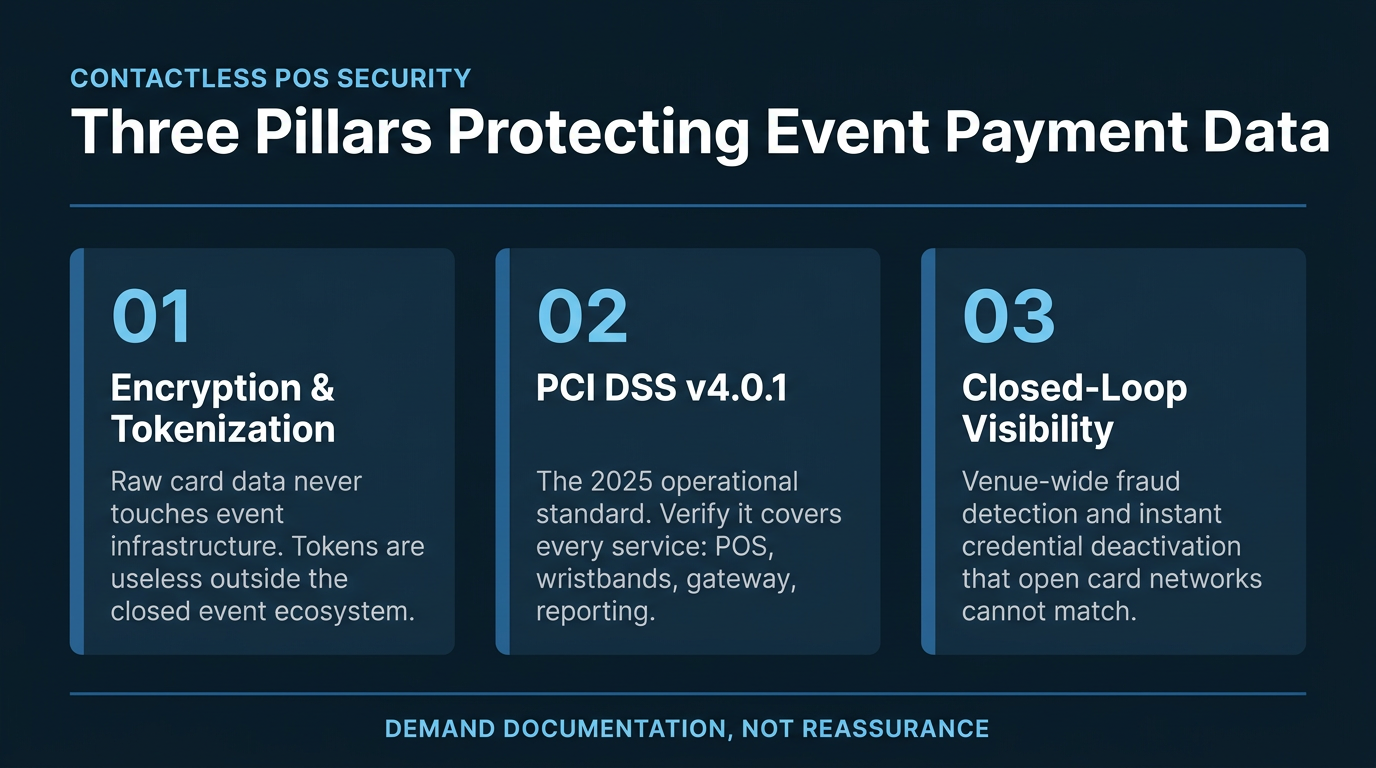
- Encryption and tokenization remove raw card data from event infrastructure entirely, so a breach yields tokens that have no value outside the payment ecosystem.
- PCI DSS v4.0.1 raised the bar in 2025, and any payment provider should be able to show current certification covering the specific services in use.
- Closed-loop RFID systems give organizers a fraud-detection advantage that open card networks cannot match, including instant deactivation and venue-wide transaction visibility.
If a payment provider cannot produce current PCI documentation, breach response procedures, and clear data-handling policies in writing, that is the answer to the security question, regardless of how the demo looks.
Thirty thousand attendees. Three hundred vendors. Ninety-six hours of continuous transactions across temporary infrastructure that did not exist a week ago. Event payment environments are unlike any other retail context, and the security model has to match. Most of the anxiety event organizers carry about cashless payment platforms comes down to one question: can a system processing transactions in under two seconds actually be safe?
The honest answer is yes, but only when the layers are right and the vendor can prove it. According to the Association for Financial Professionals 2025 fraud survey, 79% of organizations experienced attempted or actual payment fraud in 2024. Contactless POS security is not about whether attacks happen. It is about whether the architecture deflects them.
What Does Contactless POS Security Mean at Events?
Contactless POS security covers the encryption, tokenization, network protocols, and compliance standards that protect payment data from the moment a wristband, card, or phone taps a reader to the moment funds settle into a vendor account. At a live event, that protection has to hold across thousands of devices in temporary infrastructure, often with patchy connectivity, and it has to work without slowing the line.
The fundamental difference from a permanent retail setup is the operating environment. Permanent retailers harden a single physical location for years. Event organizers stand up a payment ecosystem in days, run it under extreme load, and tear it down. Magnetic stripe cards transmit the same account number to every reader, every time, but RFID, NFC, and EMV technologies all generate one-time cryptograms that authorize a single purchase and become useless the instant they are consumed. That shift from static to dynamic credentials is the foundation of modern event payment security.
How Does Cashless Payments Security Protect Against Fraud at High-Volume Events?
High-volume environments give attackers two natural advantages: distracted users and high signal-to-noise ratios that make individual fraud attempts harder to spot. Modern cashless payments security counters both with overlapping technical controls that operate without slowing the line.
End-to-End Encryption Locks Down Transmission
Encryption begins inside the payment terminal itself, before any data leaves the device. The reader transforms readable card numbers into scrambled ciphertext using algorithms that require specific decryption keys held only by the payment processor. Even staff with full system access see only encrypted strings, never live payment credentials. A compromised network connection at a remote festival site cannot expose attendee payment data, because the data crossing that network was never readable to begin with.

Tokenization Removes Card Data From the Event Entirely
Tokenization goes one step further than encryption. When attendees register payment credentials, the actual card number is sent to a secure vault operated by the payment processor, and the event system receives only a token, a random string that bears no mathematical relationship to the underlying card. The PCI Security Standards Council establishes the standards for how tokens are generated, stored, and managed, and PCI DSS v4.0.1 is the current operational version that any compliant payment provider should meet. Even a worst-case event server compromise yields tokens that work nowhere outside the closed event ecosystem.
Real-Time Monitoring and Closed-Loop Visibility
Modern systems analyze transaction streams continuously, building behavioral baselines for normal vendor activity and flagging deviations. A wristband racking up twenty bar purchases in three minutes triggers an alert. Transactions requiring physically impossible movement between two readers trigger another. The closed-loop nature of RFID adds a second advantage: organizers can see suspicious patterns across the entire venue rather than waiting on a card network to flag them. RFID wristband security at events also enables instant deactivation of lost or stolen credentials, with funds preserved and transferred to a replacement wristband within minutes.
Which Security Standards Matter Most for Event Payment Security?
Compliance standards exist because they enforce baseline protections that vendors cannot quietly skip. Three areas matter more than the rest when evaluating a provider.
PCI DSS v4.0.1 Sets the Floor
The Payment Card Industry Data Security Standard governs anyone who processes, stores, or transmits cardholder data. The current version became the operational standard in 2025 and tightened requirements around encryption, multi-factor authentication, vulnerability scanning, and script-based attack defenses. Any payment provider working at events should produce current PCI certification covering the specific services in use, not a general parent-company certification. Ask whether the contactless POS, the wristband infrastructure, the gateway, and the reporting platform are all covered.

AES-256 Encryption and Hardware Key Storage
Look for AES-256 or equivalent encryption applied across the full transaction lifecycle. The encryption standard itself is well established, but how it is implemented matters. Encryption keys must be stored in hardware security modules and rotated according to the provider's documented schedule. A system that encrypts data in transit but stores it decrypted in a queue creates exactly the kind of vulnerability window that breaches exploit.
Multi-Factor Authentication for Privileged Actions
Speed is non-negotiable for the average tap-to-pay transaction at a vendor stand, but high-value or account-level actions should require additional verification. Changing a registered payment method, withdrawing remaining balances, or accessing administrator functions should all sit behind multi-factor authentication. This is one of the requirements emphasized in the latest PCI standards, and it should be standard across any event payment system an organizer evaluates.
7 Questions Every Event Organizer Should Ask a Payment Provider
Vendor demos are designed to look secure. Real verification starts with specific questions that force documentation rather than reassurance.
- Show me your current PCI DSS v4.0.1 certificate. Ask which specific services and products it covers, rather than relying on a parent-company certification.
- Where is cardholder data actually stored, and who has access? If the answer involves event infrastructure, treat it as a red flag. Tokenization should keep raw card data inside the processor vault.
- What is your documented incident response procedure? How fast do you detect breaches, who gets notified, and what containment actions trigger automatically? Vague answers indicate vague processes.
- Can I see recent penetration test results? Reputable providers conduct regular third-party security assessments and can share summary results without compromising sensitive details.
- How does the system behave when network connectivity drops? Outdoor festivals lose signal regularly. Quality systems queue transactions locally with stored encryption keys and sync when connections restore.
- Who owns the liability if a breach occurs on your platform? Get the answer in writing. Insurance coverage and liability allocation should be clear before any contract is signed.
- How do you control vendor and staff access to system functions? Role-based access control should limit what temporary event staff can see and do. A bartender should never have access to payment data or admin settings.
What Are the Real-World Risks Event Organizers Should Plan For?
Some risks get talked about constantly in event security conversations and are largely theoretical. Others get ignored and represent the real exposure. Sorting them out matters because resources spent on hypothetical threats are resources not spent on actual ones.
Theoretical: RFID Skimming From a Distance
The fear that someone could walk through a crowd with a hidden reader and pull payment data off attendee wristbands is largely overblown. NFC operates within roughly four centimeters and event RFID systems work at slightly longer but still close ranges. Even setting range aside, secure systems require challenge-response authentication, so reading the wristband identifier yields nothing usable. Contactless payment processing best practices note that even successful interception captures only encrypted data that decrypts to nothing transactable outside the event ecosystem.
Real: E-Commerce Skimming on Pre-Event Registration Pages
The Recorded Future 2024 payment fraud report documented 269 million compromised card records on dark and clear web platforms, with a tripling of Magecart e-skimmer infections targeting e-commerce sites. Pre-event registration pages where attendees load funds onto wristbands are exactly the kind of e-commerce surface these attacks target. Make sure providers harden registration flows specifically, in addition to transaction processing.
Real: Lost Wristbands and Connectivity Failures
Lost wristbands happen at every event. The only meaningful question is how fast credentials can be deactivated and how cleanly funds transfer to a replacement. Quality systems handle this in minutes through help desk reporting or attendee mobile apps, with remaining balances preserved. Network drops during a peak set are the operational reality of outdoor events, and quality contactless POS systems queue transactions locally on hardened devices, then sync when connectivity restores. Verify how the system behaves in offline mode before deploying it.
FAQ
How secure are contactless payments at large events compared to chip cards?
They are comparably secure, and in some ways more secure when implemented as part of a closed-loop event system. Both contactless and EMV chip cards generate unique transaction codes that cannot be reused. Closed-loop event systems add fraud detection visibility across the entire venue that open card networks cannot match, including instant deactivation of lost credentials and venue-wide transaction monitoring.
Can someone hack my RFID wristband at a festival?
Practical hacking of properly secured RFID wristbands is extremely difficult. The chips operate at very short ranges, use challenge-response authentication, and transmit encrypted data that has no value outside the event ecosystem. Real-world attackers go after easier targets like e-commerce sites and email-based fraud rather than physical RFID infrastructure.
What happens to my payment information after the event ends?
Reputable providers either delete or anonymize personal payment data according to PCI DSS retention rules after the event concludes. Tokens are deactivated, and stored credentials are purged from active systems within documented timeframes. Ask any provider in writing what their retention and deletion policy is.
Is contactless POS security really safer than handling cash at events?
Yes. Cash creates exposure throughout collection, counting, transport, and reconciliation, and every step is a potential point of loss with no audit trail. Contactless systems generate complete digital records, allow instant deactivation of compromised credentials, and remove physical theft risk entirely.
How can I tell if a payment provider is actually secure or just claims to be?
Ask for documentation, not claims. Current PCI DSS certification, recent penetration test reports, written incident response procedures, and clear data handling policies should all be available on request. Providers who hesitate to share this material are telling you something important about their security posture.
Choosing a Payment Partner Built for Event-Scale Security
Contactless POS security at events is solvable, but it is solved through architecture and discipline. Encryption, tokenization, current PCI compliance, closed-loop visibility, role-based access control, and documented incident response are the components that matter. When organizers verify these elements before signing a contract, they convert a major source of operational risk into a controlled, auditable layer of their production infrastructure.
Billfold builds cashless POS systems specifically for the security and operational demands of festivals, stadiums, and live event venues, including end-to-end encryption, tokenized payment data, PCI-compliant infrastructure, and closed-loop fraud monitoring across every device on site. Reach out to the Billfold team to talk through how secure contactless payments can work at your next event.
